

Posted on August 11 2026
Canada eases entry for foreign academic examiners with new work permit exemption. Check Your Eligibility!

By , Editor & Director
Updated September 03 2026
Highlights: Canada to Make Academic Collaboration Easier with Work Permit Exemption
- Foreign academic examiners can work in Canada without a work permit if they meet specific eligibility criteria.
- Eligible examiners must be senior academic or industry professionals with an established reputation in their field to qualify for work permit exemption.
- An official invitation letter from the Canadian body must be provided by the examiners requesting their expertise.
- The new work permit exemption policies in Canada apply to foreign thesis examiners, research proposal evaluators, and programme or university project evaluators.
- Permit-exempt activities must last less than six months and cannot involve remuneration from Canadian sources.
*Want to work in Canada as a foreign academic examiner? Sign up with Y-Axis for end-to-end assistance.
Canada Updates Work Permit Exemption Rules for Foreign Academic Examiners
In a major immigration update, Canada has published specific eligibility criteria for foreign nationals seeking to work as academic examiners without obtaining a work permit. The updated instructions, issued on July 31, clarify who can qualify for the exemption and the conditions they must meet when carrying out academic evaluation activities in Canada.
The exemption is intended for established professionals invited to work in Canada across specialised academic or industry expertise. Eligible activities include evaluating theses, research proposals, and university or programme projects, provided the work does not amount to entering Canada's labour market.
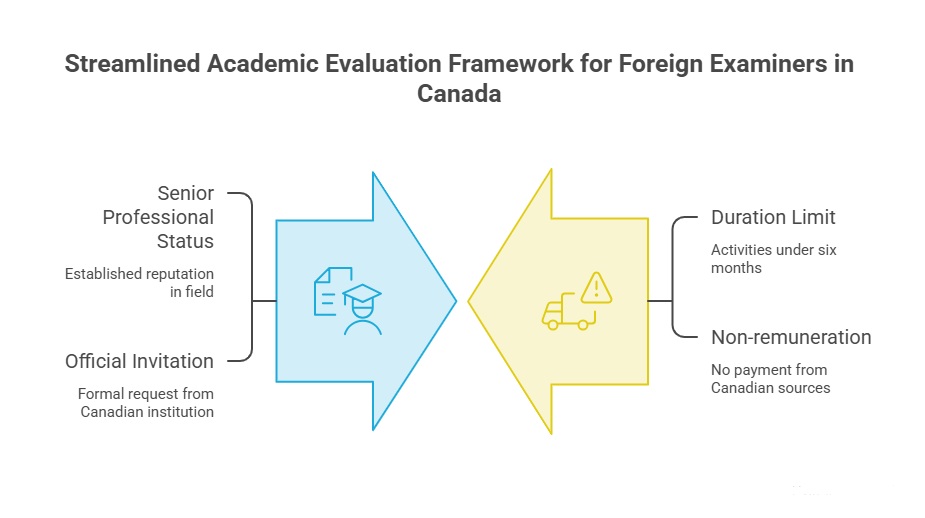
The major eligibility requirements for foreign academic examiners under new work permit exemption rules are as follows:
|
Criteria |
Details |
|
Professional profile |
Must be a senior academic or industry professional with an established reputation |
|
Invitation |
Must have an official invitation from the relevant governing body |
|
Eligible activities |
Thesis examination, research proposal evaluation, and programme or university project evaluation |
|
Duration |
Work must last less than six months |
|
Canadian remuneration |
Foreign examiners cannot receive remuneration from Canadian sources |
|
Labour market |
Activities must not amount to entering Canada's labour market |
|
Additional conditions |
Immigration officers may impose specific conditions or limits on permit-exempt work |
Note: Foreign academic examiners must still meet temporary resident requirements, including holding a valid Temporary Resident Visa (TRV) or electronic Travel Authorization (eTA), where applicable, and satisfying Canada's admissibility requirements.
Also, read...
Major Changes for Foreign Academic Examiners in Canada
Foreign nationals planning to enter Canada under this work permit exemption must carry documents demonstrating that they meet the eligibility requirements. They should also be prepared to show that their academic evaluation activities fall within the permitted categories and do not constitute participation in the Canadian labour market.
Here is what foreign examiners should know about the revised work permit exemption policies in Canada:
- Be a senior academic or industry professional with an established reputation in the relevant field.
- Obtain an official invitation letter from the Canadian governing body requesting their participation.
- Ensure the examination or evaluation activity lasts less than six months.
- Do not receive remuneration from Canadian sources for the exempt activities.
- Ensure the work does not amount to entering Canada's labour market.
- Provide documents proving eligibility when seeking entry to Canada.
- Hold a valid TRV or eTA, depending on nationality and circumstances.
- Meet Canada's general temporary resident and admissibility requirements.
- Be prepared for immigration officers to impose specific conditions on permit-exempt work.
- Understand that remuneration should generally come entirely from entities with no financial ties to Canada.
*Are you looking for step-by-step assistance with Canada immigration? Contact Y-Axis, the world's No. 1 overseas immigration consultancy.
For recent Canadian immigration updates, check out the Y-Axis Canada Immigration News Page.
FAQs
Can foreign academic examiners work in Canada without a work permit?
Yes, certain foreign academic examiners can carry out eligible activities in Canada without obtaining a work permit. The exemption applies when they meet specific eligibility criteria and their activities do not amount to entering the Canadian labour market. They must generally be senior academic or industry professionals, have an official invitation, and comply with the conditions governing the permit-exempt activity.
Who qualifies for Canada's academic examiner work permit exemption?
Foreign nationals must generally be senior academic or industry professionals with an established reputation in the relevant field. They must also have been officially invited by the appropriate governing body to participate as an examiner or evaluator. Applicants must provide documentation proving that they meet these requirements and must also satisfy Canada's general requirements for temporary residents.
Which academic activities are covered by the exemption?
Canada's updated instructions identify three categories of eligible activities: thesis examination, research proposal evaluation, and programme or university project evaluation. Foreign professionals undertaking these activities may qualify for the work permit exemption if they meet all applicable conditions. The exemption is intended for specialised evaluation work rather than employment that would involve entering Canada's labour market.
Is there a time limit for permit-exempt academic examination work?
Yes. The foreign national's academic examination or evaluation activities must last for less than six months to qualify under the exemption. Immigration officers may also impose specific conditions or limitations on the permit-exempt work. Applicants should therefore ensure that the planned duration and nature of their activities comply with the updated requirements before travelling to Canada.
Can foreign academic examiners receive payment from Canada?
No. One of the standard conditions of the exemption is that foreign nationals cannot receive remuneration from Canada for their exempt academic activities. In most cases, payment for the work must come entirely from entities that have no financial ties to Canada. This condition helps ensure that the activity does not constitute participation in the Canadian labour market.
Do foreign examiners need an invitation letter to enter Canada?
Yes. Foreign academic examiners seeking to use this work permit exemption must provide an official invitation letter from the governing body that has invited them to adjudicate or evaluate academic work. The letter helps demonstrate the purpose of their visit and supports their claim that their activities fall within one of the categories covered by Canada's permit exemption.
Does the exemption allow foreign examiners to enter Canada's labour market?
No. The exemption applies only when the foreign examiner's activities do not amount to entering Canada's labour market. The work must remain within the permitted academic or evaluation activities. Where the circumstances resemble regular employment or involve Canadian remuneration, the individual may not qualify for the exemption and could require appropriate work authorisation.
Do foreign examiners still need a visa or eTA?
Yes. The work permit exemption does not remove Canada's general entry requirements for temporary residents. Foreign examiners must have a valid Temporary Resident Visa (TRV) or electronic Travel Authorization (eTA), where required based on their nationality and circumstances. They must also meet Canada's admissibility requirements before they can enter the country for their academic evaluation activities.
Can immigration officers impose conditions on permit-exempt work?
Yes. Canadian immigration officers may place specific conditions or limitations on a foreign national's authorisation to perform work without a permit. Officers may also issue a visitor record outlining the conditions attached to the permit-exempt activity. Foreign examiners should carefully follow any restrictions imposed at the time of entry to remain compliant with Canada's immigration rules.
What documents should foreign academic examiners carry?
Foreign examiners should carry documents demonstrating that they meet the eligibility requirements for the exemption. This includes evidence of their professional standing and an official invitation from the relevant governing body. They should also have the appropriate travel document, such as a TRV or eTA where required, and be prepared to demonstrate that their activities meet the exemption's duration, payment, and labour-market conditions.
Y-Axis snapshot
1M
Successful applicants
1500+
Experienced counselors
25Y+
Expertise
50+
Offices
Tags:
Canada work permit exemption
Foreign academic examiners in Canada
Academic examiners in Canada without a work permit
Program Evaluators in Canada
Canada work authorization
Temporary residence visa in Canada
Canada immigration
migrate to Canada
Share
Options for you by Y-Axis

Get it on your mobile

Get News alerts

Contact Y-Axis
Latest Article
Related Post
Trending Article
Posted On September 25 2026
Australia Replaces Ministerial Direction 119: Is It Getting Easier for Skilled Professionals?