

Posted on October 07 2026
Australia updates student visa rules for Indian students. Check Your Eligibility!

By , Editor & Director
Updated October 07 2026
Highlights: Australia Introduces New Student Visa Rules for Indian Students with Upcoming Academic Journey
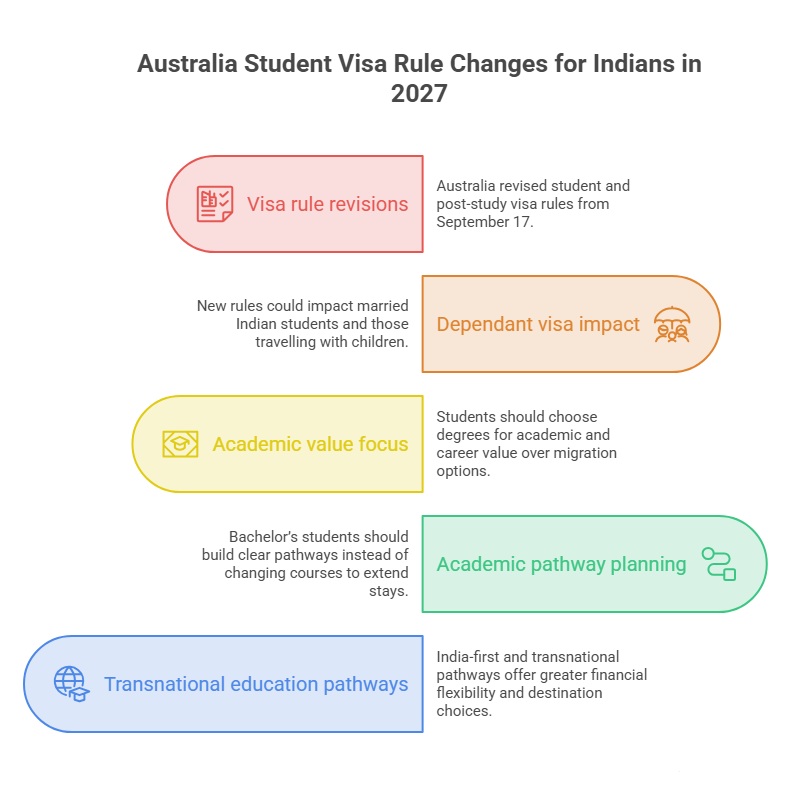
- Australia has officially revised student and post-study visa rules from September 17, prompting Indian students to rethink long-term education plans.
- New dependant visa rules could have the biggest impact on married Indian students and those travelling with children to Australia
- Indian students are advised to choose Australian degrees for academic and career value rather than relying on future migration options.
- Bachelor’s students planning a master’s should build a clear academic pathway instead of treating course changes as a way to extend their stay.
- India-first and transnational education pathways could offer students greater financial flexibility and destination choices as visa rules evolve.
*Want to study in Australia? Let Y-Axis guide you with the process.
Australia’s Student Visa Changes Leverage Future Study Plans for Indian Aspirants
Australia’s recent student and post-study visa changes are prompting Indian students and families to rethink how they plan overseas education. The September 17 changes revised rules around dependants and target visa hopping, making long-term planning increasingly important for students considering bachelor’s or master’s programmes.
The impact may be particularly significant for married students and those with dependent children, while students focused primarily on education and career opportunities may continue to view Australia as an attractive destination. The bigger shift is that migration may need to become a later-stage consideration rather than the primary reason for choosing a course.
The changes also affect family members of graduates holding Temporary Graduate visas. This means married students and parents travelling with children may need to assess family arrangements much earlier.
Also, read...
Australia Introduces Faster Visa Processing for Students and Workers. Apply Now!
Indian Students must Strategize Bachelor’s-to-Master’s Path in Australia
The new immigration changes in Australia also make academic progression more important for students beginning with a bachelor’s degree. A three- or four-year programme should be selected based on the quality of the qualification, career relevance, total cost and future study options rather than an assumption that Australia's immigration settings will remain unchanged until graduation.
Progressing from a bachelor’s to a relevant master’s in Australia remains a legitimate academic pathway, while repeated course changes primarily intended to extend a stay are being targeted. Students should therefore approach undergraduate and postgraduate study as one coherent academic journey in the country.
The table below summarises what Indian students should consider before choosing Australia:
|
Factors |
What students should evaluate |
|
Degree value |
University quality, curriculum, skills and industry relevance |
|
Career prospects |
Employment opportunities in Australia, India and other global markets |
|
Total cost |
Tuition, accommodation, living expenses, insurance, travel and currency movements |
|
Family plans |
Whether spouse or children can accompany the student under applicable rules |
|
Further study |
Suitable master’s programmes and progression options after a bachelor’s |
|
Immigration policy |
Possibility that visa and post-study rules may change before graduation |
|
Course changes |
Whether a proposed change represents genuine academic progression |
|
Alternative destinations |
Other countries and regions offering relevant education and employment opportunities |
|
India-first pathways |
Options to begin studies in India and transition overseas later |
|
Return value |
Whether the qualification remains valuable if the student returns to India |
Also, read...
Australia Updates Skilled Visa Processing Priorities for 2026. Check Your Eligibility!
Australia to Chang Education Landscape for Indian Students
Indian students remain an important part of Australia's international education market. Aspirants from India accounted for 16% of Australia's international students in the first half of 2026, while bachelor's degrees represented 41% of international higher-education enrolments during the same period.
This makes the changes particularly relevant for Indian students entering three- or four-year undergraduate programmes. Since immigration settings can change substantially during such a period, students from India studying in Australia need to assess whether their chosen qualification will remain valuable across different countries and career scenarios.
Also, read...
Australia Replaces Ministerial Direction 119: Is It Getting Easier for Skilled Professionals?
How Australia Student Visa will Affect Indians in 2027?
The Australian immigration changes shall encourage Indian students and parents to make more informed and financially resilient education decisions. A stronger focus on degree value, career outcomes and flexibility can help students avoid making major decisions solely around today's immigration rules.
Here is how the updated foreign study policies in Australia will affect Indian students in 2027:
- Better course selection: Students are encouraged to prioritise degrees that provide strong skills and career opportunities.
- Stronger long-term planning: Bachelor’s students can map relevant master's options and career pathways before committing to an undergraduate programme.
- Greater awareness of family policies: Married students and parents can assess dependant arrangements before making an overseas education commitment.
- More financial awareness: Families are encouraged to calculate the complete cost of overseas education.
- Smarter course-change decisions: Students can distinguish genuine academic progression from course changes primarily intended to prolong their stay.
- Better risk management: Families can plan for possible changes in immigration policy during a three- or four-year degree.
Are you looking for a step-by-step with Australian Immigration? Contact Y-Axis, the world’s No. 1 abroad immigration consultancy, for end-to-end support!
For more updates on Australia, check out Y-Axis Australia Immigration Updates!
FAQs
How have Australia’s new student visa changes affected Indian students?
Australia’s recent student and post-study visa changes are prompting Indian students to reconsider how they plan their education journey. Tighter dependant rules and measures targeting visa hopping could particularly affect married students and those with children. Students are increasingly advised to choose Australian degrees based on academic quality, career relevance and overall value rather than relying primarily on future migration or post-study visa opportunities.
Can international students still bring their dependants to Australia?
Australia has tightened the rules governing dependants of most new international students. While certain exceptions remain, including for eligible PhD and research students, many students can no longer assume that their spouse or children can accompany them automatically. Married students and those with dependent children should therefore check the applicable dependant rules carefully and consider their family arrangements before committing to an Australian education programme.
Will the changes affect Indian students pursuing master’s degrees?
The changes could influence demand among Indian students considering coursework-based master’s programmes, particularly those whose primary motivation is migration. However, students choosing Australia for education quality, professional development and career opportunities may continue to consider it. Research-based master’s programmes are treated differently under the new dependant arrangements. Students should therefore evaluate the specific course, family situation and applicable visa conditions before making a decision.
Should Indian students still choose Australia for a bachelor’s degree?
Indian students can still consider Australia for a bachelor’s degree, but the decision should be based on more than immigration prospects. A bachelor’s programme represents a three- or four-year commitment during which visa policies may change. Students should evaluate university quality, curriculum, career relevance, total costs, employment opportunities and further-study options. The degree should retain value even if immigration settings are different when they graduate.
Can students progress from an Australian bachelor’s to a master’s?
Yes. Progression from a bachelor’s degree to a relevant master’s remains a legitimate academic pathway. However, students should plan this progression as part of a coherent educational journey rather than treating multiple course changes as a way to extend their stay. They should assess which master’s programmes align with their undergraduate qualification, the combined cost and whether the additional degree provides meaningful academic or career value.
What does Australia’s focus on visa hopping mean for students?
Australia’s focus on visa hopping means students should be more careful about changing courses or institutions primarily to prolong their stay. Genuine academic changes can still occur when circumstances require them, but students should not assume that course selection is easily reversible. Indian students are therefore encouraged to research their initial qualification, progression options, career outcomes and long-term academic plans before applying for an Australian student visa.
How should Indian parents calculate the cost of studying in Australia?
Families should calculate the complete investment rather than looking only at tuition fees. This includes accommodation, daily living expenses, health insurance, travel, currency fluctuations and potential costs of pursuing further education. Parents should also consider what happens if immigration rules change or the student eventually returns to India. Comparing the total cost with the degree’s likely career value can provide a more realistic assessment.
Could Indian students consider studying in India before moving abroad?
Yes. Students can consider structured transnational education pathways that allow them to begin their academic journey in India and transition overseas later. This approach may reduce initial financial exposure while giving students greater flexibility over their eventual destination. Families can compare this model with a full overseas degree by considering tuition, living costs, employability, post-study opportunities, currency movements and potential changes in immigration policies.
Are Indian students becoming less interested in studying in Australia?
The changing rules do not necessarily mean Indian students are becoming opposed to overseas education or Australia. Instead, students and parents are becoming more cautious and evaluating education through factors such as return on investment, career outcomes, total costs and policy risks. Students may also compare Australia with other destinations and consider more flexible education pathways rather than making an immediate, irreversible commitment to one country.
What should Indian students consider before choosing an Australian degree?
Indian students should assess the quality and career relevance of the degree, university reputation, total education and living costs, potential employment opportunities and suitable further-study pathways. They should also consider family arrangements and recognise that immigration policies may change during their studies. Most importantly, the qualification should have value beyond migration. A strong degree should provide useful skills and career opportunities in Australia, India and other global markets.
Tags:
Australia student visa
study in Australia
Indian students in Australia
Australia immigration news
work in Australia
post-graduate students in Australia
Australia immigration
migrate to Australia
Share
Options for you by Y-Axis

Get it on your mobile

Get News alerts

Contact Y-Axis
Latest Article
Related Post
Trending Article
Posted On October 07 2026
Australia updates student visa rules for Indian students. Check Your Eligibility!