

Don't know what to do ?
Get Free Counseling
Thailand Job Market in 2026–30
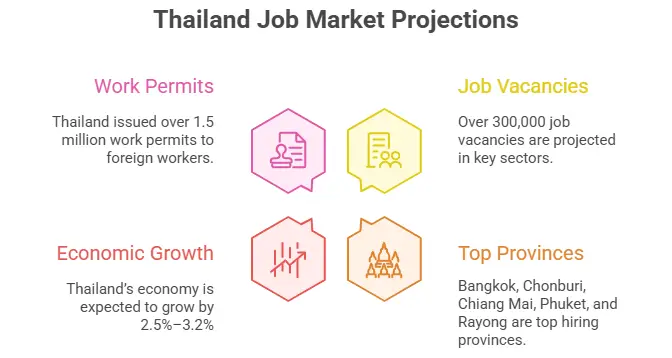
- Over 300,000+ job vacancies projected across Thailand in key sectors such as hospitality, construction, healthcare, IT, and manufacturing.
- Bangkok, Chonburi, Chiang Mai, Phuket, and Rayong remain the top provinces hiring foreign workers.
- Thailand’s economy is expected to grow by 2.5%–3.2%, driven by tourism recovery and rising investments.
- Thailand issued over 1.5 million work permits to foreign workers in recent years, with continued demand for skilled and semi-skilled professionals.
Job Outlook in Thailand
Understanding Thailand’s job outlook is essential for professionals and employers planning. With a recovering economy and strong demand across key sectors, Thailand offers growing opportunities for skilled and semi-skilled workers. Industries such as hospitality, tourism, construction, healthcare, manufacturing, and IT continue to expand, creating steady demand for foreign talent, especially English-speaking professionals.
Thailand is expected to generate over 200,000–300,000 job openings across various skill levels over the next two years. Major provinces such as Bangkok, Phuket, Chonburi (Pattaya), Chiang Mai, and Rayong remain hotspots for employment due to industrial growth, tourism recovery, and ongoing infrastructure development. Cities like Bangkok, Phuket, Pattaya, Chiang Mai, and Samut Prakan continue to attract international workers seeking stable and rewarding careers.
Thailand currently hosts over 2.3 million foreign workers under different labour categories, and the demand for migrant and skilled workers is expected to remain strong. Choosing to work in Thailand offers several advantages—affordable living costs, a multicultural environment, strong tourism-driven growth, and a high demand for English-speaking professionals.
With its warm culture, strategic location in Southeast Asia, and expanding job market, Thailand is becoming an attractive destination for Indians looking to explore **overseas job opportunities**.
General Employment Trends for the year
Employment trends in Thailand are shaped by the country’s evolving economy, rising foreign investment, and the continued recovery of its tourism-driven sectors. Opportunities in Thailand are closely linked to specific skill needs, especially in hospitality, healthcare, construction, manufacturing, IT, and logistics. Staying updated on industry-specific skills is crucial, as Thai employers prefer candidates who bring technical expertise, language proficiency, and international work experience.
Thailand’s overall economic outlook, including tourism growth, infrastructure expansion, and increasing digital adoption, continues to influence labour demand. Demographic changes, such as an ageing population, are creating more opportunities in healthcare and social support roles. At the same time, government-led initiatives to boost industries like digital services, medical tourism, and clean energy contribute to rising employment across several sectors.
*Looking to work in Thailand? Get in touch with experts at Y-Axis to guide you with the process.
Factors Influencing Job Creation or Reduction in Thailand
Several key factors shape Thailand’s job market and affect whether opportunities expand or decline. These include the country’s economic performance, availability of skilled workers, and investments in emerging industries such as robotics, electronics, medical technology, and e-commerce. Technological advancements, automation in manufacturing, and digital transformation across businesses continue to influence hiring patterns.
Government policies, including efforts to attract foreign investors and support domestic industries, also play an important role in job creation. Tourism trends, global market conditions, and international trade relationships further impact employment, especially in hospitality, logistics, and export-driven sectors. As Thailand continues to grow as a regional business and tourism hub, employers are increasingly seeking skilled talent from abroad, offering a wide range of well-paying opportunities for qualified professionals.
In-Demand Industries and Occupations in Thailand
Some of the most in-demand occupations in Thailand along with their salaries are given in the table below:
|
Occupation |
Average Salaries per year (THB) |
|
Engineering |
฿750,000 |
|
IT & Software |
฿1,000,000 |
|
Healthcare |
฿900,000 |
|
Marketing & Sales |
฿750,000 |
|
Banking & Finance |
฿1,100,000 |
|
Nursing |
฿420,000 |
|
Education |
฿500,000 |
|
Hospitality |
฿500,000 |
|
Skilled Trades |
฿580,000 |
Read more…
Highest Paying Jobs in Thailand for Indians
Workforce Demands in Different Regions of Thailand
Details of the workforce demands and opportunities across different regions and provinces in Thailand are given below:
Examination of Job Market Differences across Thailand’s Regions
Many professionals choose Thailand as it offers diverse job opportunities and a growing demand for skilled workers across multiple industries. Thailand’s job market is expanding steadily, with strong hiring needs across sectors such as hospitality, tourism, construction, manufacturing, healthcare, logistics, and IT. Regions like Bangkok, Phuket, Chonburi, Rayong, Chiang Mai, and Samut Prakan provide attractive opportunities for skilled professionals due to their economic activity, tourism growth, and industrial development.
Areas with Notable Job Opportunities in Thailand
Thailand offers strong employment opportunities across several provinces, driven by tourism, industrial growth, manufacturing, logistics, and expanding service sectors. The regions listed below are known for high hiring activity and steady demand for skilled and semi-skilled workers.
|
Province / Region |
Major Hiring Sectors |
Maximum Annual Salary (THB) |
|
Bangkok |
IT, finance, hospitality, healthcare, corporate services |
Up to THB 900,000 |
|
Phuket |
Tourism, hotels, restaurants, aviation support |
Up to THB 600,000 |
|
Chonburi (Pattaya) |
Manufacturing, logistics, automotive, hospitality |
Up to THB 750,000 |
|
Rayong |
Industrial zones, engineering, petrochemical, electronics |
Up to THB 800,000 |
|
Chiang Mai |
Education, healthcare, hospitality, IT, creative roles |
Up to THB 600,000 |
|
Samut Prakan |
Warehousing, logistics, factories, manufacturing |
Up to THB 550,000 |
|
Pathum Thani |
Manufacturing, industrial production, logistics |
Up to THB 500,000 |
|
Ayutthaya |
Factories, automotive, electronics |
Up to THB 550,000 |
|
Krabi |
Hotels, tourism, service industry |
Up to THB 520,000 |
|
Surat Thani (Koh Samui) |
Tourism, hospitality, culinary roles |
Up to THB 480,000 |
*Want to apply for jobs abroad? Avail Y-Axis Resume Marketing services to find the right one.
Impact of Technology and Automation in Thailand
Thailand’s job market is undergoing steady transformation as technology adoption, automation, and digitalization accelerate across key industries. These shifts are shaping the demand for skilled professionals and creating new opportunities for both local and foreign workers.
Technological Advancements and Automation Shaping the Job Market
Thailand has seen rapid growth in digital technologies, automation, and smart manufacturing in recent years, especially through initiatives under the Thailand 4.0 economic strategy. This transition is influencing the labour market and increasing the need for workers with skills in IT, digital services, analytics, engineering, and automation-related fields.
Industries such as manufacturing, logistics, banking, retail, and hospitality are adopting automation, e-commerce platforms, robotics, and digital tools. As a result, employers are increasingly prioritizing candidates with strong technical knowledge, digital literacy, and the ability to work with modern systems and processes. Continuous learning and skill upgrades are becoming essential for professionals aiming to stay competitive in Thailand’s evolving job market.
Potential Opportunities and Challenges for Workers in the Evolving Landscape
The shift toward digital transformation in Thailand presents both opportunities and challenges for workers. On one hand, the rising demand for tech talent is opening up opportunities in fields such as software development, cybersecurity, data analytics, digital marketing, and IT support. Additionally, high-growth industries such as healthcare, logistics, hospitality, finance, and manufacturing continue to hire skilled professionals who can adapt to new technologies.
On the other hand, automation may reduce the need for certain routine or manual roles, increasing the importance of upskilling and reskilling. Professionals must keep updating their technical and soft skills to align with changing industry requirements. Those who stay adaptable and embrace emerging technologies will benefit the most from Thailand’s expanding job market, particularly as the country deepens its focus on innovation, digital services, and advanced manufacturing.
Also, read...
What are the most in-demand jobs in Thailand for the next 10 years?
Skills in-demand in Thailand
Thai employers increasingly look for candidates with specific skills that support the country’s growing sectors, including tourism, healthcare, manufacturing, logistics, education, and IT. With digital transformation accelerating across industries, professionals who possess both technical and soft skills are highly valued.
Key Skills Sought by Employers in Thailand
- Technical and digital skills
- IT and software development
- Engineering and automation skills
- Hospitality and customer service skills
- Communication and interpersonal abilities
- Problem-solving and critical thinking
- Project management
- Marketing and digital marketing
- Sales and business development
- Financial analysis and accounting
- Logistics and supply chain management
- Healthcare and nursing skills
- Digital literacy
- Adaptability and flexibility
- Teamwork and collaboration
- Leadership skills
- Multilingual proficiency (English is highly valued)
- Time management
- Creativity and innovation
- Emotional intelligence
Importance of Upskilling or Reskilling for Job Seekers in Thailand
Upskilling and reskilling have become essential in Thailand’s evolving job market as industries adopt new technologies and shift toward digital processes. Continuous learning helps professionals remain relevant, competitive, and prepared for emerging job opportunities.
Reskilling enables individuals to update their capabilities and stay effective in their roles, particularly as automation transforms traditional tasks. Upskilling goes further, helping employees advance by developing new competencies aligned with industry growth areas such as IT, hospitality, logistics, and healthcare.
Investing in skill development benefits both individuals and organizations, fostering a culture of innovation, adaptability, and continuous improvement. For job seekers, enhancing their skill set not only strengthens their current career prospects but also opens doors to future opportunities in Thailand’s expanding economy.
Remote Work and Flexible Arrangements in Thailand
Remote work is becoming increasingly common in Thailand as businesses integrate digital tools and hybrid work models. Many companies, especially in IT, marketing, customer service, consulting, and digital services offer flexible arrangements to support employee well-being, productivity, and work–life balance.
Thailand’s Work-from-Thailand Professional (WTP) Visa
Thailand does not currently offer a traditional “Digital Nomad Visa.”
Instead, remote workers can apply for the Work-from-Thailand Professional category under the Long-Term Resident (LTR) Visa, which allows qualified professionals to live in Thailand long-term while working for an employer outside the country.
Key features of the WTP (LTR) Visa:
- Allows remote workers to live in Thailand for up to 10 years (issued as two renewable 5-year periods).
- Applicants must work for a foreign employer and earn a stable income.
- Requires proof of minimum annual income (generally USD 80,000 per year; lower thresholds apply under specific conditions).
- Offers fast-track airport services, multiple re-entry, and simplified reporting requirements.
- Eligible dependents (spouse and children) can also be included.
- This visa category is designed to attract global talent who want to enjoy Thailand’s lifestyle while continuing remote work for international companies.
Exploration of the Continuing Trend of Remote Work
Remote work has gained strong momentum in Thailand, particularly within tech companies, startups, outsourcing firms, and multinational employers. Many organizations have shifted toward hybrid work models, allowing employees to split time between office and home. This trend supports greater flexibility, improved job satisfaction, and access to a more diverse talent pool.
Employees increasingly prefer arrangements that offer flexibility, reduced commuting, and better work–life integration. Employers, on the other hand, are recognizing that hybrid and remote setups can enhance productivity, lower operational costs, and help attract global talent.
Thailand’s growing digital infrastructure, affordable cost of living, and well-developed coworking culture—especially in Bangkok, Phuket, and Chiang Mai—continue to support the growth of remote work. As digital jobs expand and industries adopt new technologies, remote work and flexible arrangements are expected to remain a prominent feature of Thailand’s evolving job market.
Implications for Both Employers and Employees in Thailand
Remote work and hybrid models are creating meaningful impacts for both employers and employees in Thailand. For employers, offering flexible work arrangements widens access to skilled professionals, including international talent, especially in sectors such as IT, marketing, customer service, design, and consultancy. Flexibility enables companies to improve employee well-being, reduce turnover, and promote a more diverse and inclusive workplace culture.
Employees working remotely in Thailand benefit from increased control over their schedules, reduced commuting time, and improved work–life balance. With flexible arrangements, individuals often experience greater productivity, creativity, and comfort in their working environment. Remote work also expands career opportunities for professionals by allowing them to collaborate with companies outside their local province or even outside Thailand. This flexibility can reduce stress, enhance job satisfaction, and support long-term career growth in Thailand’s evolving digital economy.
Government Policies and Initiatives in Thailand
The Government of Thailand continues to implement policies to support economic growth, strengthen key industries, and ensure that employers have access to the skilled workforce they need. Through ongoing labour regulations, investment incentives, and digital-economy strategies, Thailand aims to remain competitive and attractive for both local and foreign professionals.
Overview of Government Programs or Policies Influencing Employment
Thailand actively supports employment through government-led programs that encourage investment, develop workforce skills, and expand opportunities in high-demand sectors. Policies under the Thailand 4.0 initiative focus on driving innovation, digital transformation, and automation across manufacturing, technology, healthcare, and logistics.
To attract skilled foreign professionals, Thailand has introduced measures such as the Long-Term Resident (LTR) Visa, the Work-from-Thailand Professional category, and investment promotion schemes through the Thailand Board of Investment (BOI). These initiatives aim to strengthen the labour market by bringing in global expertise, supporting high-value industries, and helping organizations meet talent shortages.
Thailand has over 2.3 million registered foreign workers, reflecting the nation’s reliance on international labour in sectors like construction, hospitality, manufacturing, agriculture, and domestic services. As tourism recovers and industrial expansion continues, the need for skilled and semi-skilled foreign workers is expected to remain strong over the coming years.
Challenges and Opportunities for Job Seekers in Thailand
Certain challenges exist for job seekers exploring employment opportunities in Thailand. Below are key challenges faced by foreign and local candidates, along with practical tips and strategies to successfully navigate the Thai job market.
Challenges Faced by Job Seekers
Job seekers in Thailand often encounter obstacles such as competition from local talent, language barriers, and varying skill requirements across industries. Individuals with limited work experience, entry-level qualifications, or those unfamiliar with Thai workplace culture may find it more challenging to secure employment. Navigating visa and work permit regulations can also be a hurdle for foreign job seekers unless they possess in-demand skills or meet employer sponsorship requirements.
Tips and Strategies for Navigating the Thai Job Market Successfully
- Stay updated with industry trends and enhance your skills through online courses, certifications, and workshops relevant to Thailand’s high-demand sectors.
- Build professional networks through LinkedIn, industry events, meetups, and online communities to learn about job openings and employer expectations.
- Tailor your CV and cover letter for each application, highlighting skills that match Thai industry needs—especially in sectors like hospitality, healthcare, IT, logistics, and manufacturing.
- Explore job opportunities through established platforms, recruitment agencies, and direct company websites to connect with potential employers.
- Gain practical experience through volunteering, internships, or part-time roles, especially if you are new to the Thai job market.
- Attend professional seminars, career fairs, and training sessions to expand your knowledge and improve job readiness.
- Utilize career guidance services offered by universities, training institutes, and community organizations to strengthen job search strategies.
- Engage with industry professionals for informational discussions to understand hiring requirements and workplace expectations in Thailand.
- Maintain an updated LinkedIn profile showcasing your skills, achievements, and professional experience to improve visibility to Thai employers.
Summary of Thailand Job Outlook
Thailand’s job outlook seems is positive, with strong hiring expected across multiple sectors. Key areas of growth include hospitality, tourism, healthcare, logistics, manufacturing, construction, IT, and digital services. The tourism sector continues to rebound, creating high demand for service-oriented roles, while technological advancement under the Thailand 4.0 initiative drives employment in IT, automation, and engineering.
Manufacturing, healthcare, and logistics remain stable, offering consistent opportunities for skilled professionals. With steady economic recovery and increasing foreign investment, Thailand is emerging as an attractive destination for job seekers aiming to build long-term career prospects in Southeast Asia.
*Want to apply for jobs abroad? Get in touch with experts at Y-Axis to guide you with the process.
Don't know what to do ?
Get Free Counseling
Looking for Inspiration
Explore what Global Indians have to say about Y-Axis in shaping their future
Frequently Asked Questions