


Don't know what to do ?
Get Free Counseling
Last Updated 23 July 2026
Highest Paying Jobs in Thailand for Indians
Thailand’s economy continues to grow steadily, driven by strong performance in IT, engineering, healthcare, tourism, manufacturing, finance, and logistics. With skill shortages in multiple industries, Thailand offers excellent job opportunities for Indian professionals. Global companies in Bangkok, Phuket, Chiang Mai, and Chonburi are actively hiring skilled foreign talent to support expanding operations.
The country also provides competitive salaries in high-demand sectors, a vibrant work culture, and a favourable cost of living, making Thailand an attractive destination for Indians planning to work abroad.
| Occupation | Average Salaries per Year (INR) | Average Salaries per Year (THB) |
|---|---|---|
| Engineering | ₹ 18,00,000 | ฿750,000 |
| IT & Software | ₹ 24,00,000 | ฿1,000,000 |
| Healthcare | ₹ 21,60,000 | ฿900,000 |
| Marketing & Sales | ₹ 18,00,000 | ฿750,000 |
| Banking & Finance | ₹ 26,40,000 | ฿1,100,000 |
| Nursing | ₹ 10,08,000 | ฿420,000 |
| Education | ₹ 12,00,000 | ฿500,000 |
| Hospitality | ₹ 12,00,000 | ฿500,000 |
| Skilled Trades | ₹ 13,92,000 | ฿580,000 |
Source: Talent Site
Why Apply for Jobs in Thailand from India?
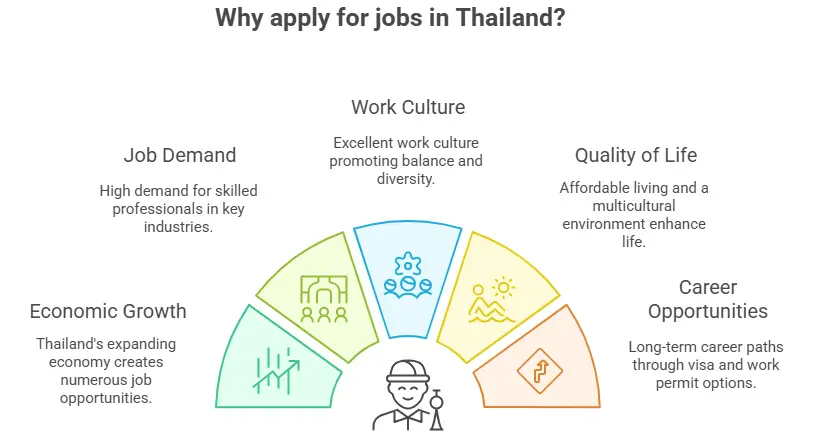
Thailand is becoming a top overseas career destination for Indians due to its growing economy, rising demand for skilled professionals, and excellent work culture. With strong hiring across IT, engineering, healthcare, hospitality, manufacturing, and finance, Thailand offers promising opportunities for Indian professionals seeking global careers. The country also offers a high quality of life, affordable living, and a multicultural work environment.
Benefits of Working in Thailand:
- Strong and growing demand for skilled professionals across IT, hospitality, healthcare, manufacturing, and logistics (DOE Thailand, 2026)
- Standard 40-hour work week, supporting work–life balance
- Competitive salaries in high-growth industries
- Affordable cost of living compared to major Asian job hubs
- English-speaking corporate environment, especially in MNCs, IT firms & international schools
- Large Indian & expat community, making relocation easier
- Long-term career opportunities through the Non-Immigrant B Visa & Work Permit pathway
Note: Thailand's Department of Employment (DOE) recorded 33,187 registered job vacancies in February 2026. Actual market demand including unregistered vacancies is significantly higher across IT, hospitality, and healthcare sectors. Source: Bank of Thailand / NSO Labour Force Survey, Q1 2026.
*Looking to work in Thailand? Talk to experts at Y-Axis to guide you with the process.
Number of Job Opportunities in Thailand by 2030
Thailand is experiencing a steady rise in workforce demand, especially across IT, engineering, healthcare, logistics, education, hospitality, and finance. With continued digital transformation, infrastructure expansion, and a fast-recovering tourism sector, Thailand is expected to generate thousands of new jobs by 2030 for both local and foreign professionals, including Indians.
| Occupation | Number of Jobs (Projected by 2030) |
|---|---|
| Healthcare | 90,000 |
| Accounting & Finance | 70,000 |
| Engineering | 80,000 |
| IT & Software | 1,10,000 |
| Hospitality | 1,00,000 |
| Marketing & Sales | 65,000 |
| Teaching & Education | 55,000 |
| Nursing | 60,000 |
| Human Resources & Management | 50,000 |
Note: Sector-specific job opening projections are indicative estimates based on current growth trends, BOI Thailand workforce data, and EEC industry forecasts. They are not official NESDC or NSO figures. Verified context: Thailand requires over 1 million high-skilled positions across targeted industries by 2029 (NXPO/IRIS Consulting, June 2025), including 500,000 digital professionals by 2030 (BOI/EEC workforce data). For official labour market statistics, visit nesdc.go.th and doe.go.th.
Also, read...
Thailand Job Market: Trends & Job Opportunities
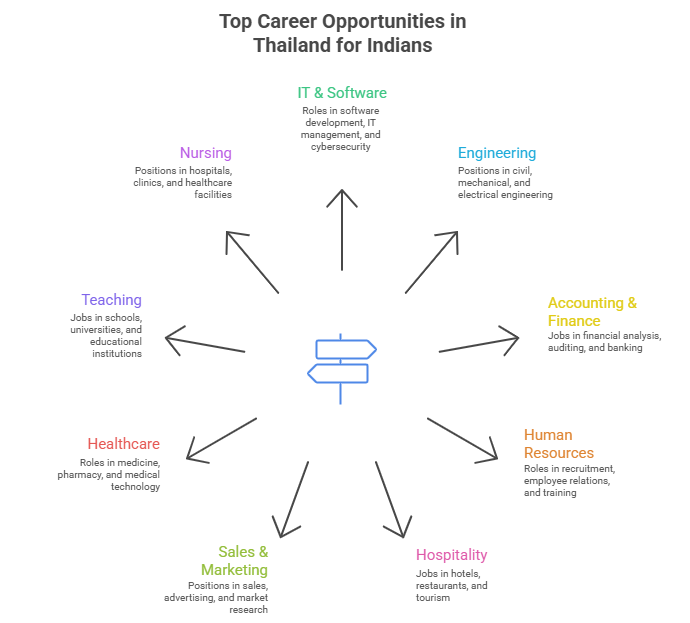
Top Careers in Thailand for Indians
IT & Software Jobs in Thailand
Thailand’s IT sector is growing rapidly with rising demand for software developers, IT support specialists, cybersecurity analysts, cloud engineers, and data professionals. Global companies and multinational IT-BPM firms in Bangkok, Phuket, and Chiang Mai actively hire skilled foreign workers.
The average salary for IT jobs in Thailand is ฿1,000,000 per year. Freshers typically start at ฿600,000 per year, while experienced professionals earn up to ฿1,600,000 per year.
Looking for IT jobs abroad? Avail Y-Axis Resume Marketing services to find the right one.
Engineering Jobs in Thailand
The engineering sector in Thailand is expanding due to infrastructure development, energy projects, and growth in manufacturing and construction. Civil, mechanical, electrical, and industrial engineers are in strong demand.
The average salary for engineering jobs in Thailand is ฿750,000 per year. Freshers start around ฿450,000 per year, and experienced engineers can earn up to ฿1,200,000 per year.
Looking for engineering jobs abroad? Y-Axis is here to provide personalized guidance!
Accounting & Finance Jobs in Thailand
Thailand has a large financial services industry, with banks, auditing firms, and multinational companies hiring foreign accountants, auditors, analysts, and finance managers.
The average salary for accounting & finance jobs in Thailand is ฿1,100,000 per year. Freshers usually earn ฿500,000 per year, and senior professionals make up to ฿1,600,000 per year.
Looking for finance jobs abroad? Let Y-Axis guide you with the process.
Human Resources (HR) Jobs in Thailand
HR professionals are in demand to support recruitment, payroll, compliance, talent management, and employee relations for both Thai and international companies.
The average salary for HR jobs in Thailand is ฿650,000 per year. Freshers earn around ฿400,000 per year, while experienced HR managers earn up to ฿1,000,000 per year.
Looking for HR jobs abroad? Talk to experts at Y-Axis for complete assistance!
Hospitality Jobs in Thailand
Thailand is one of the world’s top tourism hubs. Hotels, resorts, cruise lines, restaurants, and travel companies regularly hire chefs, front office staff, guest relations executives, supervisors, and service managers.
The average salary for hospitality jobs in Thailand is ฿500,000 per year. Freshers start at ฿300,000 per year, and experienced professionals earn up to ฿850,000 per year.
Looking for hospitality jobs abroad? Get in touch with Y-Axis to guide you with the process.
Sales & Marketing Jobs in Thailand
Sales & marketing careers are popular in Thailand, with demand across real estate, FMCG, IT, telecom, retail, and corporate sectors. Digital marketing professionals are especially in demand.
The average salary for sales & marketing jobs in Thailand is ฿750,000 per year. Entry-level salaries start at ฿400,000 per year, while experienced staff earn up to ฿1,400,000 per year.
Looking for sales & marketing jobs abroad? Let Y-Axis help you with the steps.
Healthcare Jobs in Thailand
Healthcare is a growing sector due to Thailand’s medical tourism industry and increasing patient demand. Doctors, nurses, medical technologists, physiotherapists, and lab technicians are highly sought after.
The average salary for healthcare professionals in Thailand is ฿900,000 per year. Freshers typically earn ฿500,000 per year, while experienced specialists can earn up to ฿1,500,000 per year.
Looking for healthcare jobs abroad? Talk to Y-Axis for complete assistance with the process!
Teaching Jobs in Thailand
International schools, language centers, and universities in Thailand regularly hire English teachers, STEM teachers, and corporate trainers. Indian teachers with strong English communication have excellent job opportunities.
The average salary for teaching jobs in Thailand is ฿500,000 per year. Freshers earn around ฿350,000 per year, while experienced teachers earn up to ฿850,000 per year.
Looking for teaching jobs abroad? Y-Axis is here to provide complete assistance!
Nursing Jobs in Thailand
Nursing roles are available in hospitals, clinics, wellness centers, and aged-care facilities. Skilled and experienced nurses from India are highly valued.
The average salary for nursing jobs in Thailand is ฿420,000 per year. Freshers start at ฿300,000 per year, while experienced nurses earn up to ฿650,000 per year.
Searching for nursing jobs abroad? Talk to experts at Y-Axis to guide you with the process.
How Can Indians Get Jobs in Thailand?
Indians looking for a job in Thailand can apply through trusted job portals, company career pages, and recruitment agencies. By following the right steps, you can increase your chances of securing a job offer and starting your Thailand work visa process.
Below is the step-by-step process to apply for jobs in Thailand:
Step 1: Check your eligibility to work in Thailand as a foreign skilled professional.
Step 2: Prepare a Thailand-style (APAC format) resume and a professional cover letter.
Step 3: Search for jobs on trusted portals, company websites, and Thailand-based recruitment agencies.
Step 4: Submit your application to positions that match your skills, qualifications, and experience.
Step 5: Attend interviews with Thailand employers and present your skills effectively.
Step 6: Once selected, receive your official job offer and begin the Non-Immigrant B Visa & Work Permit process.
Also, read...
What are the most in-demand jobs in Thailand for the next 10 years?
How Can Indians Move to Thailand on a Work Permit?
Indians can move to Thailand on a work permit by securing a valid job offer from a Thailand-based employer. Once the employer issues the job offer and provides all required company documents, applicants can apply for the Non-Immigrant B (Work) Visa at a Thai Embassy. After entering Thailand with this visa, the employee must obtain a Thailand Work Permit from the Ministry of Labour. Once approved, they can legally work and reside in Thailand.
Thailand Work Permit Application Process
A Thailand Work Permit allows foreign nationals, including Indians, to work legally in the country for a specific employer, occupation, and duration. All work permits in Thailand are employer-sponsored, and applicants must first obtain a Non-Immigrant B (Work) Visa before applying for the work permit inside Thailand.
Below is the step-by-step Thailand Work Permit process:
Step 1: Secure a valid job offer from an employer in Thailand
You must receive an official job offer from a registered Thai company authorized to hire foreign workers.
Step 2: Employer prepares and submits documents to support your Non-Immigrant B Visa
Your employer must provide company registration papers, tax documents, and an invitation letter for your visa application.
Step 3: Apply for the Non-Immigrant B (Work) Visa at a Thai Embassy or Consulate
Submit your passport, photographs, academic certificates, experience letters, and employer documents for visa processing.
Step 4: Travel to Thailand after your Non-B Visa is approved
The Non-Immigrant B Visa allows you to enter Thailand legally for employment purposes.
Step 5: Apply for the Thailand Work Permit at the Ministry of Labour
Once in Thailand, you must undergo a medical check-up and submit your passport, Non-B Visa, photos, and employer forms to obtain your work permit.
Step 6: Receive your Work Permit and begin working legally in Thailand
After approval, you can start your job. Your work permit is employer-specific, and you must follow all Thai labour and immigration regulations.
*Looking to work abroad? Y-Axis is here to provide complete assistance.
Types of Thailand Work Visas
Thailand offers several work visa categories through which foreign nationals, including Indians, can work in the country. All work visas are employer-specific, meaning you may work only for the company that sponsors your visa and work permit.
Thailand’s main work visa categories include:
1. Non-Immigrant B Visa (Work Visa)
This is the primary visa for foreign workers planning long-term employment in Thailand.
Key Features:
- Valid up to 4 years
- No separate work permit required
- Easier stay extension
- Fast-track processing for eligible applicants
- Minimum income requirement: THB 100,000/month (≈ ₹2.3 lakh/month) for most Smart Visa categories
- Spouse and children can accompany under Smart Visa dependent provisions
2. Thailand Work Permit
This is not a visa but a mandatory document issued after entering Thailand on a Non-B Visa.
Key Features:
- Allows you to work legally for a specific employer
- Issued by the Ministry of Labour
- Valid for 1 year (renewable with employer sponsorship)
- Must always be kept with you while working
3. Smart Visa (For Highly Skilled Professionals)
Designed for experts in high-tech industries such as:
- IT
- Engineering
- Healthcare
- Robotics
- Biotech
- Smart electronics
Key Features:
- Valid up to 4 years
- Easier stay extension
- No separate work permit required
- Fast-track processing for eligible applicants
| Category | Who It's For | Minimum Requirement |
|---|---|---|
| Smart T (Talent) | Skilled professionals in targeted industries | THB 100,000/month (≈ ₹2.3 lakh/month) |
| Smart E (Executive) | Senior executives in targeted companies | THB 200,000/month (≈ ₹4.6 lakh/month) |
| Smart I (Investor) | Foreign investors | THB 20 million investment in targeted sectors |
| Smart S (Startup) | Startup founders | THB 600,000 savings |
Source: Thailand Board of Investment — boi.go.th
4. Special Business Visa Categories
These include visas issued to foreign:
- Investors
- Company owners
- Executives
- Board members
- Consultants\
5. Thailand LTR Visa — Work-from-Thailand Professionals
The LTR Visa is Thailand's 10-year residency visa for high-earning remote workers employed by overseas companies. It is one of the most searched Thailand visa options among Indian IT professionals working remotely for US, UK, or EU employers.
| Feature | Detail |
|---|---|
| Launched | September 2022 — updated February 2025 and early 2026 |
| Validity | 10 years (two 5-year periods) |
| Minimum Income | USD 80,000/year (averaged over the past 2 years) |
| Reduced Income Threshold | USD 40,000/year for applicants holding a Master's degree or higher |
| Employer Requirement | Company with USD 50 million or more in annual revenue (lowered from USD 150 million in 2026) |
| Work Permit Required | No — employment remains with the overseas employer. |
| Income Tax Benefit | Foreign-sourced income is exempt from Thai personal income tax. |
| Health Insurance Required | USD 50,000 health insurance coverage or a USD 100,000 bank deposit. |
| Government Fee | THB 50,000 per 5-year period (≈ ₹1.15 lakh) |
| Most Relevant for Indians | Senior IT professionals working remotely for multinational companies and earning USD 80,000 or more per year. |
Note: This visa does not allow you to work for a Thai employer — your employment must remain with your overseas company. Indian freelancers or those with multiple clients should explore the Destination Thailand Visa (DTV) instead, which requires only THB 500,000 in savings with no employer revenue requirement.
Source: Thailand Board of Investment (ltr.boi.go.th), verified July 2026
Each category has its own employer or business sponsorship requirements.
Thailand Work Visa Requirements
To apply for a Thailand Work Visa, you need the following:
- A valid passport
- A valid job offer from a registered employer in Thailand
- Educational certificates relevant to the job
- Professional experience documents
- Non-Immigrant B Visa application form
- Employer's company registration and tax documents
- Medical certificate issued in Thailand
- Police Clearance Certificate (if required)
- Proof of sufficient funds
- Passport-sized photographs
- Completed Work Permit application
Thailand Work Visa for On-Shore Candidates
On-shore applicants are individuals who are already living in Thailand on a valid long-stay visa such as a student visa, spouse visa, business visa, or long-term stay permit. These applicants may apply for a Thailand Work Permit and convert their existing visa into a Non-Immigrant B Visa if they meet the requirements.
Eligibility criteria for on-shore applicants:
- Candidates must hold a valid long-stay visa (student visa, spouse visa, dependent visa, business visa, etc.).
- Candidates must secure a valid job offer from a registered employer in Thailand.
- Candidates must apply for an Alien Employment Permit (AEP) before starting work.
- Candidates must submit their documents to convert their current visa into a Non-Immigrant B Visa.
- Candidates must maintain legal stay in Thailand throughout the process.
- Tourist visa holders are not eligible to convert their visa to a work visa inside Thailand.
- Candidates must comply with Thai immigration rules and labour regulations.
Thailand Work Visa for Off-Shore Candidates
Off-shore applicants are individuals living outside Thailand (including India) who apply for a Thailand Work Visa before entering the country. These applicants must secure employer sponsorship and complete the visa process through a Thai Embassy or Consulate.
Eligibility criteria for off-shore applicants:
- Must meet the visa requirements based on nationality and job category.
- Must secure a valid job offer from a Thai employer.
- Employer must provide all required documents for the Non-Immigrant B Visa application.
- Candidates must apply for the Non-Immigrant B Visa at a Thai Embassy/Consulate before travelling.
- Off-shore applicants may enter Thailand only after their Non-B Visa is approved.
- After arrival, candidates must apply for the Thailand Work Permit at the Ministry of Labour.
- Additional requirements may apply depending on job role, industry, or visa type (e.g., SMART Visa).
Steps to Apply for a Thailand Work Visa
Step 1: Check if you meet all the eligibility rules for a Thailand Work Visa.
Step 2: Secure a valid job offer from a registered employer in Thailand.
Step 3: Your employer prepares and submits required documents for your Non-Immigrant B Visa.
Step 4: Apply for the Non-Immigrant B Visa at the Thai Embassy/Consulate in your home country.
Step 5: Travel to Thailand after visa approval and apply for your Work Permit at the Ministry of Labour.
Step 6: Receive your Work Permit and start working legally in Thailand.
How Y-Axis Helps You to Work in Thailand
Y-Axis, a leading overseas career consultancy, provides reliable and end-to-end services to help you secure a job and work legally in Thailand. Our expert team supports you throughout the Thailand work visa process, from eligibility checks to documentation, job search, and relocation assistance.
Our main services for Thailand include:
- Resume marketing services to help you find relevant jobs in Thailand across IT, engineering, hospitality, healthcare, finance, and education
- Resume writing, resume marketing, LinkedIn marketing services to help your profile stand out to Thai employers
- Expert guidance and consultation for the Non-Immigrant B Visa, Work Permit, and SMART Visa categories
- Coaching services for English communication and interview preparation, as required by employers
- Free career counselling to help you plan your overseas career — book your session today
- Complete documentation support for visa filing, work permit applications, and relocation processes
Y-Axis snapshot
1M
Successful applicants
1500+
Experienced counselors
25Y+
Expertise
50+
Offices
Don't know what to do ?
Get Free Counseling
Looking for Inspiration
Explore what Global Indians have to say about Y-Axis in shaping their future