


Don't know what to do ?
Get Free Counseling
Last Updated 24 July 2026
Thailand Work Visa for Indians: Eligibility, Requirements and Application Guide
Thailand, a Southeast Asian country renowned as a top tourist destination among foreign nationals, is now emerging as a hub for manufacturing, digital services, food processing, and automobiles. With an estimated GDP of USD 0.58 trillion in 2025, Thailand is attracting notable foreign investment, driven by an expanding job market. GDP growth stood at 1.3% in 2025, recovering from a slowdown — Thailand grew 2.5% in 2024, below the official target of 2.7%, and is projected to strengthen to approximately 2.5–2.8% in 2026 (World Bank, June 2026), supported by private consumption and export recovery. There are innumerable job opportunities available for skilled foreign professionals in high-demand sectors, including hospitality, healthcare, engineering , construction, IT support, and manufacturing.
Thailand promotes investor-friendly policies and offers affordable living costs, yet it is currently facing skill shortages in labour-intensive and skilled sectors. The Thai Job market is slowly growing, with over 100,000 job vacancies across top sectors, making it a top destination for skilled foreign workers looking to live, work, and settle abroad.
While Thai is commonly spoken across the country, some of the top multinational companies and organizations welcome English-speaking professionals, making mobility and social integration easier.
Capital: Bangkok | Population: ~71 million | Language: Thai | Currency: Thai Baht (฿) ≈ ₹2.35
Thailand Work Visa for Indians
Thailand is a great choice for individuals looking to set up their business or settle abroad. The country is not just known for its tourism, but is also emerging as a leading country for long-term career opportunities and business prospects. The Thailand work visa for Indian citizens allows qualifying Indians to seek legal employment within the country. Skilled workers and professionals can apply for a work visa in Thailand by meeting the Thailand work visa requirements for Indian citizens, which include sponsorship from an employer in Thailand and other relevant documentation.
Also, read...
Do I need a job offer for a Thailand work visa?
What is a Thailand Work Permit?
A Thailand work permit grants legal access to individuals who wish to work in the country legally. A Thai work permit is essentially a legal document that specifies the individual’s job position, job description, employment duration, and other details related to the Thai company for which the individual is employed. Foreign nationals will not be allowed to work in Thailand without a valid Thailand work permit.
Why Work in Thailand?
- Fast-growing country with a high demand for skilled & semi-skilled professionals
- High need for professionals in healthcare, hospitality, logistics, and manufacturing sectors
- 100,000 job vacancies across top industries
- Streamlined work permit pathways for skilled professionals
- Full-time workers can earn around ฿25,000–฿120,000 per month depending on role, sector, and experience — equivalent to approximately ₹9–₹43 LPA (1 THB ≈ ₹2.35, April 2026)
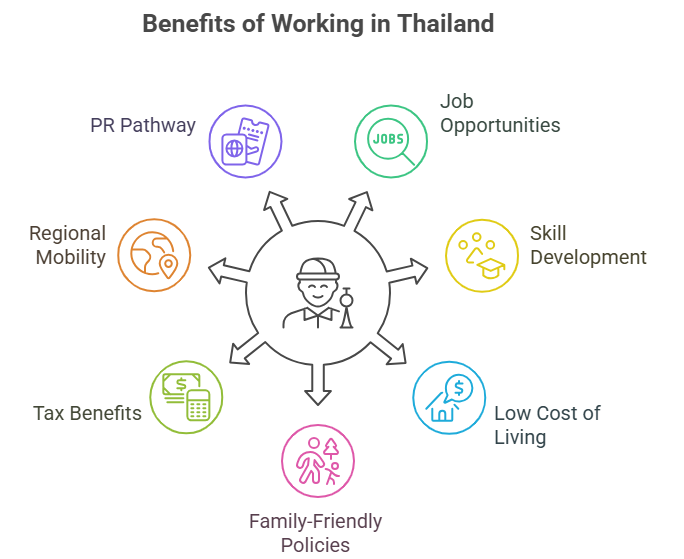
Benefits of Working in Thailand
- Growing job opportunities: Thailand has over 100,000 job vacancies across high-demand sectors like healthcare, logistics, hospitality, and manufacturing.
- Skill development programs: The Thai government offers multiple programs for hands-on training in hospitality, manufacturing, tourism, and international trade.
- Low cost of living: Thailand offers affordable living costs, providing top-notch healthcare and transportation in cities like Phuket, Pattaya, and Bangkok.
- Family-friendly government policies: The Thailand work visa allows you to bring dependents and offers healthcare benefits.
- Tax benefits: The country offers tax rates from 5% to 35% based on job role and visa type.
- Regional mobility: Located near Singapore, Malaysia, Vietnam, and Indonesia, offering wider regional access.
- PR pathway: Allows conversion to permanent residency upon meeting eligibility criteria.
Types of Thailand Work Visas
| Particulars | Non-Immigrant Visa B (Work Visa) | SMART Visa | BOI-Sponsored Work Visa (Non-IB) |
|---|---|---|---|
| Visa Type | Standard work visa for foreign nationals with a confirmed job offer from a Thai-registered employer. | A specialised visa for highly skilled experts, senior executives, investors, and startup entrepreneurs in Thailand's targeted S-Curve industries. | A work visa issued to foreign professionals employed by companies approved under BOI investment promotion. |
| Education | Bachelor's degree or relevant diploma with work experience, verified by the Thai Department of Employment. | Varies by category (Talent, Executive, Investor, Startup). May require high income, relevant experience, or investment criteria. | Relevant degree or specialised qualification aligned with the BOI-approved industry. |
| Language Requirement | No formal Thai language requirement; documents may be submitted in Thai or English. | No formal language requirement. | No formal requirement; language expectations depend on the employer. |
| Eligibility | Requires a valid job offer from a Thai company with WP.32 approval. | Applicants must qualify under the Talent, Investor, Executive, Startup, or Dependent categories within S-Curve industries. | Employment with a BOI-promoted company and pre-approval through the BOI system. |
| Typical Professions | Engineers, teachers, IT professionals, chefs, healthcare workers, and technicians. | Technology experts, executives, investors, and startup founders. | Engineers, R&D professionals, manufacturing specialists, and supply chain experts. |
| Visa Validity | Initially valid for 90 days and extendable up to 1 year, with annual renewals. | Category T (Talent): 4 years Category I (Investor): 4 years Category E (Executive): 4 years Category S (Startup): 1 year, renewable Category O (Dependants): Varies based on the principal applicant's category. Most SMART Visa holders are exempt from obtaining a separate work permit. |
Valid for 1 year and renewable annually. |
| Work Permit | Mandatory and issued after arrival in Thailand. | Not required for most SMART Visa categories. | Issued through the BOI One-Stop Service Centre. |
| Visa Fees | THB 2,000 (single-entry) / THB 5,000 (multiple-entry). | THB 10,000 per year. | THB 2,000 / THB 5,000, plus applicable BOI permit fees. |
| Minimum Monthly Salary (BOI) | Not applicable. | Not applicable. | Executive (CEO, MD, President): THB 150,000/month Manager, Engineer, IT Specialist, or Researcher with a relevant bachelor's degree: THB 50,000/month (≈ ₹1.18 lakh/month / ₹14.1 lakh/year) Manager, Engineer, IT Specialist, or Researcher without a relevant degree: THB 75,000/month Operational, IBPO, or TISO roles with a degree: THB 35,000/month Verification: New applications are assessed through the employment contract, while renewals are verified using PND 1 tax forms. |
| Salary Verification Basis | Employer contract and work permit documentation. | Depends on the requirements of the specific SMART Visa category. | New applications are verified through employment contracts, while renewals are verified through PND 1 tax forms. |
| Reference | Thai Immigration and Department of Employment regulations. | SMART Visa programme regulations. | BOI Announcement No. Por.8/2568 (effective 1 January 2026 for existing BOI companies and 1 October 2025 for new BOI certificates), DFDL September 2025, and PKF Thailand October 2025. |
Note: Also consider: Thailand LTR Visa (Long-Term Resident)
If you are working remotely for a company not based in Thailand or are a retiree with qualifying income, the BOI LTR Visa might give you better options than the Non-Immigrant B Visa. It has a valid period of 10 years, does not require a Thai work license for foreign work, and comes with tax exemptions for foreign income. Minimum income USD 80,000/year (or USD 40,000/year with a Master's degree or IP ownership).
See our Highest Paying Jobs in Thailand guide for full LTR details.
Thailand Work Visa Requirements for Indian Citizens
One of the main Thailand work visa requirements includes getting a Non-Immigrant Visa Category “B” (Business/Work) and a valid work permit.
The requirements for a Thailand work visa are as follows:
- Thailand work permit
- Non-Immigrant B Visa
- Letter of Approval from the Ministry of Labour (Form WP3)
- Employment letter from a Thai employer (job role or position, employment contract, annual salary compensation, taxes, VAT, company registration, and other financial records)
- Personal documents, which include a passport with at least 6 months of validity, a visa application form, copies of the latest passport-sized photographs, educational certificates, and an updated CV
- Financial Proof: Proof of funds worth (20,000–40,000 THB)
- Medical certificate: A valid medical certificate issued in the last 3 months
Major In-Demand Sectors in Thailand
The labour market in Thailand is expanding in the services, tourism, manufacturing, and export sectors. Currently, some of the in-demand sectors in Thailand include hospitality, healthcare, logistics, construction, engineering, and manufacturing.
The table below shows the list of high-demand jobs in Thailand along with the annual average salaries:
| Occupation | Average Monthly Salary (THB) | Approx. Annual Salary (INR) |
|---|---|---|
| Software Engineers & IT Developers | ฿50,000–฿120,000 | ₹14–₹34 LPA |
| Cyber Security Analysts | ฿55,000–฿110,000 | ₹15.5–₹31 LPA |
| Data Scientists / AI Engineers | ฿60,000–฿130,000 | ₹17–₹37 LPA |
| Medical Practitioners (Doctors, Specialists) | ฿80,000–฿250,000+ | ₹22.6–₹70.5 LPA+ |
| Nurses & Healthcare Professionals | ฿25,000–฿55,000 | ₹7–₹15.5 LPA |
| Civil & Structural Engineers | ฿40,000–฿90,000 | ₹11.3–₹25.4 LPA |
| Accountants & Finance Managers | ฿45,000–฿100,000 | ₹12.7–₹28.2 LPA |
| English / International School Teachers | ฿35,000–฿75,000 | ₹9.9–₹21.2 LPA |
| Logistics & Supply Chain Managers | ฿40,000–฿85,000 | ₹11.3–₹24 LPA |
| Hospitality & Tourism Managers | ฿35,000–฿80,000 | ₹9.9–₹22.6 LPA |
Note: 1 THB ≈ ₹2.35 (April 2026) — exchange rates fluctuate. Verify at xe.com before financial planning. 1 USD ≈ THB 33–34 (April 2026).
Also, read...
What are the most in-demand jobs in Thailand for the next 10 years?
Top Companies in Thailand Hiring Indian Professionals
| S.No. | Company | Industry | Why It’s Good for International Talent |
|---|---|---|---|
| 1 | PTT Group | Energy / Oil & Gas / Petrochemicals | Thailand’s largest state-owned energy company, offering opportunities for foreign engineers, project managers, and technical experts. |
| 2 | CP Group (Charoen Pokphand Group) | Conglomerate / Agriculture / Retail | One of Asia’s largest conglomerates, providing multinational career opportunities in IT, supply chain, retail operations, and management. |
| 3 | Thai Airways International | Aviation / Hospitality | Offers roles for international professionals in engineering, maintenance, customer service, and operational functions. |
| 4 | SCG (Siam Cement Group) | Manufacturing / Chemicals / Construction Materials | A major industrial group with global operations, recruiting engineers, R&D specialists, and technical managers. |
| 5 | Bangkok Hospital Group | Healthcare & Medical Services | A leading healthcare network employing international staff, with opportunities for doctors, nurses, and allied health professionals. |
| 6 | AIS (Advanced Info Service) | Telecommunications / IT / Digital Technology | Thailand’s leading telecom provider, hiring IT specialists, digital marketers, data analysts, and network engineers. |
| 7 | True Corporation | Telecom / Internet / Technology | A major telecom and technology company offering roles in IT, software development, network operations, and customer solutions. |
| 8 | Central Group | Retail / Hospitality / Real Estate | One of Thailand’s largest retail and hospitality groups, with opportunities in management, operations, and business functions. |
*Want to apply for jobs abroad? Try Y-Axis Resume Marketing services to find the right one.
Key Industries Hiring in Thailand
The job market in Thailand is experiencing a hiring trend in technology, healthcare, tourism, and manufacturing sectors. Job vacancy estimates vary by source and methodology — Thailand's Department of Employment reports approximately 33,000–54,000 formally registered vacancies at any given time (2026), while broader estimates including informal sector demand range from 300,000 to 700,000 positions across key growth sectors over the coming years, and Thailand is seeking skilled foreign workers to overcome ongoing workforce shortages. Some high-demand industries, such as robotics, digital technology, aviation, and next-generation automotive, that are part of the Eastern Economic Corridor (EEC) initiative will be prioritized.
Given below is the list of industries that are currently hiring in Thailand:
- Healthcare & Medical Tourism
- Financial Technology (FinTech) & Banking
- Information Technology & Digital Economy
- Construction & Infrastructure Engineering
- Education & International Schools
- Food Processing & Agribusiness
- Renewable Energy & Sustainability
- Hospitality, Tourism & Aviation
- Automotive & Electronics Manufacturing
- Logistics & Supply Chain
Average Salary in Thailand for In-Demand Jobs
Salaries in Thailand may vary depending on the occupation, industry, and job role you are applying for. Skilled foreign workers with valid work permits and Non-Immigrant B Visas are more likely to earn competitive salaries in high-demand sectors such as healthcare, finance, technology, and engineering.
The table below gives you an overview of the salary offered in Thailand per month for entry-level, mid-level, and senior professionals:
| Experience Level | Average Salary (THB per month) | Approx. Salary (INR per year) |
|---|---|---|
| Entry Level | ฿25,000 – ฿40,000 | ₹9 – ₹14 LPA |
| Mid-Level | ฿45,000 – ฿80,000 | ₹16 – ₹28 LPA |
| Senior Level | ฿90,000 – ฿200,000+ | ₹32 – ₹72 LPA |
Key Tips for Indian Professionals
- Focus on applying for jobs at multinational companies and organizations, such as CP Group, PTT, Minor International, Agoda, IBM, and Accenture, as they frequently post job openings for foreign professionals.
- Verify whether your Thai employer is sponsoring your work permit and, if so, if you require employer-related documentation for your work authorization and visa process.
- Target job roles in high-demand sectors such as healthcare, hospitality, IT services, manufacturing, logistics, etc.
- While English is widely accepted in most multinational companies, knowledge of basic Thai can facilitate social and workplace integration.
- Cross-check whether your employer holds a valid BOI promotion certificate if you plan to work in tech, R&D, or manufacturing — BOI-sponsored work permits are processed in 7–14 days via the BOI E-Expert portal at boi.go.th/en/e-expert-portal. Note that BOI companies must meet mandatory salary thresholds effective January 2026 — ensure your offer letter meets the applicable minimum before signing.
Also, read...
Thailand Introduces Online Work Permit Portal for Foreign Workers
Market Background & Trends in Thailand
- Increasing workforce demand: The country is actively seeking skilled foreign workers in the hospitality, construction, healthcare, IT, and education sectors, with over 100,000 job opportunities available.
- Skill shortages across top industries: The hospitality, logistics, healthcare, tourism, digital services, engineering, and construction sectors are currently facing significant skill shortages.
- Expanding economy: Thailand has a growing economy, with a booming hospitality and tourism industry. This creates more job opportunities for international talent in the restaurant, aviation, and tourism sectors.
- Leading Manufacturing Hub in Southeast Asia: Thailand is one of the top manufacturing hubs for electronics, automobiles, and consumer goods. Companies in industrial estates are also hiring foreign technicians, managers, and engineers.
- Work visa options for highly skilled professionals: Thailand offers visa options, such as the SMART Visa and BOI-sponsored pathways, that are specifically designed for high-skilled professionals, investors, and executives in targeted industries.
- Positive Job Outlook: Thailand is expected to have 500,000 to 700,000 job opportunities in the next five years, indicating a strong demand for foreign nationals looking to settle abroad.
Also, read...
Thailand Job Market: Trends & Job Opportunities
How to Apply for a Thailand Work Visa for Indians?
Step 1: Sign up for Resume Marketing Services: Try Y-Axis Resume Marketing Services for personalized job search support to find the right job in Thailand.
Step 2: Obtain a Valid Job Offer: Y-Axis helps you connect with registered and trusted Thai employers and companies that offer visa sponsorship for foreigners.
Step 3: Employer Applies for a Letter of Approval: Your employer submits an application for a Letter of Approval to the Ministry of Labour, accompanied by complete documentation and support from Y-Axis.
Step 4: Apply for a Thai Work Visa: Once you receive the approval letter, you can apply for a Thai work visa of your choice by filling out the application and submitting the required documents. Y-Axis will guide you throughout the process.
Step 5: Enter Thailand and obtain your work permit digitally. Fly to Thailand on your approved work visa. Within 90 days of arrival, your employer submits the work permit application through the mandatory e-Work Permit system No in-person visit to the Department of Employment is required. Employers must register on the portal and verify via the ThaiID mobile app. The work permit is issued digitally with real-time tracking via the portal, email, and SMS.
Thailand Work Visa Cost
| Visa Type | Cost |
|---|---|
| Non-Immigrant B Visa (Work Visa) | THB 2,000 (single-entry) / THB 5,000 (multiple-entry) |
| SMART Visa | THB 10,000 (varies by category) |
| BOI-Sponsored Work Visa | THB 2,000–5,000 |
Fees as of April 2026 — verify current fees from the Royal Thai Embassy India at thaiembassy.in before applying.
Additional Costs (if applicable):
- Medical Check-up: ฿1,500–฿3,000 (₹3,500–₹7,000) — required for work permit application
- Document Translation & Legalisation: Approx. ฿500–฿2,000 per document (₹1,200–฿4,800) — third-party service; costs vary
- Work Permit Fee: ฿3,000 (1-year permit) + ฿100 application fee = ฿3,100 total (฿1,500 for 6 months; ฿750 for 3 months)
- Re-Entry Permit (for travel outside Thailand):
Single re-entry: ฿1,000 (immigration office) / ฿1,200 (airport counter)
Multiple re-entry: ฿3,800 (immigration office) / ฿4,000 (airport counter)
- Health Insurance: ฿8,000–฿30,000/year (₹19,000–₹71,000) depending on coverage level and provider
- Airfare to Thailand: ₹12,000–₹25,000 (one-way average from India — indicative only; subject to change)
Thailand Work Visa Processing Time
Thailand work visa processing time in 2026: Non-Immigrant B Work Visa takes 4–6 weeks in total. SMART Visa takes 30–60 days depending on category and documentation. BOI-Sponsored Work Visa is fast-tracked to 7–14 days via the BOI E-Expert system. From October 13, 2025, all work permit applications in Thailand are submitted digitally through the e-Work Permit system at e-workpermit.doe.go.th — no in-person Department of Employment visit is required.
| Visa Type | Processing Time |
|---|---|
| Non-Immigrant B Visa (Work Visa) | 4–6 weeks (includes embassy processing and work permit approval). |
| SMART Visa | 30–60 days (varies depending on the visa category and supporting documentation). |
| BOI-Sponsored Work Visa | 7–14 days (fast-track processing through the BOI E-Expert system). |
Factors Influencing Processing Time:
- Incomplete Application: Applications that are incomplete, with missing documents or incorrect details, can lead to delays in visa processing.
- Missing employer credentials: A lack of employer documents, such as business registration and tax filings, can also delay processing time, as employer documentation is crucial.
- Time & place of application: Processing varies depending on where and when you apply. Applying during peak seasons can slow down approval timelines.
- Visa types: The type of work visa you apply for affects processing time, as some visas have stricter requirements than others.
Thailand Dependent Visa: Can I Bring My Family on a Work Visa?
| Visa Type | Spouse | Children |
|---|---|---|
| Non-Immigrant B Visa (Work Visa) | Can accompany the primary applicant on a Non-Immigrant O (Dependent) Visa. The spouse may require a separate work permit to work legally in Thailand and does not need to convert to a Non-B Visa. | Children under 20 years of age can accompany the applicant on a Non-Immigrant O Visa. A separate Non-Immigrant ED Visa is required for school enrolment. |
| SMART Visa (Categories T, I, E, S) | Spouses receive the same visa validity as the primary applicant. They may work in permitted occupations without obtaining a separate work permit after endorsement from the Smart Visa Unit (processing time: approximately 14 days). | Children under 20 receive the same visa validity as the principal applicant. Children above 20 who are enrolled in full-time education may qualify with supporting evidence. An ED Visa is required for school enrolment. |
| BOI-Sponsored Work Visa (Non-IB) | Spouses can accompany the applicant on a Non-Immigrant O Visa. BOI endorsement is generally required, and a separate work permit must be obtained for employment in Thailand. | Children under 20 years of age can accompany the applicant on a Non-Immigrant O Visa. A separate ED Visa is required for attending school in Thailand. |
Pathway to Permanent Residency in Thailand (PR)
Foreign workers can qualify for permanent residence in Thailand after residing in the country after holding a valid Non-Immigrant B visa for 3 continuous years. The pathway to PR in Thailand is quota-based, with around 100 approvals per nationality per year. Applications for the quota are available through the Thai Ministry of Interior and may not be open every year. You may also be eligible for Thai citizenship via naturalization upon completing 10 consecutive years in the country.
Thailand PR for Indians: 100 permanent residence visas per nationality per year. Requires 3 consecutive years on Non-Immigrant B visa, THB 80,000 monthly income for 2 years, valid work permit, income tax history, Thai language proficiency, and clean criminal record.
To be eligible for PR, you must have:
- A valid Non-Immigrant B visa with a minimum of 3 consecutive years of extension
- A monthly income of ฿80,000
- A valid work permit and proof of income tax payments in Thailand
- Have a clear criminal record
- Proof of Thai language proficiency
Alternative income track: Directors of a Thai company with a minimum paid-up capital of THB 10 million earning a minimum of THB 50,000–80,000 per month may qualify for PR under a separate track if the company meets specific export or BOI criteria.
Work Visa Guidelines and Requirements for Thai Employers
Thai employer workforce ratios for foreign worker sponsorship depend on the type of company:
- General work permit (non-BOI, non-export companies): 4 Thai nationals for every 1 foreign employee (4:1 ratio) — this is the standard rule for most Thai companies.
- Export-oriented companies: 50 Thai nationals for every 5 foreign employees (10:1 ratio) — applies to companies in specific export categories under the Labour Protection Act. Verify your company's export classification with your employer.
- BOI Manufacturing companies with 100 or more total employees: Must maintain a minimum of 70% Thai nationals in their total workforce (approximately 2.3:1 ratio). Service businesses and manufacturers with fewer than 100 employees are exempt from this requirement.
BOI Salary Compliance: All foreign staff employed by BOI-promoted companies must meet the mandatory minimum monthly salary thresholds effective January 1, 2026 (BOI Announcement Por.8/2568). Renewals are verified by Thai tax authority PND 1 forms submitted by the employer. Offering a salary below the applicable threshold will result in work permit rejection or non-renewal.
How can Y-Axis help you?
As the world's No. 1 overseas immigration consultancy, Y-Axis has been providing unbiased, personalized services for 25 years. Our team of experts offers comprehensive assistance throughout your immigration journey, ensuring a seamless process. Our impeccable services include:
- Y-Axis Resume Writing Services to help you create a compelling resume
- Expert assistance with Thai visas
- Review of your documents and visa application form
- Complete application processing
- Y-Axis Resume Marketing Services to help you find the best jobs for you
Y-Axis snapshot
1M
Successful applicants
1500+
Experienced counselors
25Y+
Expertise
50+
Offices
Don't know what to do ?
Get Free Counseling
Looking for Inspiration
Explore what Global Indians have to say about Y-Axis in shaping their future