

Migrate to Germany
Sign up for a free expert consultation

Don't know what to do?
Get Free Counseling
Last Updated 07 August 2026
Germany Immigration from India - Opportunity Card (6/14 Points), EU Blue Card (EUR 50,700 Standard / EUR 45,934 Shortage), PR in 21 Months, Dual Citizenship and Skilled Immigration Act Guide
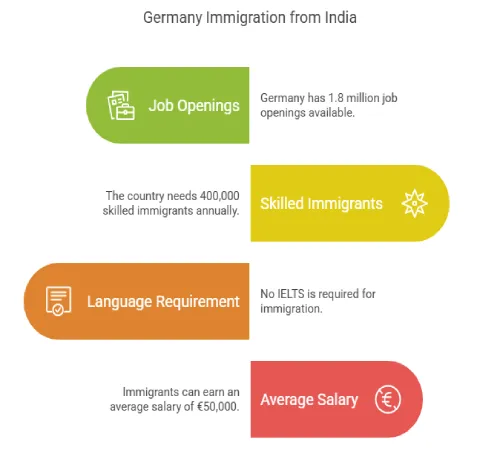
- 1.8 million job openings
- Needs 400,000 skilled immigrants each year
- No IELTS required (though the Opportunity Card requires A1-level German OR B2-level English, and the EU Blue Card settlement fast-track requires B1 German)
- Earn an average annual salary of €50,000
Germany Immigration offers diverse pathways for professionals with the right background. With a thriving economy and a high standard of living, Germany is one of the best places to build your life and settle as a family. Germany is the world’s 3rd largest economy, is looking for skilled migrants. Germany has always been an economic and cultural powerhouse and has now thrown open its doors to skilled professionals who can contribute to the country.
Jump to: Opportunity Card | EU Blue Card | Work Permit | Germany PR | Dual Citizenship | Salary Table | Best Cities | 2026 Updates
*Want to migrate to Germany? Get started with the Migrate to Germany Flipbook.
German Visas for Indians
A German visa is an official authorization that permits individuals from other countries to enter Germany for a designated period. Additionally, it allows foreigners to transit through Germany's international airports while traveling to other destinations. Below is the list of visas
- Opportunity Card
- Work Visa
- Business Visa
- Student Visa
- Visit Visa
- Dependant Visa
- Self-employment visa
- Freelance Visa
For more detailed information, also read...
Life in Germany
Life for an immigrant in Germany is always positive. They have access to high-quality healthcare, education, and a strong social support system. Immigrants often find diverse job opportunities and experience a rich cultural life. Learning the German language is essential, and integrating into the local community enhances the overall experience.
Germany Skilled Immigration Act Reforms 2023-2026
Germany introduced a new ‘Skilled Immigration Act’ to address the shortage of skilled workers in the country. It also allows skilled workers to migrate to Germany from any of the non-EU countries. The German government hopes that the Skilled Immigration Act will fulfill workforce market needs and attract, among others, caregivers, workers in IT, and STEM.
- Introduced opportunity card for jobseekers with a validity of 1 year
- 1.5-year extended residence permits for Indian students
- More employment opportunities for Indians
- Germany needs 400,000 skilled workers to meet the workforce demand
- Streamlined re-admission procedures
- Reduced visa processing times for Indian applicants
- Germany enacted dual citizenship into law on June 27, 2024 (Gesetz zur Modernisierung des Staatsangehörigkeitsrechts). All naturalised German citizens may now hold multiple nationalities permanently — this is not a time-limited status.
- Important for Indian applicants: while Germany permits dual citizenship, India does not currently allow Indian citizens to hold foreign citizenship simultaneously under the Indian Citizenship Act, 1955. Indians who naturalise in Germany are generally required to renounce Indian citizenship. An Overseas Citizen of India (OCI) card is a different status and may be worth exploring. Consult a lawyer specialising in both Indian and German nationality law before proceeding.
- Dual citizenship and the special citizenship status are valid for 3–5 years for skilled workers after satisfying certain criteria
- Germany aims to attract both academic and vocational skills
- The overall application process is also simplified to apply for citizenship in Germany.
Best cities in Germany to live in
Germany is one of the largest countries in Europe and is among the top destinations for skilled workers worldwide. It is a major economic force and a top place to live and work. The population of Germany is approximately 84-85 million (2025 estimate, Destatis). In terms of area, Berlin is nine times larger than Paris.
Below is the list of the best cities in Germany to live in:
- Munich
- Hamburg
- Essen
- Leipzig
- Cologne
- Berlin
- Dortmund
- Stuttgart
- Dusseldorf
- Frankfurt am Main
- Dortmund
Benefits of migrating to Germany
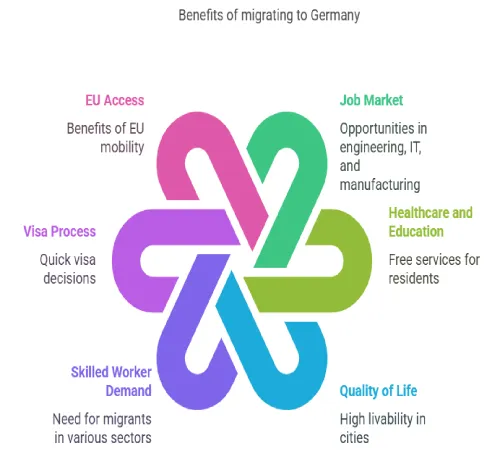
- The great job market for professionals in engineering, IT, and manufacturing sectors.
- Incredible benefits for residents include free healthcare and education.
- German cities are consistently among the ‘World’s Most Liveable Cities’.
- Shortage of skilled workers in several sectors, creating opportunities for migrants.
- One of the quickest visa decisions in a leading economy, allowing you to plan better.
- Great salary, great benefits, and access to all of the European Union once you get your visa.
- The largest populated country in Western Europe and also the largest economy in Europe.
- Germany is the 2nd most popular migration destination in the world, after the United States.
- Germany is an increasingly attractive destination for business immigrants, and the population is growing due to the rise in migrant activity.
- Wages or salaries in Germany are higher than in most countries.
- Germany needs 400,000 migrants per year.
Germany Immigration Points Calculator
Quick eligibility check of Y-Axis helps applicants understand their scores. The points are directly based on your answers. The Quick eligibility does not assure you of the points displayed. You are evaluated technically by our expert team to give you a better score.
*Check your eligibility to migrate to Germany through the Y-Axis Germany Immigration Points calculator.
How to migrate to Germany?
Germany has one of the world’s most well-organized and fastest immigration processes. The best way to migrate to Germany is through the Opportunity Card.
The Opportunity Card is a long-term residence permit that allows you to look for a job for a period of one year and is extendable to one more year. With this visa, you can enter Germany and attend interviews, which is a much better process than applying for a job from abroad. It takes two months to get the Opportunity Card, so the earlier you apply, the better.
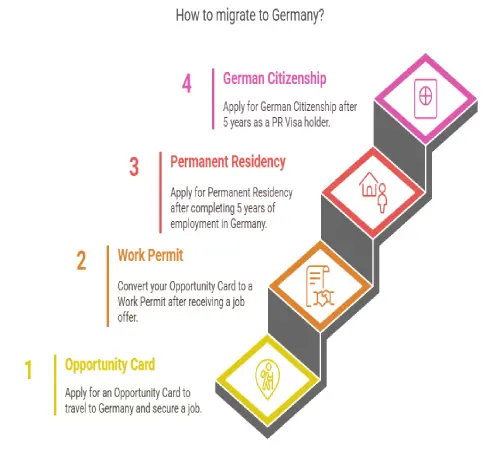
Step 1: Apply for an Opportunity Card and travel to Germany to secure a job
Step 2: Convert to a Work Permit after receiving the job offer.
Step 3: Apply for Germany PR — 5 years as an employee (standard route), or 21 months with an EU Blue Card and B1 German (fast-track route)
Step 4: Apply for German citizenship after 5 years of total legal residence from your first German permit — this countdown runs in parallel with your PR countdown from Day 1, not after PR is granted. A 3-year route is available for exceptional civic, social, or professional integration.
Language Requirement: A1-level German OR B2-level English (most Indian IT professionals already meet the B2 English bar).
Work Rights While Job-Searching: Opportunity Card holders may work part-time up to 20 hours/week, and can undertake unlimited 2-week trial employment periods without needing a separate work permit — useful for testing a role before committing to a full work-permit conversion.
Work and Stay Agency (WSA) — New in 2026: Germany launched a centralised digital immigration platform in 2026, giving applicants and employers a single portal for visa and work permit processing. Complete applications submitted through WSA see processing times 25-30% faster. Employers are encouraged to register early.
Germany Work Permit Visa
Germany is an ideal country to work in because of its lowest unemployment rates in Europe, an array of job opportunities, and several opportunities to develop careers and experience. Many foreigners join the workforce to gain a high-paying job in Germany along with the work-life balance it offers.
EU Blue Card Fast-Track to Germany Permanent Residency
EU Blue Card holders can reach Germany's settlement permit significantly faster than standard work permit holders:
- 21 months with a valid EU Blue Card and B1-level German (achievable in roughly 300-400 study hours)
- 27 months with a valid EU Blue Card, with no specific language requirement
This is Germany's fastest legal route to permanent residency across any immigration pathway — and one of the fastest PR timelines among major global destinations for qualified Indian professionals. From June 2026, EU Blue Cards are valid for up to 4 years (increased from the previous shorter duration).
Germany Work Permit Requirements
- Have German-recognized qualifications
- Have a job offer from a German-based employer
2026 salary thresholds by permit category (verify all figures against BAMF/BGBl. before publishing):
- EU Blue Card, standard occupations: €50,700/year (€4,225/month)
- EU Blue Card, shortage occupations/recent graduates/IT specialists: €45,934.20/year (€3,827.85/month)
- General employment with extensive professional experience (Sec 19c Abs. 2 AufenthG): €45,630/year (€3,802.50/month)
- Skilled workers over 45 (first-time permit): €55,770/year (€4,647.50/month)
- Collective agreement route: where your employer is bound by a German collective wage agreement, the agreed remuneration is sufficient regardless of the above thresholds
All thresholds are reviewed annually against the pension insurance assessment ceiling.
Jobs in Germany
- Germany is seeking qualified foreign workers in the shortage occupations (e.g., engineers, technicians, scientists, IT)
- More than 1.2 Million vacancies across the German job market.
In-Demand White-Collar Occupations – Germany (EUR) | 2026
| Occupation | Annual Salary Range (EUR) |
|---|---|
| AI / ML Engineer | EUR 70,000 – 120,000 |
| MLOps / AI Infrastructure Engineer | EUR 80,000 – 130,000 |
| Cloud Architect | EUR 80,000 – 115,000 |
| Cybersecurity Specialist | EUR 65,000 – 100,000 |
| Software Engineer | EUR 65,000 – 95,000 |
| Data Scientist | EUR 60,000 – 120,000 |
| Physician / Medical Doctor | EUR 80,000 – 150,000 |
| Healthcare / Biotech Professional | EUR 60,000 – 100,000 |
| Investment Banker / Quant Analyst | EUR 80,000 – 200,000+ |
| Financial Risk Manager | EUR 60,000 – 95,000 |
| Digital Marketing Manager | EUR 70,000 – 140,000 |
| Sales Manager | EUR 60,000 – 90,000 |
| HR Manager | EUR 55,000 – 85,000 |
List of IT companies offering jobs in Germany
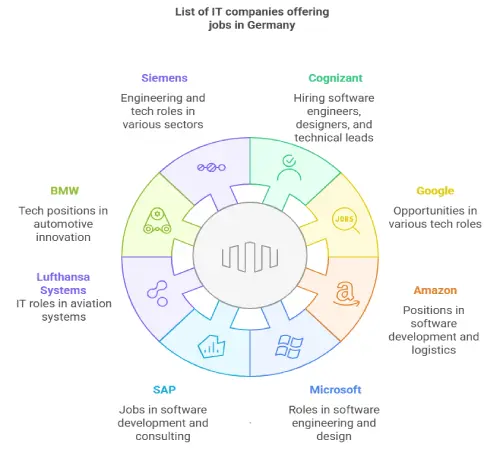
Cognizant is at the top and is looking to hire software engineers, designers, and technical leads.
- Cognizant
- Amazon
- Microsoft
- SAP
- Lufthansa Systems
- BMW
- Siemens
- Adidas
- Philips;
German Opportunity Card Requirements
6/14 points are required to qualify for a German Opportunity card.
| Criteria | Maximum Points |
|---|---|
| Age | 2 |
| Qualification | 4 |
| Relevant Work Experience | 3 |
| German Language Skills | 3 |
| English Language Skills | 1 |
| Previous Residence | 1 |
| Spouse Qualifying for Opportunity Card | 1 |
| Shortage Occupation | 1 |
| Total | 16 |
Proof of funds required for Germany Opportunity Card
The applicant must have sufficient financial resources to fund the job search in Germany.
For both Option 1 and Option 2, the proof of sufficient financial means is required to cover the costs of living for the duration of the stay by one of the following documents:
Option 1: Proof of a “Sperrkonto” (blocked account) in Germany with sufficient funds currently amounting to at least EUR 1,091 per month, which is EUR 13,092 for one year and EUR 6,546 for the 6 months visa.
Option 2: “Verpflichtungserklärung” (formal obligation letter with the planned length of stay of one year with the purpose of stay as - Chancenkarte/Long Term visa) by a sponsor living in Germany.
Option 3: Recent 3 months statements of a savings bank account. We recommend clients to start making small deposits regularly into the savings account so that they can have enough funds (EURO 13,092)
*Note: For all the international locations and 6 months visa option, a blocked account OR formal obligation letter is mandatory and savings account will not be accepted.
EU Blue Card
An EU Blue Card is a residence permit for skilled non-EU foreign nationals to work in an EU country. It allows its holder to enter the EU country and remain in a particular place for employment.
Germany Announces New EU Blue Card Policy
Germany's recently updated EU Blue Card policies are set to attract skilled tech professionals, especially from India. The new changes will be effective from 2025. The major changes introduced for the EU Blue Card include:
Reduced Salary Requirement:
- 2026 EU Blue Card Salary Thresholds (effective January 1, 2026; BGBl. 2025 I Nr. 278):
- Standard occupations (Big Blue Card): €50,700 gross/year (€4,225/month)
- Shortage occupations, recent graduates (within 3 years), and IT specialists (Small Blue Card): €45,934.20 gross/year (€3,827.85/month)
- Expanded list of eligible occupations: Skilled workers are required in the IT and healthcare sector in Germany.
- Opportunities for recent graduates: Germany will welcome fresh graduates who have completed university courses in the last three years.
- Opportunities for IT professionals without a degree IT professionals with at least two years of relevant work experience can get an EU Blue Card without a formal university degree (reduced from 3 years under the updated Skilled Immigration Act).
- Streamlined application process: Germany has reduced the processing times to facilitate the EU Blue Card application process.
Germany Entrepreneur Visa
There are two ways to establish your own business in Germany: either working as a freelancer (Freiberufler) or by launching a business as a self-employed entrepreneur (Gewerbe). Know more about the best possible approach for you on types of new businesses.
Germany Student Visa
Germany is an ideal study destination for overseas students with its world-class education and vibrant city life. Its welcoming culture allows it to welcome immigrants from the world over.
Universities in Germany have different deadlines for application.
There are, however, two general timelines if you wish to study in Germany:
Intake 1 (Summer Intake) – The summer semester (March to August). The applications must be submitted before January 15 every year.
Intake 2 (Winter Intake): The winter semester (between September and February or October and March).
Applications must be submitted before July 15 every year.
International students who complete a German degree are eligible for an 18-month post-study job search permit. Time spent in Germany during study and this job-search period counts toward your citizenship residency countdown from Day 1 — a pathway that few competing destinations offer as clearly.
Most Indian students target the Winter intake, since it aligns better with the April end of the Indian academic year.
Germany Family Sponsorship
Third-country nationals who are legal residents in Germany may want to bring over their family members from their native countries outside the EU, either temporarily or permanently. The Immigration Authorities in Germany, who support the reunification of families, have a special visa in place for this purpose to allow them to join their family members in Germany.
Sponsoring family members requires demonstrating sufficient income to support them; the exact threshold varies by family size and location — confirm your specific figure with BAMF or a Y-Axis immigration expert. Family members granted a residence permit under sponsorship can also receive their own work permit.
How to get a Germany PR Visa?
Standard route: You become eligible for Germany's settlement permit (Niederlassungserlaubnis) after 5 years of legal residence, provided you meet income self-sufficiency requirements, have made 60 months of pension contributions, hold B1-level German, have passed a knowledge-of-society test, have a clean criminal record, and have adequate accommodation.
EU Blue Card fast-track (Germany's fastest PR route): EU Blue Card holders can apply for the settlement permit after just 21 months with B1-level German, or 27 months with no specific language requirement.
Germany vs. Other Top Destinations for Indian Professionals (2026)
Germany's EU Blue Card route offers one of the fastest combined PR-and-citizenship timelines among major destinations for qualified Indian professionals, especially when paired with dual citizenship since June 2024.
| Destination | PR Timeline | Key Notes |
|---|---|---|
| Germany (EU Blue Card) | 21 months | B1 German required; dual citizenship permitted since June 2024. |
| USA (H-1B → Green Card) | EB-3: 30–50+ years for Indian applicants | $100,000 employer fee on new H-1B petitions from September 2025; weighted lottery system. |
| Canada (Express Entry) | Typically 6 months–2 years | No per-country cap; points-based immigration system. |
| Sweden (EU Blue Card) | 21 months | Citizenship eligibility increased to 8 years under the June 2026 law. |
Y-Axis - The Best German Immigration Consultants in India
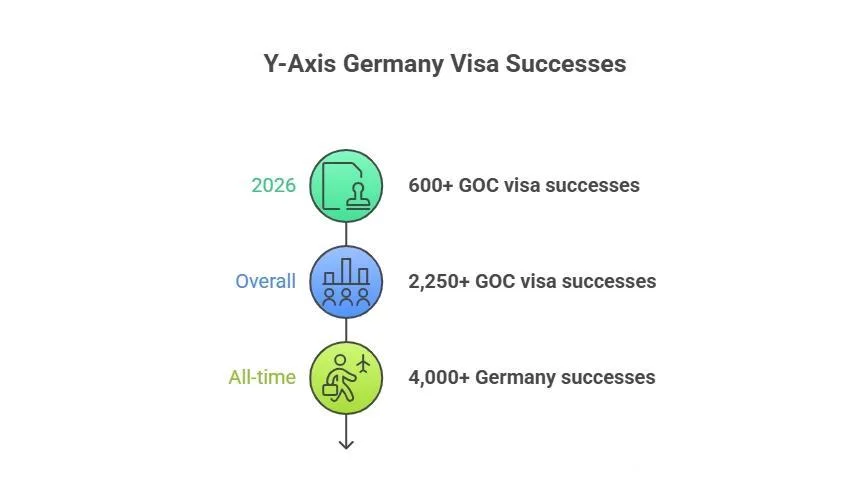
Y-Axis proudly celebrates 600+ GOC visa successes in 2026 alone, taking our total cumulative GOC visa successes to 2,250+ since the launch of the program. Adding to this milestone, we have also achieved 4,000+ all-time Germany visa successes across both the Germany Opportunity Card (GOC) and Job Seeker Visa (JSV) programs, helping thousands turn their dream of settling and working in Germany into reality.
Y-Axis, the world’s best immigration company, provides unbiased immigration services for every client based on their interests and requirements. The impeccable services of Y-Axis include:
- Expert guidance/counseling for Germany Immigration
- Germany Immigration Points Calculator
- Expert career counseling
How can Y-Axis assist you?
Y-Axis, the world’s best immigration company, provides unbiased immigration services for every client based on their interests and requirements. The impeccable services of Y-Axis include:
- Expert guidance/counseling for Germany Immigration
- German language coaching
- Free eligibility checks through the Germany Immigration Points Calculator
Y-Axis snapshot
1M
Successful applicants
1500+
Experienced counselors
25Y+
Expertise
50+
Offices
Looking For Inspiration
Explore what Global Indians have to say about Y-Axis in shaping their future