


Posted on May 28 2026
Which Canadian Province Gives PR Easily and Quickly?

By , Editor & Director
Updated May 31 2026
Saskatchewan, Manitoba, and Nova Scotia consistently offer the most accessible paths to Canadian permanent residence through Provincial Nominee Programs (PNPs). Canada's PR system allows each province to run its own immigration streams with some offering streamlined immigration routes.
The choice of province depends on your occupation, education, language score, and and job offer. Some provinces use their own points system while others rely on federal CRS score. This system is relevant as you can receive a provincial nomination even if your federal CRS score is moderate. A provincial nomination adds +600 CRS points to your Express Entry profile. At that level, an Invitation to Apply (ITA) is virtually guaranteed making it the most reliable ways to fast-track Canadian PR from India.
| Quick Fact | Detail |
|---|---|
| Active Provincial Programs | 11 provinces and territories operate Provincial Nominee Programs (PNPs), while Quebec and Nunavut manage immigration through separate systems. |
| CRS Boost from Nomination | A provincial nomination adds 600 CRS points, making an Invitation to Apply (ITA) for permanent residence highly likely. |
| Fastest Nomination Processing | Approximately 3–5 months in provinces such as Saskatchewan, Nova Scotia, and Prince Edward Island (PEI). |
| PR After Nomination (IRCC) | Federal permanent residence processing typically takes 6–12 months after receiving a provincial nomination. |
| Lowest-Barrier Provinces | Saskatchewan, Manitoba, Nova Scotia, Prince Edward Island (PEI), and New Brunswick are often considered more accessible for eligible applicants. |
| Job Offer Required? | No. Several Provincial Nominee Program streams allow applicants to apply without a Canadian job offer. |
| Indian Applicants | Indian nationals consistently rank among the largest groups receiving provincial nominations each year. |
| PR Cost (Federal Application) | CAD 1,365 for the principal applicant, plus CAD 230 for the Right of Permanent Residence Fee. |
*Want to apply for Canada work visa? Let Y-Axis guide you with the process.
How Does Canada’s Provincial Nominee Program Work?
Canada's Provincial Nominee Program (PNP) allows provinces and territories to select immigrants based on their own labour shortages and economic priorities. Each province publishes its own list of in-demand occupations and holds regular draws from its Expression of Interest (EOI) pool.
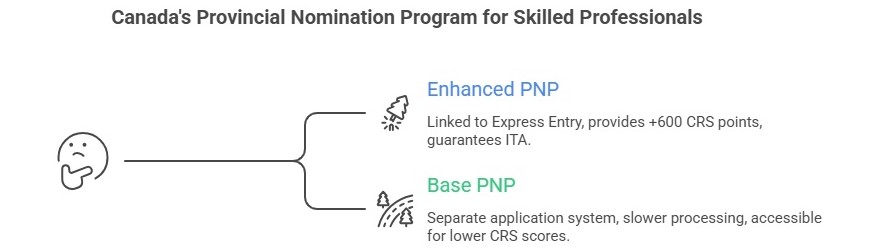
There are two main PNP tracks:
- Enhanced PNP — Linked to the federal Express Entry pool. The province sends a Notification of Interest to a candidate in the Express Entry pool. A nomination instantly adds +600 CRS points, guaranteeing an ITA at the next federal draw.
- Base PNP — The province runs its own application system, separate from Express Entry. Processing is slightly slower but often more accessible for candidates with lower CRS scores or specific skills.
Once you receive a provincial nomination, you apply to IRCC for federal PR. Approval rates for nominated candidates are very high which is typically above 95%.
*Interested to know more about Canada PNP? Let Y-Axis assist you with the process.
Watch To Know More: Canada PR Through Provincial Nomination
Canada continues to attract skilled professionals through pathways like Express Entry and employer-sponsored work opportunities, especially in sectors facing labour shortages. With benefits such as high quality of life, strong career growth, permanent residency options, and demand for global talent, Canada remains a popular destination for Indians looking to build an international career and long-term future abroad.
Watch Now: Why Work in Canada?
Discover why Canada is a top destination for skilled professionals, offering competitive salaries, excellent quality of life, career growth opportunities, and multiple PR pathways.
Which Canadian Province Is Easiest for PR? — Top Provinces Compared
The table below compares the seven most accessible provinces for Indian professionals based on processing speed, scoring method, and job offer requirements.
| Province | Program | Own Scoring System? | Job Offer Needed? | Nomination Time | Best For |
|---|---|---|---|---|---|
| Saskatchewan | SINP | Yes — 100-point grid | No (many streams) | 3–5 months | IT professionals, engineers, healthcare workers, and skilled trades |
| Manitoba | MPNP | Yes — LAF scoring system | No (Overseas Stream) | 4–6 months | Overseas applicants, healthcare professionals, and IT workers |
| Nova Scotia | NSNP | Linked to Express Entry | No (Labour Market Priorities Stream) | 3–5 months | Applicants with lower CRS scores, healthcare professionals, and tradespeople |
| Prince Edward Island (PEI) | PEI PNP | Yes — Expression of Interest (EOI) pool | Depends on the stream | 3–6 months | Rural immigration candidates, hospitality, and food service workers |
| New Brunswick | NBPNP | Yes — EOI scoring system | Yes (for most streams) | 4–6 months | Skilled workers and bilingual applicants |
| Alberta | AAIP | Yes — provincial points grid | No (Tech and Rural streams) | 4–6 months | Technology professionals and candidates interested in rural communities |
| British Columbia | BC PNP | Yes — Skills Immigration scoring system | No (certain Skills Immigration streams) | 4–8 months | Technology professionals, healthcare workers, and international graduates |
*Confused about which Canada PNP Program is the easiest? Sign up with Y-Axis for expert guidance.
Province-by-Province Breakdown: Fastest PR Routes
Saskatchewan — Most Accessible for Overseas Applicants
Saskatchewan runs one of the most Indian-friendly PNP streams in Canada. The Saskatchewan Immigrant Nominee Program (SINP) uses its own 100-point scoring grid and not the federal CRS system. Your score is calculated based on education, work experience, language, and adaptability factors.
The Occupation In-Demand stream in Saskatchewan does not require a job offer for many roles. Saskatchewan's in-demand list covers IT professionals, engineers, healthcare workers, accountants, and skilled tradespeople. The province actively invites candidates from overseas through regular Expression of Interest draws.
Saskatchewan is particularly well-suited for Indian professionals with strong educational backgrounds and work experience in shortage occupations. The province holds draws frequently and processes nominations within 3–5 months on average.
*Want to find out your chance for Saskatchewan PNP? Avail Y-Axis Saskatchewan Points Calculator to evalulate your score.
Manitoba — Strong Pathway for Skilled Workers Without Canadian Experience
Manitoba's Provincial Nominee Program (MPNP) uses a Labour Market Factor (LAF) points system. Overseas skilled workers can qualify through the Skilled Worker Overseas stream without needing Canadian work experience or a job offer in all cases.
A connection to Manitoba significantly boosts your points which includes having a close relative already living and working in the province, having studied in Manitoba, or having previously worked there. Even without a direct connection, candidates with strong occupational profiles in healthcare, IT, and manufacturing regularly receive invitations.
Manitoba has positioned itself as a welcoming province for internationally trained professionals. Recognition of Indian educational credentials is well-established in the healthcare and engineering sectors.
*Want to find out your chance for Manitoba PNP? Avail Y-Axis Manitoba Points Calculator to evalulate your score
Nova Scotia — Lowest CRS Draws in Canada's Express Entry-Linked PNPs
Nova Scotia's Labour Market Priorities (LMP) stream is notable for drawing candidates at CRS scores far below the federal Express Entry average. These targeted draws invite candidates by specific NOC occupation codes for healthcare professionals, IT workers, engineers, and trades as it do not always require a job offer.
Nova Scotia also runs the Demand: Express Entry stream for candidates in the federal pool. The province's small size means less competition for foreign nationals to secure a Canada permanent residence (PR). Candidates who receive a provincial nomination from Nova Scotia proceed to federal PR through the enhanced channel.
If your Express Entry CRS score is in the 350–420 range and your occupation is on Nova Scotia's priority list, you have a very high chance of being nominated.
Also,read...
Establish Your Business & Settle in Canada
Prince Edward Island — Regular Draws, Less Competition
PEI is Canada's smallest province. It runs an Expression of Interest system with regular draws under the Labour Impact and Express Entry categories. Fewer applications mean less competition and more predictable draw cycles.
PEI actively recruits workers in food processing, hospitality, agriculture, and healthcare. It also targets skilled workers who intend to live and work long-term in the province. A commitment to settle in PEI is taken seriously — candidates who express a genuine intention to stay are preferred.
*Want to find out your chance for PEI PNP? Avail Y-Axis Prince Edward Island Points Calculator to evalulate your score
New Brunswick — Active Recruitment With Bilingual Advantages
New Brunswick faces ongoing population challenges and actively recruits skilled immigrants to fill labour gaps. The province holds regular NBPNP draws for skilled workers and Express Entry candidates. Most streams require a job offer, but New Brunswick employers are actively hiring internationally.
Bilingual candidates are those with working proficiency in both English and French — have a strong advantage. New Brunswick's French-speaking communities offer additional integration pathways. IT, healthcare, manufacturing, and professional services are the most in-demand sectors.
Also, read...
Canada introduces a fast-track PR pathway for selected temporary workers. Apply now!
Alberta — Large Economy, Fast-Track Tech and Rural Pathways
Alberta is Canada's fourth-largest province by population and its most energy-rich. The Alberta Advantage Immigration Program (AAIP) runs multiple streams including the Accelerated Tech Pathway, which fast-tracks nominations for software engineers, data scientists, and IT professionals without requiring a job offer.
The Rural Renewal Stream opens PR pathways in smaller Alberta communities, where competition is lower and employer demand is high. Alberta's salaries are among the highest in Canada as the average annual earnings for IT and engineering professionals regularly exceed CAD 85,000.
Also,read...
British Columbia — Best for Tech Professionals and International Graduates
BC PNP is competitive but highly rewarding. The Skills Immigration stream covers a wide range of occupations in technology, healthcare, and the skilled trades. Tech workers in Vancouver's thriving ecosystem benefit from the BC Tech Pilot, which offers faster processing.
International graduates from BC institutions can apply through the International Graduate stream. BC employers are among the most internationally experienced in Canada, and many actively sponsor PNP applications for qualified overseas candidates.
*Want to find out your chance for BC PNP? Avail Y-Axis British Columbia Points Calculator to evalulate your score
Which Province Suits Your Profile?
Use this table to match your occupational background with the right provincial stream.
| Your Profile | Best Province Match | Recommended Stream |
|---|---|---|
| IT / Software Professional (No Canadian Experience) | Saskatchewan or Alberta | SINP Tech Talent Pathway / AAIP Accelerated Tech Pathway |
| Healthcare Professional (Nurse, Doctor, Technician) | Nova Scotia or Manitoba | Labour Market Priorities Stream (LMP) / MPNP Skilled Worker in Manitoba |
| Tradesperson (Electrician, Plumber, Welder) | Saskatchewan or New Brunswick | SINP Occupation In-Demand / NBPNP Skilled Worker Stream |
| International Graduate (Studied in Canada) | British Columbia or Ontario | BC PNP International Graduate / OINP Masters Graduate Stream |
| Rural or Smaller-City Preference | Prince Edward Island (PEI) or New Brunswick | PEI Labour Impact Category / NBPNP Strategic Recruitment Stream |
| High CRS Score (450+) Without Nomination | British Columbia or Ontario | Enhanced PNP Streams Linked to Express Entry |
| Business Owner or Self-Employed Professional | Manitoba or Prince Edward Island (PEI) | MPNP Business Investor Stream / PEI Business Impact Category |
| Engineer (Civil, Mechanical, Electrical) | Saskatchewan or Alberta | SINP Occupation In-Demand / AAIP Rural Renewal or Relevant Skilled Worker Streams |
Also,read...
How Much Can You Earn in Each Canada Province: Salary Comparison Table
Salary levels vary significantly across Canada’s provinces.
The table below highlights average annual salaries in key sectors, with approximate INR conversions.
| Province | Avg. Annual Salary (CAD) | Approx. INR Equivalent | High-Demand Sectors |
|---|---|---|---|
| Saskatchewan | CAD 60,000 – 80,000 | INR 37.5 – 50 lakhs | Healthcare, Engineering, IT, Skilled Trades, Agriculture |
| Manitoba | CAD 58,000 – 75,000 | INR 36 – 47 lakhs | Healthcare, Manufacturing, IT, Logistics |
| Nova Scotia | CAD 55,000 – 72,000 | INR 34 – 45 lakhs | Healthcare, IT, Skilled Trades, Education |
| Prince Edward Island (PEI) | CAD 50,000 – 65,000 | INR 31 – 41 lakhs | Agriculture, Hospitality, Healthcare, Food Services |
| New Brunswick | CAD 55,000 – 70,000 | INR 34 – 44 lakhs | IT, Manufacturing, Healthcare, Bilingual Services |
| Alberta | CAD 70,000 – 100,000 | INR 44 – 63 lakhs | Energy, Technology, Engineering, Finance |
| British Columbia | CAD 70,000 – 100,000 | INR 44 – 63 lakhs | Technology, Finance, Healthcare, Real Estate |
Note: 1 CAD ≈ INR 62.5 (indicative only). Rates fluctuate. Gross salaries before Canadian income tax.
Also,read...
What's New in Canada Express Entry System? New Categories, Rules & Updates for Applicants
How Long Does It Take to Get PR Through Each Province?
The total timeline to Canadian PR through a provincial nomination has two stages: provincial nomination and federal IRCC processing.
The table below highlights the average timeline for the nomination process:
| Province | Nomination Processing | IRCC PR After Nomination | Total Estimated Timeline |
|---|---|---|---|
| Saskatchewan (SINP) | 3–5 months | 6–12 months | 9–17 months |
| Manitoba (MPNP) | 4–6 months | 6–12 months | 10–18 months |
| Nova Scotia (NSNP) | 3–5 months | 6–12 months | 9–17 months |
| Prince Edward Island (PEI PNP) | 3–6 months | 6–12 months | 9–18 months |
| New Brunswick (NBPNP) | 4–6 months | 6–12 months | 10–18 months |
| Alberta (AAIP) | 4–6 months | 6–12 months | 10–18 months |
| British Columbia (BC PNP) | 4–8 months | 6–12 months | 10–20 months |
Also,read....
Canada Extends LMIA-Exempt Work Permit Pilot for High-Skilled Workers. Check Your Eligibility Now!
How to Apply for Canadian PR Through a Provincial Nominee Program
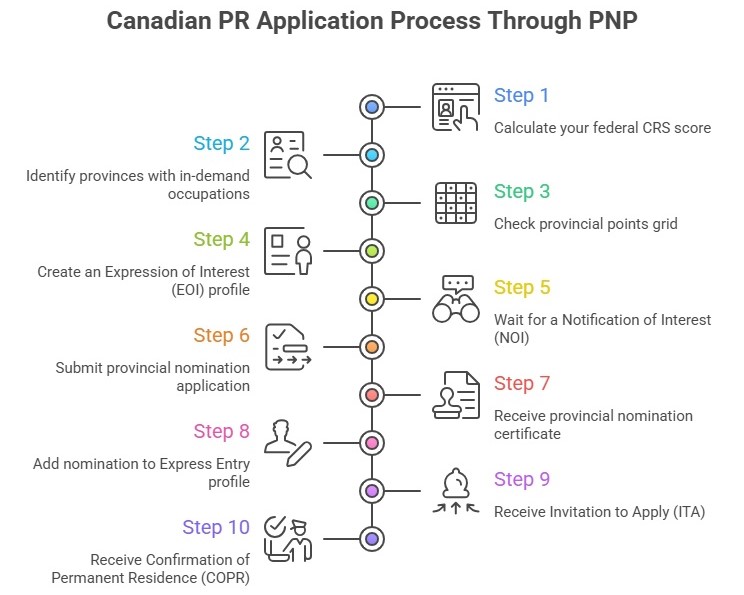
The steps to apply for Canadian PR through a provincial nomination program are as follows:
- Step 1: Calculate your federal CRS score using the IRCC Express Entry points calculator at ircc.canada.ca.
- Step 2: Identify provinces where your occupation appears on the in-demand or shortage occupations list.
- Step 3: Check each province's own points grid to see if you qualify for their EOI pool.
- Step 4: Create an Expression of Interest (EOI) profile with your chosen province — or multiple provinces.
- Step 5: Wait for a Notification of Interest (NOI) or an invitation to apply from the province.
- Step 6: Submit a complete provincial nomination application with all required documents within the deadline given.
- Step 7: Receive your provincial nomination certificate after assessment (3–6 months typically).
- Step 8: Add the nomination to your federal Express Entry profile (enhanced PNP stream) to receive +600 CRS points.
- Step 9: Receive your Invitation to Apply (ITA) at the next federal draw and submit your complete PR application to IRCC within 60 days.
- Step 10: Receive your Confirmation of Permanent Residence (COPR), complete your medical exam if required, and land in Canada as a permanent resident.
Also,read...
Breaking News! Canada Express Entry Updates CRS Points for Job Offer – Check Your Eligibility Now!
What Documents Do You Need for a Provincial Nomination Application?
| Document | Details / Notes |
|---|---|
| Valid Passport | Minimum 2 years of validity recommended beyond the expected Permanent Residence (PR) approval date. |
| Educational Credential Assessment (ECA) Report | Must be obtained from an IRCC-designated organization such as WES, IQAS, CES, or ICES. Processing typically takes 4–8 weeks. |
| Language Test Results | IELTS General Training or CELPIP results are required. Most Provincial Nominee Program (PNP) streams require a minimum CLB 7 score. |
| Work Experience Proof | Employment reference letters, salary slips, tax documents, and supporting evidence for each employer listed in the application. |
| Job Offer Letter | Required for specific PNP streams. The offer must come from a genuine and registered Canadian employer. |
| Proof of Settlement Funds | Recent bank statements and financial documents demonstrating sufficient funds to support settlement in Canada. |
| Police Clearance Certificates (PCC) | Required from India and any country where the applicant has lived for six months or longer since the age of 18. |
| Medical Examination Report | Must be completed through an IRCC-approved panel physician. Medical results are generally valid for 12 months. |
| Provincial Nomination Certificate | Issued by the province after successful nomination and required for the federal PR application. |
| Photographs | Must meet current IRCC photo specifications and be taken within the last six months. |
Note: Document requirements may vary by province and stream. Always verify with the official provincial immigration portal before submission.
Also,read...
IRCC speeds up Canada Work Visas and Tourist Visas for Indians. Check your eligibility for Canada!
Tips to Improve Your PNP Application and Approval Chances
- Get your ECA (Educational Credential Assessment) done early which takes 4–8 weeks and is required for most streams.
- Score CLB 9 or above in IELTS (band 7.0) as higher language scores directly increase your CRS and provincial points.
- Register an EOI in multiple provincial pools simultaneously which is allowed and increases your chances of an invitation.
- A connection to a province such as family, education, prior work experience adds significant points in most PNP systems.
- Target smaller provinces such as PEI, New Brunswick, and Nova Scotia where draw thresholds are lower and competition is less intense.
- Apply for a job offer (full-time, part-time or contract role) in your target province to boost your score.
- Keep your Express Entry profile updated with new IELTS scores, job changes, or promotion updates to lift your CRS points.
- Respond to all provincial correspondence immediately without missing a deadline.
*Are you looking for step-by-step assistance with Canada immigration? Contact Y-Axis, the world's No. 1 overseas immigration consultancy!
FAQs
What is the Provincial Nominee Program (PNP) in Canada?
The Provincial Nominee Program (PNP) allows Canadian provinces and territories to nominate immigrants based on their own labour market needs. Each province runs its own streams and draws from its Expression of Interest pool. A successful nomination adds +600 CRS points to your federal Express Entry profile — making an Invitation to Apply virtually certain. PNP is one of the most reliable routes to Canadian permanent residence for skilled workers from India. It is separate from — but works alongside — the federal Express Entry system. Y-Axis can assess your PNP eligibility for free.
Which Canadian province gives PR most easily to Indian professionals?
Saskatchewan, Manitoba, and Nova Scotia are consistently the most accessible provinces for Indian professionals seeking PR. Saskatchewan's SINP uses its own 100-point grid and includes many streams without a job offer requirement. Manitoba's MPNP targets overseas skilled workers through the Labour Market Factor system. Nova Scotia's Labour Market Priorities stream has historically drawn candidates at lower CRS scores than the federal average. Prince Edward Island and New Brunswick also offer accessible entry points with regular draws. The right province for you depends on your occupation, education, and language scores. Y-Axis can match you to the best option.
Can I apply for a Canadian PNP without a job offer?
Yes. Several Canadian PNP streams do not require a Canadian job offer. Saskatchewan's SINP Occupation In-Demand stream allows candidates in listed occupations to apply without employer sponsorship. Manitoba's MPNP Skilled Worker Overseas stream also does not require a job offer in all cases. Alberta's AAIP Accelerated Tech Pathway is open to tech professionals without an offer. Nova Scotia's Labour Market Priorities stream similarly does not always require prior employment in Canada. However, having a job offer — where applicable — significantly boosts your provincial points score. Y-Axis can guide you to the right job-offer-free stream.
What is the CRS score and how does it affect my PNP application?
The Comprehensive Ranking System (CRS) is the federal points grid used in Canada's Express Entry system to rank skilled worker profiles. It scores you on age, education, language ability, work experience, and adaptability. A provincial nomination adds +600 CRS points, which effectively guarantees an Invitation to Apply (ITA) at the next federal draw regardless of your base score. Most provinces also run their own separate scoring systems — meaning a lower federal CRS does not automatically disqualify you at the provincial level. Understanding both scoring systems is key to choosing your fastest route. Y-Axis can calculate your score for free.
How much does it cost to apply for Canadian PR through a province?
Costs vary by province and stream. Provincial nomination fees typically range from CAD 250 to CAD 500 depending on the province. The federal PR application fee through IRCC is CAD 1,365 for the principal applicant, plus CAD 230 as the Right of Permanent Residence fee. Spouse and dependent fees apply separately. Educational credential assessment (ECA) from WES or similar costs approximately CAD 230. Language testing (IELTS) costs approximately INR 16,000–17,000 in India. Total costs for a family of two typically range from CAD 4,000 to CAD 7,000 including all fees. Y-Axis provides a complete cost breakdown.
How long does it take to get PR through a Canadian provincial program?
The total timeline has two stages. First, the provincial nomination stage takes approximately 3 to 6 months depending on the province. Saskatchewan and Nova Scotia are among the fastest at 3 to 5 months. Second, IRCC processes the federal PR application after nomination in approximately 6 to 12 months for Express Entry-linked streams. The total estimated timeline from EOI registration to PR card issuance is typically 9 to 18 months. Incomplete applications, missing documents, or additional verification requests can extend timelines. Starting your ECA and language testing early reduces delays significantly. Y-Axis helps you prepare a complete application from day one.
Is the Saskatchewan SINP a good option for Indian professionals?
Yes. The Saskatchewan Immigrant Nominee Program (SINP) is one of the most popular and accessible PNPs for Indian professionals. It uses a 100-point scoring grid based on education, work experience, language, and adaptability — completely separate from the federal CRS. Many SINP streams, including the Occupation In-Demand stream, do not require a Canadian job offer. Saskatchewan has a persistent shortage of IT professionals, engineers, healthcare workers, accountants, and tradespeople — all common profiles among Indian applicants. Processing time is approximately 3 to 5 months for nomination. Y-Axis has helped hundreds of Indian professionals through the SINP process.
Can I apply for Manitoba MPNP from outside Canada?
Yes. Manitoba's Skilled Worker Overseas stream is specifically designed for applicants living outside Canada. You do not need to be present in Canada to register an Expression of Interest or receive a nomination. Manitoba uses its own Labour Market Factor (LAF) scoring system. Key factors include your occupation, education, language skills, and any connection to Manitoba — such as a close relative, prior study, or a job offer from a Manitoba employer. Overseas applicants with a strong occupational profile in healthcare, IT, manufacturing, or skilled trades are regularly invited. Y-Axis specialises in Manitoba MPNP applications for Indian professionals.
What is the difference between Enhanced PNP and Base PNP?
The Enhanced PNP is linked to Canada's federal Express Entry pool. A province selects a candidate from the Express Entry pool and sends a Notification of Interest. If the candidate accepts, the nomination adds +600 CRS points, guaranteeing an Invitation to Apply at the next federal draw. The Base PNP operates outside the Express Entry system. The province manages its own application portal and EOI pool. Processing under Base PNP is slightly slower — the nominee applies directly to IRCC for PR rather than through Express Entry. Both pathways lead to permanent residence. Y-Axis can advise which track suits your profile.
Does a provincial nomination guarantee Canadian permanent residence?
A provincial nomination does not legally guarantee PR, but it makes approval highly likely. The federal government — through IRCC — makes the final decision on every PR application. However, the approval rate for nominated candidates is consistently above 95%. Receiving a nomination adds +600 CRS points, which ensures an ITA from Express Entry. Once you submit a complete, accurate federal PR application with all required documents, the chances of refusal are very low barring criminal inadmissibility, misrepresentation, or serious medical issues. Starting with a well-prepared application minimises risk significantly. Y-Axis reviews every file for completeness before submission.
What documents do I need for a Canadian PNP application?
Core documents for most PNP applications include a valid passport, an ECA (Educational Credential Assessment) report from WES or IQAS, language test results (IELTS General or CELPIP), employment reference letters on company letterhead, pay stubs and tax records, proof of settlement funds, and police clearance certificates from India and all countries of residence. A job offer letter is required for some streams. Medical examination by an IRCC-designated physician is required at the federal PR stage. Requirements vary by province and stream. Always verify current requirements on the official provincial immigration portal. Y-Axis provides a tailored document checklist.
Which Canadian provinces are best for healthcare professionals from India?
Nova Scotia, Manitoba, and Saskatchewan are the top three provinces for Indian healthcare professionals seeking PR. Nova Scotia's Labour Market Priorities stream regularly invites nurses, healthcare aides, and allied health professionals with targeted draws at lower CRS thresholds. Manitoba's MPNP covers nursing, pharmacy, physiotherapy, and other healthcare occupations in its Skilled Worker in Manitoba stream. Saskatchewan's SINP lists numerous healthcare occupations as in-demand, often without a job offer requirement. British Columbia also has strong demand for nurses and doctors, particularly through the BC PNP Health Authority stream. Y-Axis has dedicated healthcare immigration consultants.
Can my spouse and children get PR with me through a PNP?
Yes. When you apply for Canadian PR, your spouse or common-law partner and dependent children under 22 can be included in your application as accompanying family members. They receive PR status at the same time as you. Your spouse will have full right to work anywhere in Canada once PR is granted. Children can attend Canadian public schools tuition-free as permanent residents. There is an additional IRCC application fee per family member. Some provinces also allow spouses to apply for open work permits during the federal PR processing stage. Y-Axis handles complete family PR applications.
What is the minimum IELTS score required for a Canadian PNP?
Most Canadian PNP streams require a minimum language score equivalent to Canadian Language Benchmark (CLB) 7, which corresponds to an IELTS General Training band score of 6.0 in each module (listening, reading, writing, speaking). However, higher scores improve your CRS points and provincial scoring significantly. A CLB 9 (IELTS 7.0) adds considerably more CRS points than CLB 7. Some provincial streams may accept CLB 5 or 6 for certain trade or low-skilled occupations. CELPIP is accepted as an alternative to IELTS. Y-Axis can help you understand exactly which score you need for your target province and stream.
Can I register with multiple Canadian provinces at the same time?
Yes. Registering an Expression of Interest (EOI) with multiple provincial programs simultaneously is allowed and strongly recommended. Each province has its own EOI pool and draw schedule. Registering with Saskatchewan, Manitoba, and Nova Scotia at the same time maximises your chances of receiving an invitation from whichever province holds a draw first. There is generally no fee for registering an EOI — fees are charged only after you submit a full nomination application. Some provinces require you to declare which province you are applying to, but there is no rule against maintaining profiles in multiple pools. Y-Axis monitors all pools on your behalf.
What happens after I receive a provincial nomination certificate?
Once you receive your provincial nomination certificate, you have two steps remaining. For Enhanced PNP streams — linked to Express Entry — you update your federal Express Entry profile to reflect the nomination. Your CRS score instantly jumps by +600 points and you receive an Invitation to Apply (ITA) at the next federal draw. You then have 60 days to submit a complete PR application to IRCC. For Base PNP streams, you apply directly to IRCC using a paper-based or online process. After IRCC approves your application, you receive your Confirmation of Permanent Residence (COPR) and your PR card arrives by mail. Y-Axis guides every step.
Are there any Canadian PNP streams specifically for international students?
Yes. Several provinces have dedicated PNP streams for international students who graduated from Canadian institutions. British Columbia's BC PNP International Graduate stream targets graduates from BC colleges and universities. Ontario's OINP Masters Graduate and PhD Graduate streams invite recent international graduates. Nova Scotia, New Brunswick, PEI, and Manitoba all have graduate-specific pathways. Saskatchewan's SINP International Graduate stream supports those who studied in Saskatchewan. These streams typically have lower points requirements, recognising Canadian education as a strong integration factor. Graduates with Canadian degrees, diplomas, and post-graduation work permits are well-positioned. Y-Axis assists international graduates returning home.
What is the Alberta Advantage Immigration Program (AAIP)?
The Alberta Advantage Immigration Program (AAIP) is Alberta's provincial nominee program. It has several streams targeting different applicant types. The Accelerated Tech Pathway is designed for software engineers, data scientists, and tech professionals — it does not require a job offer and processes nominations quickly. The Rural Renewal Stream helps smaller Alberta communities recruit immigrants directly. The Alberta Opportunity Stream targets workers already employed in Alberta. The Self-Employed Farmer Stream covers agricultural entrepreneurs. Alberta offers among the highest average salaries in Canada for tech and engineering professionals, with annual earnings often exceeding CAD 85,000. Y-Axis specialises in AAIP applications for Indian professionals.
Can I get Canadian PR without a university degree through a provincial program?
Yes. Several PNP streams do not require a university degree. Trade workers — electricians, welders, plumbers, carpenters, and construction professionals — can qualify through occupation-specific streams in Saskatchewan, New Brunswick, and Manitoba. The key requirements for trade streams are relevant certification, work experience in the trade, and a qualifying language score. A diploma or trade certification is typically sufficient. Some provinces also have streams for food processing workers, truck drivers, and childcare workers. The federal CRS still awards points for higher education, but provincial scoring systems often value work experience equally. Y-Axis can identify the right stream for non-degree applicants.
How can Y-Axis help me get Canadian PR through a provincial program?
Y-Axis Overseas Careers is India's most trusted immigration consultancy with over 25 years of experience and more than 10 lakh clients guided through the process. Our Canada PR specialists assess your CRS score, identify the best matching province, register your EOI, prepare your full documentation, and file both your provincial nomination and federal PR application. We also help with ECA referrals, IELTS preparation, Express Entry profile management, and family visa filing. Our end-to-end support means no missed deadlines, no incomplete files, and no avoidable rejections. Contact us today. Phone: +91-7670800000 | Email: info@y-axis.com | Website: https://www.y-axis.com | Free assessment: https://www.y-axis.com/free-assessment/
📞 Call: +91-7670800000
📩 Email: info@y-axis.com
🌐 Visit: https://www.y-axis.com
Tags:
province in Canada best for PR without job offer
Canada PR through provincial nomination
Saskatchewan SINP occupation in demand
Manitoba MPNP
overseas skilled worker in Canada
Nova Scotia labour market
Canada permanent residence
Share
Options for you by Y-Axis

Get it on your mobile

Get News alerts

Contact Y-Axis
Latest Article
Popular Post
Trending Article
Posted On October 09 2026
Canada’s Immigration Reset: Why the Next Move May Be About Fit, Not Volume