

Posted on April 10 2026
What's New in Canada Express Entry System? New Categories, Rules & Updates for Applicants

By , Editor & Director
Updated September 04 2026
The Express Entry System in Canada has undergone major changes, introducing new categories, selection rules, and targeted draws this year. Canada's Immigration Minister, Lena Metlege Diab, announced five new targeted categories in February 2026. Several other priority streams in Canadian provinces and territories (PTs) were also renewed as a part of the updated policies. The revised Express Entry framework included occupations like physicians, researchers, senior managers, transport professionals, and skilled military recruits. With category-based invitations, updated CRS considerations, and occupation-specific draws, candidates can now access more tailored pathways to receive an Invitation to Apply (ITA) for Canada permanent residence(PR).
*Want to check your eligibility for Canada? Try the FREE Y-Axis Canada CRS points calculator to get an instant score!
What is New in the Canada Express Entry System 2026?
The new updates to the Canada Express Entry System prioritize candidates with Canadian work experience, language proficiency, and in-demand skills. The federal government in Canada has revised its Express Entry system to make it more strategic and responsive, offering applicants improved opportunities for Canadian permanent residence (PR) based on current workforce demands.
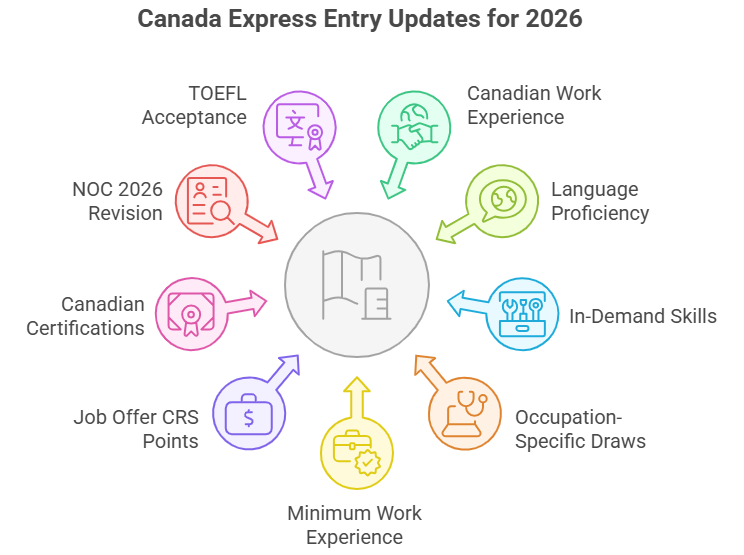
The table below highlights revised rules for Canada Express Entry Draw for 2026:
| New Express Entry Category / Update | What's New | CRS Score / Rule Changes for Selection | Eligibility Requirements | In-Demand Occupations |
|---|---|---|---|---|
| Physicians with Canadian Work Experience (Added Dec 8, 2025; First draw Feb 19, 2026) | First-ever occupation-specific physician draw | CRS 169 (Lowest in Express Entry history); 391 ITAs issued; average pool CRS ~500 | Foreign-trained doctors with 12 months Canadian clinical experience within last 3 years under NOC 31100, 31101, 31102 | General Practitioners & Family Physicians (31102), Specialists in Surgery (31101), Specialists in Clinical & Laboratory Medicine (31100) |
| Researchers with Canadian Work Experience (New 2026; Feb 18, 2026) | Introduced under Canada's International Talent Attraction Strategy | General CEC draws CRS 507–511; category-based selection becomes key pathway | 12 months Canadian research/academic experience in last 3 years | University Professors (41200), Teaching & Research Assistants (41209), Research Professionals |
| Senior Managers with Canadian Work Experience (First draw March 5, 2026) | First dedicated draw for executives | CRS 429, 250 ITAs issued | 12 months Canadian senior leadership experience (NOC 00012-00015; TEER 0 only) | Senior Managers – Financial, Health, Trade, Construction sectors |
| Transport Occupations (New 2026 Version) | Completely redesigned transport category | Minimum experience increased 6 → 12 months (Feb 18, 2026) | 12 months experience in Canada or abroad within last 3 years | Commercial Pilots (27200), Aircraft Mechanics (72404), Air Traffic Controllers (72601), Railway Engineers |
| Skilled Military Recruits (New 2026) | Linked to Canada's Defence Industrial Strategy | Requires Canadian Armed Forces job offer | 10 years military service, 3-year job offer, 2-year post-secondary education | Military Physicians, Nurses, Pilots, Engineers, Technicians |
| French Language Proficiency (Renewed 2026) | Highest-volume category | Francophone target 9% in 2026 → 10.5% by 2028 | NCLC Level 7 French proficiency; no occupation restriction | All Express Entry occupations eligible |
| Healthcare and Social Services (Renewed 2026) | Expanded occupations | Minimum 12 months experience | 12 months Canadian or international experience within last 3 years | Registered Nurses (31301), Social Workers (41300), Medical Technologists (32120), PSWs |
| Trades Occupations (Renewed 2026) | Focus on construction & industrial trades | Cooks and Chefs removed | 12 months experience in last 3 years | Electricians (72200), Welders (72106), Plumbers (72300), Carpenters (72310) |
| STEM Occupations (Renewed 2026) | No draws yet since April 2024 | Must rely on PNP or CRS improvement | 12 months experience Canada or abroad | Software Engineers (21231), Data Scientists (21211), Engineers |
| Education Occupations (Added Feb 27, 2025; Renewed 2026) | Dedicated pathway for teachers | Standard category-based selection | 12 months experience within last 3 years | Teachers (41220), Early Childhood Educators (42202), Teacher Assistants |
| Agriculture & Agri-Food (Retired 2026) | Category removed | No Express Entry draws | Must apply through PNP pathways | Farm supervisors, agriculture workers (No longer eligible) |
| Minimum Work Experience Rule | Updated across categories | Increased 6 → 12 months (Feb 18, 2026) | Applies to most new categories | Applies to all category-based draws |
| Job Offer CRS Points Removed | Major CRS rule change | 50-200 CRS points removed (March 25, 2025) | Job offers still valid for eligibility | All applicants impacted |
| Job Offer CRS Points Return (Planned) | Future CRS update | Possible return late 2026 (not confirmed) | High-wage and regulated occupations likely | Healthcare, engineering, regulated professions |
| CRS Points for Canadian Certifications (Planned) | New CRS boost planned | Additional CRS points proposed | Must hold Canadian licence/certification | Healthcare, engineering, trades |
| General CEC CRS Scores | High cut-offs for non-priority candidates | CRS 507–511 | Standard Express Entry eligibility | Non-category applicants |
| Category-Based CRS Range | Lower cut-offs for priority categories | CRS 169–467 | Category eligibility required | Priority category candidates |
| Tie-Breaking Rule | Profile timestamp used | Earlier profile gets ITA | Applies when CRS scores match | All Express Entry applicants |
| NOC 2026 Revision | Major classification update | 165 occupations impacted | Release expected Dec 2026 | All Express Entry occupations |
| TOEFL Accepted (Pending) | New language test planned | Not yet implemented | IELTS, CELPIP, PTE currently accepted | All applicants |
Also, read...
Benefits of Express Entry Updates for Indians
The Canadian federal government has introduced multiple changes to its Express Entry System, which have significantly benefited qualified Indian professionals across fields such as STEM, healthcare, and engineering. The new system gives greater weight to the skills of foreign nationals by lowering CRS cut-off scores, introducing new category-based draws, and providing expedited pathways for skilled workers.
The benefits of Express Entry updates for Indian professionals in 2026 are as follows:
- Category-based targeted draws prioritize in-demand sectors such as healthcare, STEM, trades, and transportation.
- Lower Comprehensive Ranking System (CRS) cut-off score for Indian applicants with specialized skills.
- Introduction of new occupational categories, including researchers, senior managers, aviation professionals (pilots and mechanics), and foreign-trained medical doctors with Canadian work experience.
- Provinces have increased autonomy to nominate candidates based on regional labor needs with an additional 600 CRS points, creating a higher probability of selection for Canada PR.
- Healthcare professionals, such as physicians, can secure a work permit in less than 14 days.
- Reintroduction of CRS bonus points for Express Entry candidates with valid, high-wage job offers.
- Indian students and temporary workers living in Canada can access the Canadian Experience Class (CEC), which remains a priority draw.
- Indian professionals with French language skills continue to have a greater advantage in targeted draws for PR.
Also, read...
Breaking News! Canada Express Entry Updates CRS Points for Job Offer – Check Your Eligibility Now!
Steps to Apply for Canada Express Entry
To apply for Canada Express Entry, check your eligibility for the program under the respective occupational streams, clear the language proficiency test, and the Educational Credential Assessment (ECA).
The steps to apply for Canada Express Entry are as follows:
Step 1: Check your eligibility for the federal programs (FSWP, FSTP, CEC) and other occupation-based draws.
Step 2: Select a suitable stream under the Express Entry System based on your qualification, occupation, experience, etc.
Step 3: Complete the required language proficiency test (IELTS or CELPIP for English).
Step 4: Verify your education obtained outside Canada through the Educational Credential Assessment (ECA).
Step 5: Gather all necessary documents, such as proof of language proficiency, an Educational Credential Assessment (ECA), a valid passport, etc.
Step 6: Create and submit your Express Entry profile on the Immigration, Refugees and Citizenship Canada (IRCC) website.
Step 7: Await your ranking in the Comprehensive Ranking System (CRS), which is based on age, education, language, and work experience.
Step 8: Upon selection, you will receive your Invitation to Apply (ITA) for Canada PR.
Step 9: After receiving the ITA, submit your complete application, including a police clearance certificate (PCC), medical exams, and proof of funds, within the next 60 days.
Step 10: Await approval for your permanent residence status in Canada.
*Want to apply for Express Entry? Let Y-Axis guide you with the process.
How to Improve Your CRS Score?
Improving the Comprehensive Ranking Score (CRS) is essential to increase your chances of receiving an Invitation to Apply (ITA) for Canadian permanent residency through Express Entry. Applicants must pass the language proficiency test with the required score (CLB 9) and secure provincial nomination to receive an additional 600 bonus points to improve the overall CRS ranking.
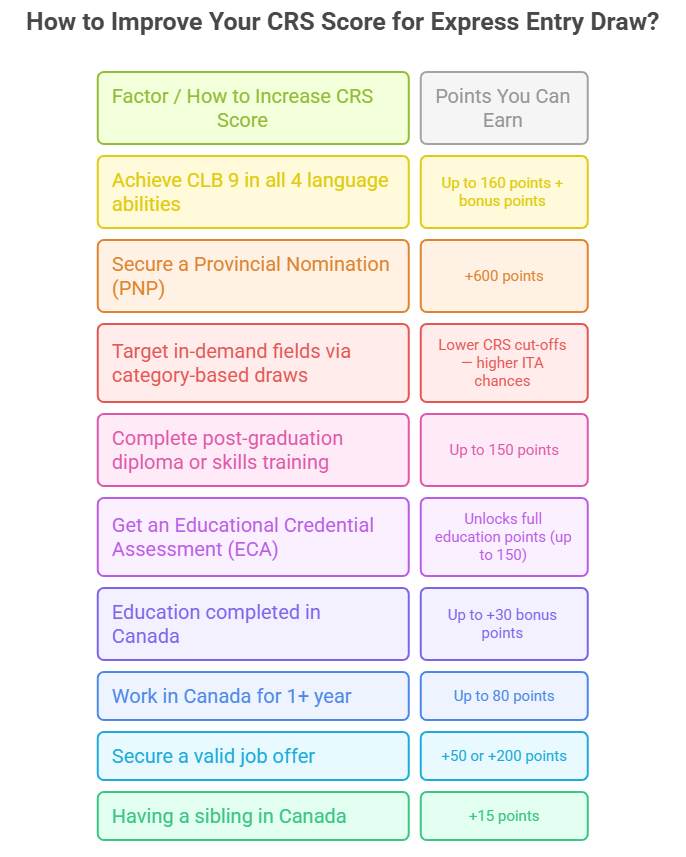
Here is how you can improve your CRS score for Canada Express Entry draws:
- Achieve Canadian Language Benchmark (CLB) 9 in all four abilities (Listening, Reading, Writing, Speaking) of the language proficiency test.
- Secure a Canadian provincial nomination for an additional 600 points.
- Target In-Demand Fields like tech, healthcare, or skilled trades across provinces such as Ontario (OINP), British Columbia (BCPNP), Alberta (Alberta PNP), etc.
- Maximize your educational credentials by completing a post-graduation diploma and skills training in addition to a bachelor's degree.
- Ensure all your foreign educational qualifications are assessed by an Educational Credential Assessment (ECA) agency.
- Education gained in Canada can add up to 30 extra points.
- Optimize your work experience by working in Canada for one year to be eligible for the Canadian Experience Class (CEC).
- Secure a valid job offer for an extra 50 or 200 points.
- Having a sibling in Canada with citizenship or PR adds 15 points to your CRS rank.
*Are you looking for step-by-step assistance with Canada immigration? Contact Y-Axis, the world's No. 1 overseas immigration consultancy.
For recent Canadian immigration updates, check out the Y-Axis Canada Immigration News Page.
FAQs
When will the new Canada Express Entry changes take effect for applicants?
Canada has introduced major changes to its Express Entry System this year, set to take effect in phases. The new occupational categories were introduced on February 18, 2026. CRS points for job offers were restored on March 13, 2026, after being removed on March 25, 2025, and most new category-based draws are active for the current year.
What are the new categories in the Canada Express Entry system?
IRCC introduced five new occupational categories in 2026 to target specialized candidates across fields such as medical doctors, researchers, senior managers, transport occupations, and skilled military recruits.
The category-based Express Entry draws were introduced for the following occupations:
- Medical Doctors: Targeting doctors with Canadian work experience.
- Researchers: Targeting research roles with Canadian work experience.
- Senior Managers: Targeting senior managers with Canadian work experience.
- Transport Occupations: Focusing on in-demand transport jobs.
- Skilled Military Recruits: For foreign military applicants with a job offer from the Canadian Armed Forces.
What are the recent updates to the Canada Express Entry program?
The recent Express Entry updates in the ongoing year are as follows:
- Introduction of five new occupational categories.
- Minimum work experience increased from 6 months to 12 months.
- Reintroduction of CRS points for a job offer in Canada.
- Removal of the agriculture and agro-food-based category.
- Major overhaul of the NOC system impacting more than 165 job categories.
What documents have changed under the new Express Entry rules?
Under the new Express Entry rules for 2026, the following are the documentation changes announced:
- Proof of work experience for up to 12 months instead of the earlier 6 months.
- Targeted category documents for doctors, researchers, senior managers, and skilled military recruits to prove Canadian work experience.
- The Test of English as a Foreign Language (TOEFL) is accepted for certain Express Entry programs.
- Documents for job descriptions, titles, and main duties in reference letters must align with the new NOC 2026 revisions.
Which occupations benefit most from the new Express Entry category-based draws?
The occupations that benefited the most from the new Express Entry category-based draws are as follows:
- Healthcare and Social Services (37+ NOCs): Doctors, nurses, paramedics, physiotherapists, social workers, and dental assistants.
- STEM Occupations (11+ NOCs): Software engineers/developers, data scientists, cybersecurity experts, AI specialists, and mathematicians.
- Trade Occupations (25+ NOCs): Electricians, plumbers, carpenters, welders, and heavy-duty mechanics.
- Transport Occupations: Truck drivers, aircraft mechanics, and marine transport workers.
- French-language proficiency: Candidates with strong French skills (CLB 7+) are prioritized regardless of occupation.
- Education Occupations: Teachers, assistants, and early childhood educators.
- New 2026 Categories: Senior managers (financial/business), university professors/researchers, and Canadian Armed Forces recruits.
Are there any new provincial nomination programs linked to Express Entry?
As of early 2026, the Canadian federal government continues to update its Provincial Nomination Program (PNP) framework to speed up PR processing. The provinces and territories have been granted full authority to assess candidates for PR selection based on intent to stay and economic establishment.
Have language score requirements changed under the new Express Entry system?
Yes, the language requirements and scoring system have been revised under the updated Express Entry System. While the minimum language proficiency criteria remain CLB 7, the system favors applicants with CLB 9+ to maximize Comprehensive Ranking System (CRS) points. Additionally, TOEFL has been accepted to assess applicants' language proficiency.
How do the recent Express Entry changes affect CRS score calculations?
The recent Express Entry updates have reduced the CRS score required for candidate selection for Canada permanent residence (PR). Additionally, points for a job offer have been restored this year after they were removed earlier.
Are CRS points for job offers restored under the updated Express Entry System?
Yes, Canada has officially announced its plan to restore CRS points for a job offer in March 2026. The bonus points (50 or 200) for jobs backed by a Labor Market Impact Assessment (LMIA) are being reintroduced to prioritize high-wage occupations and foreign professionals with Canadian work experience, which was earlier removed in 2025.
What are the latest updates on Express Entry eligibility for the Canadian Experience Class?
Canada has updated Express Entry for the Canadian Experience Class (CEC), now requiring at least 12 months of skilled Canadian work experience (TEER 0, 1, 2, or 3) instead of 6 months within the last 3 years. For a part-time role, the hours must total at least 1,560 to meet the 12-month requirement. Additionally, work experience must be gained on a temporary work permit status and excludes time spent as a full-time student.
Tags:
Canada immigration
migrate to Canada
Canada permanent residence
Canada PR
work in Canada
Canadian Experience Class
Provincial Nomination Program
skilled workers in Canada
Express Entry points for job offer
jobs in Canada
CRS points for Express
Share
Options for you by Y-Axis

Get it on your mobile

Get News alerts

Contact Y-Axis
Latest Article
Popular Post
Trending Article
Posted On October 09 2026
Canada’s Immigration Reset: Why the Next Move May Be About Fit, Not Volume