

Posted on January 06 2026
What are the key differences between Subclass 189 and Subclass 190 Visas?

By , Editor
Updated January 08 2026
Australia is one of the top countries for skilled professionals who want better career opportunities and a chance to get permanent residency (PR). Under Australia’s General Skilled Migration (GSM) program, two of the most popular visa options are the Subclass 189 Skilled Independent visa and the Subclass 190 Skilled Nominated visa.
With recent and ongoing migration changes for 2025–26, such as giving priority to in-demand occupations and changes in state nomination rules, it has become very important to clearly understand how Subclass 189 and Subclass 190 visas are different. Knowing these differences can help you choose the right visa based on your skills, points score, and location preference.
Subclass 189 and Subclass 190
Subclass 189 Skilled Independent Visa
It is a permanent residency visa that does not require sponsorship from an Australian state, territory, or family member. Applicants must score at least 65 points, but higher points improve the chances of receiving an invitation. Once granted, this visa allows you to live, work, and study anywhere in Australia, access Medicare, and later apply for Australian citizenship once eligible. Invitations for Subclass 189 are issued through regular skill-based invitation rounds, with a strong focus on high-demand occupations.
Subclass 190 Skilled Nominated Visa
It is also a permanent residency visa, but it requires nomination from an Australian state or territory government. Applicants receive 5 additional points for state nomination, which helps improve selection chances. After the visa is granted, holders are generally expected to live and work in the nominating state or territory for a certain period. This visa also provides full PR benefits, including Medicare access and a pathway to citizenship.
Want to apply for Subclass 189 or Subclass 190? Contact Y-Axis for complete guidance.
Key Differences Between the Skilled Independent Visa and the Skilled Nominated Visa
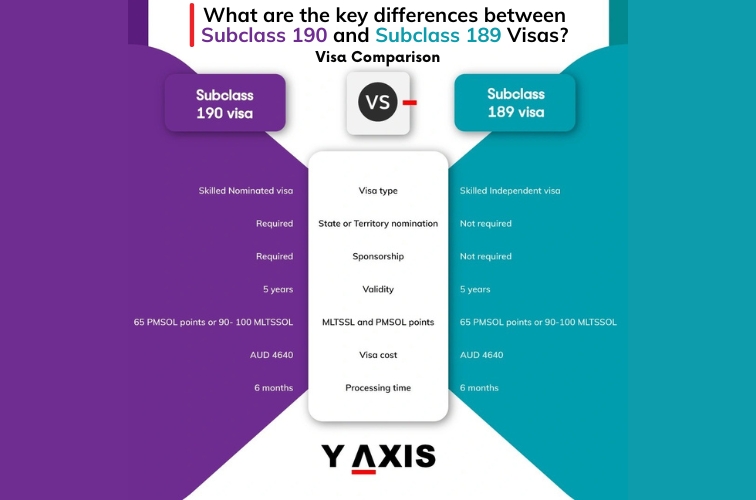
The Subclass 189 and Subclass 190 visas are both part of Australia’s skilled migration program, but they differ in sponsorship requirements, flexibility, and selection process. While Subclass 189 offers independent permanent residency, Subclass 190 is designed for skilled workers who are willing to settle in a specific Australian state or territory.
|
Feature |
Subclass 189 – Skilled Independent |
Subclass 190 – Skilled Nominated |
|
Visa Type |
Permanent Residency from day one |
Permanent Residency from day one |
|
Sponsorship |
Not required |
State or territory nomination required |
|
Place of Living |
Can live and work anywhere in Australia |
Expected to live and work in the nominating state |
|
Points Bonus |
Based only on your points score |
5 extra points for state nomination |
|
Pathway to PR |
Direct PR (granted immediately) |
Direct PR (granted immediately) |
|
Invitation Frequency (2026) |
Regular national invitation rounds |
Depends on state nomination allocations |
|
Processing Time |
Usually faster after the invitation |
It may take longer due to state nomination |
|
Visa Cost (Primary Applicant) |
Standard PR visa cost |
Standard PR visa cost |
2026 Updates for Subclass 189 and 190 Visas
From 2026, Australia’s skilled migration program will continue to focus on labor market needs and the quality of applicants. These changes affect both Subclass 189 and Subclass 190 visas.
Regular Invitation Rounds for Subclass 189
Invitations for the Subclass 189 visa are now issued through structured and planned rounds, rather than irregular draws. This improves transparency and predictability for applicants.
Occupation-Based Prioritization
Occupations are prioritized based on national skill shortages. Roles in healthcare, engineering, IT, construction, education, and trades receive higher priority for invitations.
Strong Focus on State Needs for Subclass 190
Each Australian state and territory sets its own occupation list and nomination criteria. States invite candidates based on local workforce shortages.
Migration Program Planning Levels
Annual migration planning levels continue to control how many skilled visas are granted. These limits directly affect the number of invitations for both Subclass 189 and Subclass 190 visas.
Points and Competition Still Matter
While the minimum points requirement remains 65, competition is high. Strong English scores, skilled work experience, qualifications, and partner skills are important to stay competitive.
Eligibility Requirements for Subclass 189 and Subclass 190 Visas
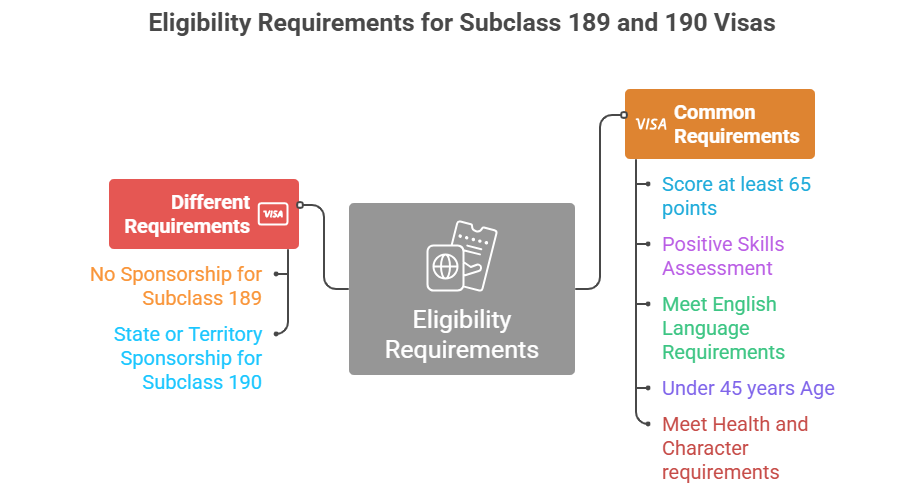
Both visas share common eligibility rules, but also have key differences.
Common Requirements
To apply for either visa, you must:
- Score at least 65 points in the points test
- Have a positive skills assessment for your nominated occupation
- Meet the English language requirement
- Be under 45 years of age at the time of invitation
- Meet health and character requirements
Different Requirements
- Subclass 189: No sponsorship required; selection is based only on points and occupation demand
- Subclass 190: State or territory nomination is mandatory, and applicants must commit to living in that state
* Want to work in Australia? Start here to get expert guidance with the Migrate to Australia Flipbook.
Subclass 189 or Subclass 190 – Which Visa Should You Choose?
Choose Subclass 189 if:
- You have a high points score
- You want complete freedom to live anywhere in Australia
- You do not want state-based obligations
Choose Subclass 190 if:
- You need 5 extra points through state nomination
- Your occupation is in demand in a specific state
- You are willing to live and work in the nominating state initially
How to Apply for Subclass 189 and Subclass 190 Visas?
Step 1: Check if your occupation is on the skilled occupation list
Step 2: Get a positive skills assessment
Step 3: Submit an Expression of Interest (EOI) in SkillSelect
Step 4: Apply for state nomination (Subclass 190) or wait for selection (Subclass 189)
Step 5: Receive an invitation to apply
Step 6: Submit your visa application with the required documents
Step 7: Get your visa approved and move to Australia
Want assistance with Australia immigration? Talk to Y-Axis, the world’s No.1 overseas immigration consultant, for end-to-end support.
FAQs
What is the main difference between Subclass 189 and Subclass 190 visas?
The main difference between Subclass 189 and Subclass 190 visas is state nomination. Subclass 189 does not need sponsorship from any Australian state or territory and allows you to live anywhere in Australia. Subclass 190 requires nomination from a state or territory government, and applicants are expected to live and work in that state for some time. Both visas offer permanent residency, but Subclass 190 gives 5 extra points, making it easier for some applicants to qualify.
Is Subclass 189 a permanent residency visa?
Yes, Subclass 189 is a permanent residency visa. Once granted, you can live, work, and study anywhere in Australia without restrictions. You will get access to Medicare, Social Security benefits (after eligibility periods), and you can sponsor eligible family members. This visa also allows you to apply for Australian citizenship once you meet the residency requirements. It is one of the most flexible skilled migration visas because it does not require state or employer sponsorship.
Is Subclass 190 a permanent residency visa?
Yes, Subclass 190 is also a permanent residency visa. It gives the same PR benefits as Subclass 189, including access to Medicare, work rights, and a pathway to Australian citizenship. The key difference is that Subclass 190 requires state or territory nomination. After getting the visa, applicants are expected to live and work in the nominating state for a certain period. However, legally, it is still a permanent visa from the first day.
Do I need a state nomination for a Subclass 189 visa?
No, state nomination is not required for the Subclass 189 visa. This visa is fully independent and is based only on your points score, occupation demand, skills assessment, and English proficiency. Because there is no state support, competition is very high, and applicants usually need strong points to receive an invitation. Subclass 189 is suitable for candidates who want full freedom to live anywhere in Australia.
Why is state nomination required for the Subclass 190 visa?
State nomination is required for Subclass 190 because the visa is designed to meet specific workforce needs of Australian states and territories. Each state nominates skilled workers based on local labor shortages. In return, nominated applicants are expected to live and work in that state for some time. State nomination also helps applicants by giving 5 extra points, which improves their chances of receiving an invitation.
How many extra points do I get for a Subclass 190 nomination?
You receive 5 additional points for a state or territory nomination under the Subclass 190 visa. These extra points are added to your total points score in SkillSelect. This benefit is helpful for applicants who may not meet the required points for Subclass 189. The extra points can significantly improve your ranking and increase your chances of receiving an invitation to apply for permanent residency.
What is the minimum points requirement for Subclass 189 and 190 visas?
The minimum points requirement for both Subclass 189 and Subclass 190 visas is 65 points. However, meeting the minimum score does not guarantee an invitation. Due to high competition, applicants often need much higher points to be selected. Factors such as English proficiency, skilled work experience, qualifications, partner skills, and state nomination (for Subclass 190) play an important role in improving your overall score.
Can I live anywhere in Australia with a Subclass 189 visa?
Yes, Subclass 189 visa holders can live and work anywhere in Australia. There are no location restrictions or state obligations. You can choose any city or state based on your job opportunities or lifestyle preferences. This flexibility makes Subclass 189 very popular among skilled professionals. You can also change employers freely and access national benefits available to permanent residents.
Do I need to live in a specific state after getting a Subclass 190 visa?
Yes, Subclass 190 visa holders are expected to live and work in the nominating state or territory for a certain period, usually around two years. This commitment is not legally enforced but is strongly expected by the state government. Moving away immediately may affect future visa applications or sponsorship opportunities. The purpose of this requirement is to support workforce needs in that specific state.
Which visa is easier to get: Subclass 189 or Subclass 190?
For most applicants, Subclass 190 is easier to get than Subclass 189. This is because Subclass 190 provides 5 extra points through state nomination and has lower competition compared to Subclass 189. Subclass 189 is highly competitive and usually requires very high points. Applicants with moderate scores often have better chances through Subclass 190 if their occupation is in demand in a particular state.
Are invitation rounds for Subclass 189 conducted regularly in 2026?
Yes, from 2026 onwards, Subclass 189 invitation rounds are expected to be conducted in a more structured and regular manner. While the exact frequency depends on government planning levels, the process is now more predictable than before. Invitations are issued based on occupation demand, points ranking, and overall migration targets. This helps applicants plan their applications better and understand when invitations are likely to occur.
How does occupation demand affect Subclass 189 invitations?
Occupation demand plays a very important role in Subclass 189 invitations. Applicants working in high-demand occupations such as healthcare, engineering, IT, construction, and education usually get higher priority. Even with high points, candidates in low-demand occupations may wait longer for an invitation. The Australian government regularly reviews labor market needs and adjusts invitation priorities accordingly to fill skill shortages.
How do Australian states select candidates for Subclass 190 visas?
Australian states select Subclass 190 candidates based on local workforce shortages. Each state has its own occupation list, eligibility criteria, and selection process. States usually consider factors like work experience, English level, settlement ability, and commitment to live in the state. Applicants must submit an Expression of Interest and, in many cases, a separate state nomination application before receiving an invitation.
What are the age requirements for Subclass 189 and 190 visas?
Applicants must be under 45 years of age at the time they receive an invitation for both Subclass 189 and Subclass 190 visas. Age points decrease as you get older, so applying earlier improves your chances. If you turn 45 after submitting your Expression of Interest but before receiving an invitation, you will not be eligible for these visas.
Is a skills assessment mandatory for both Subclass 189 and 190 visas?
Yes, a positive skills assessment is mandatory for both Subclass 189 and Subclass 190 visas. The assessment must be done by the relevant assessing authority for your nominated occupation. It confirms that your qualifications and work experience meet Australian standards. Without a valid skills assessment, you cannot submit a valid Expression of Interest or receive an invitation.
What English language level is required for Subclass 189 and 190 visas?
At a minimum, applicants must meet the Competent English level for both visas. This usually means achieving at least IELTS 6.0 in each band or equivalent scores in other approved English tests. Higher English scores give more points and greatly improve your chances of receiving an invitation. Many successful applicants score Proficient or Superior English to stay competitive.
Can I apply for Australian citizenship after getting a Subclass 189 visa?
Yes, Subclass 189 visa holders can apply for Australian citizenship once they meet the residency and other eligibility requirements. Generally, you must live in Australia for a certain number of years, including at least one year as a permanent resident. Citizenship allows you to vote, apply for an Australian passport, and enjoy full rights as an Australian citizen.
Can Subclass 190 visa holders apply for Australian citizenship?
Yes, Subclass 190 visa holders can also apply for Australian citizenship after meeting residency requirements. The process and eligibility conditions are the same as for Subclass 189 visa holders. Once you have lived in Australia for the required period and meet character and language requirements, you can apply for citizenship regardless of the visa subclass you entered under.
Does the Subclass 190 visa restrict job opportunities to one state?
Legally, Subclass 190 does not restrict you from working outside the nominating state. However, you are expected to live and work in that state for a reasonable period. Not following this commitment may affect your relationship with state authorities or future visa applications. Most applicants follow this expectation to maintain good compliance with migration guidelines.
How do I apply for a Subclass 189 or Subclass 190 visa through SkillSelect?
To apply, you must first get a positive skills assessment and meet eligibility criteria. Next, submit an Expression of Interest (EOI) through SkillSelect. For Subclass 190, you also apply for state nomination. If selected, you will receive an invitation to apply for the visa. After submitting documents and completing health and character checks, your visa application will be processed by the Australian government.
Tags:
Subclass 189 visa
Subclass 190 visa
Australia skilled migration
Skilled Independent visa
Skilled Nominated visa
Australia PR pathway
Australian work visa
Skilled migration Australia
Share
Options for you by Y-Axis

Get it on your mobile

Get News alerts

Contact Y-Axis
Latest Article
Popular Post
Trending Article

Posted On March 31 2026
Scholarships in Spain for Indian Students 2026 – Top Scholarships, How to Apply & Tips