


Posted on September 25 2026
What Are the Different Types of Germany Visas to Immigrate?

By , Editor & Director
Updated September 25 2026
Germany is a major destination for skilled professionals, students, job seekers and families looking to live and work in Europe. Depending on your purpose and duration of stay, Indian citizens may need either a Schengen visa for short stays of up to 90 days or a German National Visa (D visa) for stays longer than 90 days.
Skilled professionals can explore pathways such as the EU Blue Card, skilled-worker residence permits and the Opportunity Card (Chancenkarte) for job searching. Germany also provides routes for international students, vocational trainees, family reunification and, after meeting the applicable conditions, permanent residence through a settlement permit.
*Willing to migrate to Germany for work, study or permanent residence? Contact Y-Axis for complete guidance.
Different Types of Germany Visas
|
Germany Visa Type |
Who Is It For? |
Main Purpose |
|
Skilled workers and other eligible residents who meet the requirements for a settlement permit |
To live and work permanently in Germany |
|
|
Qualified skilled workers with an eligible job and qualifications |
To work and live in Germany |
|
|
International students admitted to a recognised German university or higher-education institution |
To study in Germany |
|
|
Highly qualified professionals with a qualifying job offer and salary |
To work in qualified employment and establish long-term residence in Germany |
|
|
Qualified non-EU job seekers who meet the recognition or points-system requirements |
To enter Germany to search for qualified employment |
|
|
Vocational Training Visa |
Applicants who have secured or are seeking eligible vocational training |
To undertake vocational training in Germany |
|
Spouses, children and other eligible family members of people living in Germany |
To join eligible family members in Germany |
|
|
Tourists, business visitors and other short-term visitors |
To visit Germany for up to 90 days within the applicable Schengen rules |
What Are the Germany Visa Requirements for Indian Citizens?
Common documents and requirements may include:
- Valid Indian passport
- Completed visa application and supporting documents
- Recent biometric photographs, where required
- Proof of admission to a German educational institution, for student applications
- Recognised or comparable educational/professional qualifications, where required
- APS certificate for applicable Indian student applicants
- German or English language certificate, where required
- Employment contract or binding job offer for employment visas
- Proof of professional qualifications and work experience
- Recognition or comparability of foreign qualifications, where required
- Proof of sufficient financial resources
- Blocked bank account or other accepted proof of financial support, where applicable
- Health insurance
- Proof of accommodation, where required
- Police/character documents, where required
- Marriage certificate or birth certificates for applicable family-reunification applications
- Proof of relationship to the family member in Germany
- Other documents specified in the relevant German visa checklist
*Check your eligibility to migrate to Germany through the Y-Axis Germany Immigration Points calculator.
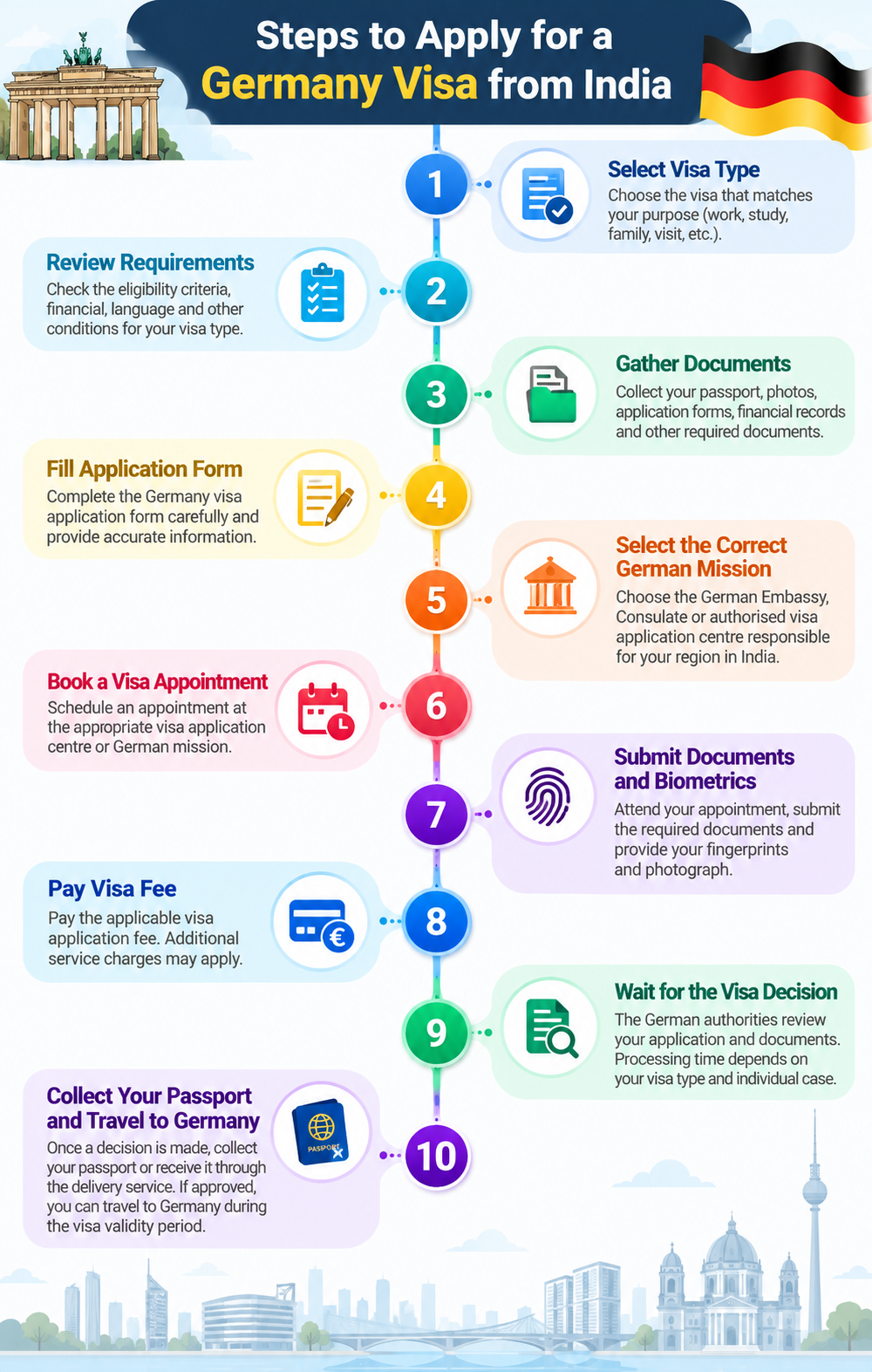
Steps to Apply for a Germany Visa from India
Step 1: Select the visa that matches your purpose, such as work, study, EU Blue Card, family reunification, Opportunity Card or visiting Germany.
Step 2: Review the requirements for your selected visa and make sure you meet the qualification, financial, language and other eligibility conditions.
Step 3: Collect your passport, photographs, application forms, financial documents, qualifications, insurance and other documents required for your visa type.
Step 4: Fill in the Germany visa application form carefully and provide accurate information that matches your supporting documents.
Step 5: Choose the German Embassy, Consulate or authorised visa application centre responsible for applications from your place of residence in India.
Step 6: Schedule an appointment at the appropriate visa application centre or German mission and select a suitable available date.
Step 7: Attend your appointment, submit the required documents and provide your fingerprints and photograph when required.
Step 8: Pay the applicable Germany visa application fee. Additional service charges may apply depending on where you submit your application.
Step 9: The German authorities will review your application and documents before making a decision. Processing time depends on the type of visa and your individual application.
Step 10: Once a decision is made, collect your passport or receive it through the available delivery service. If your visa is approved, you can travel to Germany during its validity period.
Germany Visa Fees and Processing Time for Indians
|
Germany Visa / Immigration Type |
Government Fee |
Processing Time |
|
Permanent Residence |
€113–€147 approx. |
Several weeks to months |
|
Work Visa |
€75 / ₹8,400 |
6–8 weeks |
|
Student Visa |
€75 / ₹8,400 |
6–8 weeks |
|
EU Blue Card |
€75 / ₹8,400 |
Around 10 days* |
|
Opportunity Card |
€75 / ₹8,400 |
Several weeks to months |
|
Vocational Training Visa |
€75 / ₹8,400 |
6–8 weeks |
|
Family Reunification Visa |
€75 / ₹8,400 |
Several weeks to months |
|
Visit / Schengen Visa |
€90 / ₹10,100 |
Around 15 days |
Processing time can be longer depending on the application and the German authority handling it.
*Looking for help with overseas immigration? Contact Y-Axis, worlds’s number one immigration consultancy for guidance and visa assistance.
FAQs
What are the main types of Germany visas for Indians?
Indian citizens can apply for different Germany visas based on their purpose of travel. Common options include Work Visa, Student Visa, EU Blue Card, Opportunity Card, Vocational Training Visa, Family Reunification Visa and Visit Visa. People who meet the required conditions may also apply for permanent residence in Germany. The right visa depends on your qualifications, job, study plans, family situation and intended length of stay.
How much does a Germany visa cost for Indians?
The visa fee depends on the type of visa you apply for. Most German National Visas, including Work, Student, EU Blue Card and Opportunity Card visas, cost around €75 for adults. A Schengen Visit Visa generally costs €90 for adults. Additional service charges may apply when submitting your application through a visa application centre in India.
How long does a Germany visa take to process?
Germany visa processing times depend on the visa category and individual application. Work and Student Visas may take around 6–8 weeks, while some EU Blue Card applications can be processed faster. Family and Opportunity Card applications may take several weeks or longer. A Visit Visa normally takes around 15 days. Processing can take longer if additional documents or checks are required.
Can Indians apply for a Germany Work Visa?
Yes, Indian citizens can apply for a Germany Work Visa if they meet the requirements for the selected work route. Applicants generally need a suitable qualification, relevant work experience and an eligible job offer from a German employer. Some professions require recognition of qualifications or professional registration. The exact requirements depend on the occupation, qualification, salary and type of German residence permit.
What is the Germany EU Blue Card?
The EU Blue Card is a residence permit for highly qualified professionals who have a suitable job in Germany and meet the required salary conditions. It can provide a pathway to long-term residence in Germany. Applicants generally need a recognised higher education qualification or comparable qualification and an eligible employment contract. The salary requirement depends on the profession and current German immigration rules.
What is the Germany Opportunity Card?
The Opportunity Card allows eligible non-EU citizens to enter Germany and search for qualified employment. Applicants can qualify through a recognised qualification or by meeting the points-based requirements. Depending on the rules, applicants may need to show sufficient funds and meet language or qualification conditions. The card is mainly useful for qualified people who want to look for suitable employment after arriving in Germany.
What are the requirements for a Germany Student Visa?
Students generally need admission to a recognised German university or educational institution before applying for a Student Visa. They may also need proof of academic qualifications, language ability, health insurance and enough money to support themselves during their stay. Indian students may need an APS certificate where applicable. Additional documents can be requested depending on the course, university and applicant's individual circumstances.
Can Indian citizens get permanent residence in Germany?
Yes, eligible Indian citizens can apply for permanent residence, known as a settlement permit, after meeting the required conditions. The time needed depends on the applicant's residence permit and situation. Requirements can include stable income, pension contributions, German language skills, sufficient living space and knowledge of Germany's legal and social system. EU Blue Card holders may qualify for permanent residence under faster conditions.
Can I take my family to Germany?
Eligible family members may be able to join a person living in Germany through the Family Reunification Visa. This can include a spouse and children, depending on the applicant's residence status and individual circumstances. Applicants normally need documents proving the family relationship. Other requirements can include accommodation, financial support and health insurance. The exact rules depend on the residence status of the person already living in Germany.
What documents are needed for a Germany visa from India?
The documents depend on the visa category. Common documents include a valid passport, completed application form, photographs, proof of qualifications, financial documents and health insurance. Work applicants may need an employment contract, while students need university admission documents. Family applicants may need marriage or birth certificates. Applicants should always check the latest German visa checklist because additional documents may be required.
Tags:
Germany Visa
Germany Visa for Indians
Germany Immigration
Germany Work Visa
Germany Study Visa
Germany EU Blue Card
Germany Family Visa
Germany Permanent Residence
Germany Visa Requirements
Germany Visa Fees
Germany Visa Processing Time
Germany
Share
Options for you by Y-Axis

Get it on your mobile

Get News alerts

Contact Y-Axis
Latest Article
Popular Post
Trending Article
Posted On September 25 2026
Canada vs. Australia for HR Professionals: Which Country Should You Choose?