

Posted on September 24 2026
What Are the Different Types of Australia Visas to Immigrate?

By , Editor & Director
Updated September 26 2026
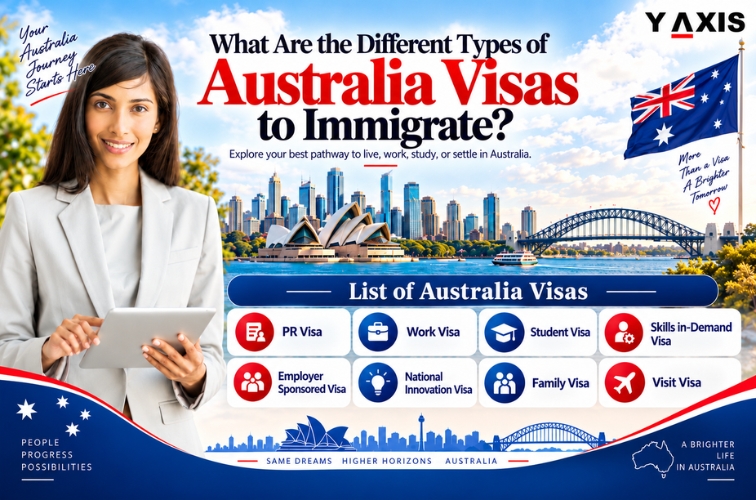
Australia is one of the top destination for skilled professionals, students, workers and families looking to build a future abroad. Depending on your purpose, you may need a work visa, student visa, visitor visa or permanent visa. Skilled workers can explore pathways such as Skilled Independent (subclass 189), Skilled Nominated (subclass 190), Skilled Work Regional (subclass 491) and employer-sponsored visas. Australia also has family and regional migration options.
*Willing to migrate to Australia on a PR visa? Contact Y-Axis for complete guidance.
Different Types of Australia Visas
|
Australia Visa Type |
Who Is It For? |
Main Purpose |
|
Eligible skilled workers and other applicants who meet Australian permanent residence requirements |
To live and work permanently in Australia |
|
|
Skilled workers with an eligible occupation |
To work temporarily or permanently in Australia |
|
|
International students |
To study at an eligible Australian education institution |
|
|
Skilled workers with an eligible occupation and employer sponsor |
To work temporarily in Australia |
|
|
Skilled workers nominated or sponsored by an Australian employer |
To work in Australia, with some streams providing a pathway to PR |
|
|
Highly talented individuals with internationally recognised achievements |
To live and work in Australia as a permanent resident |
|
|
Eligible partners and family members of Australian citizens or permanent residents |
To join eligible family members in Australia |
|
|
Tourists, business visitors and family visitors |
To visit Australia temporarily |
*Also Read....
What are the key differences between Subclass 189 and Subclass 491 Visas
What Are the Australia Visa Requirements for Indian Citizens?
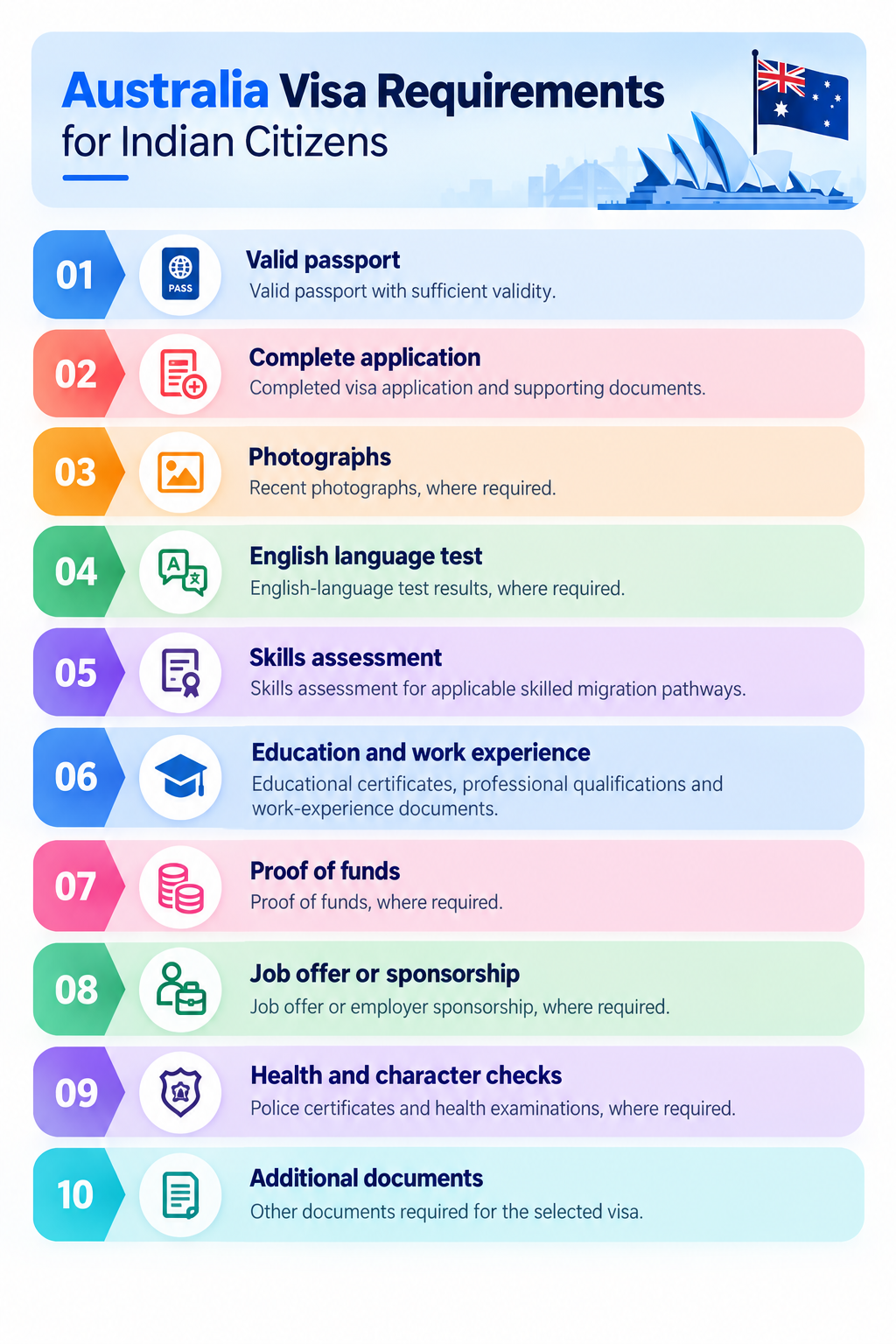
The exact requirements depend on the visa or immigration program you choose. Common documents and requirements may include:
- Valid passport with sufficient validity
- Completed visa application and supporting documents
- Recent photographs, where required
- English-language test results, where required
- Skills assessment for applicable skilled migration pathways
- Educational certificates and professional qualifications
- Employment reference letters and work-experience documents
- Proof of funds, where required
- Job offer or employer sponsorship, where required
- Expression of Interest (EOI) through SkillSelect for eligible skilled visas
- State or territory nomination, where required
- Police certificates, where required
- Health examinations, where required
- Proof of relationship for family and partner applications
- Other documents required for the selected visa
For skilled visas such as subclasses 189, 190 and 491, applicants generally need an eligible occupation, a suitable skills assessment and the required points. An EOI through SkillSelect is required before an invitation can be issued. For employer-sponsored visas, requirements can include employer sponsorship, an eligible occupation, relevant skills and work experience. Some occupations may also require professional registration or licensing.
*Check your score with the Y-Axis Australia PR Points calculator.
Australia Visa Application Process
The general application process depends on the visa category, but commonly involves:
Step 1: Choose the appropriate Australia visa or immigration program.
Step 2: Check your eligibility for the selected pathway.
Step 3: Complete a skills assessment, if required for your occupation and visa.
Step 4: Take an English-language test, if required.
Step 5: Prepare the required documents, such as passport, education, employment and financial documents.
Step 6: Submit an Expression of Interest (EOI) through SkillSelect for applicable skilled visas.
Step 7: Obtain state or territory nomination if required for your visa.
Step 8: Receive an invitation and submit your visa application within the required timeframe. For skilled visas, invited applicants generally have 60 days to apply.
Step 9: Complete health examinations, police checks and other checks, if required.
Step 10: Wait for the visa decision and follow the instructions provided by the Department of Home Affairs.
Australia Visa Fees for Indians
Australian visa fees are charged in Australian dollars (AUD) and can change. The current charges below apply from 1 July 2026 and are base charges for the main applicant. Additional applicant charges and other costs may apply.
|
Application Type |
Visa Subclass |
Government Fee (AUD) |
|
PR Visa – Skilled Independent |
189 |
$6,135 |
|
PR Visa – Skilled Nominated |
190 |
$6,140 |
|
PR Visa – Permanent Residence (Skilled Regional) |
191 |
$630 |
|
Work Visa – Skilled Work Regional |
491 |
$6,140 |
|
Student Visa |
500 |
$2,500 |
|
Skills in-Demand Visa |
482 |
$4,015 |
|
Employer Sponsored Visa – Employer Nomination Scheme |
186 |
$6,140 |
|
Employer Sponsored Visa – Skilled Employer Sponsored Regional |
494 |
$6,140 |
|
National Innovation Visa |
858 |
$6,235 |
|
Family Visa – Partner Visa |
820/801 or 309/100 |
$11,710 |
|
Visit Visa – Visitor (Tourist stream, outside Australia) |
600 |
$250 |
Australia Visa Processing Time
Australia does not provide one fixed processing time for all applicants from India. Processing times vary by visa type, application completeness, health and character checks, application volume and other factors. The latest published July 2026 median processing times are:
|
Australia Visa / Immigration Type |
Current Median Processing Time |
|
PR Visa – Skilled Independent / Skilled Nominated / Skilled Regional |
8 months |
|
Work Visa – Skilled Work Regional |
98 days |
|
Student Visa |
21 days |
|
Skills in-Demand Visa |
98 days |
|
Employer Sponsored Visa |
98 days |
|
Family Visa – Partner Visa |
23 months |
|
Visit Visa |
Less than 1 day |
*Looking for help with overseas immigration? Contact Y-Axis, worlds’s number one immigration consultancy for guidance and visa assistance.
FAQs
What are the main types of Australian visas for Indians?
Australia offers different visa options based on your purpose of travel. Common options include skilled work visas, student visas, visitor visas, employer-sponsored visas, regional visas, partner and family visas, and permanent residence visas. Skilled professionals may consider visas such as 189, 190, 491, 186, and 494. The right visa depends on your occupation, qualifications, work experience, English skills, family situation, and eligibility.
Which Australian visa is suitable for skilled workers?
Skilled workers can explore several Australian visa options. The Skilled Independent visa (189) is for eligible skilled workers who meet the points requirements. The Skilled Nominated visa (190) requires nomination by an Australian state or territory. The Skilled Work Regional visa (491) is for eligible applicants who live and work in regional Australia. Employer-sponsored visas may also be suitable if you have an eligible employer.
Do I need a skills assessment for an Australian skilled visa?
Yes, a skills assessment is generally required for points-tested skilled visas such as 189, 190, and 491. The assessment checks whether your qualifications and work experience match your nominated occupation. The relevant assessing authority depends on your occupation. You should complete the required skills assessment before submitting your Expression of Interest (EOI), where applicable, and make sure your assessment is valid.
Do I need an English test to apply for an Australian visa?
English requirements depend on the visa you apply for. Skilled migration applicants usually need to meet a specified English level, and approved tests may include IELTS, PTE, TOEFL iBT, OET, or Cambridge C1 Advanced. Your English result can also affect your points for some skilled visas. Check the exact English requirement for your visa before booking a test or submitting your application.
How many points are needed for Australian skilled migration?
For points-tested skilled visas such as 189, 190, and 491, the minimum points threshold is generally 65 points. However, reaching 65 points does not guarantee that you will receive an invitation to apply. Points can come from factors such as age, English ability, education, skilled work experience, and other eligible criteria. Invitation requirements can change depending on the occupation and migration program.
Do I need a job offer to get an Australian skilled visa?
You do not need a job offer for the Skilled Independent visa (189). However, other Australian visa pathways may require nomination or employer sponsorship. For example, employer-sponsored visas require an eligible sponsoring employer, while the 190 and 491 pathways involve state or territory nomination or other eligible nomination arrangements. Always check the specific requirements of the visa you plan to apply for.
What documents are required for an Australian visa application?
Documents depend on the visa type and your personal situation. Common documents include a valid passport, identity documents, education certificates, employment references, English test results, skills assessment, police certificates, and health examination results. Skilled applicants may also need an EOI and nomination documents. Family or partner applications can require relationship evidence. Immigration authorities may request additional documents during processing.
How much does an Australian visa application cost?
Australian visa fees vary depending on the visa subclass. For example, the main applicant fee can be around AUD 6,135 for the Skilled Independent visa (189) and around AUD 6,140 for several other skilled permanent visas. Student and temporary work visas have different fees. Additional applicant charges and other costs may apply. Visa charges can change, so check the latest official fee before applying.
How long does an Australian visa application take?
Processing time depends on the visa type, application quality, documents, and other factors. Published July 2026 median processing times were around 8 months for skilled permanent visas, 98 days for skilled temporary visas, and 21 days for student visas. These are general category-level figures, not India-specific guarantees. Individual applications may take longer or shorter depending on circumstances and processing requirements.
Can Indians apply for permanent residency in Australia?
Yes, Indian citizens can apply for Australian permanent residence if they meet the requirements of an eligible pathway. Skilled workers may explore visas such as 189, 190, and employer-sponsored 186. Regional pathways can also provide routes toward permanent residence. Applicants generally need to meet requirements related to occupation, skills, English, health, character, and other visa-specific conditions.
Tags:
Australia Visa
Australia Visa for Indians
Australia Immigration
Australia Work Visa
Australia Study Visa
Australia Family Visa
Australia Permanent Residence
Australia Visa Requirements
Australia Visa Fees
Australia Visa Processing Time
Australia
Share
Options for you by Y-Axis

Get it on your mobile

Get News alerts

Contact Y-Axis
Latest Article
Popular Post
Trending Article
Posted On October 01 2026
The Borderless Indian