


Posted on May 13 2026
Scholarships to Study in Italy 2026 – Which Ones Cover Tuition Fee & How to Apply

By , Editor & Director
Updated May 17 2026
Italy is becoming a popular country for Indian students who want to study abroad at an affordable cost. The country is known for its high-quality education, famous universities, beautiful cities, and rich cultural experience. Compared to countries like the USA, UK, and Australia, the cost of studying in Italy is much lower. In addition to affordable tuition fees, many universities and government organizations in Italy also provide scholarships for international students.
These scholarships can help students reduce their education expenses by covering tuition fees, accommodation, living costs, food expenses, and health insurance. Some scholarships provide full financial support, while others offer partial tuition fee waivers or monthly allowances. Students can apply for scholarships for bachelor’s, master’s, PhD, and research programs in different fields of study. For Indian students who want to study in Europe without spending a very high amount, Italy can be a good option because of the wide range of scholarships and the affordable education system.
Why Study in Italy with Scholarships?
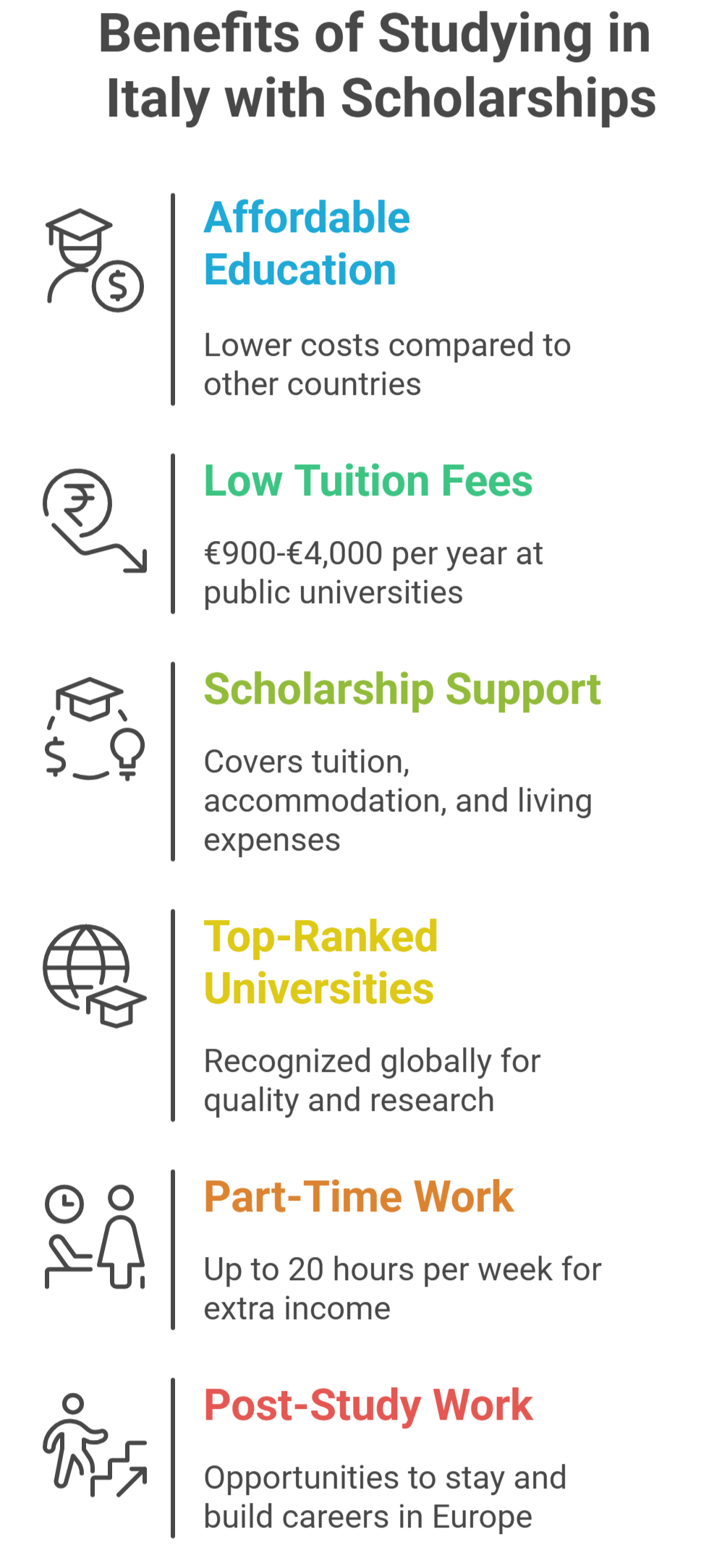
Affordable Education Compared to Other Countries
Italy offers quality education at a much lower cost compared to countries like the USA, UK, Canada, and Australia. Tuition fees at public universities in Italy are generally affordable for international students, making it easier for students from middle-income families to study abroad.
Low Tuition Fees at Public Universities
Most public universities in Italy charge tuition fees between €900 and €4,000 per year, depending on the university and course. This is much lower than the tuition fees charged by universities in many English-speaking countries. Because of this, students can complete their education in Italy at a lower overall cost.
Scholarships Help Reduce Expenses
Many scholarships in Italy help students by covering tuition fees, accommodation expenses, food costs, and monthly living expenses. Some scholarships also provide free meals, hostel facilities, and health insurance. These financial benefits help students manage their budget while studying in Italy.
Top-Ranked Universities in Italy
Italy is home to many well-known universities that are recognized around the world for their education quality and research programs. Universities such as the University of Bologna, Politecnico di Milano, and Sapienza University of Rome attract thousands of international students every year. Degrees from these universities are accepted globally and can improve career opportunities.
Part-Time Work Opportunities for Students
International students in Italy are allowed to work part-time for up to 20 hours per week during their studies. This allows students to earn some extra income to manage daily expenses and gain international work experience while studying.
Post-Study Work Opportunities
After completing their education, international students may have opportunities to stay in Italy and search for jobs. Italy offers post-study work options that help graduates gain work experience and build their careers in Europe. Students with skills in fields such as engineering, business, technology, fashion, and design may find good career opportunities in Italy and other European countries.
*Willing to study in Italy? Contact Y-Axis for complete guidance
Top Scholarships to Study in Italy for International Students
Italian Government Scholarship (Borse di Studio Governo Italiano)
This is the most well-known scholarship for international students who want to study in Italy. It is offered by the Italian Ministry of Foreign Affairs and International Cooperation (MAECI) through the platform called Universitaly.
What Does It Cover?
- Full tuition fee waiver which you do not pay any university fees
- Monthly allowance of €900 for students who take up residence in Italy
- Health insurance coverage during the study period
- Free access to Italian language and culture courses
Who Can Apply?
- Non-Italian citizens living outside Italy
- Students who want to pursue undergraduate, postgraduate, PhD, fine arts, or Italian language and culture courses
- Applicants who have not already completed a study programme at the same level in Italy
- Age limit varies by course type (generally under 28–30 for degree programmes, under 35 for art courses)
- Each country has a specific number of seats allocated. India, for example, typically receives 20–25 scholarship slots per cycle.
DSU Scholarships (Diritto allo Studio Universitario)
DSU stands for Diritto allo Studio Universitario, which means “Right to University Education.” These scholarships are financial support programs provided by regional authorities in Italy to help students manage their education and living expenses. DSU scholarships are available for both Italian and international students, including non-EU students who have a valid residence permit in Italy. Different regions in Italy manage these scholarships through organizations such as EDISU, ADISU, DiSCo, and DSU Toscana.
What Does the DSU Scholarship Cover?
The DSU scholarship can help students reduce many study-related expenses, including:
- Full or partial tuition fee waiver
- Financial support of around €2,500 to €5,500 per year depending on the student’s family income and region
- Free or low-cost accommodation in university hostels, if available
- Discounted or free meals at university cafeterias
Who Can Apply?
Students can apply for the DSU scholarship if they:
- Are enrolled in an Italian university
- Meet the required family income limit under the ISEE financial assessment system
- Maintain the required academic performance and complete the minimum study credits each year
The scholarship is mainly designed to support students from low-income families who need financial help to continue their education in Italy.
Bocconi University Merit Scholarships
Bocconi University in Milan is one of the top business schools in Europe and consistently ranks in the global top 20 for economics and management. It runs one of the most transparent and generous scholarship programmes for international students in Italy.
What Does It Cover?
Bocconi offers three main scholarship categories:
- Full-Fee Scholarship: Covers 100% of annual tuition fees (around €14,000/year)
- Partial Scholarships (50%, 25%, 15%): Cover a percentage of tuition based on merit or financial need
- Need-Based Grants: For students with demonstrated financial hardship, independent of merit score
For Master's students, Bocconi also offers the International Students Award, which can cover up to 100% of tuition fees.
Who Can Apply?
- Admitted students who apply for financial aid at the time of enrolment
- Evaluated on a combination of academic merit (GPA, test scores, prior qualifications) and financial situation (family income)
- Both EU and non-EU students are eligible
Deadlines for Bocconi admissions and scholarships typically fall between January and April for programmes starting in September.
Politecnico di Milano — Merit Scholarships and Fee Reductions
Politecnico di Milano is Italy's top engineering and design university and is consistently ranked among the world's best technical universities. It attracts a large number of international students, particularly for its Master of Science programmes in engineering, architecture, and design.
What Does It Cover?
- Full or partial tuition fee waiver based on merit
- "Premio di Studio" — a merit award paid in cash (typically €3,000 to €5,000) for students who perform exceptionally well in their first year
- Reduced fees based on income (ISEE) for enrolled students
Who Can Apply?
- Students applying for Bachelor's or Master's programmes
- Selection for merit scholarships is largely based on prior academic performance and entrance test results (for some programmes)
- International students (non-EU) can apply for income-based fee reductions after getting their ISEE parificato in Italy
University of Bologna (UNIBO) — International Scholarship
The University of Bologna is the oldest university in the world (founded in 1088) and one of the most respected research universities in Europe. It offers a structured fee reduction system and targeted scholarships for international students.
What Does It Cover?
- Total or partial tuition fee reduction based on income (ISEE parificato)
- Fee brackets are calculated on a sliding scale; students with very low incomes may pay zero tuition
- The university also offers specific awards for high-merit students in selected Master's programmes
Who Can Apply?
- All enrolled students who submit an ISEE proficiency in Italy
- Students with an ISEE score under €13,900 typically receive a full tuition exemption
- Additional merit-based awards exist for selected international programmes
Invest Your Talent in Italy (IYT) Programme
Invest Your Talent in Italy is a joint programme run by the Italian Ministry of Foreign Affairs and Italian trade and investment agencies. It is specifically aimed at students from select countries who want to study a Master's programme in Italy with a built-in internship component.
What Does It Cover?
- Free tuition at partner Italian universities
- Monthly living allowance (amount varies by programme, usually €500–€900/month)
- Language support and cultural orientation
- Guaranteed internship placement with Italian companies or multinational firms based in Italy after completing the course
Which Countries Are Eligible?
The programme targets students from specific countries in Africa, Asia, Latin America, and Eastern Europe. Eligible countries change slightly each cycle, but have included India, Brazil, Nigeria, Egypt, Vietnam, Morocco, and others. Check the current year's announcement for the updated list.
INFN National Scholarships (For PhD Students)
The Istituto Nazionale di Fisica Nucleare (INFN), Italy's National Institute for Nuclear Physics, offers PhD positions and research fellowships for international students interested in physics, nuclear science, and related fields.
What Does It Cover?
- Full PhD funding (stipend of approximately €1,200–€1,400 per month net)
- No tuition fees for enrolled PhD students (Italian PhDs generally have no tuition fees)
- Research funding and access to INFN laboratories
Who Can Apply?
- Students with a Master's degree in physics, engineering, or a related field
- Applicants must apply for open positions advertised on infn.it
- Positions are research-specific and competitive
Italy Scholarship Comparison Table
|
Scholarship |
Type |
Tuition Coverage |
Monthly Allowance |
Deadline (Approx.) |
|
Italian Government Scholarship |
Government |
Full waiver |
€900/month |
March 31 |
|
DSU Regional Scholarships |
Need-based |
Full/partial waiver |
€200–€450/month |
Sep–Oct |
|
Bocconi Merit Scholarship |
University |
Up to 100% |
None (some grants) |
Jan–Apr |
|
Politecnico di Milano |
University |
Full/partial |
€3,000–€5,000 award |
Varies |
|
University of Bologna |
University |
Full/partial (ISEE) |
None |
Oct–Nov |
|
Invest Your Talent |
Government + University |
Full waiver |
€500–€900/month |
Dec–Jan |
|
INFN PhD Fellowship |
Research |
Full (no PhD fees) |
€1,200–€1,400/month |
Varies |
*Read more...
Top Scholarships in Italy for Indian Students
Documents Required for Scholarships in Italy
Most scholarships in Italy ask students to submit similar documents during the application process. Preparing these documents early can make the application process easier and help avoid delays.
- Valid passport
- Academic mark sheets and degree certificates
- English language test scores such as IELTS or TOEFL for English-taught courses
- Italian language certificate for courses taught in Italian
- Statement of Purpose (SOP) or motivation letter explaining why you want to study in Italy
- Recommendation letters from teachers, professors, or employers
- Income proof documents for need-based scholarships like DSU
- An admission letter or proof of enrolment from an Italian university
Some scholarships may ask for additional documents depending on the university or course requirements. Students should always check the official scholarship guidelines before applying.
*Also read...
Study in Italy for free
Step-by-Step Guide to Apply for Scholarships in Italy
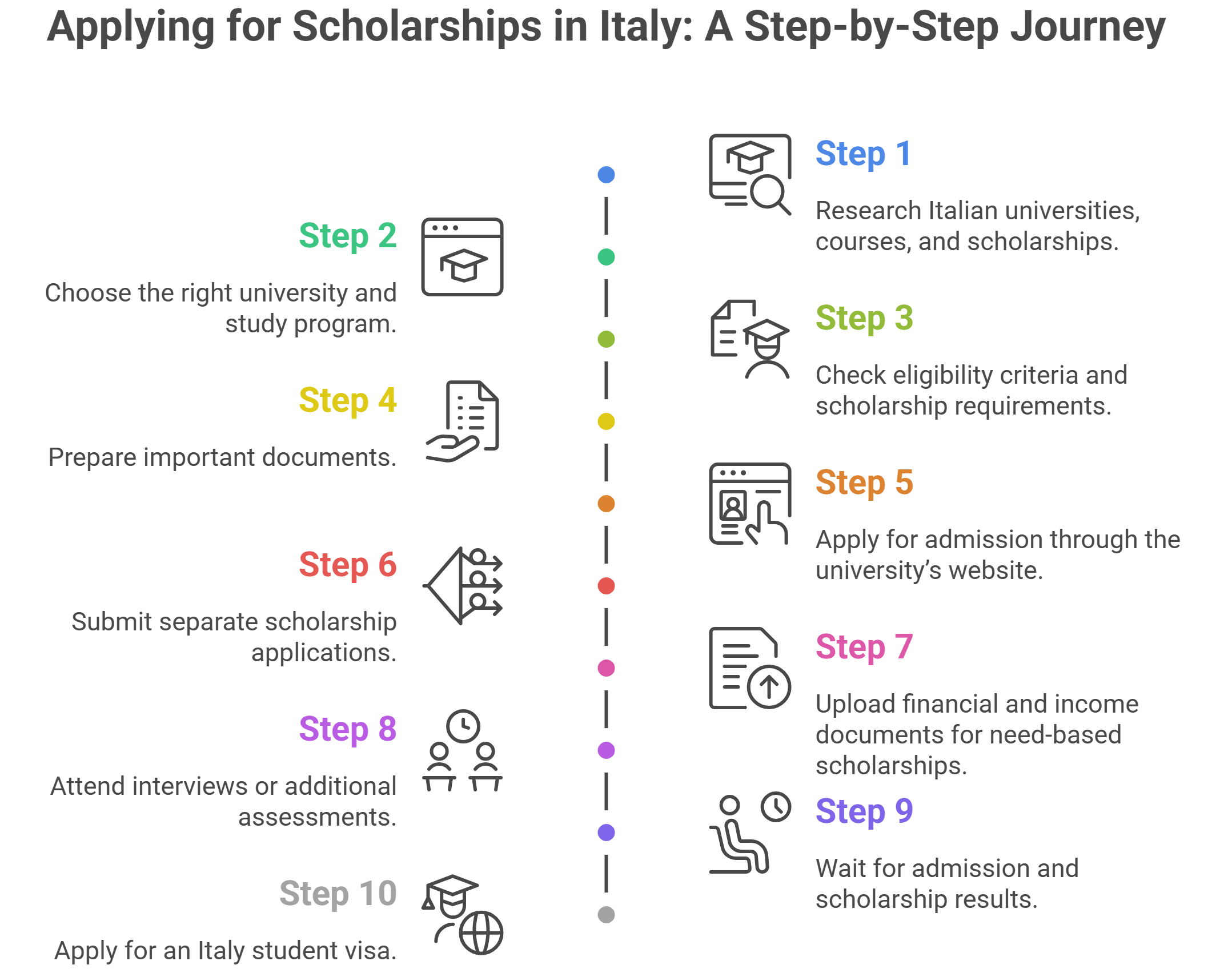
Step 1: Research Italian universities, courses, and available scholarships.
Step 2: Choose the right university and study program based on your goals.
Step 3: Check the eligibility criteria and scholarship requirements carefully.
Step 4: Prepare important documents such as passport, transcripts, SOP, and language test scores.
Step 5: Apply for admission through the university’s official website.
Step 6: Submit separate scholarship applications if required by the university or scholarship provider.
Step 7: Upload financial and income documents for need-based scholarships like DSU.
Step 8: Attend interviews or additional assessments if requested.
Step 9: Wait for admission and scholarship results from the university.
Step 10: Apply for an Italy student visa after receiving confirmation.
Step 11: Arrange accommodation, travel, and other preparations before moving to Italy.
Common Mistakes Students Should Avoid While Applying for Scholarships in Italy
Getting a scholarship in Italy can be competitive, and many students miss good opportunities because of simple mistakes during the application process. Avoiding these errors can improve your chances of receiving financial support.
Applying After the Deadline
Many students apply too late and miss scholarship opportunities. Most Italian scholarship applications open several months before the academic year starts. For example, the Italian Government Scholarship usually has a deadline around March 31 each year. Missing the deadline may mean waiting another year to apply again.
Not Understanding the ISEE Financial Process
Some scholarships, especially DSU scholarships, require students to submit income proof through a system called ISEE Parificato. This process is completed in Italy after arrival by submitting translated financial documents at a CAF office. Students who do not prepare these documents in advance may miss tuition fee reductions and financial benefits.
Applying for Admission but Forgetting Scholarship Applications
At some universities, scholarship applications are separate from university admission applications. Students may receive admission but still lose scholarship opportunities because they did not complete the financial aid application form. Always check whether scholarships require a separate application.
Not Checking Country-Based Scholarship Availability
Some Italian government scholarships provide a limited number of seats for each country. The number of scholarships available may vary depending on the applicant’s country. Students should check the available slots for their country and apply as early as possible.
Submitting Incomplete Documents
Missing documents such as passports, transcripts, language test scores, or recommendation letters can delay or reject applications. Students should carefully review all document requirements before submission.
Waiting Until the Last Minute
Many students rush their applications near the deadline, which can lead to mistakes in forms or missing documents. Applying early gives students enough time to prepare documents and correct any errors.
*Planning to do masters in Italy? Contact Y-Axis for complete guidance
Tips to Increase Your Chances of Getting Scholarships in Italy
Applying for scholarships in Italy can become easier if students prepare early and follow the correct process. Here are some useful tips that can help improve your chances of receiving financial support.
Apply Early: Many scholarships in Italy have limited seats and strict deadlines. Applying early gives you enough time to prepare documents and avoid last-minute mistakes.
Maintain Good Academic Scores: Most scholarships consider academic performance during selection. Students with strong grades and achievements usually have better chances of getting scholarships.
Write a Strong Statement of Purpose (SOP): Your SOP should clearly explain your academic goals, career plans, and reasons for choosing Italy. A well-written SOP can create a good impression on scholarship committees.
Prepare Financial Documents Properly: For need-based scholarships like DSU, students must provide income and financial documents. Make sure all documents are translated, valid, and ready before applying.
Check Scholarship Requirements Carefully: Each scholarship has different eligibility rules and document requirements. Read the official guidelines carefully before submitting your application.
Apply for Multiple Scholarships: Do not depend on only one scholarship opportunity. Applying for multiple scholarships can improve your chances of receiving financial aid.
Improve Your Language Skills: Some programs may require English or Italian language proficiency certificates. Preparing for IELTS, TOEFL, or Italian language exams in advance can help during admissions and scholarship applications.
Keep Important Documents Ready: Prepare documents such as passports, transcripts, recommendation letters, language test scores, and admission letters early to avoid delays.
Stay Updated on Deadlines: Scholarship deadlines may change every year. Regularly check university and scholarship websites for the latest updates and announcements.
Research Universities and Courses Carefully: Choose universities and courses that match your academic background and career goals. Some universities also offer special scholarships for international students in selected programs.
*Looking for assistance with Italy student visa? Talk to Y-Axis, the world’s No. 1 overseas immigration consultancy for end-to-end support.
FAQs
Can international students get scholarships in Italy?
Yes, international students can apply for many scholarships in Italy offered by the Italian government, universities, and regional scholarship authorities. These scholarships are available for bachelor’s, master’s, PhD, and research programs in different fields of study. Depending on the scholarship type, students may receive full or partial tuition fee waivers, monthly financial support, accommodation assistance, food subsidies, and health insurance coverage. Italy is considered one of the most affordable study destinations in Europe because many universities and scholarship programs help students reduce their education and living expenses significantly.
Are scholarships in Italy fully funded?
Some scholarships in Italy are fully funded and can cover major student expenses such as tuition fees, monthly allowances, accommodation costs, health insurance, and study materials. Programs like the Italian Government Scholarship and certain DSU scholarships provide extensive financial support for eligible students. However, not all scholarships are fully funded. Some universities may offer partial tuition fee waivers, merit-based discounts, or financial grants to reduce study expenses. The amount of support usually depends on the student’s academic performance, financial background, and the scholarship program selected.
What is the Italian Government Scholarship?
The Italian Government Scholarship, also known as the MAECI Scholarship, is one of the most popular scholarship programs for international students who want to study in Italy. It is offered by the Italian Ministry of Foreign Affairs and International Cooperation. The scholarship helps students by providing tuition fee waivers, monthly financial support, health insurance coverage, and access to Italian language courses. It is available for students applying for master’s, PhD, research, fine arts, and language programs. Students from several countries, including India, can apply if they meet the eligibility requirements.
What is the DSU Scholarship in Italy?
The DSU Scholarship is a financial aid program provided by regional authorities in Italy to support students from low-income families. DSU stands for “Diritto allo Studio Universitario,” which means the right to university education. This scholarship can help students by covering tuition fees, accommodation, food expenses, and living costs. Some students may also receive free meals and hostel facilities. Both Italian and international students, including non-EU students, can apply for this scholarship if they meet the required income and academic criteria set by the regional scholarship authorities.
Can Indian students apply for scholarships in Italy?
Yes, Indian students can apply for many scholarships available in Italy. These include Italian Government Scholarships, DSU regional scholarships, and university-specific financial aid programs offered by top Italian universities. Indian students who meet academic, financial, and language requirements may receive tuition fee waivers, monthly allowances, accommodation support, and other financial benefits. Italy has become a popular destination for Indian students because of its affordable education system and wide range of scholarship opportunities. Applying early and preparing proper documents can improve the chances of receiving scholarship support.
What documents are required for scholarships in Italy?
Students applying for scholarships in Italy usually need to submit several important documents during the application process. Common documents include a valid passport, academic mark sheets, degree certificates, English or Italian language test scores, Statement of Purpose (SOP), recommendation letters, and proof of university admission. For need-based scholarships such as DSU, students may also need to provide family income and financial documents. Some universities or scholarship programs may ask for additional documents depending on the course and scholarship type, so students should always check official requirements carefully.
Is IELTS required for scholarships in Italy?
IELTS or TOEFL scores are commonly required for courses taught in English at Italian universities. These tests help universities check whether international students can understand and communicate in English properly during their studies. However, some universities may accept alternative English proficiency proofs, such as previous education completed in English or university-issued language certificates. The language requirement depends on the university and course selected. Students applying for Italian-taught programs may also need Italian language certificates such as B1 or B2 level proficiency instead of IELTS.
How much does the DSU Scholarship provide?
The DSU Scholarship provides financial support to students who need help managing their education and living expenses in Italy. Depending on the student’s family income, university location, and regional rules, the scholarship amount may range from approximately €2,500 to €5,500 per year. In addition to financial support, students may also receive tuition fee waivers, free or discounted accommodation, subsidized meals, and other student benefits. The exact amount and facilities provided can vary between different regions and universities in Italy. Students must meet both income and academic requirements to qualify.
Which universities in Italy offer scholarships?
Many universities in Italy provide scholarships and financial aid for international students. Some of the most popular universities offering scholarships include the University of Bologna, Politecnico di Milano, and Bocconi University. These universities offer merit-based and need-based scholarships that may cover tuition fees, living expenses, or accommodation costs. Several other public and private universities in Italy also provide financial support programs for bachelor’s, master’s, and PhD students. Scholarship availability and eligibility requirements may differ depending on the university and program selected.
Can students study in Italy for free?
Yes, some students may study in Italy at a very low cost or almost free if they receive scholarships that cover tuition fees and living expenses. Scholarships such as DSU Scholarships, Italian Government Scholarships, and university-specific financial aid programs can significantly reduce the cost of education. Since tuition fees at public universities in Italy are already affordable compared to many other countries, scholarships can help students manage accommodation, food, transportation, and other daily expenses as well. Students with strong academic performance and financial need usually have better chances of receiving support.
What is ISEE Parificato in Italy?
ISEE Parificato is a financial assessment system used in Italy to evaluate the income and financial condition of international students applying for need-based scholarships such as DSU. It helps universities and scholarship authorities determine whether a student qualifies for tuition fee reductions and financial support. International students usually need to submit translated income and family financial documents after arriving in Italy. The process is completed through authorized offices called CAF centers. Students who successfully complete the ISEE Parificato process may receive scholarships, accommodation support, and reduced university fees.
When should students apply for scholarships in Italy?
Students should apply for scholarships in Italy as early as possible because many scholarship applications open several months before the academic year starts. Most scholarship deadlines are usually between January and October, depending on the university and scholarship program. Applying early gives students enough time to prepare documents, complete university admissions, and avoid last-minute mistakes. Some scholarships have limited seats and high competition, so early applications can improve the chances of selection. Students should regularly check official university and scholarship websites for updated deadlines and application announcements each year.
Are scholarships available for bachelor’s and master’s programs?
Yes, scholarships in Italy are available for many types of study programs, including bachelor’s, master’s, PhD, research, diploma, and language courses. International students can apply for scholarships offered by the Italian government, universities, and regional authorities. Some scholarships are based on academic merit, while others are based on financial need. Students studying subjects such as engineering, business, arts, science, fashion, and technology may find several scholarship opportunities in Italy. The eligibility requirements and financial benefits may vary depending on the scholarship program and university selected by the student.
Can international students work while studying in Italy?
Yes, international students in Italy are generally allowed to work part-time during their studies. Students can usually work up to 20 hours per week while attending university. Part-time jobs can help students earn extra money to manage daily expenses such as food, transportation, and accommodation. Many students work in restaurants, cafes, retail stores, or university-related jobs while studying. Working part-time also helps students gain international work experience and improve communication skills. However, students should balance their work and studies carefully to maintain good academic performance throughout their course.
What are the tuition fees in Italy without scholarships?
Tuition fees in Italy are considered affordable compared to many other popular study destinations such as the USA, UK, and Australia. At public universities in Italy, tuition fees generally range from around €900 to €4,000 per year depending on the university, course, and student’s financial background. Private universities may charge higher fees. Courses such as medicine, business, and specialized master’s programs may also cost more. Even without scholarships, many students choose Italy because of its lower education costs and affordable living expenses compared to other European countries.
Is accommodation included in Italian scholarships?
Some scholarships in Italy include accommodation support for international students. Scholarships such as the DSU Scholarship may provide free or low-cost accommodation in university hostels or student residences, depending on availability. In some cases, students may also receive financial support to help manage housing expenses. Accommodation benefits can vary depending on the scholarship type, region, and university. Students should carefully check the scholarship details to understand what expenses are covered. Applying early may improve the chances of receiving hostel accommodation through scholarship programs in Italy.
How can students increase their chances of getting scholarships?
Students can improve their chances of getting scholarships in Italy by preparing early and following the application process carefully. Maintaining good academic scores is very important because many scholarships are merit-based. Writing a strong Statement of Purpose (SOP) that clearly explains academic goals and career plans can also help create a good impression. Students should submit complete and accurate documents before the deadline to avoid rejection. Applying for multiple scholarships, improving language skills, and regularly checking official scholarship updates can further increase the chances of receiving financial support.
Are there scholarships for PhD students in Italy?
Yes, Italy offers several scholarships and research fellowships for PhD students in different academic and scientific fields. Programs such as INFN research fellowships provide financial support and monthly stipends for students pursuing advanced research in subjects like physics, engineering, and nuclear science. Many Italian universities also offer funded PhD programs where students may receive tuition fee waivers and research grants. These scholarships help students focus on their studies and research work without worrying about major financial expenses. Eligibility requirements usually depend on academic qualifications and research experience.
Can students apply for multiple scholarships in Italy?
Yes, students can apply for multiple scholarships in Italy if they meet the eligibility requirements for each program. Applying for different scholarships can improve the chances of receiving financial support for tuition fees, accommodation, and living expenses. Some scholarships are provided by the Italian government, while others are offered by universities or regional authorities. Students should carefully check whether scholarships can be combined or used together because some programs may have restrictions. Preparing documents early and applying before deadlines can help students apply for multiple scholarship opportunities successfully.
What are the benefits of studying in Italy with scholarships?
Studying in Italy with scholarships offers many benefits for international students. Scholarships help reduce major expenses such as tuition fees, accommodation costs, food expenses, and daily living costs. Students also get the opportunity to study at globally recognized universities and gain quality education at affordable costs. Italy provides international exposure, cultural experience, and career opportunities across Europe. Scholarships make studying abroad easier for students from different financial backgrounds. In addition, students may gain access to internships, research opportunities, and post-study work options that can support their future careers.
📞 Call: +91-7670800000
📩 Email: info@y-axis.com
🌐 Visit: https://www.y-axis.com
Tags:
Italy scholarships for international students
study in Italy scholarships
DSU scholarship Italy
Italian government scholarship
scholarships in Italy 2026
study abroad in Italy
tuition fee waiver Italy
Bocconi University scholarships
Share
Options for you by Y-Axis

Get it on your mobile

Get News alerts

Contact Y-Axis
Latest Article
Popular Post
Trending Article
Posted On September 25 2026
Canada vs. Australia for HR Professionals: Which Country Should You Choose?