

Posted on October 15 2026
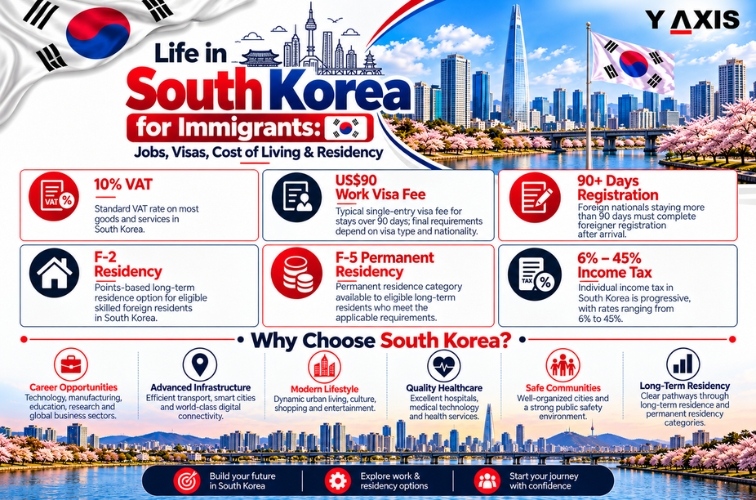
Life in South Korea for Immigrants: Jobs, Visas, Cost of Living & Residency

By , Editor
Updated October 17 2026
Life for immigrants in South Korea offers strong salaries, world-class technology jobs, and a clear route to permanent residency. Most Indian professionals move on an employer-sponsored E-7 work visa, which needs a job offer from a Korean company. The D-10 job-seeker visa lets eligible graduates look for work in Korea for up to 6 months. After a few years, skilled workers can move to the points-based F-2-7 residency visa, which needs 80 points. Permanent residency (F-5) usually follows after 5 years of legal stay, with income and basic Korean language rules. Gangnam, Yongsan, Mapo, Pangyo, and Songdo are popular areas for expats. Korea now has about 2.87 million foreign nationals, and demand for skilled talent in semiconductors, batteries, and IT keeps growing.
Some quick facts about South Korea are as follows:
|
Population |
Approximately 51 million, with about 2.87 million foreign nationals living in the country |
|
Capital |
Seoul (South Korea's capital and largest city) |
|
Official Language |
Korean (English is used in global companies, research, and international schools) |
|
Currency |
South Korean Won (KRW) |
|
Popular Immigrant Hubs |
Seoul (Gangnam, Yongsan, Mapo), Pangyo, Songdo, Busan |
|
Economy |
World leader in semiconductors, batteries, automobiles, shipbuilding, and electronics; strong demand for engineers, IT professionals, and researchers |
|
Typical Route to Long Stay |
Employer-sponsored E-7 work visa, followed by the points-based F-2-7 residency visa |
|
Long-Term Residency |
F-5 permanent residency after about 5 years of legal stay, or 3 years on F-2-7 or the Top-Tier Visa; citizenship by naturalisation after 5 years |
*Want to settle in South Korea? Sign up with Y-Axis for end-to-end assistance.
Why Choose South Korea to Migrate Abroad?
South Korea runs an employer-sponsored work visa system for skilled professionals. It also offers points-based residency and a clear path to permanent residency.
Here is why you should choose a life in South Korea:
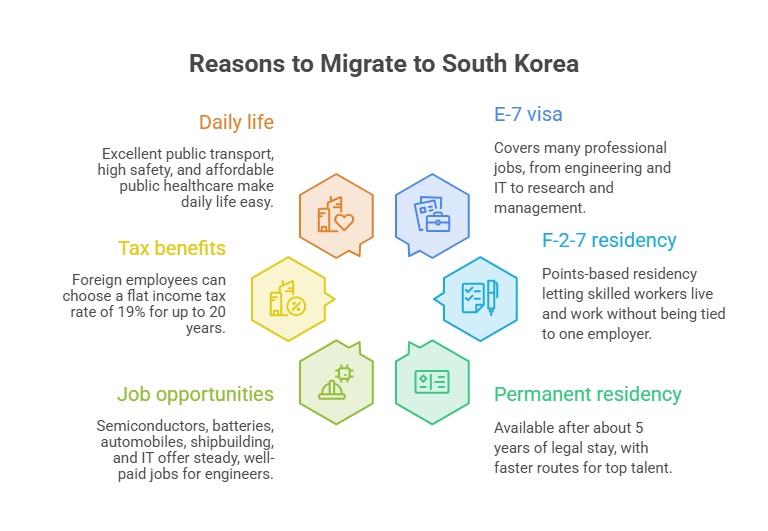
- The E-7 visa covers many professional jobs, from engineering and IT to research and management.
- The F-2-7 points-based residency lets skilled workers live and work in Korea without being tied to one employer.
- Permanent residency (F-5) is available after about 5 years of legal stay, and faster routes exist for top talent.
- Semiconductors, batteries, automobiles, shipbuilding, and IT offer steady, well-paid jobs for engineers.
- Foreign employees can choose a flat income tax rate of 19% for up to 20 years, instead of progressive rates.
- Excellent public transport, high safety, and affordable public healthcare make daily life easy.
Note: Indian passport holders need a visa for any stay in South Korea. The K-ETA travel authorisation applies only to visa-exempt nationalities, so it is not an option for Indian citizens.
*Want to work in South Korea? Let Y-Axis assist you with the process.
Can I Move to South Korea as an Indian Immigrant?
Most Indians move to South Korea on an employer-sponsored E-7 work visa, which needs a confirmed job offer. Graduates of top universities can also use the D-10 job-seeker visa to look for work in Korea first.
The steps to migrate to South Korea as an Indian professional are as follows:
Step 1: Secure a job offer from a Korean employer, since the E-7 visa needs this before you apply
Step 2: Select a suitable pathway, such as the E-7 work visa, D-10 job-seeker visa, or Top-Tier Visa
Step 3: Your employer applies for a Certificate for Confirmation of Visa Issuance from the Korea Immigration Service
Step 4: Apply for your visa at the Korean Embassy or Consulate in India using the issuance number
Step 5: Travel to South Korea once your visa is issued
Step 6: Register for your Alien Registration Card (ARC) at the immigration office within 90 days of arrival
Step 7: Enrol in the National Health Insurance Service, open a local bank account, and get a mobile number
Also, read...
Highest Paying Job Opportunities in South Korea
Best Visa Options to Live in South Korea
South Korea offers several routes depending on your job offer, education, salary, and investment profile. The table below shows the main options for skilled workers and their route to long-term residence.
|
Visa Type |
Best For |
Duration |
Long-Term Pathway |
|
E-7 Work Visa (Specific Activities) |
Job offer from a Korean employer in a listed professional occupation |
Typically 1-3 years, renewable |
Can lead to F-2-7 residency and then F-5 permanent residency |
|
D-10 Job-Seeker Visa |
Graduates of top universities or experienced professionals who score enough points |
Up to 6 months, extendable |
Switch to an E-7 work visa once you find a job |
|
Top-Tier Visa |
Highly paid specialists in high-tech fields, such as semiconductors and batteries |
Long-term stay |
Faster route to F-5 permanent residency after 3 years |
|
D-8 Corporate Investor Visa |
Foreign investors who set up or invest in a Korean company |
1-5 years, renewable |
Can lead to long-term residency with continued investment |
Also, read...
The South Korea Job Market Outlook
Best Areas to Live in South Korea
South Korea's job market and living costs vary by area. Choosing the right neighbourhood can influence your commute, cost of living, housing expenses, and overall quality of life.
The table below highlights the major South Korea areas and their best qualities for settlement abroad:
|
Area |
Best For |
Sightseeing |
Average Rent |
Job Market |
How Much You Can Save |
|
Gangnam (Seoul) |
Corporate professionals |
COEX Mall, Bongeunsa Temple |
KRW 1,000,000-1,600,000/mo (1BR, plus deposit) |
Strong, finance, tech & corporate HQs |
Lower, highest rents |
|
Yongsan & Itaewon (Seoul) |
Expats & international lifestyle |
N Seoul Tower, War Memorial of Korea |
KRW 1,000,000-1,500,000/mo (1BR, plus deposit) |
Good, embassies & global firms |
Lower, high rents |
|
Mapo (Hongdae & Sinchon, Seoul) |
Young professionals & students |
Hongdae street, Han River parks |
KRW 700,000-1,100,000/mo (1BR, plus deposit) |
Good, media, startups & services |
Moderate savings potential |
|
Pangyo (Seongnam) |
IT & tech professionals |
Pangyo Techno Valley, Hyundai Department Store |
KRW 900,000-1,300,000/mo (1BR, plus deposit) |
Very strong, IT, gaming & software |
Moderate savings potential |
|
Songdo (Incheon) |
Families & international schools |
Central Park, Songdo Convensia |
KRW 700,000-1,000,000/mo (1BR, plus deposit) |
Good, biotech & global companies |
Good savings potential |
Note: Most Korean rentals need a deposit (key money) of KRW 5-20 million on top of monthly rent. Figures vary by building age and size. Confirm current listings before budgeting.
Also, read...
What Are the Most In-Demand Jobs in South Korea for the Next 10 Years?
Cost of Living in South Korea
South Korea's cost of living changes by location. Gangnam and Yongsan cost the most, while Mapo, Songdo, and cities outside Seoul are more affordable.
Below is a breakdown of average monthly expenses for a single adult living outside the most premium areas:
|
Rent (1BR apartment, outside prime area, e.g. Mapo/Songdo) |
KRW 700,000-1,100,000/month, plus a deposit |
|
Utilities (electricity, gas, water & building fees) |
KRW 100,000-200,000/month |
|
Groceries |
KRW 400,000-600,000/month |
|
Public Transport (subway / bus with T-money) |
KRW 60,000-100,000/month |
|
Healthcare |
Employees join the National Health Insurance Service (NHIS) and pay about half the premium, with the employer paying the rest; patients pay a share of treatment costs |
|
Dining Out (per meal) |
KRW 9,000-15,000 |
|
Mobile & Internet |
KRW 50,000-80,000/month |
|
Entertainment & Leisure |
KRW 150,000-300,000/month |
Also, read...
What are the Eligibility Requirements for a South Korea Work Visa?
Is South Korea Expensive Compared to Japan or Singapore?
South Korea is generally much cheaper than Singapore, mainly due to lower rents. Living costs in Seoul are broadly similar to Tokyo.
Salaries for skilled professionals are strong compared to living costs. Many immigrants build good savings, especially outside Gangnam and Yongsan.
Gangnam and Yongsan are the priciest areas. However, salaries in semiconductors, IT, and finance are also among the highest. This makes South Korea a strong choice for career growth.\
Work in South Korea
South Korea's job market runs on semiconductors, batteries, automobiles, shipbuilding, and IT. Leading employers include Samsung, SK Hynix, Hyundai, LG, and Naver.
The table below shows some of the most in-demand jobs in South Korea for immigrants.
|
Occupation |
Average Monthly Salary |
Demand Level |
Average Savings |
|
Semiconductor & Electronics Engineering |
KRW 4,000,000-8,000,000 |
Very High |
KRW 1,000,000-2,500,000/month |
|
IT & Software Development |
KRW 3,500,000-7,000,000 |
High |
KRW 800,000-2,000,000/month |
|
Battery & Automotive Engineering |
KRW 3,800,000-7,000,000 |
High |
KRW 900,000-2,000,000/month |
|
Research & Academia |
KRW 3,500,000-6,500,000 |
High |
KRW 800,000-1,800,000/month |
|
Shipbuilding & Manufacturing Engineering |
KRW 3,000,000-5,500,000 |
High |
KRW 600,000-1,500,000/month |
|
Hospitality & Tourism |
KRW 2,200,000-3,200,000 |
Moderate |
KRW 200,000-600,000/month |
Settling in South Korea
Once you arrive in South Korea, you need to register for your Alien Registration Card, join the national health insurance, enrol children in school, and set up your day-to-day essentials.
Here is a quick overview of what to expect during your first weeks in the country:
|
Housing |
Healthcare |
Education for Children |
Banking & Financial Essentials |
|
Search via apps like Zigbang and Dabang, or English-speaking real estate agents; strong demand in Seoul and Pangyo |
Employees are enrolled in the National Health Insurance Service (NHIS) through their employer |
Public schools are low-cost; international schools teach in English, with British, American, and IB curriculum options |
Open an account with KB Kookmin Bank, Shinhan Bank, Woori Bank, or Hana Bank |
|
Landlords usually ask for a deposit (key money) of KRW 5-20 million plus monthly rent; building maintenance fees are extra |
Spouses and children can be added to the employee's NHIS cover as dependants |
International school fees range from around KRW 30 million to KRW 45 million+ a year |
An Alien Registration Card (ARC) and passport are usually needed to open a full bank account |
|
Allow 2-4 weeks to find a rental; contracts usually run for 1-2 years |
Private top-up insurance is optional for wider cover and private hospitals |
Apply for school places early; popular international schools have waitlists |
Basic accounts can be opened within a few days once your ARC is issued |
Permanent Residency and Long-Term Residency in South Korea
Long-term residency in South Korea is mainly available through the F-2-7 points-based residency visa and the F-5 permanent residency visa.
|
E-7 Work Visa Holder |
Renewed every 1-3 years with continuous employment; can move to F-2-7 after meeting stay and points rules |
|
F-2-7 Points-Based Residency |
Needs 80 points based on age, education, Korean language, and income; work for any employer |
|
F-5 Permanent Residency (General) |
Usually needs 5 years of legal stay, income at or above Korea's GNI per capita, and basic Korean skills |
|
F-5 via F-2-7 or Top-Tier Visa |
Faster route after 3 years on F-2-7 or the Top-Tier Visa, if all conditions are met |
|
Korean Citizenship (Naturalisation) |
Generally needs 5 years of continuous legal residence, Korean language and civics knowledge, and good conduct |
Important note: To qualify for F-2-7, you need at least 80 points across age, education, Korean language ability, and annual income. Higher incomes and TOPIK or KIIP scores add more points. F-5 permanent residency generally needs 5 years of legal stay, an income at or above Korea's GNI per capita, and completion of the Korea Immigration and Integration Program (KIIP) or an equivalent Korean language level. The Top-Tier Visa can shorten this to 3 years for highly paid specialists in high-tech fields. Korean citizenship generally needs 5 years of residence, and South Korea does not usually allow dual citizenship for naturalised adults. India also does not allow dual citizenship.
Dependent Benefits for Immigrants in South Korea
South Korea allows E-7 and other professional visa holders to bring their spouse and children on an F-3 dependent visa.
Here are the benefits of securing a South Korea dependent visa:
- Spouses and unmarried children under 19 can join you on an F-3 dependent visa
- Dependent children can study in Korean public schools or international schools
- Family members can be added to your National Health Insurance Service cover as dependants
- F-3 holders need separate permission or their own work visa to take up a job
- F-2-7 and F-5 holders can bring family members on a related residency status, with wider rights to work
Practical Settlement Checklist for Indians Moving to South Korea
The steps for smooth transition to South Korea for Indians are as follows:
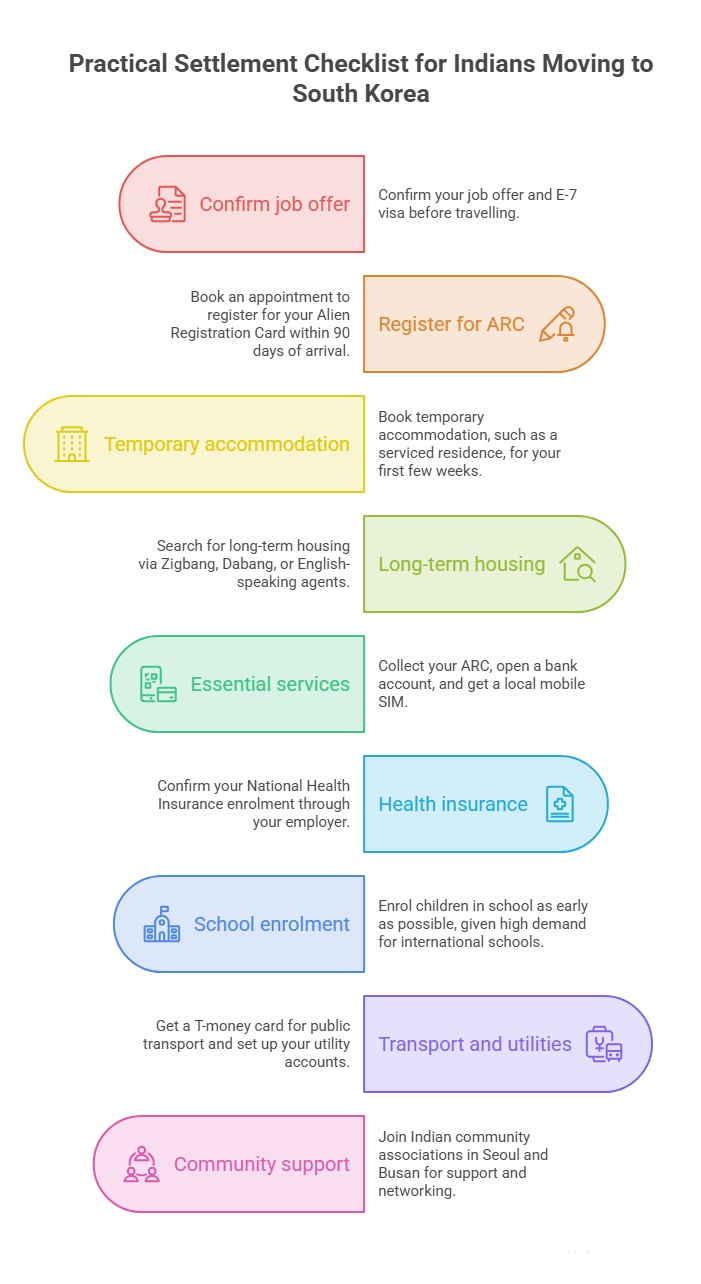
Step 1: Confirm your job offer and E-7 visa before travelling, since Korea's employment route requires this in advance
Step 2: Book an appointment to register for your Alien Registration Card (ARC) within 90 days of arrival
Step 3: Book temporary accommodation, such as a serviced residence, for your first few weeks
Step 4: Search for long-term housing via Zigbang, Dabang, or English-speaking agents
Step 5: Collect your ARC, open a bank account, and get a local mobile SIM
Step 6: Confirm your National Health Insurance enrolment through your employer
Step 7: Enrol children in school as early as possible, given high demand for international schools
Step 8: Get a T-money card for public transport and set up your utility accounts
Step 9: Join Indian community associations in Seoul and Busan for support and networking
*Are you looking for step-by-step assistance with South Korea immigration? Contact Y-Axis, the world's No. 1 overseas immigration consultancy!
FAQs
What is the easiest way for Indians to move to South Korea?
Most Indians move on an employer-sponsored E-7 work visa, which needs a confirmed job offer from a Korean company. Graduates of top universities can also apply for the D-10 job-seeker visa to look for work in Korea first. Highly paid specialists in high-tech fields may qualify for the Top-Tier Visa.
What is the E-7 visa in South Korea?
The E-7 visa is South Korea's main work visa for foreign professionals. It covers listed occupations such as engineers, IT specialists, researchers, and managers. You need a job offer, a relevant degree or work experience, and a salary that meets the minimum set for your job.
Can I move to South Korea without a job offer?
It is difficult, since the E-7 visa needs confirmed employment. However, the D-10 job-seeker visa lets eligible graduates and professionals stay in Korea for up to 6 months to look for work. Investors can also set up a company and apply for a D-8 investor visa.
Is healthcare free for immigrants in South Korea?
No. Healthcare is not free, but it is affordable. Employees join the National Health Insurance Service through their employer and pay about half the premium. Patients also pay a share of treatment costs, which is usually low compared to private healthcare in many countries.
What is the average salary for skilled workers in South Korea?
Salaries vary by sector and experience. IT professionals typically earn KRW 3.5-7 million a month, and semiconductor engineers earn KRW 4-8 million a month. Foreign employees can choose a flat income tax rate of 19% for up to 20 years.
Can I bring my family to South Korea on a work visa?
Yes. E-7 visa holders can bring their spouse and unmarried children under 19 on an F-3 dependent visa. Family members can be added to your national health insurance as dependants. Children can study in public or international schools.
Which area in South Korea is best for Indian immigrants?
Gangnam and Yongsan offer premium living and strong job access, though they cost the most. Pangyo suits IT professionals, as many tech companies are based there. Mapo and Songdo suit budget-conscious professionals and families looking for lower rents.
How much does it cost to live in South Korea?
South Korea's cost of living varies by area. In Gangnam, a one-bedroom flat costs around KRW 1-1.6 million a month, plus a deposit. In Mapo or Songdo, similar housing costs about KRW 0.7-1.1 million. Groceries, utilities, and transport add around KRW 0.6-0.9 million a month.
How do I get permanent residency in South Korea?
Most professionals move from an E-7 visa to the F-2-7 points-based residency visa, which needs 80 points. F-5 permanent residency generally needs 5 years of legal stay, an income at or above Korea's GNI per capita, and basic Korean skills. F-2-7 and Top-Tier Visa holders can apply after 3 years.
How can I get South Korean citizenship?
Naturalisation generally needs 5 years of continuous legal residence, good conduct, and a pass in the Korean language and civics test. South Korea does not usually allow dual citizenship for naturalised adults. India also does not allow dual citizenship, so you would need to give up your Indian citizenship.
Tags:
South Korea immigration
South Korea work visa
Korea E-7 visa
Living in South Korea
Cost of living in South Korea
Best areas in Seoul
Jobs in South Korea for Indians
Healthcare in South Korea
Housing in South Korea
Settle in South Korea
Share
Options for you by Y-Axis

Get it on your mobile

Get News alerts

Contact Y-Axis
Latest Article
Popular Post
Trending Article
Posted On October 16 2026
Australia Updates Health Insurance Guidance for Visa Holders: What You Need to Know