

Posted on July 09 2026
What are the Eligibility Requirements for a South Korea Work Visa?

By , Editor
Updated July 12 2026
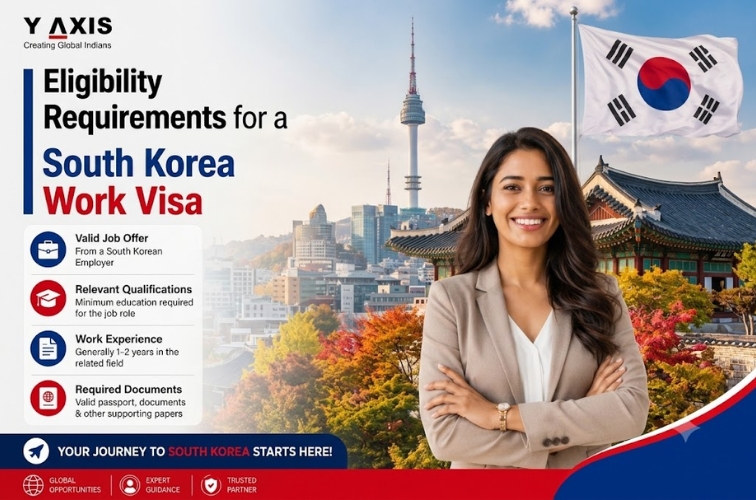
To apply for a South Korea work visa from India, you need a confirmed job offer from a Korean employer for a role designated as eligible by South Korea's Ministry of Justice. Foreign applicants also need to secure a Confirmation of Visa Issuance (CVI) processed through the Korea Immigration Service. The process is largely employer-led with your Korean employer filing the CVI application with the local immigration office in Korea. The most common route for Indian professionals is the E-7 (Specific Activity) visa, covering specialised and skilled occupations across IT, engineering, finance, and manufacturing. Once your visa is issued and you arrive in Korea, you must register for an Alien Registration Card (ARC) at the local immigration office within 90 days. This serves as your official proof of identity and residency in Korea for legal work and settlement.
*Interested to work in South Korea? Let Y-Axis assist you with the process.
Eligibility Criteria to Apply for a South Korea Work Visa from India
Applying for a South Korea work visa from India requires employer sponsorship under South Korea's Immigration Control Act. The employer files for a Confirmation of Visa Issuance (CVI) through the Korea Immigration Service. Foreign nationals cannot self-sponsor an E-7 visa and the procedures are mainly employer-initiated. South Korea work visa processing time takes around 4 to 8 weeks. It takes around 2 to 6 weeks for CVI approval in Korea, followed by about 10 working days for visa stamping at the Korean Embassy or VFS Global/BLS International centres in India.
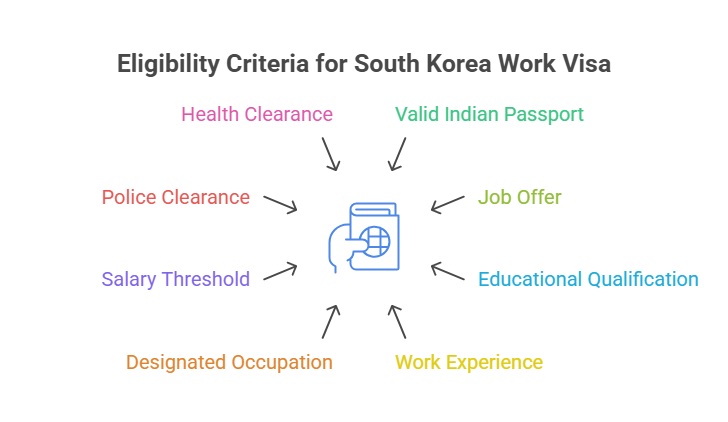
- Valid Indian passport
- Confirmed job offer/signed employment contract from a Korean employer, specifying job title, salary, and contract duration
- Bachelor's degree (or higher) relevant to the applied occupation, or equivalent professional experience
- Minimum 1 to 5 years of relevant work experience
- Role must match one of the 87+ occupations designated by the Ministry of Justice
- Salary threshold meeting the applicable minimum requirements for the occupation subcategory
- A valid Police Clearance Certificate (PCC) from India
- Health/medical clearance
*Interested to apply for a South Korea work visa? Sign up with Y-Axis for end-to-end assistance.
Watch to Know More: South Korea's India Visit Opens NEW Study & Work Opportunities for Indians!
Eligibility Requirements by Visa and Permit Type
South Korea's work authorisation system is built around Ministry of Justice-designated visa categories rather than a single generic work visa.
The table below outlines the main visa and permit types relevant to Indian professionals.
| Visa / Permit Type | Who Can Apply | Fee | Validity | Key Benefit |
|---|---|---|---|---|
| E-7-1 (Professionals) | Managers, engineers, IT specialists, and other professionals in designated occupations with a bachelor's degree and at least one year of experience (or a master's degree, subject to eligibility). | Standard long-term visa consular fee (approximately ₹5,100) plus VFS/BLS service charges; no separate government work permit fee. | Up to 3 years initially; renewable. | Most common route for skilled foreign professionals with a broad range of eligible occupations. |
| E-7-2 (Semi-Professional) | Office and service workers in designated semi-professional occupations. | Standard consular fee structure. | Up to 3 years; renewable. | Lower salary threshold than E-7-1 for eligible occupations. |
| E-7-3 (General Skilled Labourers) | Skilled trade workers in designated occupations. | Standard consular fee structure. | Up to 3 years; renewable. | Suitable pathway for qualified skilled tradespeople. |
| E-7-4 (Points-Based Skilled Worker) | Primarily existing E-9, E-10, or H-2 visa holders in Korea who meet the required points and employment criteria. | Standard consular fee structure. | Extended stay based on the K-Point system. | Provides a pathway toward long-term residence for eligible workers already in Korea. |
| D-7 (Intra-Company Transfer) | Employees transferred from an overseas branch to a Korean branch or subsidiary of the same multinational company. | Standard consular fee structure. | Up to 3 years; renewable. | Facilitates internal company transfers without requiring a local job search. |
| D-8 (Business Investment) | Foreign entrepreneurs and investors establishing or managing a business in South Korea. | Standard consular fee structure plus applicable business registration costs. | Linked to the validity of the business registration; renewable. | Allows business ownership and self-employment in South Korea. |
| Alien Registration Card (ARC) | All E- and D-series visa holders staying in South Korea for more than 90 days. | Approximately KRW 30,000 (around ₹1,900) for card issuance. | Valid for the same period as the underlying visa and renewed accordingly. | Serves as official proof of identity and residence; required for banking, mobile services, and access to healthcare. |
*Want to apply for South Korea entry visa? Let Y-Axis assist you with the process.
What are the Employer Requirements for Sponsoring Indian Professionals in South Korea?
Korean employers sponsoring an E-7 visa must demonstrate legitimate and sustainable business operations. This is to show that hiring a foreign professional is necessary and justified, while complying with the Ministry of Justice's foreign employee ratio guidelines. Employers must also submit company financial statements, tax payment records, and supporting documentation to the local Korea Immigration Service office.
- Company must hold legitimate business registration and demonstrate ongoing commercial operations in Korea
- Must justify why the specific role cannot be filled by a Korean national and why the foreign hire is essential
- Must comply with the foreign-to-domestic employee ratio applicable to E-7 sponsorship, which varies by company size and sector
- Must submit company financial statements, tax payment records, and a list of national employees as part of the CVI application
- The employer, not the employee, files the Confirmation of Visa Issuance (CVI) application with the local Korea Immigration Service office
Also, read...
South Korea Job Market in 2026–30
E-7 Occupation Categories and the K-Point System
South Korea's E-7 visa is built around a fixed list of Ministry of Justice-designated occupations rather than open eligibility. The job that you are hired for must match one of the approved occupation codes in the occupation list. The E-7-4 subcategory uses a separate points-based assessment, the K-Point System, primarily for long-term E-9, E-10, or H-2 visa holders already working in Korea.
| Category | Details |
|---|---|
| E-7-1 Visa | Covers 67 professional and managerial occupations, including software developers, engineers, finance specialists, and other highly skilled roles. It is the primary work visa route for many Indian IT and technical professionals. |
| E-7-2 & E-7-3 Visas | Cover 10 semi-professional occupations (E-7-2) and 10 skilled trade occupations (E-7-3), providing opportunities across a range of technical and vocational fields. |
| E-7-4 Eligibility | Assessed through the K-Point System, which considers salary, years of legal employment in South Korea, professional certifications, and Korean language proficiency. Applicants generally require at least 200 out of 300 points. |
| 2026 E-7-4 Quota | The annual quota is 33,000 applicants, with applications accepted throughout the year via the HiKorea portal under a rotational allocation system. |
| Top-Tier Visa Track | Designed for highly qualified professionals earning at least three times South Korea's GNI per capita, holding a master's degree from a top-ranked university, or having experience with a Global 500 company. Eligible applicants may qualify for F-5 permanent residence after 3 years instead of the standard 5–6 years. |
| 2030 Immigration Policy Future Strategy | Announced in March 2026, this strategy aims to simplify 39 employment visa categories into three skill-based tiers and introduce the proposed E-7-M visa for eligible foreign graduates. |
Also, read...
Top In-Demand Jobs in South Korea for Indians
Salary Standards and Tax Benefits for Indian Professionals
South Korea's Ministry of Justice sets minimum annual salary thresholds for each E-7 subcategory, reviewed annually. Beyond the visa's own salary rules, Korea also offers a distinctive tax advantage that makes it financially attractive compared to many other work-visa destinations.
| Category | Details |
|---|---|
| E-7-1 Minimum Salary | KRW 31,120,000 per year (approximately ₹19–20 lakh) for applications submitted between February 1 and December 31, 2026. |
| E-7-2 & E-7-3 Salary | Approximately KRW 31–33 million per year (around 80% of South Korea's GNI per capita), depending on the occupation. |
| Top-Tier Visa Salary | Minimum annual income equivalent to three times South Korea's GNI per capita. |
| Eligible Salary Components | Only base salary and fixed allowances are counted. Meal and transport reimbursements are excluded. |
| Foreign Worker Tax Option | Eligible employees who begin work by December 31, 2026, may opt for a flat 19% income tax (20.9% including local surtax) for up to 20 years. |
| Working Hours & Social Security | Standard 40-hour workweek with mandatory enrolment in the National Pension Service (NPS) and National Health Insurance Service (NHIS). |
| India–Korea DTAA | The India–South Korea Double Taxation Avoidance Agreement (DTAA) helps prevent double taxation on the same income earned by Indian professionals working in South Korea. |
Also, read...
What are the most in-demand jobs in South Korea for the next 10 years?
Job Mobility and Family Sponsorship on a South Korea Work Visa
South Korea allows E-7 visa holders a degree of flexibility in changing employers and bringing family members, though both come with specific conditions set by the Ministry of Justice.
- E-7 visa holders can request an employer change through the Korea Immigration Service
- Spouses and children can join E-7 visa holders in Korea through the F-3 Dependent Family Visa
- Workers already in Korea on an E-9, E-10, or H-2 visa may upgrade to E-7-4 status after 4 or more years of legal employment within the past 10 years, subject to K-Point System scoring
- Long-term E-7 visa holders who complete 5 years of continuous legal residence, meet income and language requirements via the Korea Immigration and Integration Program (KIIP), and maintain a clean record become eligible to apply for F-5 Permanent Residency
Also, read...
What Sector-Specific Requirements Apply for South Korea Work Visas?
Certain professions in South Korea require additional regulatory recognition or fall under separate visa categories. The table below outlines sector-specific considerations for Indian professionals.
| Sector | Additional Requirements |
|---|---|
| Information Technology & Software | One of the largest sectors for E-7-1 sponsorship. Software development, cloud computing, AI, and cybersecurity are included among the 67 designated E-7-1 occupations. No separate technology licence is required, as employers assess qualifications and work experience directly. South Korea continues to expand foreign hiring in the tech and semiconductor industries under its 2030 Immigration Policy Future Strategy. |
| Shipbuilding & Manufacturing | Major shipbuilders such as HD Hyundai and Samsung Heavy Industries recruit foreign professionals, including Indian E-7 visa holders, for technical and engineering roles. The proposed E-7-M visa is intended to support foreign graduates of Korean technical colleges seeking employment in the manufacturing sector. |
| Healthcare & Nursing | Foreign-trained doctors, nurses, and allied health professionals must obtain recognition or licensing from the relevant Korean health authority before practising. Eligible applicants generally apply under the appropriate employment visa category based on their profession. |
| Finance & Accounting | Finance professionals, accountants, and risk or compliance specialists commonly apply under the E-7-1 visa. Internationally recognised professional qualifications are advantageous, while regulated financial positions may require compliance with Korean licensing and regulatory requirements. |
| Research & Development (E-3) | Scientists and researchers employed by Korean research institutes or corporate R&D centres generally apply under the E-3 Researcher Visa instead of the E-7 category. Eligible foreign researchers may also qualify for tax incentives under applicable regulations. |
| Education (E-1 / E-2) | University professors normally apply under the E-1 Professor Visa, while eligible language instructors may apply under the E-2 Visa. These visa categories are separate from the standard E-7 employment route. |
Also, read...
Why apply for a South Korea Digital Nomad Visa?
How to Apply for a South Korea Work Visa from India?
The South Korea work visa process is employer-led at the Confirmation of Visa Issuance (CVI) stage, followed by an embassy or visa-centre application in India. The employer secures CVI approval in Korea first, after which the employee applies for the visa itself.
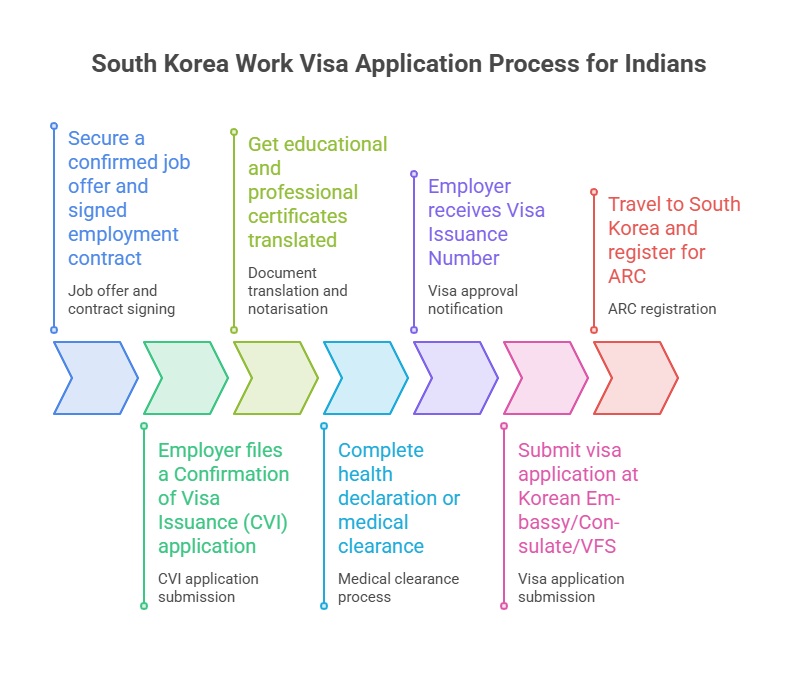
The steps to apply for a South Korea work visa for Indians are as follows:
Step 1: Secure a confirmed job offer and signed employment contract from a Korean employer.
Step 2: Your employer files a Confirmation of Visa Issuance (CVI) application with the local Korea Immigration Service office.
Step 3: Get your educational and professional certificates translated into Korean or English, with notarisation or apostille confirmation as required.
Step 4: Complete any required health declaration or medical clearance requested by your employer or Korea Immigration Service.
Step 5: Once approved, your employer receives the Visa Issuance Number and shares it with you to complete your visa application.
Step 6: Submit your visa application at the Korean Embassy in New Delhi, the Consulate General in Mumbai, or through VFS Global/BLS International centres in India, along with your Visa Issuance Number and required documents.
Step 7: Once your visa is approved, travel to South Korea and register for your Alien Registration Card (ARC) at the local immigration office to legally start living and working in the country.
*Are you looking for step-by-step assistance with overseas immigration? Contact Y-Axis, the world's No. 1 overseas immigration consultancy
FAQs
What is the South Korea work visa for Indians?
The South Korea work visa for most Indian professionals is the E-7 (Specific Activity) visa, an employer-sponsored visa for specialised and skilled occupations designated by the Ministry of Justice. The process is managed through a Confirmation of Visa Issuance (CVI) filed by your Korean employer with the local Korea Immigration Service office. India is not currently part of Korea's Employment Permit System (EPS) for non-professional E-9 workers, so the E-7 route remains the primary path for skilled Indian applicants, especially in IT, engineering, and manufacturing.
Can Indian nationals apply for a South Korea work visa?
Yes. Indian professionals are increasingly employed in South Korea, particularly in IT, engineering, shipbuilding, and finance. Major Korean shipbuilders such as HD Hyundai and Samsung Heavy Industries have been directly hiring Indian E-7 visa holders. The process is employer-initiated — your Korean employer files the Confirmation of Visa Issuance (CVI) application on your behalf. You cannot self-sponsor. Once approved, you apply for the visa itself at the Korean Embassy in New Delhi, the Consulate in Mumbai, or through VFS Global/BLS International centres in India.
What are the documents required for a South Korea work visa from India?
Documents typically include a valid Indian passport with at least 6 months' remaining validity, a signed employment contract specifying salary and job duties, educational and professional certificates translated into Korean or English with notarisation or apostille as required, a Police Clearance Certificate (PCC), recent passport-sized photographs, and any health declaration or medical clearance requested by your employer. Your employer separately submits company financial statements and supporting documentation as part of the Confirmation of Visa Issuance (CVI) application.
What is the South Korea work visa fee for Indian applicants?
Unlike many Gulf countries, South Korea does not charge a separate government work-permit fee. Indian applicants pay the standard long-term visa consular fee of approximately ₹5,100 for stays over 90 days, plus a VFS Global or BLS International service fee of around ₹1,100 to ₹1,380. After arrival, Alien Registration Card (ARC) registration carries a nominal fee of approximately KRW 30,000 (~₹1,900). Additional costs may apply for document translation, notarisation, or apostille attestation.
How long does the South Korea work visa process take?
The process typically takes 4 to 8 weeks in total. The Confirmation of Visa Issuance (CVI) stage, handled by your employer with the Korea Immigration Service, generally takes 2 to 6 weeks depending on the occupation category and completeness of the application. Visa stamping at the Korean Embassy or VFS Global/BLS International centres in India typically takes around 10 working days, though processing can extend during peak periods or if additional documentation is requested.
Can I change jobs on a South Korea work visa?
Yes, E-7 visa holders can request an employer change through the Korea Immigration Service, though the process requires the new employer to file supporting documentation and justify the transfer. Unlike a fully open job market, your new role must still match an approved E-7 occupation category and meet the applicable salary threshold. Workers on E-9, E-10, or H-2 visas may also upgrade to E-7-4 status after 4+ years of legal employment, subject to K-Point System scoring.
Can my family come with me on a South Korea work visa?
Yes. E-7 visa holders can bring their spouse and children to South Korea through the F-3 Dependent Family Visa. However, F-3 dependents generally cannot work in Korea unless they separately qualify for and obtain a work-eligible visa status change. Children with a valid residence status can access South Korea's education system. Family members also become eligible for National Health Insurance Service coverage once registered as legal residents.
What is the flat tax rate benefit for foreign workers in South Korea?
Foreign workers who begin employment in Korea by December 31, 2026 can elect a flat 19% national income tax rate (20.9% including the local surtax) instead of Korea's standard progressive rates of 6% to 45%. This election is available for up to 20 years of Korean tax residency and is generally most advantageous for those earning above roughly KRW 70-80 million annually, though it forfeits standard deductions, so comparing both systems is recommended.
What sectors are actively hiring Indian professionals in South Korea?
South Korea actively hires Indian professionals in IT and software (cloud computing, AI, cybersecurity — all E-7-1 designated occupations), shipbuilding and manufacturing (HD Hyundai and Samsung Heavy Industries employ Indian E-7 workers directly), semiconductors, finance and accounting, and research and development under the E-3 Researcher visa. South Korea's 2030 Immigration Policy Future Strategy is further expanding skilled worker pathways, including a new E-7-M visa for manufacturing graduates.
Can a South Korea work visa lead to permanent residency?
Yes. E-7 visa holders who complete 5 years of continuous legal residence, meet income and Korean language requirements through the Korea Immigration and Integration Program (KIIP), and maintain a clean record become eligible for F-5 Permanent Residency. A Top-Tier Visa track offers an accelerated path to F-5 after just 3 years for highly qualified applicants meeting specific salary, education, or global employer criteria. Y-Axis can advise on the pathway best suited to your profile.
Tags:
Work in South Korea
South Korea work visa
migrate to South Korea
South Korea immigration
eligibility requirements for South Korea work visa
South Korea E-7 visa for Indians
South Korea work permit for Indians
Alien Registration Card
South Korea fl
Share
Options for you by Y-Axis

Get it on your mobile

Get News alerts

Contact Y-Axis
Latest Article
Popular Post
Trending Article
Posted On October 16 2026
Australia Updates Health Insurance Guidance for Visa Holders: What You Need to Know