


Posted on June 23 2026
Work in South Korea and Get Permanent Residency in 3 Years Under Expanded Top-Tier Visa. Check Your Eligibility Now!

By , Editor & Director
Updated June 23 2026
Highlights: South Korea Opens Fast-Track Permanent Residency Path for Global Talent
- South Korea expanded its Top-Tier Visa on June 1, 2026, for professors, researchers, and science and technology experts.
- The Top-Tier visa in South Korea offers F-2 resident status, family benefits, a 3-year PR pathway, and a 2-year job-seeker permit.
- Global industry professionals need a top-100 university degree, 8+ years of experience, and a qualifying high salary for visa approval
- Researchers and academics will be assessed based on awards, publications, research impact, and technology commercialisation achievements.
- South Korea is set to attract 2,000 global science and technology professionals by 2030 to boost innovation and R&D.
*Want to apply for a South Korea work visa? Let Y-Axis assist you with the process.
South Korea Streamlines Permanent Residency in 3 Years for Skilled Professionals
South Korea has announced a major expansion of its Top-Tier Visa programme, extending eligibility to professors, researchers, and science and technology experts from around the world. The move is aimed at attracting highly skilled talent to support the country's innovation and research ecosystem.
The updated programme offers a fast-track route to residency while broadening access beyond corporate professionals in strategic industries. The expansion is part of South Korea's plan to strengthen its global competitiveness in advanced technologies and research.
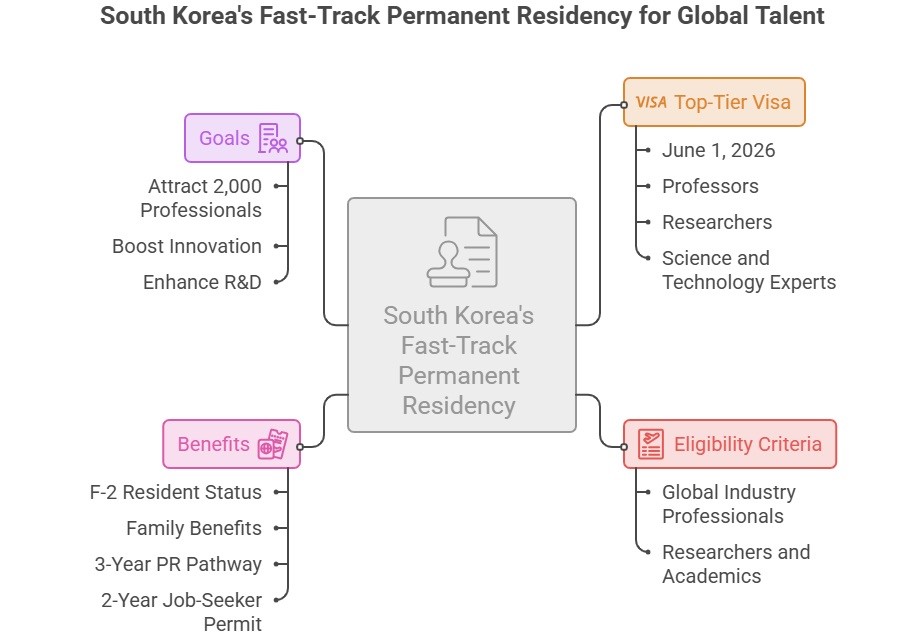
| Category | Details |
|---|---|
| Successful applicants receive | F-2 resident status, family residency benefits, a pathway to permanent residency after 3 years, and a 2-year job-seeker visa to access South Korea's booming job market. |
| Who qualifies? | High-tech professionals with a Master's or PhD from a top-100 university, at least 8 years of experience, 3 or more years at a leading global company, and a qualifying salary. |
| What's changing? | Eligibility now includes university professors, research scientists, technology researchers, and academics involved in innovation and technology commercialisation. |
Also, read...
Highest Paying Jobs in South Korea for Indians
Why Is South Korea Expanding the Top-Tier Visa Programme in 2026?
South Korea has widened the scope of its Top-Tier Visa to attract world-class talent in science and technology. The expansion comes amid growing global competition for researchers and highly skilled professionals in advanced sectors.
The initiative supports South Korea's long-term economic strategy by addressing talent shortages and strengthening research capabilities across universities, government institutes, and corporate R&D centres.
The major highlights of South Korea fast-tracking permanent residence for global talent are as follows:
- South Korea aims to attract 2,000 science and technology professionals by 2030.
- The programme now targets researchers, academics, and professors in addition to industry professionals.
- Applicants may qualify based on research publications, international awards, innovation achievements, and technology commercialisation contributions.
- The expansion helps address challenges such as an ageing population, declining birth rate, and shortage of specialised researchers.
- South Korea is strengthening its talent pool in AI, semiconductors, biotechnology, and advanced research sectors.
- Eligible candidates can join universities, government-funded research institutes, and corporate R&D laboratories.
- The policy supports South Korea's goal of maintaining its position as a global technology leader.
- Major employers expected to benefit include Samsung Electronics, SK Hynix, and LG Electronics.
Also, read...
What Does South Korea's Expanded Top-Tier Visa Mean for Indian Professionals?
South Korea's expanded Top-Tier Visa programme could create new opportunities for highly skilled Indian professionals seeking international career and research prospects. The inclusion of academics and researchers broadens access to one of Asia's fastest pathways to permanent residency.
Here’s how Indian professionals will benefit from South Korea’s fast-track immigration and PR pathway in 2026:
- Indian engineers, researchers, and technology professionals may benefit from expanded visa eligibility.
- AI specialists, semiconductor experts, and biotechnology professionals are among the key talent groups targeted.
- University professors and academic researchers can now qualify under the broadened programme.
- Indian professionals working for global technology firms may find it easier to access opportunities in South Korea.
- Eligible applicants can obtain permanent residency after just three years of residence.
- The programme offers family residency benefits and a two-year job-seeker visa for qualified candidates.
- South Korea's growing investment in research and innovation could increase demand for Indian STEM talent.
*Are you looking for step-by-step assistance with overseas immigration? Contact Y-Axis, the world’s No. 1 immigration consultancy!
For recent immigration updates, check out the Y-Axis News Page!
FAQs
What is South Korea's Top-Tier Visa?
South Korea's Top-Tier Visa is a special long-term residence programme designed to attract highly qualified foreign professionals. It offers successful applicants F-2 resident status, family residency benefits, a pathway to permanent residency after three years, and a two-year job-seeker visa while searching for qualifying employment. The programme was launched to strengthen South Korea's talent pool in strategic sectors such as artificial intelligence, semiconductors, biotechnology, and now science and technology research and academia.
Who is newly eligible under the expanded Top-Tier Visa programme?
From June 1, 2026, South Korea expanded the Top-Tier Visa to include university professors, research scientists, technology researchers, and academics involved in innovation and technology commercialisation. Previously, the programme mainly targeted senior professionals working in advanced industries such as AI and semiconductors. The expansion allows qualified academic and research professionals to apply based on research achievements, publications, awards, and innovation contributions rather than only corporate employment history.
What benefits do successful applicants receive?
Successful applicants receive long-term F-2 resident status, which allows them to live and work in South Korea. Their spouses and family members may also reside in the country. In addition, the programme provides a pathway to permanent residency after three years and a two-year job-seeker visa that allows eligible candidates to remain in South Korea while searching for qualifying employment with universities, research institutes, government-funded organisations, or high-tech companies.
What are the eligibility requirements for high-tech industry professionals?
High-tech industry applicants generally need a Master's degree or PhD from a top-100 global university, at least eight years of professional experience, and at least three years of experience with a Fortune Global 500 or equivalent leading company. They must also secure employment with a qualifying South Korean high-tech employer and meet a salary threshold set at more than three times South Korea's per-capita gross national income, which is roughly above US$100,000 annually.
How are professors and researchers assessed under the new rules?
Professors and researchers are assessed using criteria focused on academic and research excellence rather than corporate experience alone. Authorities consider internationally recognised awards, published research, academic achievements, contributions to technology commercialisation, research experience, and the overall impact of the applicant's work. This approach broadens eligibility for scientists and academics who may not have worked in multinational corporations but have made significant contributions to research, innovation, or technological development.
Why is South Korea expanding this visa programme?
South Korea is expanding the programme because it faces growing global competition for highly skilled talent. The country is dealing with an ageing population, a declining birth rate, shortages of specialised researchers, and intense competition in AI, semiconductors, and biotechnology. By attracting world-class scientists, academics, and technology professionals, South Korea aims to strengthen its universities, research institutes, and corporate R&D capabilities while maintaining its position as a leading global technology and innovation hub.
How many professionals does South Korea aim to attract?
The South Korean government aims to attract 2,000 science and technology professionals by 2030 through the expanded Top-Tier Visa programme. These professionals are expected to support research and innovation across universities, government-funded think tanks, corporate laboratories, and advanced technology industries. The initiative is part of a broader national strategy to address talent shortages and boost the country's long-term competitiveness in emerging technologies and high-value research sectors.
What does this mean for Indian professionals?
The expansion could create significant opportunities for Indian professionals because India supplies a large share of global STEM talent. Engineers, AI specialists, semiconductor researchers, biotechnology professionals, and university academics may now have wider access to South Korea's talent visa. The relatively fast pathway to permanent residency, combined with opportunities in research, higher education, and advanced technology sectors, may make South Korea a more attractive destination for qualified Indian candidates.
Can family members accompany Top-Tier Visa holders?
Yes. One of the key advantages of the Top-Tier Visa is that it allows spouses and family members to reside in South Korea together with the principal applicant. This family-friendly feature is intended to make relocation more attractive for highly skilled international professionals. In addition to residence benefits for family members, the main applicant receives long-term resident status and a pathway to permanent residency, providing greater stability than many temporary work visa programmes.
Which sectors and institutions are expected to benefit most from the expansion?
Universities, government-funded research institutes, corporate R&D laboratories, and advanced technology companies are expected to benefit most. The programme is designed to strengthen talent pipelines in artificial intelligence, semiconductors, biotechnology, and other science and technology fields. Major South Korean companies such as Samsung Electronics, SK Hynix, and LG Electronics could benefit from improved access to highly skilled global researchers and specialists as the country works to expand its innovation and research capacity.
📞 Call: +91-7670800000
📩 Email: info@y-axis.com
🌐 Visit: https://www.y-axis.com
Tags:
Permanent residence in South Korea
work in South Korea
South Korea work visa
South Korea PR
South Korea Top-Tier visa
overseas immigration
migrate to South Korea
South Korea immigration news
Share
Options for you by Y-Axis

Get it on your mobile

Get News alerts

Contact Y-Axis
Latest Article
Related Post
Trending Article

Posted On September 16 2026
Belarus Makes Travel Easier for Indians With New E-Visa Facility. Apply Now!