

Posted on April 17 2026
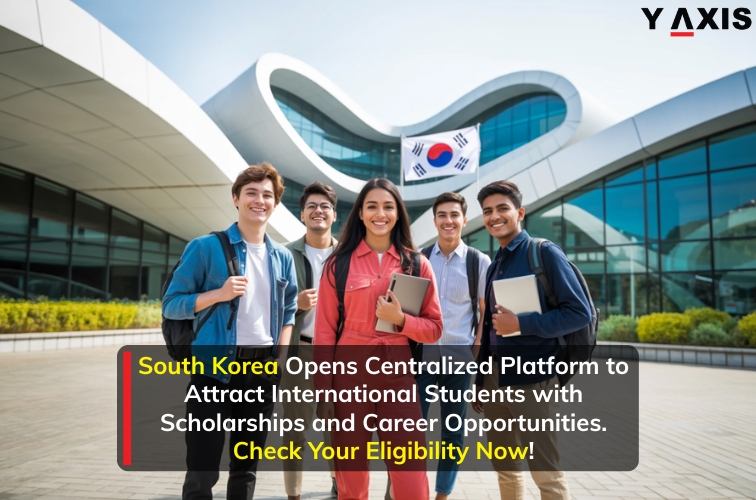
South Korea Opens Centralized Platform to Attract International Students with Scholarships and Career Opportunities. Check Your Eligibility Now!

By , Editor
Updated April 26 2026
Highlights: South Korea Launches New Digital Hub for Overseas Students
- South Korea has launched a permanent digital promotion hub with live admission webinars for international students.
- The centralized platform will provide comprehensive information on universities' scholarships, visas, and employment opportunities in South Korea.
- The online portal for global students is an initiative by South Korea's Ministry of Education in partnership with the National Institute for International Education.
- The new promotion hub can be accessed through the government-run official portal established in 2012 for international students.
- The newly launched centralized hub is a permanent system that will replace the short-term online fairs conducted to acquire eligible students.
*Want to apply for a South Korea student visa? Let Y-Axis guide you with the process.
South Korea Opens Permanent Student Recruitment Platform to Expand Work and Study Opportunities
South Korea has recently launched a new online promotion hub to conduct live admission webinars for international students. The centralized platform is a dedicated system designed to attract international students, with live updates on scholarships and career opportunities in South Korea.
The permanent digital promotion hub will share comprehensive information about universities, scholarships, visas, and employment. This centralized system will also support educational fair applications and scholarship updates throughout the year.
The Ministry of Education has introduced the initiative in partnership with the National Institute for International Education in South Korea to replace short-term online fairs with a permanent system.
While prospective international students can keep track of new updates in real time, universities and local institutes in the country can also maintain continuous engagement with applicants.
Here is how South Korea’s centralized online promotion hub works for overseas students:
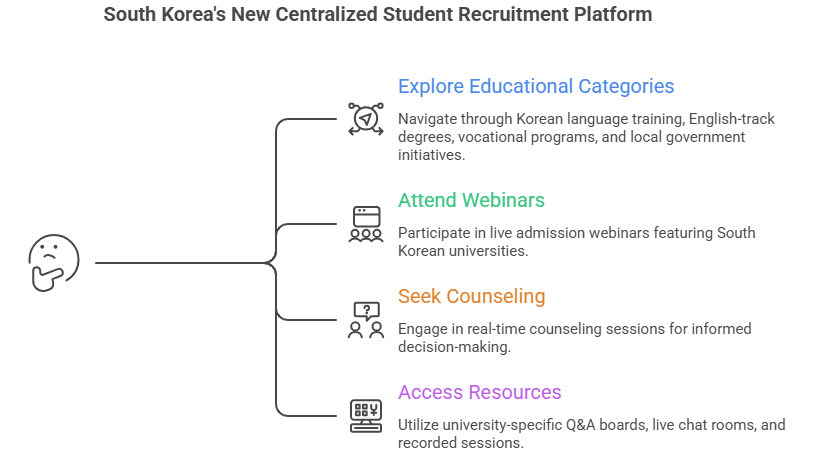
- The platform interface is divided into four sections based on educational categories.
- The four sections comprise Korean language training programs, English-track degree courses, junior college vocational programs, and local government initiatives such as student support policies and regional visa programs.
- The portal will host a webinar-based admission fair on Sundays featuring 40 universities in South Korea.
- Real-time counseling sessions will be held to help overseas students make an informed choice.
- Every session will include briefings about language training, employment-linked programs, and degree courses.
- Interested candidates can access university-specific question-and-answer boards, live chat rooms, and recorded sessions through the online platform.
Also, read...
South Korea Expands Visas for Foreign Talent – Check Your Eligibility Now!
How will South Korea’s Online Promotion Hub Benefit International Students?
South Korea’s newly launched online promotion hub is a year-long initiative to share important study updates to overseas students. The centralized information portal aims to make studying in South Korea more accessible to international students.
The benefits of a dedicated online portal for international students in South Korea are as follows:
- Access to all university programs and admission details in one place.
- Scope to apply for a scholarship and financial support for study abroad.
- Simplified student visa guidance and requirements.
- Discover part-time work and post-study job opportunities.
- live webinars and virtual university events, driving easier admission pathways.
- Year-round application and admission updates to make informed study-abroad decisions.
Are you looking for step-by-step assistance with overseas immigration? Contact Y-Axis, the world’s No. 1 overseas immigration consultancy!
For recent immigration updates, check out Y-Axis News Page!
FAQs
What is the new Study in Korea online hub and what does it offer?
South Korea's Ministry of Education and the National Institute for International Education (NIIED) have launched a permanent virtual exhibition on the official "Study in Korea" portal. Unlike the earlier short-term online fairs that ran for about 10 days at a time, this hub is now a year-round platform offering integrated information on university programs, scholarships, visas, and job opportunities for international students. Think of it as your one-stop shop before you even begin your application journey, available any time, any day.
What sections does the Study in Korea portal cover?
The hub is organized into four sections: Korean language training programs offered by university-affiliated institutes; English-track degree programs; junior college programs focused on vocational education; and local government initiatives, including student support policies and region-specific visa programs. So whether you're keen on learning Korean first or jumping straight into an English-taught degree, there's a dedicated section covering exactly what you need.
What is the difference between a D-2 and D-4 visa for studying in South Korea?
These are the two main student visa categories you'll encounter. The D-2 visa is for any student enrolling in a Bachelor's, Master's, or PhD program at a junior college, university, or graduate school. The D-4 visa is for any person attending a university-run language school, a qualified educational institute, or any other institute other than an academic research institute. Simply put, if you're doing a full degree, go D-2; if you're doing a language course first, go D-4.
What documents do I need to apply for a South Korea student visa (D-2)?
The general requirements for a D-2 student visa application include the Certificate of Admission (CoA) issued by your Korean university, and students from certain countries, including India, China, Vietnam, Nepal, and the Philippines, are also required to submit a Tuberculosis Test Certificate. Beyond these, you'll typically need your passport, completed visa application form, academic transcripts, and proof of financial capability. Always confirm with your nearest Korean embassy, as requirements can vary slightly by country.
Can I work part-time in South Korea while studying on a student visa?
Yes, you can, but there are rules to follow. Students on a D-4 visa can start working part-time after completing the first six months in Korea, and language students can generally work up to 20 hours per week, though schools increasingly require a minimum attendance of 90% from the previous semester and at least a TOPIK Level 2 certificate to grant work permission. D-2 degree students have similar part-time options through the S-3 work permit. Breaking work hour limits carries serious immigration penalties.
What is the Global Korea Scholarship (GKS) and who can apply?
The GKS, formerly known as KGSP, is South Korea's flagship fully funded government scholarship for international students. It covers tuition fees, a monthly living allowance, a settlement allowance, round-trip airfare, and Korean language training, making it one of the most comprehensive scholarships available for international students. To be eligible, your nationality and both your parents' nationalities must be non-Korean, you must be under 40 years of age for graduate programs, and you need a minimum GPA of 80% from your most recent academic program.
How do I apply for the GKS Scholarship, through embassy or university?
There are two ways to apply. In 2025, the Global Korea Scholarship selected 1,820 students, 720 through the Embassy Track and 1,100 through the University Track. The Embassy Track means applying through the Korean embassy in your home country, while the University Track involves applying directly to a participating Korean university. Both tracks are competitive, so having strong academics and a well-prepared application matters enormously. Check the official Study in Korea portal for the list of participating universities.
Can I switch from a D-4 visa to a D-2 visa once I'm already in South Korea?
Yes, it's entirely possible. To convert from a D-4 to a D-2 visa, you need to be accepted into a degree program at a Korean university, gather required documents including your new acceptance letter and proof of financial support, and then visit the local immigration office in South Korea to submit your application. Many students follow this exact path — they arrive on a D-4 to study Korean first, get admitted to a degree program, and then upgrade to a D-2. Just make sure your paperwork is clean and your visa status is valid throughout the process.
Does the Study in Korea portal offer support in languages other than English or Korean?
Yes, and this is one of its standout features. The revamped Study in Korea website, run by NIIED, features a 24-hour intelligent consultation service powered by AI, along with automatic translation available in over 100 languages. This makes the platform genuinely accessible to students from across the world, regardless of whether they speak English or Korean fluently. It's a significant upgrade from the older version and reflects Korea's seriousness about attracting diverse international talent.
What happens to my visa if my attendance drops below the required level?
This is something many students underestimate. If your attendance falls below 70%, you may be denied a visa extension and required to leave the country immediately. For those wanting to work part-time, most schools and immigration offices require a minimum attendance of 90% from the previous semester to grant work permission. Attendance isn't just an academic formality in Korea, it's directly tied to your immigration status. Treat it seriously from day one, because immigration authorities do check these records.
Tags:
South Korea student visa
international students in South Korea
work in South Korea
overseas students in South Korea
South Korea immigration news
Scholarship in South Korea
study abroad in South Korea
International education South
Share
Options for you by Y-Axis

Get it on your mobile

Get News alerts

Contact Y-Axis
Latest Article
Related Post
Trending Article
Posted On October 15 2026
India-Switzerland Mobility Pact Opens New Work, Study and Travel Opportunities for Indians. Check Your Eligibility!