

Posted on August 21 2026
Life in Iceland for Immigrants: Jobs, Visas, Cost of Living & PR

By , Editor & Director
Updated August 23 2026
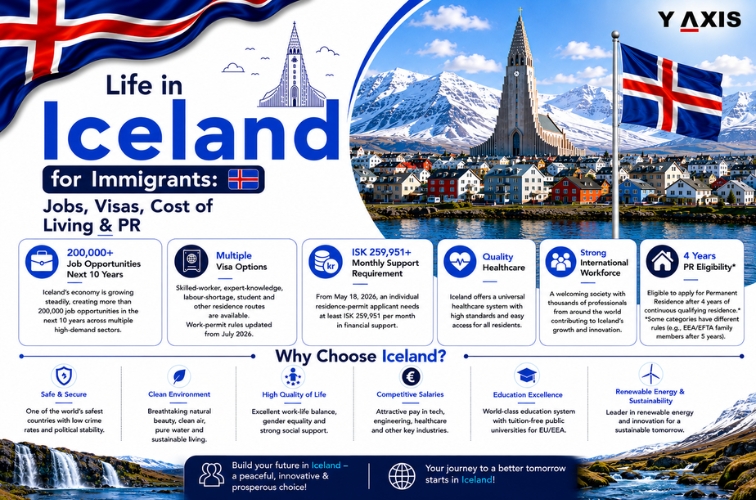
Life for immigrants in Iceland is shaped by a small, high-trust Nordic economy, strong worker protections, and a steady need for skilled and semi-skilled labour. Iceland has no general work permit quota, but most routes need a confirmed job offer and a salary that matches Icelandic collective agreements. The Permit for Skilled Professionals offers an easier path for specialists in shortage sectors, while the General Work Permit covers other roles subject to a labour market test. Reykjavik, Kopavogur, and Akureyri offer the strongest job markets in tourism, construction, fisheries, IT, and healthcare, while near-free healthcare, free education, and high salaries make Iceland attractive for long-term settlement. Permanent residence is generally available after 4 years of continuous residence, with citizenship possible after spending 7 years in Iceland.
Some quick facts about Iceland are as follows:
|
Population |
Approximately 387,000 (2025-26) |
|
Capital |
Reykjavik |
|
Official Language |
Icelandic |
|
Currency |
Icelandic Króna (ISK) |
|
Popular Immigrant Hubs |
Reykjavik, Kopavogur, Hafnarfjordur, Akureyri, Reykjanesbær |
|
Economy |
No general work permit quota; steady shortage in tourism, hospitality, construction, fisheries, IT, healthcare, and skilled trades |
|
Typical Route to Long Stay |
General Work Permit or Permit for Skilled Professionals; Permit Based on Shortage of Workers for specific sectors |
|
Permanent Residence |
Generally after 4 years of continuous residence, subject to an Icelandic language course or test; Icelandic citizenship generally after 7 years |
*Want to settle in Iceland? Sign up with Y-Axis for end-to-end assistance.*
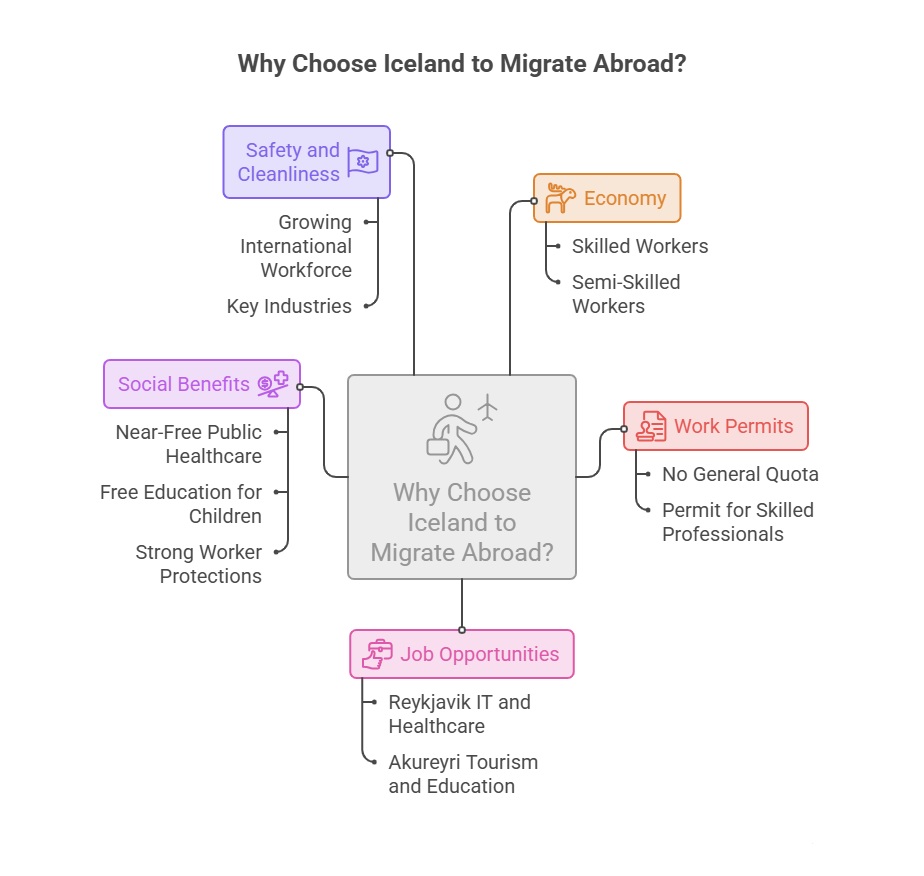
Why Choose Iceland to Migrate Abroad?
Iceland runs a small, high-trust Nordic economy, with steady demand for skilled and semi-skilled workers across construction, fisheries, tourism, and healthcare.
Here is why you should choose a life in Iceland:
- No general annual quota system, with work permits issued based on employer need and salary thresholds tied to collective agreements.
- The Permit for Skilled Professionals offers a more direct route for specialists with a recognised degree or technical training, with a lighter labour market test.
- Reykjavik's IT and healthcare sector, alongside Akureyri's tourism and education base, offer strong opportunities for skilled and semi-skilled workers.
- Near-free public healthcare, subsidised doctor visits, and free education for children.
- Strong worker protections, generous parental leave, and a clear path to permanent residence and citizenship.
- One of the safest and cleanest countries in the world, with a growing international workforce supporting key industries.
*Want to work in Iceland? Let Y-Axis assist you with the process.*
Can I Move to Iceland as an Indian Immigrant?
Most Indian nationals move to Iceland through the General Work Permit, which needs a confirmed job offer and a labour market test, or the Permit for Skilled Professionals for specialists whose qualifications are in demand. Iceland does not allow a change from a tourist visa to a work visa within the country — you must apply from outside Iceland before travelling.
Here is what you need to do to migrate to Iceland:
Step 1: Confirm you have a job offer from an Icelandic employer before applying — Iceland does not allow visa conversion from within the country
Step 2: Confirm your route, such as the General Work Permit, Permit for Skilled Professionals, or Permit Based on Shortage of Workers
Step 3: Get your educational and professional qualifications assessed, if required, so your role is recognised in Iceland
Step 4: Apply for your residence permit through the Directorate of Immigration (Útlendingastofnun) and pay the application fee
Step 5: Complete biometrics and any required documentation checks
Step 6: Travel to Iceland once your permit is approved, and register your move with a local registration office
Step 7: Get your kennitala (Icelandic national ID number) to access healthcare, banking, and other services
Best Visa Options to Live in Iceland
Iceland offers several routes depending on your qualifications, job offer status, and the sector you work in. The table below shows the main options for skilled and semi-skilled workers and their route to long-term residence.
|
Visa Type |
Best For |
Duration |
Long-Term Pathway |
|
General Work Permit |
Job offer where no Icelandic or EEA candidate is available; subject to a labour market test |
Typically 1 year, renewable |
Permanent residence generally after 4 years |
|
Permit for Skilled Professionals |
Specialists with a recognised degree or technical training in demand; lighter labour market test |
Typically 1-2 years, renewable |
Permanent residence generally after 4 years |
|
Permit Based on Shortage of Workers |
Roles in sectors with a documented labour shortage |
Typically 1 year, renewable |
Permanent residence generally after 4 years |
|
Long-Term Remote Work Visa |
Remote workers employed by a foreign company, meeting income requirements |
Up to 6 months |
Not a route to permanent residence |
Also, read...
Iceland job outlook: skill shortages, salaries and job trends
Best Areas to Live in Iceland
Iceland's job market and living costs vary by area. Choosing the right area can influence your career opportunities, cost of living, housing expenses, and overall quality of life.
The table below highlights the major Icelandic towns and cities and their best qualities for settlement abroad:
|
Area |
Best For |
Sightseeing |
Average Rent |
Job Market |
How Much You Can Save |
|
Reykjavik |
IT, healthcare & tourism |
Hallgrímskirkja, Harpa Concert Hall |
ISK 280,000-350,000/mo (1BR) |
Strongest overall, highest salaries |
Lower, given highest cost of living |
|
Kopavogur |
Engineering & retail |
Sky Lagoon, Smáralind Mall |
ISK ~240,000-300,000/mo (1BR)* |
Strong, engineering and construction |
Moderate savings potential |
|
Hafnarfjordur |
Construction & marine trades |
Hafnarfjordur harbour, local music scene |
ISK ~230,000-290,000/mo (1BR)* |
Strong, skilled trades |
Moderate savings potential |
|
Akureyri |
Tourism, education & healthcare |
Akureyrarkirkja, Lake Mývatn |
ISK ~180,000-250,000/mo (1BR)* |
Good, regional hub of the north |
Good savings potential |
|
Reykjanesbær |
Airport services & hospitality |
Blue Lagoon, Viking World Museum |
ISK ~170,000-230,000/mo (1BR)* |
Good, airport and tourism roles |
Good savings potential |
*Rent figures for Kopavogur, Hafnarfjordur, Akureyri, and Reykjanesbær are estimated at 15-35% below central Reykjavik rents, based on regional cost differentials — confirm current listings before budgeting.
Cost of Living in Iceland
Iceland's cost of living changes by location. Reykjavik and the surrounding capital region cost the most by a wide margin, while towns like Akureyri and Reykjanesbær remain considerably more affordable.
Below is a breakdown of average monthly expenses for a single adult in a mid-sized Icelandic town (outside Reykjavik):
|
Rent (1BR apartment, city centre) |
ISK 180,000-250,000/month |
|
Utilities (electricity, heating, water) |
ISK 15,000-25,000/month |
|
Groceries |
ISK 90,000-130,000/month |
|
Public Transport |
ISK 12,000-15,000/month for a monthly pass |
|
Healthcare |
Heavily subsidised; doctor visit co-pay ISK 500-3,500; free for children under 18, including dental |
|
Dining Out (per meal) |
ISK 2,500-4,500 |
|
Mobile & Internet |
ISK 8,000-12,000/month |
|
Entertainment & Leisure |
ISK 15,000-30,000/month |
Also, read...
What are the Eligibility Requirements for an Iceland Work Visa?
Is Iceland Expensive Compared to Norway or Denmark?
Iceland is broadly comparable to Norway for cost of living, and generally more expensive than Denmark for housing and groceries, while offering strong salaries that can offset the difference for skilled workers.
Salaries for skilled foreign professionals in Iceland are proportionally strong against the local cost of living outside Reykjavik, so many immigrants build meaningful savings, particularly in towns like Akureyri and Reykjanesbær.
Reykjavik remains the priciest place to live in Iceland, though its salaries are also the highest in the country. This makes Iceland a strong choice for immigrants who want high wages and strong worker protections, alongside a lower cost of living than Reykjavik itself once you move to a smaller town.
Work in Iceland
Iceland's job market runs on tourism, construction, fisheries, IT, healthcare, and skilled trades, with growing demand in renewable energy and clean-tech sectors.
The table below shows some of the most in-demand jobs in Iceland for immigrants.
|
Occupation |
Average Monthly Salary |
Demand Level |
Average Savings |
|
IT & Software |
ISK 1,100,000-1,600,000 |
High |
ISK 150,000-300,000/month |
|
Healthcare (Nurses & Support Staff) |
ISK 900,000-1,400,000 |
Very High |
ISK 100,000-250,000/month |
|
Engineering |
ISK 1,000,000-1,500,000 |
High |
ISK 120,000-280,000/month |
|
Construction & Skilled Trades (e.g. Welders) |
ISK 480,000-750,000 |
Very High |
ISK 60,000-150,000/month |
|
Fisheries & Marine |
ISK 500,000-800,000 |
Very High |
ISK 60,000-150,000/month |
|
Tourism & Hospitality |
ISK 513,000-600,000 |
Very High |
ISK 30,000-80,000/month |
Settling in Iceland
Once you arrive in Iceland, you need to register your move, get your kennitala, apply for healthcare access, enrol children in school, and set up your day-to-day essentials.
Here is a quick overview of what to expect during your first weeks in the country:
|
Housing |
Healthcare |
Education for Children |
Banking & Financial Essentials |
|
Search via mbl.is/fasteignir or local rental sites; competitive rental market in Reykjavik and Kopavogur |
Get your kennitala first, then register with a local health centre (heilsugæsla); doctor visits cost ISK 500-3,500 |
Free public schools; free healthcare including dental for children under 18 |
Open an account with Landsbankinn, Íslandsbanki, or Arion Bank |
|
Landlords typically require 1-3 months' rent as a deposit and proof of income |
Public healthcare is heavily subsidised, though non-urgent care can involve wait times |
Public school enrolment is managed by the local municipality |
A kennitala (national ID number) is required before opening an account |
|
Allow several weeks to secure a rental in Reykjavik, given limited supply |
Private healthcare options exist but are less common than in mainland Europe |
Icelandic-language support classes are usually available for immigrant children |
Basic accounts can typically be opened within a few days once your kennitala is issued |
Permanent Residence in Iceland
Permanent residence in Iceland generally follows a 4-year timeline of continuous residence on a qualifying permit, such as employment, family reunification, humanitarian, or missionary grounds.
Important note: To qualify for permanent residence, you must complete an Icelandic-language course of at least 150 lessons with at least 85% attendance, or pass an Icelandic-language assessment test instead. You must also continue to meet the conditions of your original permit, such as an active work contract, and apply for permanent residence at least four weeks before your existing residence permit expires. Icelandic citizenship generally requires 7 years of legal residence (reduced to 4 years for Nordic citizens, or 3 years for spouses of Icelandic citizens), an A1-A2 level Icelandic language test, and proof of financial self-sufficiency and good character. Confirm the latest requirements with the Directorate of Immigration (Útlendingastofnun) before planning your timeline.
The table below shows the main routes and their approximate timelines:
|
Main Immigration Routes |
Approximate Timeline |
|
Work Permit Holder (General or Skilled Professional) |
Continuous employment and permit renewal → permanent residence generally after 4 years |
|
Permit Based on Shortage of Workers Holder |
Continuous employment in a shortage role → permanent residence generally after 4 years |
|
Permanent Residence Permit |
4 years of continuous residence, an Icelandic-language course (150 lessons, 85% attendance) or assessment test, and continued means of support → renewable permanent permit |
|
Icelandic Citizenship |
7 years of legal residence (4 years for Nordic citizens, or 3 years for spouses of Icelandic citizens married 3+ years), an A1-A2 level Icelandic language test → naturalisation |
Dependent Benefits for Immigrants in Iceland
Iceland allows eligible visa holders to bring immediate family members through family reunification, generally with access to work and study rights once their own permit is granted.
Here are the benefits of securing an Iceland dependent visa:
- Spouses and partners can apply for a residence permit through family reunification and can generally work once their own permit is issued
- Dependent children can enrol in Iceland's free public schools, with free healthcare including dental up to age 18
- Family members get access to Iceland's subsidised healthcare system once registered and issued a kennitala
- Sponsors must generally show sufficient income and housing to support family members joining them
- Dependants generally follow the same route to permanent residence as the main applicant, subject to their own continuous residence
Practical Settlement Checklist for Indians Moving to Iceland
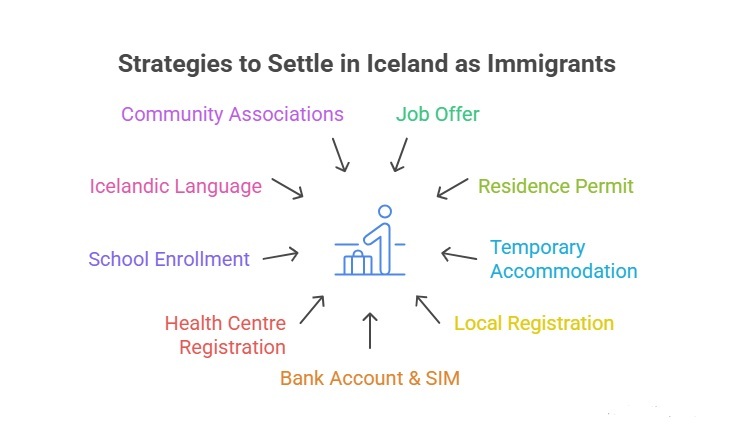
Moving to Iceland involves a few key steps. Complete them in order to avoid delays.
Follow the steps below for a smooth move to Iceland:
Step 1: Confirm your job offer and residence permit before travelling — Iceland generally does not allow visa conversion from within the country
Step 2: Apply for your Iceland residence permit through the Directorate of Immigration (Útlendingastofnun) before you travel
Step 3: Book temporary accommodation for your first few weeks after arrival
Step 4: Register your move locally and apply for your kennitala (national ID number)
Step 5: Open an Icelandic bank account and get a local mobile SIM
Step 6: Register with a local health centre (heilsugæsla) for healthcare access
Step 7: Enrol children in school as early as possible
Step 8: Start learning Icelandic — a language course or test is required for permanent residence and citizenship
Step 9: Join local Indian community associations for support and networking
*Are you looking for step-by-step assistance with overseas immigration? Contact Y-Axis, the world's No. 1 overseas immigration consultancy!*
FAQs
What is the easiest way for Indians to move to Iceland?
Most Indians move through the General Work Permit, which needs a confirmed job offer and a labour market test, or the Permit for Skilled Professionals for specialists whose qualifications are in demand. Both generally require a job offer secured before you travel, since Iceland does not allow visa conversion from within the country.
Does Iceland have a general work permit quota?
No. Iceland does not operate a general annual quota system for foreign workers. Work permits are issued based on employer need, salary thresholds aligned with collective agreements, and whether the role could reasonably be filled by an Icelandic or EEA/EFTA national. Shortage occupations often receive faster processing.
Can I move to Iceland without a job offer?
It is very difficult without a job offer, since the General Work Permit, Permit for Skilled Professionals, and Permit Based on Shortage of Workers all require confirmed employment before you apply. Iceland generally does not accept applications for a work-based residence permit from within the country.
Is healthcare free for immigrants in Iceland?
Iceland has a heavily subsidised public healthcare system. Once you have a kennitala and are registered with a local health centre, doctor visits typically cost ISK 500-3,500. Healthcare, including dental care, is free for children under 18.
What is the average salary for skilled workers in Iceland?
Salaries vary by sector and location. IT professionals typically earn ISK 1,100,000-1,600,000/month, healthcare workers earn ISK 900,000-1,400,000/month, and engineers earn ISK 1,000,000-1,500,000/month. Reykjavik offers the highest salaries but also the highest cost of living.
Can I bring my family to Iceland on a work visa?
Yes. Spouses and partners can apply for a residence permit through family reunification and can generally work once their own permit is issued, and dependent children can enrol in Iceland's free public schools with free healthcare up to age 18. Sponsors must generally show sufficient income and housing to support family members joining them.
Which city in Iceland is best for Indian immigrants?
Reykjavik offers the strongest job market and largest international community, though it comes with the highest cost of living. Kopavogur and Hafnarfjordur suit engineering and construction professionals at a lower cost, Akureyri suits tourism and healthcare workers, and Reykjanesbær suits those in airport services and hospitality.
How much does it cost to live in Iceland?
Iceland's cost of living varies by location. In Reykjavik, a single person can expect to pay ISK 280,000-350,000 for a one-bedroom apartment, while towns like Akureyri and Reykjanesbær cost ISK 170,000-250,000 for similar housing. Groceries, utilities, and transport add several hundred thousand ISK a month on top.
How long does it take to get permanent residence in Iceland?
Permanent residence is generally available after 4 years of continuous residence on a qualifying permit, such as employment or family reunification. You must also complete an Icelandic-language course of at least 150 lessons, or pass a language assessment test, and continue to meet the conditions of your original permit.
How can I get Icelandic citizenship?
Icelandic citizenship by naturalisation generally requires 7 years of legal residence (reduced to 4 years for Nordic citizens, or 3 years for spouses of Icelandic citizens married for at least 3 of those years), provided you pass an A1-A2 level Icelandic language test and demonstrate financial self-sufficiency and good character.
Tags:
Iceland immigration
Iceland work visa
Iceland permanent residency
Living in Iceland
Cost of living in Iceland
Best areas in Iceland
Jobs in Iceland for Indians
Healthcare in Iceland
Housing in Iceland
Settle in Iceland
Share
Options for you by Y-Axis

Get it on your mobile

Get News alerts

Contact Y-Axis
Latest Article
Popular Post
Trending Article
Posted On October 09 2026
Canada’s Immigration Reset: Why the Next Move May Be About Fit, Not Volume