


Don't know what to do ?
Get Free Counseling
Last Updated 07 September 2026
Iceland Job Outlook: Trends and Opportunities
- Iceland is expected to create around 20,000–25,000 new job openings over the next decade.
- Iceland’s economy remains stable, supported by strong growth in renewable energy, IT, and tourism.
- Iceland's GDP contracted by 1.3% in 2024 and returned to growth of 1.3% in 2025, driven by strong private consumption. GDP growth is forecast at 1.6–2.5% for 2026 (OECD / Statistics Iceland, 2026).
- Iceland's unemployment rate rose to 6.4% in March 2026 (Statistics Iceland), up from 2.9% in Q4 2024 — the highest level since 2021. Skilled professionals in IT, healthcare, and renewable energy remain in demand despite the broader uptick.
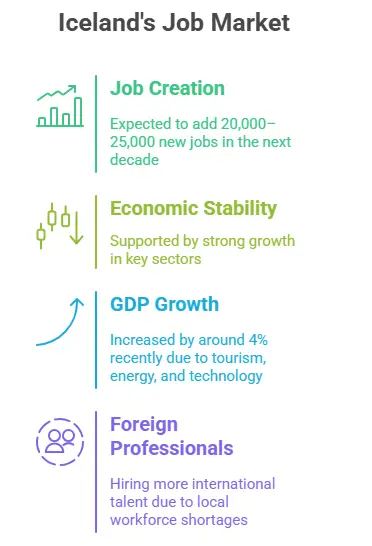
Job Outlook in Iceland
Iceland has strong demand for skilled professionals across in-demand sectors, and the country is hiring more foreign professionals because the local workforce is small. Industries like IT, renewable energy, healthcare, construction, and tourism continue to grow rapidly. Iceland's unemployment rate rose to 6.4% in March 2026 — up from under 3% in late 2024 — reflecting a broader economic slowdown after several years of rapid growth. Despite this, shortages persist in high-demand sectors such as IT, healthcare, renewable energy, and construction, where skilled foreign professionals continue to be actively recruited (Statistics Iceland, April 2026). Experts estimate that Iceland may create around 20,000–25,000 new job openings over the next decade due to industry expansion and skill shortages.
Iceland has a total population of approximately 390,000 people — one of the smallest national workforces in Europe — which is why the country consistently relies on skilled immigration to fill gaps across key industries.
Cities like Reykjavik, Kopavogur, and Hafnarfjordur show the highest number of job opportunities.
Inflation is projected at approximately 3.1% in 2026, down from 4.3% in 2025, with real wages expected to continue rising as monetary policy eases (OECD, 2026; Statistics Iceland).
Factors Affecting Iceland’s Job Market
- Demand and supply of skilled workers
- Growth in renewable energy and tech industries
- Tourism and seasonal hiring
- Strong focus on digital skills
- Government labor policies
- Ageing population increasing healthcare needs
*Planning to work in Iceland? Y-Axis can guide you through every step!
In-Demand Industries and Top Job Opportunities in Iceland
Iceland has a strong and stable job market driven by growing industries such as IT, renewable energy, healthcare, finance, tourism, and engineering. The country focuses heavily on clean energy, technology, and skilled services, which creates steady demand for qualified professionals. These industries offer good salaries, career growth, and opportunities for both locals and international workers.
Iceland has no statutory minimum wage set by law. Instead, wages are determined through collective bargaining agreements (Kjarasamningar) between trade unions — primarily ASÍ (Icelandic Confederation of Labour) — and employer associations. As of January 2026, the effective minimum wage under collective agreements is approximately ISK 513,000–515,000 per month for full-time employees, one of the highest effective minimums in the world. Approximately 90% of workers in Iceland are covered by collective agreements. Source: Playroll, wage.is, January 2026.
| Occupation | Average Monthly Salary (ISK) | Approx. Annual Salary (ISK) |
|---|---|---|
| IT & Software Development | ISK 900,000–1,400,000 | ISK 10,800,000–16,800,000 |
| Engineering | ISK 650,000–950,000 | ISK 7,800,000–11,400,000 |
| Accounting & Finance | ISK 700,000–1,000,000 | ISK 8,400,000–12,000,000 |
| Healthcare (Doctors) | ISK 750,000–1,300,000 | ISK 9,000,000–15,600,000 |
| Human Resource Management | ISK 650,000–900,000 | ISK 7,800,000–10,800,000 |
| Hospitality & Tourism | ISK 513,000–650,000 | ISK 6,156,000–7,800,000 |
| Sales & Marketing | ISK 600,000–900,000 | ISK 7,200,000–10,800,000 |
| STEM Specialists | ISK 800,000–1,200,000 | ISK 9,600,000–14,400,000 |
| Teaching | ISK 513,000–700,000 | ISK 6,156,000–8,400,000 |
| Nursing | ISK 513,000–700,000 | ISK 6,156,000–8,400,000 |
*Read more about In-demand Jobs in Iceland
Job Vacancies in Iceland
Iceland is seeing steady job growth due to limited local workforce availability and expansion in essential industries. Sectors such as healthcare, tourism, renewable energy, construction, and IT are creating new employment opportunities. Major investments in renewable energy projects (hydropower and geothermal energy), tourism infrastructure, and public services are increasing demand for skilled workers. As Iceland continues to grow its green energy sector and tourism economy, employers are hiring foreign professionals to support long-term workforce needs.
The average gross monthly salary in Iceland is approximately ISK 909,000 (around €5,900–€6,100 per month) as of 2024, with wages projected to reach ISK 934,452 per month by end of 2026 (Statistics Iceland; Trading Economics, 2026). Real wage growth stood at 1.9% year-on-year as of early 2026.
The table below shows the estimated number of job openings in Iceland by 2030:
| Occupation | Estimated Number of Jobs by 2030 |
|---|---|
| Healthcare | 18,000 |
| Nursing | 14,000 |
| Hospitality & Tourism | 20,000 |
| IT & Software | 10,000 |
| Engineering | 8,000 |
| Construction & Infrastructure | 12,000 |
| Marketing & Sales | 6,000 |
| Teaching & Education | 7,000 |
| Accounting & Finance | 4,000 |
| Human Resources & Management | 3,000 |
Top Iceland Cities with Growing Job Opportunities
Iceland’s demand for skilled professionals varies from city to city because each region has its own industries and growth areas. Bigger cities like Reykjavik, Kopavogur, and Hafnarfjordur hire more professionals due to their strong economies, while northern and coastal cities hire more people in tourism, education, and marine industries. Understanding which cities are growing helps job seekers choose the right place to work, depending on their skills and career goals.
| City | Key Hiring Sectors |
|---|---|
| Reykjavik | IT, Healthcare, Tourism, Energy |
| Kopavogur | Engineering, Construction, Retail |
| Hafnarfjordur | Marine, Fisheries, Skilled Trades |
| Akureyri | Tourism, Healthcare, Education |
| Reykjanesbær | Airport Services, Hospitality |
In-Demand Skills in Iceland
Employers in Iceland prefer candidates who can adapt, solve problems, work in teams, and handle modern digital tools. The table below shows the most in-demand skills in Iceland across different categories:
| Category | In-Demand Skills |
|---|---|
| Technology Skills | Software Development, AI & Machine Learning, Data Analytics, Cloud Computing, Cybersecurity |
| Business & Marketing Skills | Digital Marketing, Social Media Management, Finance & Accounting, Project Management |
| Technical & Trade Skills | Electrical Work, Plumbing, Mechanical Repair, HVAC Technology |
| Healthcare Skills | Nursing, Physiotherapy, Mental Health Support, Health Administration |
| Soft Skills | Problem-Solving, Adaptability, Communication, Teamwork, Time Management |
Impact of Iceland’s Green Energy Revolution on Job Creation
Iceland is known for its clean and renewable energy, especially geothermal and hydropower. As the country expands its green energy projects, more jobs are being created across many sectors. New power plants, geothermal research, energy engineering, and sustainability projects all need skilled workers. This growth is also increasing jobs in construction, maintenance, environmental science, and technology. Because of Iceland’s focus on clean energy, professionals with skills in engineering, energy technology, and environmental studies have excellent career opportunities.
How Remote Work and Digital Nomads Are Changing Iceland’s Job Market?
Remote work and digital nomads are creating big changes in Iceland’s job market. More international professionals are choosing to live and work in Iceland because the country offers fast internet, a safe environment, and beautiful natural surroundings. Iceland also introduced a long-term digital nomad visa, allowing foreign workers to live in the country while working for companies abroad.
This rise in remote workers is increasing demand for co-working spaces, rental housing, tech support jobs, and services like tourism, food, and transport. Many Icelandic companies are also offering flexible and hybrid work options, making it easier for skilled workers to join the workforce from anywhere in the country. Overall, remote work and digital nomads are helping Iceland grow its economy and attract more global talent.
Work Culture and Employee Benefits in Iceland
Iceland has one of the best work cultures in the world. People enjoy a healthy work–life balance, with shorter working hours and a strong focus on family time. Workplaces are friendly, equal, and respectful, and employees are treated fairly. Most companies offer flexible work schedules, remote-work options, and supportive managers.
Iceland's standard contracted working week is 40 hours (five 8-hour days). In practice, the average actual hours worked among employed persons was 35.8 hours per week in Q4 2025, reflecting the country's strong work-life balance culture and widespread use of flexible and hybrid working arrangements (Statistics Iceland, Q4 2025).
Some of the employee benefits in Iceland are listed below:
- Flexible working hours
- Paid parental leave
- Strong labor laws
- Health insurance coverage
- Paid sick leave
- Paid annual vacation
- Pension contributions
- Equal pay policies
- Safe workplace standards
How to Work in Iceland as an Indian Professional
Iceland is a member of the European Economic Area (EEA) and the Schengen Area, but it is not an EU member state. Non-EEA nationals, including Indian citizens, require a work permit to legally work in Iceland.
| Visa / Permit | Who It Is For | Key Requirement |
|---|---|---|
| Work Permit (General) | Non-EEA nationals with a confirmed job offer | Employer must register the role and confirm that no suitable EEA candidate was available. |
| Specialist Work Permit | Highly skilled professionals in shortage roles | Relevant qualifications and a valid job offer; shortage occupations may benefit from faster processing. |
| Long-Term Residence Permit | Professionals intending to settle in Iceland | Minimum of 3 years of continuous legal residence in Iceland. |
| Digital Nomad / Remote Worker Visa | Remote workers employed by non-Icelandic employers | Proof of sufficient remote income and accommodation arrangements in Iceland. |
Tips to Succeed in the Iceland Job Market
- Build a strong professional network
- Keep your CV updated
- Learn Icelandic basics
- Research skills needed in your field
- Improve digital and technical skills
- Apply early and follow up
Summary of Iceland Job Outlook
Iceland’s job market is growing quickly, especially in sectors like IT, renewable energy, healthcare, construction, tourism, and skilled trades. The country continues to face a shortage of workers, which means skilled immigrants will be increasingly needed in the coming years. In the future, Iceland is expected to create even more jobs in green energy, digital technology, and infrastructure development. As the country invests in geothermal power, electric transport, and sustainable industries, new roles will open up for engineers, technicians, and environmental specialists. Tourism and hospitality will also continue to grow, while healthcare and social services will require more professionals due to Iceland’s aging population. With the right skills, qualifications, and work experience, professionals can find stable jobs, good salaries, and strong career growth.
*Want expert guidance to migrate to Iceland? Contact Y-Axis, India’s #1 overseas immigration consultant!
Y-Axis snapshot
1M
Successful applicants
1500+
Experienced counselors
25Y+
Expertise
50+
Offices
Don't know what to do ?
Get Free Counseling
Looking for Inspiration
Explore what Global Indians have to say about Y-Axis in shaping their future