

Posted on June 23 2026
What are the Eligibility Requirements for an Iceland Work Visa?

By , Editor & Director
Updated July 03 2026
To apply for an Iceland work visa from India, you need to secure a valid job offer from a registered Icelandic employer whose position cannot be filled by a local or EEA/EFTA national. The Iceland work permit system is administered jointly by the Directorate of Immigration (Útlendingastofnun) and the Directorate of Labour (Vinnumálastofnun). Indian professionals can apply under two primary immigration pathways which include the Residence Permit for Work Based on Expert Knowledge, suited to IT, engineering, healthcare, and research professionals, and the Residence Permit for Work Based on Shortage of Labour, available in sectors with documented workforce shortage. Professionals need applying for an Iceland work visa must meet the salary threshold, hold relevant qualifications, and pass a labour market test confirming no suitable candidate was available locally.
*Want to apply for an Iceland work visa? Let Y-Axis guide you with the process.
Eligibility Criteria to Apply for an Iceland Work Visa from India
Applying for an Iceland work visa from India requires your Icelandic employer to initiate the process on your behalf by submitting a combined work and residence permit application to the Directorate of Immigration. Indian professionals migrating to Iceland must hold the relevant educational qualifications or demonstrable expertise, meet the collective agreement salary threshold for their sector, and satisfy a labour market test confirming no suitable candidate was available from Iceland.
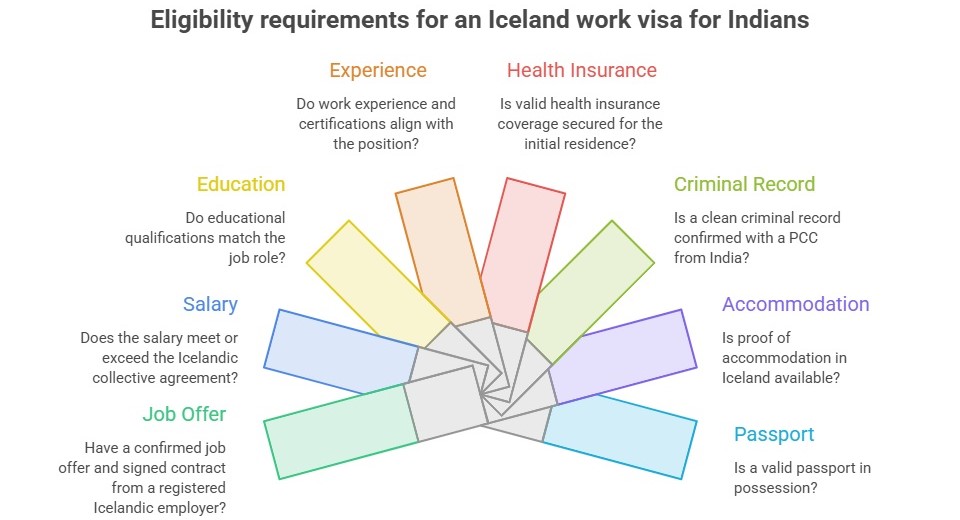
The eligibility criteria for an Iceland work visa are as follows:
- A confirmed job offer and signed employment contract from a registered Icelandic employer
- Salary meeting or exceeding the applicable Icelandic collective agreement for the sector (minimum ISK 484,000–627,000+ per month gross in 2026, depending on role)
- Relevant educational qualifications matching the job role
- Relevant work experience and professional certifications aligned with the position
- Valid health insurance coverage for the initial period of residence
- Clean criminal record (Police Clearance Certificate (PCC) from India)
- Proof of accommodation in Iceland
- Valid passport
*Want to work in Iceland? Sign up with Y-Axis for end-to-end assistance.
Eligibility Requirements by Permit Type
The specific eligibility criteria vary depending on which Iceland work permit category you are applying for.
The table below highlights the requirements as per Iceland work permit categories for Indians.
| Permit Type | Who Can Apply | Key Eligibility Requirements | Validity | Key Benefits |
|---|---|---|---|---|
| Residence Permit Based on Expert Knowledge | Highly skilled professionals with specialised expertise | Confirmed job offer from a registered Icelandic employer; employer must prove no suitable candidate was available in Iceland or EEA/EFTA; relevant degree or equivalent professional expertise; salary meeting sector collective agreement requirements; fulfil all general immigration requirements | Up to 4 years | 25% income tax reduction on earnings for the first 3 years; spouses and dependent children can work without a separate permit |
| Residence Permit Based on Shortage of Labour | Skilled workers in occupations facing labour shortages | Confirmed job offer in a shortage occupation; employer must demonstrate unsuccessful recruitment efforts in Iceland and EEA/EFTA; relevant trade or vocational qualification; minimum salary of ISK 484,000–513,000+ per month (2026); fulfil all general immigration requirements | Initially 1 year, renewable | Access to sectors with high labour demand; pathway to long-term employment in Iceland |
| Long-Term Remote Work Visa (Digital Nomad Visa) | Non-EEA nationals working remotely for foreign employers or as self-employed professionals | Minimum income of ISK 1,000,000 per month (ISK 1,300,000 if applying with a partner); comprehensive health insurance; clean criminal record; must not have received an Icelandic long-term visa within the previous 12 months | Up to 6 months | Live and work remotely from Iceland; no local employer sponsorship required |
Also, read...
What are the Employer Requirements for Hiring Foreign Workers in Iceland?
Icelandic employers sponsoring a non-EEA national's work permit must meet specific obligations under Icelandic immigration and employment law. These requirements ensure the job offer is genuine and that the terms of employment are fair and legally compliant.
Labour Market Test (Directorate of Labour)
For both the Expert Knowledge permit and the Shortage of Labour permit, the employer must demonstrate to the Directorate of Labour (Vinnumálastofnun) that no suitable candidate was available from Iceland, the EEA, or EFTA states before hiring a third-country national. This requirement applies to all non-EEA permit categories, making Iceland's labour market test universal across permit types.
- The employer must provide evidence of genuine recruitment efforts — advertising the role domestically and within the EEA/EFTA where required
- The employment contract must meet or exceed the applicable Icelandic collective agreement for salary, working hours, and conditions
- The employer must be registered with the Icelandic Company Registry and in good standing with tax and social security obligations
- For Shortage of Labour permits, the employer must confirm the role falls under a currently recognised shortage sector per the Directorate of Labour's updated list
Also, read...
Tax Incentive for Foreign Expert Employees in Iceland
Iceland offers a notable tax incentive for qualified foreign experts that distinguishes it from most European destinations. Under this provision, only 75% of income earned by a foreign expert is subject to Icelandic income tax for the first three years of work in Iceland, provided certain conditions are met. This reduces the effective tax burden significantly for Expert Knowledge permit holders.
- The tax incentive applies to Expert Knowledge permit holders, not Shortage of Labour permit holders
- The application must be submitted within three months of commencing work in Iceland through the Icelandic Centre for Research
- Medical professionals must separately obtain recognition of their professional title from the Directorate of Health before the incentive applies
- The incentive provides a meaningful financial advantage for Indian IT, engineering, and research professionals relocating to Iceland
Watch to Know More: Work in Iceland | High-Paying Jobs & Work Visa Explained
Discover high-paying jobs in Iceland, salary insights, in-demand occupations, and the work visa process for skilled professionals.
What Occupation-Based Requirements Apply for Iceland Work Visas?
Specific sectors in Iceland have distinct licensing or qualification recognition requirements that must be satisfied before a work permit is fully processed.
| Sector | Additional Requirements |
|---|---|
| Healthcare and medical | Professional title (doctor, nurse, pharmacist, etc.) must be recognised by the Directorate of Health (Embætti landlæknis) before commencing practice. Icelandic language proficiency is typically required for patient-facing clinical roles in public hospitals. |
| Teaching and education | Teaching qualifications must be evaluated and recognised by the Directorate of Education (Menntamálastofnun). Icelandic language is required for public school positions. International school roles generally operate in English. |
| Legal services | Foreign lawyers must obtain recognition from the Icelandic Bar Association (Lögmannafélag Íslands) for regulated legal practice. English-medium roles in international corporate environments generally do not require local bar membership. |
| Engineering and IT | No formal registration is required for most IT and software roles — widely available under the Expert Knowledge permit. Licensed engineering roles in regulated sectors (geothermal, construction, marine) may require verification through the relevant Icelandic professional body. IT and engineering are two of the most recruited sectors for non-EEA professionals. |
| Finance and accounting | Chartered accountants and auditors must be registered with the Icelandic Association of Registered Auditors. Most corporate finance, analysis, and fintech roles do not require local registration. |
| Tourism and hospitality | Non-EEA tourism guides must apply for a temporary work permit regardless of tour duration. Tour operators must notify the Directorate of Labour of employee arrivals before they begin work. |
Want to find a job in Iceland? Avail Y-Axis Resume Marketing Services to find the right match.
How to Apply for an Iceland Work Visa from India?
Applying for an Iceland work visa from India requires your Icelandic employer to initiate the process by submitting a combined work and residence permit application to the Directorate of Immigration on your behalf. You must not commence work until both the work permit (issued by the Directorate of Labour) and the residence permit (issued by the Directorate of Immigration) have been approved.
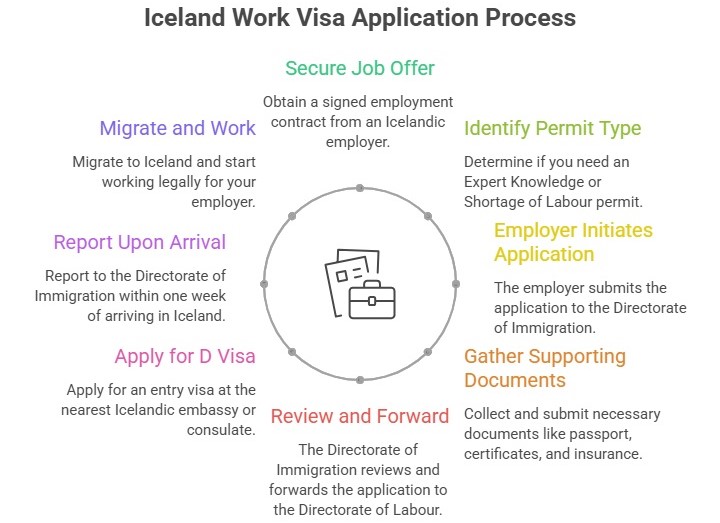
The steps to apply for an Iceland work visa for Indians are as follows:
Step 1: Secure a job offer with a signed employment contract from a registered Icelandic employer confirming the role, salary, and start date.
Step 2: Identify the correct permit type either Expert Knowledge permit for qualified professionals in IT, engineering, healthcare, or research, or Shortage of Labour permit if your role falls under a documented shortage sector.
Step 3: Your employer initiates the application by submitting a combined work and residence permit application on paper to the Directorate of Immigration (Útlendingastofnun).
Step 4: Gather and submit your supporting documents such as valid passport, Police Clearance Certificate from India, educational certificates with certified translations, professional certifications, health insurance, and proof of accommodation in Iceland.
Step 5: The Directorate of Immigration reviews the residence permit conditions and forwards the work permit application to the Directorate of Labour (Vinnumálastofnun) for a decision.
Step 6: Upon approval of both permits, apply for a D Visa (entry visa) at the nearest Icelandic embassy or consulate to enter Iceland legally.
Step 7: Report in person within one week of arriving in Iceland to the Directorate of Immigration to be photographed — this is required for your residence permit card to be issued.
Step 8: Upon receiving your residence permit card, migrate to Iceland and legally start working for your sponsoring employer.
Are you looking for step-by-step assistance with overseas immigration? Contact Y-Axis, the world's No. 1 overseas immigration consultancy!
FAQs
What is the Iceland work visa for Indians?
Iceland does not issue a separate work visa as a standalone document. Instead, non-EEA nationals including Indians require both a work permit and a residence permit to work legally in Iceland. The work permit is administered by the Directorate of Labour (Vinnumálastofnun) and the residence permit by the Directorate of Immigration (Útlendingastofnun). The two most common routes are the Residence Permit Based on Expert Knowledge, suited to IT, engineering, healthcare, and research professionals, and the Residence Permit Based on Shortage of Labour, available in sectors with documented workforce gaps. Both applications are submitted in paper form by the employer on behalf of the Indian applicant. Contact Y-Axis at +91-7670800000 or info@y-axis.com for guidance.
Can Indian nationals apply for an Iceland work visa?
Yes, Indian nationals can apply for an Iceland work permit and residence permit through the Expert Knowledge route or the Shortage of Labour route, depending on their qualifications, sector, and employer's eligibility. The process is employer-led — a registered Icelandic employer must initiate the combined application on behalf of the Indian professional and submit it to the Directorate of Immigration. Indians in IT, software engineering, healthcare, research, and construction are among the most actively recruited sectors. Iceland also offers a 25% income tax reduction for Expert Knowledge permit holders for the first three years of work, making it financially attractive for high-skilled Indian professionals. Call Y-Axis at +91-7670800000 for a free eligibility check.
What is the minimum salary required for an Iceland work visa?
Iceland does not have a statutory minimum wage. Instead, wages are governed by collective agreements between trade unions and employer associations. As of January 2026, the effective collective agreement minimum for general full-time work is approximately ISK 484,000 to ISK 498,000 per month gross, rising to approximately ISK 513,000 per month when shift premiums and contractual additions are included. Qualified tradespeople and journeymen typically earn a minimum of ISK 627,000 per month. Expert Knowledge permit holders — IT engineers, researchers, senior professionals — commonly earn ISK 700,000 to ISK 1,200,000+ per month. The employment contract must guarantee regular minimum working hours consistent with the applicable collective agreement. Contact Y-Axis at +91-7670800000 for sector-specific salary guidance.
What is the Expert Knowledge work permit in Iceland?
The Expert Knowledge work permit (Dvalarleyfi fyrir sérfræðinga) is Iceland's primary permit for highly skilled non-EEA professionals in fields such as IT, engineering, research, finance, and healthcare. It requires the employer to demonstrate that no suitable candidate was available from Iceland, the EEA, or EFTA states. The permit is valid for up to four years and is renewable. Expert Knowledge permit holders are eligible for a 25% income tax reduction on earnings for the first three years of work, applied for through the Icelandic Centre for Research within three months of commencing work. Spouses and dependent children of Expert Knowledge permit holders may also work in Iceland without a separate work permit. Contact Y-Axis at +91-7670800000 for guidance on qualifying for this permit.
Is a labour market test required for an Iceland work visa?
Yes. A labour market test is required for both the Expert Knowledge permit and the Shortage of Labour permit in Iceland, making it universal across all non-EEA work permit categories. The employer must demonstrate to the Directorate of Labour that no suitable candidate was available from Iceland, the EEA, or EFTA states before hiring a third-country national. For the Shortage of Labour route, the employer must additionally confirm that the role falls under a currently recognised shortage occupation as listed by the Directorate of Labour (vmst.is). The labour market test is conducted as part of the combined work and residence permit application process. Call Y-Axis at +91-7670800000 to identify the right permit route for your profile.
What documents are needed to apply for an Iceland work visa?
Documents required from the applicant include a valid passport with at least six months' validity and two blank pages, educational qualification certificates with certified translations if not in English or Icelandic, relevant professional certifications, a Police Clearance Certificate from India, valid health insurance for the initial period of residence, and proof of accommodation in Iceland. The employer must separately submit the employment contract, company registration documents, evidence of recruitment efforts within Iceland and the EEA/EFTA, and a statement justifying the necessity of hiring a non-EEA national. Unlike Finland, there is no online application portal — all documents are submitted in paper form to the Directorate of Immigration at Dalvegur 18, Kópavogur. Contact Y-Axis at +91-7670800000 for a complete document checklist.
How long does the Iceland work visa process take?
Processing times for Iceland work and residence permits vary significantly. The Directorate of Immigration estimates up to 180 days for standard first-time work-based residence permits, with high-volume periods extending to eight to ten months. Both the residence permit (Directorate of Immigration) and the work permit (Directorate of Labour) must be approved before the applicant can start work, and both are processed as part of the same application. Submitting a complete paper application with all required documents, including a statement from a former employer attesting to expertise, and ensuring the employer responds promptly to any requests from the Directorate of Labour are the most effective ways to minimise delays. For the most current processing time estimates, check the Directorate of Immigration's website or contact Y-Axis at +91-7670800000.
What is the D Visa for Iceland?
The D Visa (Dvísumleiðin) is a national long-stay visa that allows approved non-EEA workers to enter Iceland legally once their work and residence permit applications have been approved. After the Directorate of Immigration approves the residence permit and the Directorate of Labour approves the work permit, the Indian applicant applies for a D Visa at the nearest Icelandic embassy or consulate to travel to Iceland. The applicant must then report in person to the Directorate of Immigration within one week of arrival to be photographed, after which the physical residence permit card — which includes the kennitala (national identity number) — is issued and sent to the applicant's Icelandic address. Contact Y-Axis Overseas Careers at +91-7670800000 or info@y-axis.com for end-to-end D Visa guidance.
Can an Iceland work visa lead to permanent residence?
Yes. After four years of continuous lawful residence in Iceland, a foreign national may apply for a permanent residence permit (Varanlegt dvalarleyfi) from the Directorate of Immigration, provided they have met the conditions of their temporary residence permit throughout — including maintaining employment, paying taxes, and holding no criminal record. The permanent residence permit provides the right to live and work in Iceland without further permit renewals. After completing seven years of continuous residence, foreign nationals may apply for Icelandic citizenship, subject to language requirements and integration conditions under the current Citizenship Act. The Expert Knowledge permit, which is valid for up to four years, provides a clear timeline for reaching the permanent residence threshold in a single permit cycle. Call Y-Axis at +91-7670800000 for guidance on Iceland's long-term settlement pathway.
What are the employer requirements for sponsoring an Iceland work visa?
Icelandic employers sponsoring a non-EEA national must be registered with the Icelandic Company Registry and in good standing with tax and social security obligations. The employer must submit a combined work and residence permit application on paper to the Directorate of Immigration, including the signed employment contract (which must meet collective agreement minimums), company registration documents, and evidence of recruitment efforts within Iceland and the EEA/EFTA. The employer must also obtain a statement from the relevant trade union confirming the salary and conditions meet collective agreement standards. The employer bears primary legal responsibility for ensuring the employee holds a valid work permit before starting work — commencing work without a permit can result in fines or imprisonment of up to two years for both the employer and the employee. Contact Y-Axis at +91-7670800000 for employer-side guidance.
📞 Call: +91-7670800000
📩 Email: info@y-axis.com
🌐 Visit: https://www.y-axis.com
Tags:
work in Iceland
Iceland work visa
migrate to Iceland
overseas immigration
Iceland work visa for Indians
Iceland work permit
EU expert permit Iceland
foreign workers in Iceland
apply for Iceland work visa
Share
Options for you by Y-Axis

Get it on your mobile

Get News alerts

Contact Y-Axis
Latest Article
Popular Post
Trending Article
Posted On September 18 2026
What Are the Different Types of Canada Visas to Immigrate?