

Posted on January 08 2026
How can I migrate to Canada as a Chef?

By , Editor
Updated January 27 2026
You can migrate to Canada as a chef through immigration pathways like Express Entry and Canada PNP, provided you meet specific general criteria, which include skilled work experience, language proficiency skills (English or French), and an Educational Credential Assessment (ECA) if you have completed your studies outside Canada. Chefs can migrate to Canada through the Federal Skilled Worker Program (FSWP), the Canadian Experience Class (CEC), and the Federal Skilled Trades Program (FSTP) under the Express Entry program. The Canadian PNP also invites skilled professionals, offering many job opportunities for chefs, based on specific provincial labour market requirements. While you can no longer get CRS points for a job offer through Express Entry, it can boost your eligibility when applied through employer-driven pathways or specific PNP streams. To qualify for a chef job in Canada, you must match the correct occupation classification, which is NOC 62200 (TEER 2) for chefs.
Also, read…
Canada Immigration Pathways for Chefs
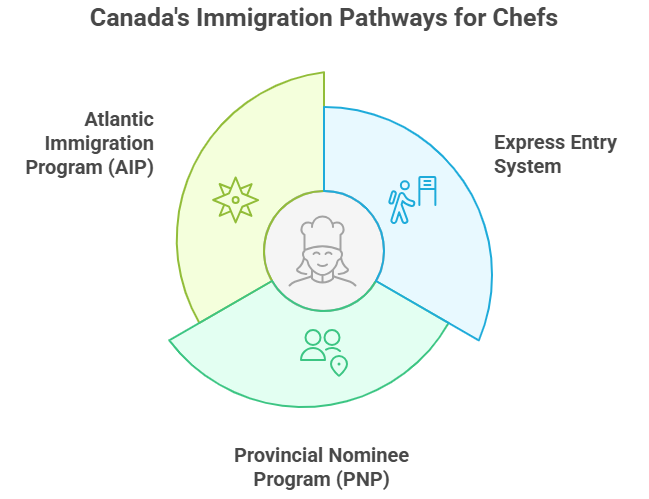
Chefs looking to work in Canada can migrate to Canada through federal and provincial immigration programs, based on their work experience, language skills, and job classification. Some of the most common Canadian immigration pathways for chefs include Express Entry and the Provincial Nominee Programs (PNPs), as well as employer-driven programs such as the Atlantic Immigration Program (AIP). The eligibility requirements, however, may vary depending on the chosen program.
Express Entry (Federal Pathways)
Express Entry is one of the most popular immigration pathways for Canadian immigration. The Express Entry system is a points-based system that manages applications for the FSWP, FSTP, and CEC. Chefs looking to migrate to Canada can qualify under the Federal Skilled Worker Program (FSWP) and the Canadian Experience Class (CEC), provided they meet the relevant work experience, education, and language requirements. Chefs who have previously worked in Canada and have Canadian work experience can also qualify through the CEC program.
How it works: Candidates must create an Express Entry profile, get a CRS score, and receive an Invitation to Apply (ITA) for permanent residence through Express Entry Draws.
Benefits: Offers a direct pathway to Canadian permanent residence, allowing qualifying chefs to reside and work anywhere in Canada.
Additional factors: Chefs must match the NOC 62200 (TEER 2). Those with Canadian work experience and provincial nomination (which adds 600 points) have a better chance of being selected through the Express Entry Draws.
*Want to apply for Express Entry? Let Y-Axis guide you with the steps.
Canada Provincial Nominee Programs (PNPs)
Through the Provincial Nominee Programs (PNPs), Canadian provinces nominate skilled workers, including chefs, depending on provincial labour market requirements, primarily in the food services and hospitality sector. Some of the PNP streams require a job offer as a prerequisite, while others focus on candidates who are already working in the province.
How it works: Each Canadian province is assigned a specific set of PR allocations. The provinces conduct their own PNP draws based on the labour market needs and nominate eligible candidates for PR.
Benefits: Having a provincial nomination can add a total of 600 CRS points, which can boost your selection under the Express Entry system.
Additional factors: The eligibility criteria for PNP programs may vary by province. Prince Edward Island, Ontario, Nova Scotia, Manitoba, British Columbia, and Saskatchewan are some of the Canadian provinces with a high demand for chefs.
*Want to apply for Canada PNP? Talk to experts at Y-Axis to help you with the steps.
Atlantic Immigration Program (AIP)
The Atlantic Immigration Program (AIP) is an employer-driven, federal immigration pathway that allows skilled professionals to get permanent residency in the four Atlantic provinces, namely New Brunswick, Newfoundland & Labrador, Nova Scotia, and PEI. Chefs looking to immigrate to any of the four Atlantic Provinces in Canada can apply through the AIP. To qualify for the Atlantic Immigration Program (AIP), you must, however, have a confirmed job offer from a designated Canadian employer. The AIP program mainly focuses on hospitality roles in the four provinces.
How it works: Chefs must obtain a valid job offer, after which they can directly apply through the AIP without needing a CRS ranking.
Benefits: The AIP program has lower language requirements, with no CRS score. It provides employer-supported settlement.
Additional factors: The AIP program is specifically designed for long-term settlement, promoting workforce retention in the Atlantic Provinces of Canada.
Read more…
Atlantic Immigration Pilot Program: A step by step guide to Canada PR
Eligibility Criteria for Chefs to Migrate to Canada
Skilled professionals, including chefs, who wish to migrate to Canada for jobs in skilled sectors must meet specific educational qualifications, demonstrate relevant work experience, and prove language proficiency. They must also obtain an LMIA-sponsored job offer and provide proof of funds.
The general eligibility criteria for chefs to migrate to Canada are as follows:
- Education: Have a recognized Canadian educational credential or an ECA (Educational Credential Assessment) if you have studied outside Canada. This is not mandatory for all Canadian immigration programs.
- Work experience: You must have at least 12 months of skilled professional experience as a chef or in any of the culinary-related job roles listed under NOC 62200 (TEER 2). Some of the PNP programs or employer-driven streams may also require more than 12 months of experience.
- Language proficiency: You must have proficiency in English or French, which can be demonstrated through language tests such as IELTS, CELPIP, TEF, or TCF. The minimum CLB/NCLC levels may differ based on the immigration program you are applying for. (for example, CLB 7 for FSWP, and low requirements if applied through certain PNPs or AIP).
- Job offer (program-specific): A valid Canadian job offer is not mandatory but may be required when applying for PNPs or AIP.
- Trade certification (optional): Having a provincial trade certification or a Red Seal endorsement is not compulsory for PR, but it can boost your employability chances and eligibility under specific provincial streams.
- Proof of settlement funds: You will need to submit proof of funds for specific PR programs, depending on the chosen pathway and the applicant's status.
- Admissibility requirements: Chefs must also clear a medical examination and meet the criminal clearance requirements.
*Looking for chef jobs in Canada? Avail Y-Axis Resume Marketing Services to find the right one.
How to Apply for Canada Immigration as a Chef?
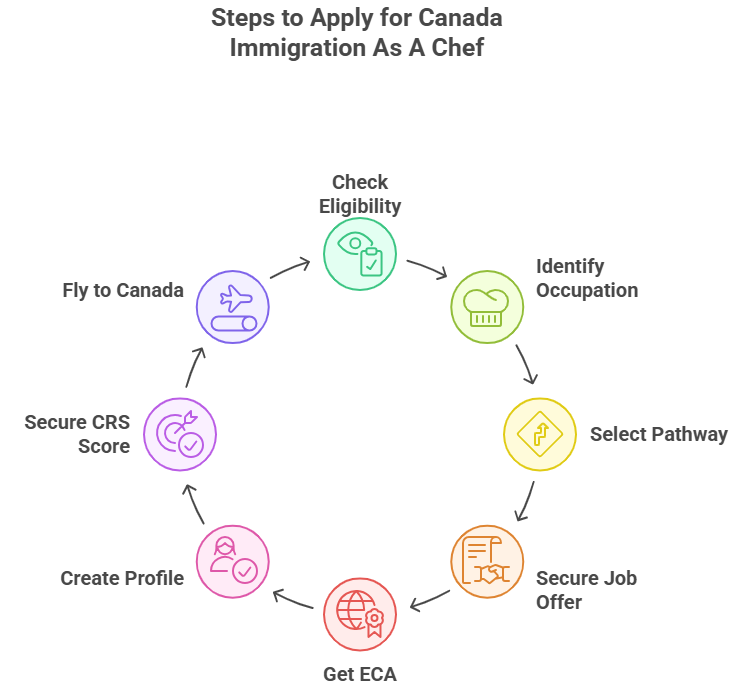
You can immigrate to Canada as a chef through Express Entry, PNP, or the Atlantic Immigration Program (AIP). While the eligibility and requirements vary based on the type of program, here is a step-by-step process you can follow to migrate to Canada as a chef:
Step 1: Check your eligibility for Canadian immigration pathways available to chefs, such as Express Entry, Canada PNP, or the Atlantic Immigration Program (AIP).
Step 2: Choose the right occupation listed under the National Occupational Classification (NOC). For chefs, you must choose the NOC 62200 (TEER 2).
Step 3: Select the immigration pathway that best fits your profile, based on your work experience, language skills, and preferred location in Canada
Step 4: Arrange the documents required for the Canadian immigration program
Step 5: Create a profile online using the official IRCC portal (if applying for Express Entry or any of the relevant PNP streams)
Step 6: Get an ECA (Educational Credential Assessment), if you have studied outside Canada. You may not need an ECA if you have a verified Canadian degree or credential.
Step 7: Boost your profile by working on factors like language scores, Canadian experience, or a PNP nomination to receive an ITA (Invitation to Apply) if applying via Express Entry.
Step 8: Complete and submit your PR application once you receive an ITA, along with the medical tests, police clearance certificate, and biometrics.
Step 9: Obtain a Confirmation of Permanent Residence (COPR), and fly to Canada to start your dream job as a chef.
*Are you looking for step-by-step assistance with Canadian immigration? Contact Y-Axis, the world’s No. 1 overseas immigration consultancy, for end-to-end assistance!
FAQs
What are the main visa options for chefs migrating to Canada?
The main visa options in Canada for chefs include Express Entry for Federal Programs and Provincial Nominee Program to meet the high demand for culinary experts in Canada. The Atlantic Immigration Program (AIP) in Canada is an LMIA-exempt route for chefs to migrate to Canada. The Federal Skilled Trades Program (FSTP) through Express Entry provides a streamlined pathway for a temporary work permit for LMIA-sponsored chef jobs, followed by permanent residence.
What documents do chefs need to migrate to Canada through skilled worker programs?
Chefs can migrate to Canada through various skilled worker programs, such as Express Entry, PNP, and AIP(LMIA-exempted). The documents required for chefs to migrate to Canada via various immigration programs are as follows:
- Educational certificates or ECA for higher studies completed outside Canada.
- Legal work experience letter.
- Qualifying language proficiency test results in IELTS/CELPIP/TEF (CLB 5/4).
- Proof of settlement funds.
- Police Clearance Certificate.
- LMIA-sponsored job offer letter (Exempted for AIP).
- Medical fitness report.
- Valid passport.
What are the fastest immigration pathways for skilled chefs to Canada?
The fastest immigration pathways for skilled chefs to Canada include Express Entry through the Federal Skilled Worker, Federal Skilled Trades, and Canadian Experience Class programs. The Provincial Nominee Program is also a faster hiring process for chefs. The provincial streams target chefs for labour shortage culinary sectors in the Canadian provinces. Other faster options for Canadian immigration include the Atlantic Immigration Program (AIP) for hospitality roles in specific provinces.
How to get a Canadian work permit as a professional chef?
To obtain a Canadian work permit as a professional chef, you must first secure a job offer from a Canadian employer that offers LMIA sponsorship for Express Entry. It is possible to apply for a work permit provided you have the required qualification and at least one year of job experience. The steps involve getting a job with LMIA (not needed for AIP) and then passing the language proficiency tests (IELTS/CELPIP). Applications can be submitted to Immigration, Refugees and Citizenship Canada (IRCC) through the Express Entry Program if you are aiming for a Canada PR.
How to migrate to Canada as a chef?
To migrate to Canada as a chef, you need to apply through popular pathways for immigration like Express Entry and Provincial Nominee Programs. Chefs must have a valid job offer, the required skills, language proficiency, and at least one year of work experience to qualify. The AIP (Atlantic Immigration Program) offers an alternative pathway for commercial culinary experts to migrate to Atlantic provinces like New Brunswick and Nova Scotia, which have a high demand for chefs.
How to Apply for Provincial Nominee Programs for Chefs in Canada?
To apply for the Provincial Nominee Programs (PNP) for chef jobs in Canada, you can follow the steps given below:
- Check eligibility in different Canadian provinces for culinary-based professions.
- Apply for nomination under the Express Entry stream, with necessary documents and the minimum CRS score.
- Wait for an invitation (ITA) based on your CRS ranking for Express Entry-aligned PNPs.
- Apply for a work permit and Canada permanent residence at the IRCC.
- Pass federal medical examinations and submit a Police clearance certificate.
- Get your Confirmation of Permanent Residence (COPR).
- Upon approval, fly to Canada!
What are the requirements for Express Entry as a chef from India?
- Minimum 1-2 years of work experience in commercial cooking.
- Proof of language proficiency (CLB 7+) in IELTS, TOEFL, etc.
- A minimum higher secondary school qualification is required (ECA is needed for higher studies completed outside Canada).
- High score in the Comprehensive Ranking System (CRS).
- Age cap between 18 and 35 for maximum CRS score.
- Clear criminal records.
- Proof of sufficient funds for settlement.
Are there Canadian employers willing to sponsor chefs from India?
Yes, there are Canadian employers willing to sponsor chefs from India. Canada has a high demand for chefs, and employers want to sponsor Indian chefs having expertise in ethnic cuisines, with Canada's focus on skilled immigration for renowned restaurant chains. Chefs need to secure a LMIA-approved job offer, relevant work experience, and skills to migrate to Canada. Culinary professionals can look for chef jobs on reliable job websites with search phrases like “visa sponsorship for chef jobs”.
What is the average salary range for chefs in major Canadian cities?
The average annual salary for chefs in Canada ranges from $40,000 to over $80,000. The yearly compensation may vary by province and skillset. Senior chefs with experience and the specialisation, earn significantly more than entry-level chefs, with a potential for $100k and more.
Do you need language proficiency tests done for Canadian chef immigration?
Yes, for most Canadian chef immigration programs, it is mandatory to have language proficiency of CLB 7 or higher in both English and French. Chefs applying through the various immigration pathways need to appear for IELTS General Training, CELPIP-General, PTE Core for English language, and TEF Canada or TCF Canada for French. Passing the proficiency test is essential for securing a higher score in the CRS ranking, leading to selection.
Tags:
Migrate to Canada as a chef
Canada PR pathways
Canada immigration pathways
Canada immigration
migrate to Canada Chef jobs in Canada
Chef jobs abroad
Chef jobs in Canada for foreigners
Chef jobs in Canada with visa sponsorship
Chef in Canada salary
Share
Options for you by Y-Axis

Get it on your mobile

Get News alerts

Contact Y-Axis
Latest Article
Popular Post
Trending Article

Posted On February 17 2026
How can I migrate to Japan as a Chef?