

Posted on November 04 2026
Canada vs. UK for Hospitality Professionals: Which Country Should You Choose?

By , Editor & Director
Updated November 06 2026
Canada and the United Kingdom both have large hospitality sectors with steady demand for skilled staff. Canada is the better choice for hospitality professionals who want permanent residence. Chefs, cooks and restaurant managers can qualify for Express Entry or Provincial Nominee Programs (PNPs). The UK offers fewer options for new arrivals. Since 22 July 2025, chefs, restaurant managers and hotel managers cannot get new Skilled Worker visas. Indian graduates aged 18 to 30 can still work in UK hospitality through the India Young Professionals Scheme.
The right destination depends on your role, age, experience, budget and long-term plans. Both countries need staff in hotels, restaurants, resorts, catering and tourism. However, their visa rules differ sharply. Before choosing a country, compare visa eligibility, salaries, living costs and the route to permanent residence.
*Want to work abroad? Contact Y-Axis for guidance and assistance with your immigration plans.
Canada vs. UK for Hospitality Professionals: Quick Comparison
|
Factor |
Canada |
United Kingdom |
|
Hospitality job demand |
Steady demand for cooks, chefs, food service supervisors, restaurant managers and hotel staff, especially in tourism regions. |
Steady demand for chefs, front-of-house staff and hotel and restaurant managers. Visa sponsorship for overseas workers is very limited. |
|
Major hospitality hubs |
Toronto, Vancouver, Calgary, Banff, Whistler, Montreal, Ottawa and Niagara Falls. |
London, Edinburgh, Manchester, Birmingham, Glasgow, Liverpool, Bristol and Bath. |
|
Popular hospitality roles |
Cooks, Chefs, Bakers, Food Service Supervisors, Restaurant and Food Service Managers and Accommodation Service Managers. |
Chefs, Hotel Managers, Restaurant Managers, Bar Managers, Front Office Staff and Event Coordinators. |
|
Skilled migration |
Express Entry for TEER 0–3 roles, PNPs such as Alberta's Tourism and Hospitality Stream, and employer-supported work permits. |
Chefs, restaurant managers and hotel managers are not eligible for new Skilled Worker visas. No hospitality roles are on the Temporary Shortage List. |
|
Other entry routes |
Study permits for hospitality diplomas, followed by eligible work permits. |
India Young Professionals Scheme, Graduate visa after a UK degree and the High Potential Individual (HPI) visa. |
|
Qualification assessment |
An Educational Credential Assessment (ECA) is needed for the Federal Skilled Worker Program. |
No regulator assesses hospitality qualifications. Employers review your degree, diploma and experience. |
|
Certifications |
Provinces require food handler certification for most food service roles. Red Seal certification is valued for cooks and bakers. |
A Level 2 Food Hygiene certificate is usually expected. A personal licence is needed to authorise alcohol sales. |
|
English-language requirements |
IELTS General Training or CELPIP results, or TEF/TCF for French, are required for Express Entry. |
B1-level English is required for the India Young Professionals Scheme. B2-level English is required for new Skilled Worker visa applicants. |
|
Job offer and sponsorship |
A job offer is not required for Express Entry. Employer work permits usually need an LMIA. Low-wage LMIAs are not processed in cities with unemployment of 6% or higher. |
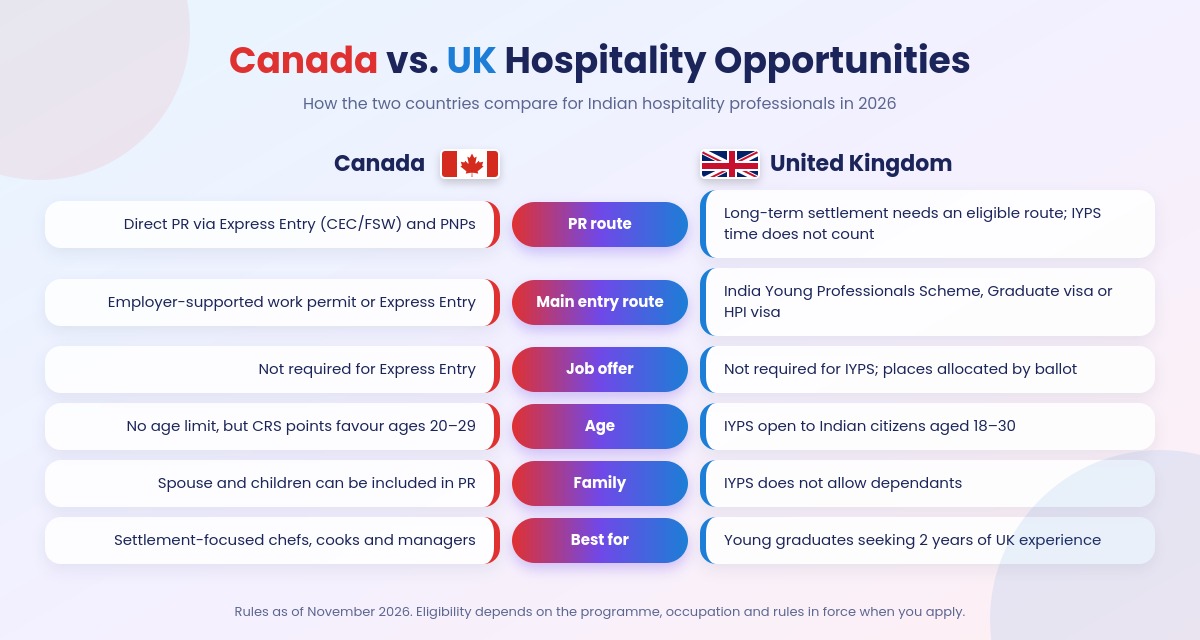
The India Young Professionals Scheme needs no job offer or sponsor. Places are limited to 3,000 a year and allocated by ballot. |
|
Permanent residence potential |
Eligible applicants can apply directly for PR through Express Entry, PNPs or other programmes. |
Time on the India Young Professionals Scheme does not count towards settlement. Settlement needs an eligible route, such as a Skilled Worker visa. |
|
Family migration |
A spouse and dependent children can be included in a PR application. Spouses of some workers may qualify for open work permits. |
The India Young Professionals Scheme does not allow dependants. |
|
Best suited for |
Hospitality professionals seeking a long-term career and a direct path to permanent residence. |
Young Indian graduates who want up to two years of UK hospitality experience. |
*Check your eligibility for Canada through the Y-Axis Canada CRS Score Calculator.
Canada vs. UK: Which Country Offers Better Opportunities for Indian Hospitality Professionals?
Canada may be a suitable option if you:
- Have at least one year of skilled work experience as a chef, cook, baker, food service supervisor or hospitality manager.
- Work in an occupation classified as TEER 0, 1, 2 or 3 under the National Occupational Classification (NOC).
- Can complete an Educational Credential Assessment (ECA) for your degree or diploma.
- Have strong English or French test scores, such as IELTS, CELPIP, TEF or TCF.
- Are eligible for Express Entry, a Provincial Nominee Program (PNP) or another suitable immigration route.
- Are willing to gain Canadian work experience, which can help you qualify for the Canadian Experience Class.
- Want to apply for permanent residence with your spouse and children.
- Are open to working in tourism regions and smaller cities, not just Toronto or Vancouver.
*Want to migrate to Canada? Contact Y-Axis for guidance on your immigration options.
The UK may be a suitable option if you:
- Are an Indian citizen aged 18 to 30 with a bachelor's degree or higher.
- Can meet the India Young Professionals Scheme requirements, including B1-level English and £2,530 in savings.
- Want up to two years of work experience in UK hotels, restaurants or catering.
- Do not need to bring a spouse or children with you.
- Plan to complete a UK degree and then use the Graduate visa to work.
- Hold a degree from an eligible global university and qualify for the High Potential Individual visa.
- Want international experience in London, Edinburgh or other major tourism cities.
- Understand that long-term settlement depends on your visa and the rules in force when you apply.
*Want to migrate to the UK? Contact Y-Axis for guidance on available immigration pathways.
Canada vs. UK: Salary, Living Costs and Savings for Hospitality Professionals
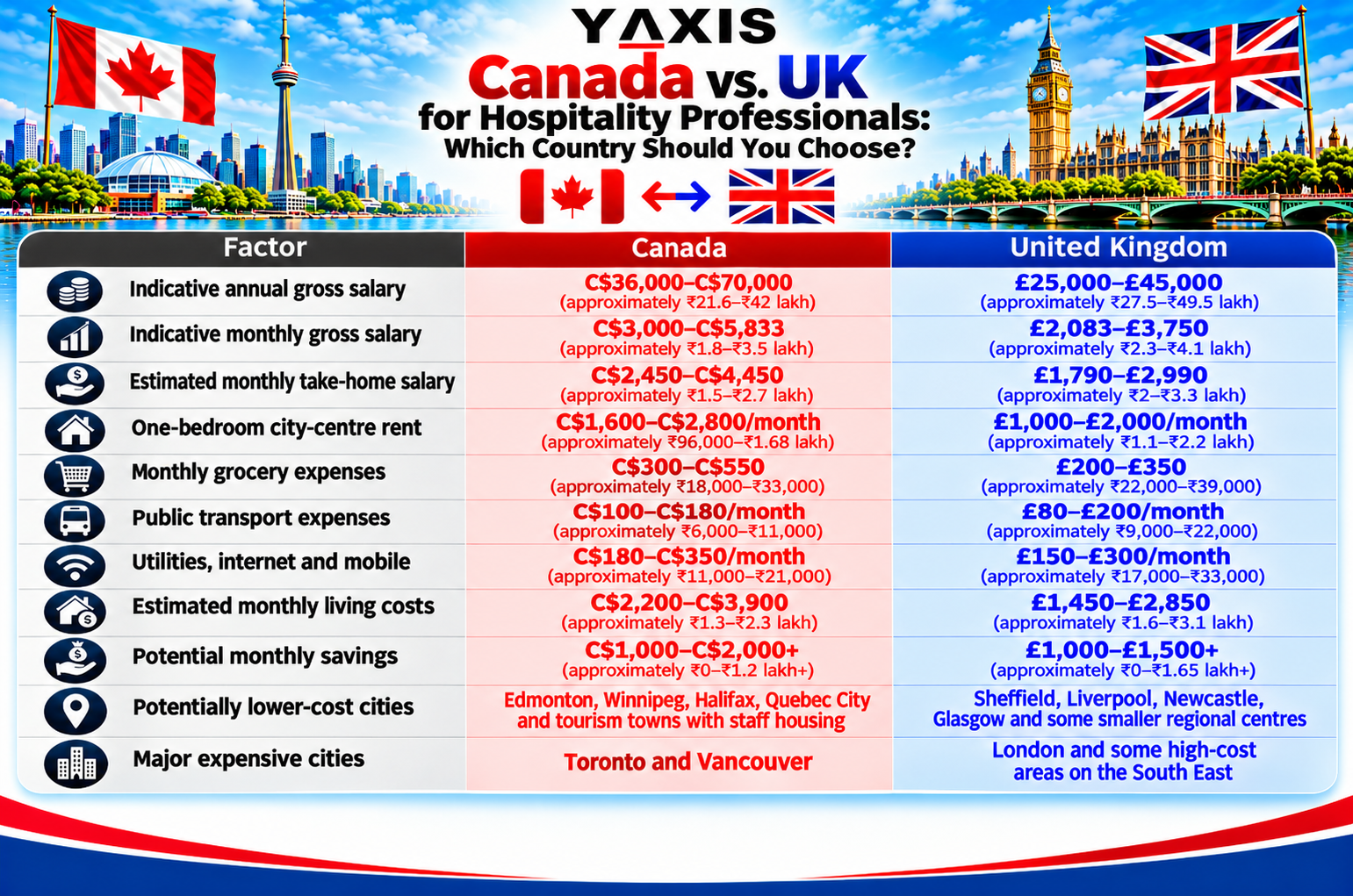
The following table provides illustrative planning estimates for a chef, cook or hospitality supervisor living alone in a major city.
|
Factor |
Canada |
United Kingdom |
|
Indicative annual gross salary |
C$36,000–C$70,000 (approximately ₹21.6–₹42 lakh) |
£25,000–£45,000 (approximately ₹27.5–₹49.5 lakh) |
|
Indicative monthly gross salary |
C$3,000–C$5,833 (approximately ₹1.8–₹3.5 lakh) |
£2,083–£3,750 (approximately ₹2.3–₹4.1 lakh) |
|
Estimated monthly take-home salary |
C$2,450–C$4,450 (approximately ₹1.5–₹2.7 lakh) |
£1,790–£2,990 (approximately ₹2–₹3.3 lakh) |
|
One-bedroom city-centre rent |
C$1,600–C$2,800/month (approximately ₹96,000–₹1.68 lakh) |
£1,000–£2,000/month (approximately ₹1.1–₹2.2 lakh) |
|
Monthly grocery expenses |
C$300–C$550 (approximately ₹18,000–₹33,000) |
£200–£350 (approximately ₹22,000–₹39,000) |
|
Public transport expenses |
C$100–C$180/month (approximately ₹6,000–₹11,000) |
£80–£200/month (approximately ₹9,000–₹22,000) |
|
Utilities, internet and mobile |
C$180–C$350/month (approximately ₹11,000–₹21,000) |
£150–£300/month (approximately ₹17,000–₹33,000) |
|
Estimated monthly living costs |
C$2,200–C$3,900 (approximately ₹1.3–₹2.3 lakh) |
£1,450–£2,850 (approximately ₹1.6–₹3.1 lakh) |
|
Potential monthly savings |
C$1,000–C$2,000+ (approximately ₹50,000–₹1.2 lakh+) |
£500–£1,500+ (approximately ₹50,000–₹1.65 lakh+) |
|
Potentially lower-cost cities |
Edmonton, Winnipeg, Halifax, Quebec City and tourism towns with staff housing |
Sheffield, Liverpool, Newcastle, Glasgow and some smaller regional centres |
|
Major expensive cities |
Toronto and Vancouver |
London and some high-cost areas in the South East |
Note: Canadian figures are based on typical wages for cooks, chefs and restaurant managers. UK figures range from the National Living Wage of £12.71 an hour to typical head chef and hotel manager pay. Shared housing, staff accommodation, tips and service charges can improve savings in both countries.
*Looking for assistance with overseas immigration? Contact Y-Axis, the world's number one immigration consultancy, for guidance on immigration options and visa requirements.
FAQs
Is Canada or the UK better for hospitality professionals?
Canada is generally better for hospitality professionals who want permanent residence. Chefs, cooks, food service supervisors and restaurant managers fall under TEER 0–3 occupations, which are eligible for Express Entry. Several provinces also offer PNP options. The UK is more limited because most hospitality roles lost Skilled Worker visa eligibility on 22 July 2025. However, young Indian graduates can still gain UK experience through the India Young Professionals Scheme. Your age, role, experience and long-term goals should guide your choice.
Can Indian chefs get a UK Skilled Worker visa in 2026?
In most cases, no. From 22 July 2025, new Skilled Worker visas are only available for jobs at RQF Level 6, which is degree level. Chefs are classified at RQF Level 3, so employers cannot sponsor new chef applicants. Chefs are also not on the Temporary Shortage List. Chefs who already held a Skilled Worker visa before this date can usually extend or change employers under transitional rules. New applicants should explore other routes, such as the India Young Professionals Scheme.
Does Canada have an Express Entry category for hospitality workers?
No. Canada's 2026 Express Entry categories do not include a dedicated hospitality category. However, many hospitality roles are TEER 0, 2 or 3 occupations, so they remain eligible for the Federal Skilled Worker Program and the Canadian Experience Class. Candidates must still score well under the Comprehensive Ranking System (CRS). Canadian work experience, strong language scores and a provincial nomination can improve your chances of receiving an invitation to apply.
What is Alberta's Tourism and Hospitality Stream?
Alberta's Tourism and Hospitality Stream is a PNP pathway for temporary foreign workers already employed in Alberta's tourism and hospitality sector. Candidates need a full-time job offer from an eligible Alberta employer and must meet work experience and language requirements. Alberta issues invitations through an Expression of Interest system. The stream has a small annual allocation of 156 nominations in 2026. A provincial nomination can then support an application for permanent residence.
What is the India Young Professionals Scheme?
The India Young Professionals Scheme lets Indian citizens aged 18 to 30 live and work in the UK for up to two years. Applicants need a bachelor's degree or higher, B1-level English and savings of at least £2,530. No job offer or sponsor is required. The UK offers 3,000 places each year through a random ballot. Successful applicants can work for most employers, including hotels and restaurants. The visa does not allow dependants or lead to settlement.
How much do hospitality professionals earn in Canada and the UK?
In Canada, hospitality professionals typically earn between C$36,000 and C$70,000 a year. Cooks earn towards the lower end, while restaurant and accommodation managers earn more. In the UK, typical pay ranges from about £25,000 to £45,000 a year. The National Living Wage is £12.71 an hour from April 2026. Actual pay depends on your role, experience, employer and city. Tips and service charges can add to your income.
Which hospitality jobs qualify for Express Entry?
Hospitality jobs classified under TEER 0, 1, 2 or 3 of Canada's National Occupational Classification can qualify. Examples include restaurant and food service managers (NOC 60030), accommodation service managers (NOC 60031), chefs (NOC 62200), food service supervisors (NOC 62020), cooks (NOC 63200) and bakers (NOC 63202). Roles such as servers and kitchen helpers are TEER 5 and do not qualify. You also need eligible work experience and language scores.
Do I need a job offer to move to Canada as a hospitality worker?
A job offer is not required for Express Entry. You can enter the pool if you meet the programme requirements. However, many hospitality workers first move to Canada on an employer-supported work permit. This usually needs a Labour Market Impact Assessment (LMIA). Low-wage LMIA applications are currently not processed in cities with unemployment of 6% or higher. Most provincial hospitality streams also require a job offer.
What certifications help hospitality professionals find jobs in Canada and the UK?
In Canada, a provincial food handler certificate is required for most food service roles. Red Seal certification is valued for cooks and bakers. In the UK, employers usually expect a Level 2 Food Hygiene certificate. A personal licence is needed to authorise alcohol sales. A hospitality degree or diploma, culinary training and international hotel experience can also improve your job prospects in both countries.
Can hospitality workers bring their family to Canada or the UK?
In Canada, you can include your spouse and dependent children in a permanent residence application. Spouses of some work permit holders may also qualify for open work permits. In the UK, the India Young Professionals Scheme does not allow dependants. Your partner would need their own visa to join you. Family options in the UK depend on your visa route and the rules in force when you apply.
Tags:
Work in Canada
Work in UK
Canada immigration
UK immigration
Express Entry
Canada PNP
India Young Professionals Scheme
Hospitality jobs abroad
Chef jobs in Canada
Hotel management jobs abroad
Share
Options for you by Y-Axis

Get it on your mobile

Get News alerts

Contact Y-Axis
Latest Article
Popular Post
Trending Article
Posted On November 06 2026
Canada Reports 68% Drop in Asylum Claimants as New Immigration Rules Take Effect