

Posted on October 09 2026
Canada vs. Australia for Nurses: Which Country Should You Choose?

By , Editor & Director
Updated October 09 2026
If you are a nurse planning to work and settle abroad, Canada and Australia are two popular destinations to consider. Both countries have established healthcare systems, demand for qualified nursing professionals, competitive salaries and immigration pathways that can lead to permanent residence. However, the better option depends on your nursing specialisation, qualifications, clinical experience, English-language ability, registration requirements, age, salary expectations, family plans and preferred immigration pathway.
Canada can be attractive for nurses because of its healthcare workforce demand, provincial nursing opportunities, Express Entry, Provincial Nominee Programs (PNPs) and other immigration pathways. Nurses can find opportunities across hospitals, community healthcare, long-term care, rehabilitation, mental health, aged care and other healthcare settings.
Australia can be particularly attractive for nurses seeking opportunities across hospitals, aged care, community healthcare, mental health, emergency care, critical care and regional healthcare. Australia also offers skilled and employer-sponsored migration pathways for eligible nursing professionals.
*Want to migrate abroad? Contact Y-Axis for complete guidance and assistance.
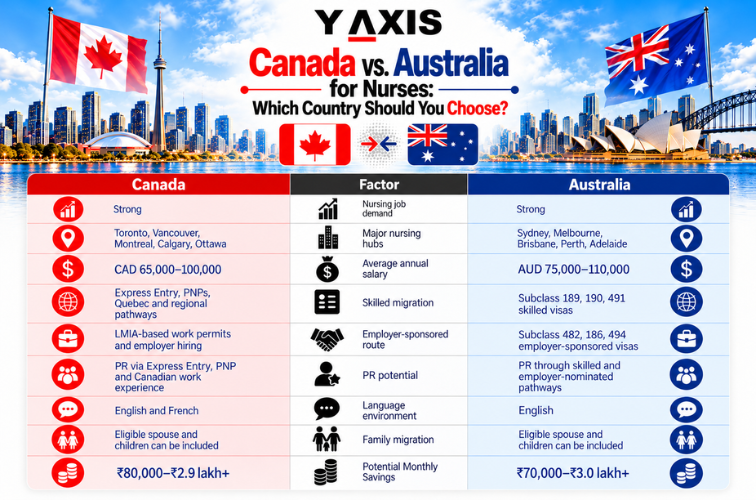
Canada vs. Australia for Nurses: Quick Comparison
|
Factor |
Canada |
Australia |
|
Nursing job demand |
Opportunities in hospitals, community healthcare, long-term care, mental health and specialised nursing |
Opportunities in hospitals, aged care, community healthcare, mental health, emergency and critical care |
|
Major nursing hubs |
Toronto, Vancouver, Calgary, Edmonton, Ottawa, Montreal and Winnipeg |
Sydney, Melbourne, Brisbane, Perth, Adelaide, Canberra and Hobart |
|
Popular nursing roles |
Registered Nurses, Practical Nurses, Nurse Practitioners, Clinical Nurses, Critical Care Nurses, Emergency Nurses and Mental Health Nurses |
Registered Nurses, Enrolled Nurses, Nurse Practitioners, Clinical Nurses, Critical Care Nurses, Emergency Nurses and Mental Health Nurses |
|
Skilled migration |
Express Entry, Provincial Nominee Programs (PNPs) and other eligible pathways |
Skilled Independent (189), Skilled Nominated (190), Skilled Work Regional (491) and other eligible pathways |
|
Professional assessment / registration |
Internationally educated nurses must meet the requirements of the relevant provincial/territorial nursing regulator |
Internationally qualified nurses must meet NMBA registration requirements through Ahpra |
|
Nursing licensing / registration |
Provincial/territorial: Registration is required with the relevant nursing regulator. Requirements may include credential assessment, language testing, NCLEX-RN and additional requirements |
National: Registration is through NMBA/Ahpra. International nurses may need qualification assessment, English requirements and an outcomes-based assessment |
|
Professional qualification |
Nursing registration is managed by provincial and territorial regulatory bodies |
Nursing registration is nationally regulated through NMBA/Ahpra |
|
English-language requirements |
Requirements vary by provincial regulator and registration pathway |
English requirements apply unless an applicable exemption is met |
|
Licensing examinations / competency |
Eligible RN applicants may need to pass NCLEX-RN; additional provincial requirements may apply |
Some internationally qualified nurses may need to complete an outcomes-based assessment or other NMBA/Ahpra requirements |
|
Visa sponsorship |
Eligible healthcare employers may support foreign nurses through employer-specific work permits |
Eligible employers can sponsor nurses through employer-sponsored visa pathways |
|
PR potential |
Express Entry, PNPs and other eligible permanent residence pathways |
Skilled and employer-sponsored permanent residence pathways |
|
Family migration |
Available through eligible immigration pathways |
Available through eligible visa pathways |
|
Best suited for |
Nurses prioritising immigration options, long-term settlement and Canada's healthcare sector |
Nurses prioritising skilled migration, career development, lifestyle and Australia's healthcare sector |
*Check your eligibility to Canada through the Y-Axis Canada CRS Score Calculator.
Canada vs. Australia: Which Country Offers Better Opportunities for Indian Nurses?
Both Canada and Australia offer career and migration opportunities for Indian nurses. However, the right destination depends on your nursing qualification, registration eligibility, clinical experience, nursing specialisation, English-language proficiency, age, immigration score, career goals and preferred lifestyle.
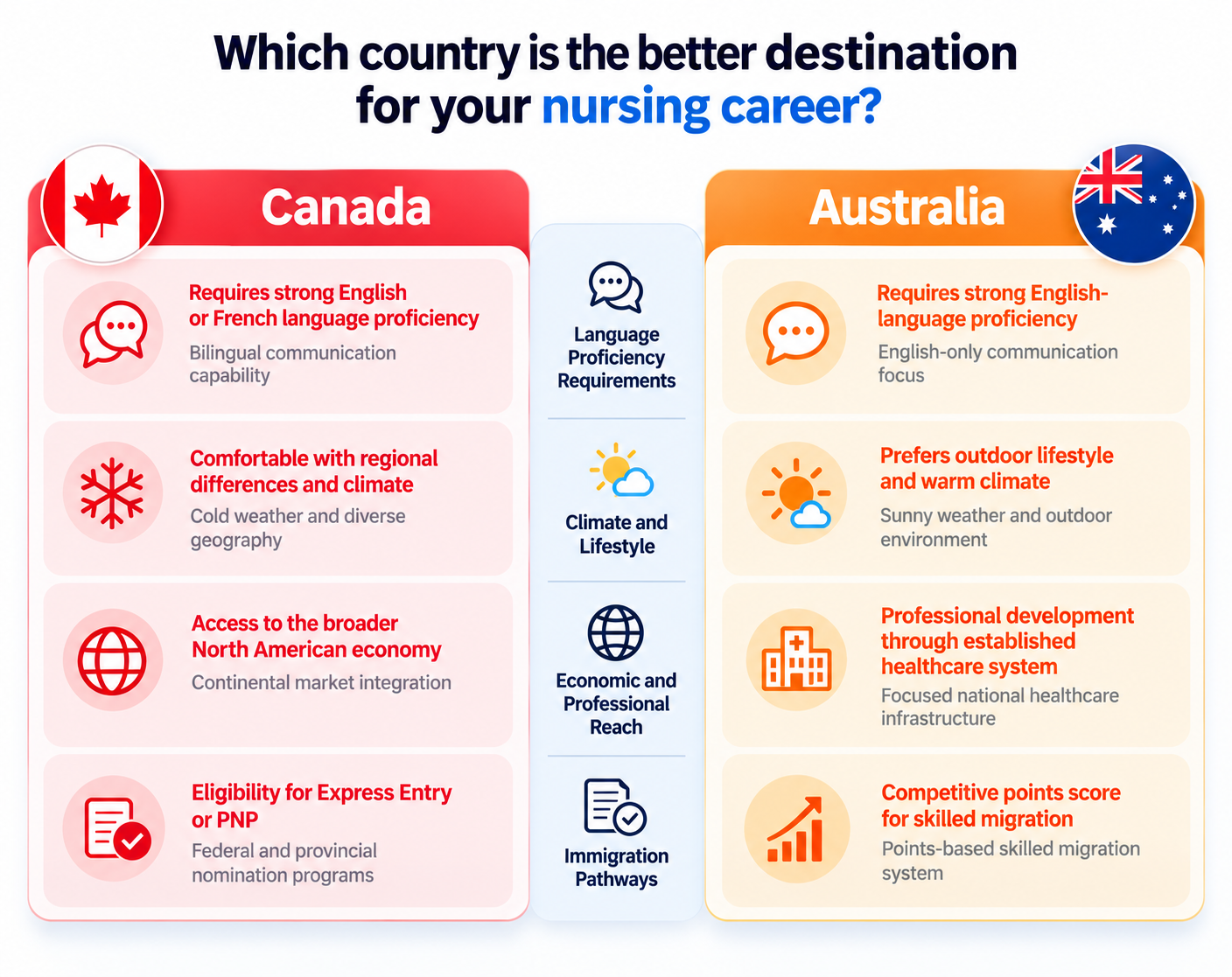
Canada may be a suitable option if you:
- Have a recognised nursing qualification and relevant clinical experience.
- Meet the requirements for assessment and registration as a nurse in the Canadian province or territory where you intend to work.
- Have several years of relevant nursing experience.
- Have strong English or French language proficiency, depending on your intended pathway.
- Meet the eligibility requirements for Express Entry or a Provincial Nominee Program (PNP).
- Work in a nursing specialisation with opportunities in Canada's hospitals, long-term care facilities, community healthcare and other healthcare settings.
- Prioritise permanent residence and long-term settlement in Canada.
- Want to build a career in areas such as critical care, emergency nursing, mental health, community nursing, aged care or specialised clinical practice.
- Are prepared to complete applicable credential assessments, examinations, bridging programs or provincial registration requirements, where required.
- Want access to Canada's major healthcare and employment centres and the broader North American economy.
- Are comfortable with Canada's climate and regional differences in employment opportunities.
*Want to migrate to Canada? Get in touch with experts at Y-Axis to guide you with the process.
Australia may be a suitable option if you:
- Hold a recognised nursing qualification and meet Australia's nursing registration requirements.
- Can obtain the required registration or assessment for your nursing occupation.
- Have strong English-language proficiency and can meet applicable registration and visa requirements.
- Have relevant clinical nursing experience.
- Have a competitive points score for skilled migration, where applicable.
- Have access to Australian employer sponsorship or an eligible nursing job opportunity.
- Have experience in areas such as critical care, emergency nursing, mental health, aged care, community nursing, medical-surgical nursing or other specialised fields.
- Want to explore opportunities within Australia's hospitals, aged care facilities, community healthcare services and regional healthcare sectors.
- Prefer Australia's climate, outdoor lifestyle and work-life environment.
- Are looking to build a long-term nursing career in Australia's major cities or regional healthcare centres.
- Are interested in professional development through Australia's established nursing and healthcare system.
- Are willing to meet the registration requirements of the Nursing and Midwifery Board of Australia (NMBA) and other applicable authorities.
*Want to migrate to Australia? Get in touch with experts at Y-Axis to guide you with the process.
Canada vs. Australia: Salary, Living Costs & Savings for Nurses
For nurses, the financial benefit of working abroad depends on more than just salary. Taxes, housing, groceries, transportation and other daily expenses can significantly affect how much you can save each month. The table below compares nursing salaries, estimated take-home pay, housing and daily living expenses in Canada and Australia. Actual costs and savings vary depending on nursing specialisation, experience, location, tax rates, shift allowances and individual lifestyle.
|
Factor |
Canada |
Australia |
|
Median Nursing Salary |
₹45 lakh–₹75 lakh/year |
₹48 lakh–₹80 lakh/year |
|
Monthly Gross Salary |
₹3.75–₹6.25 lakh |
₹4.00–₹6.65 lakh |
|
Estimated Monthly Take-Home Salary |
₹2.90–₹4.80 lakh |
₹3.10–₹5.10 lakh |
|
1-Bedroom City-Centre Rent |
₹1.36–₹1.91 lakh/month |
₹1.70–₹2.42 lakh/month |
|
Monthly Grocery Expenses |
₹27,000–₹41,000 |
₹20,400–₹34,000 |
|
Public Transport Expenses |
₹6,800–₹10,600/month |
₹10,200–₹14,800/month |
|
Utilities + Internet + Mobile |
₹12,300–₹20,900/month |
₹13,600–₹29,200/month |
|
Estimated Monthly Living Costs |
₹1.84–₹2.66 lakh |
₹2.24–₹3.26 lakh |
|
Potential Monthly Savings |
₹80,000–₹2.9 lakh+ |
₹70,000–₹3.0 lakh+ |
|
Lower-Cost Nursing Cities |
Calgary, Edmonton, Winnipeg, Montreal |
Brisbane, Adelaide, Perth |
|
Major Expensive Nursing Cities |
Toronto, Vancouver |
Sydney, Melbourne |
*Looking for assistance with overseas immigration? Contact Y-Axis, one of the world's leading immigration consultancies, for guidance and visa assistance.
FAQs
Is Canada or Australia better for nurses?
Both Canada and Australia offer good opportunities for qualified nurses. Canada can be attractive for nurses who prioritise permanent residence, long-term settlement and opportunities across different provinces. Australia offers strong demand for nurses, competitive salaries and attractive lifestyle options. Your better choice depends on your nursing qualification, work experience, registration eligibility, English-language skills, age, family plans and preferred immigration pathway.
Are nurses in demand in Canada and Australia?
Yes, nurses are in demand in both Canada and Australia. Both countries have healthcare systems that require qualified nursing professionals across hospitals, aged care, community healthcare, mental health and specialised areas. Demand can vary by location and nursing specialisation. Nurses with relevant qualifications, clinical experience and professional registration may find opportunities in both countries, particularly in regional and healthcare shortage areas.
Can Indian nurses work in Canada?
Yes, Indian nurses can work in Canada if they meet the requirements of the relevant provincial or territorial nursing regulator. Internationally educated nurses may need credential assessment, English-language testing, examinations and additional education or competency requirements. The exact process depends on the province and nursing category. Nurses must obtain the required registration before they can practise as nurses in Canada.
Can Indian nurses work in Australia?
Yes, Indian nurses can work in Australia after meeting the country's nursing registration requirements. Internationally qualified nurses generally apply through the Australian Health Practitioner Regulation Agency (Ahpra) and the Nursing and Midwifery Board of Australia (NMBA). Depending on their qualifications and experience, they may need to meet English-language requirements, complete assessments and satisfy other registration standards before practising as nurses.
Which country pays nurses more, Canada or Australia?
Nursing salaries in both Canada and Australia can be competitive, but actual earnings vary by experience, specialisation, location, employer and shift allowances. Australia may offer higher salaries in some nursing roles, while Canada can also provide strong earning opportunities, particularly for experienced and specialised nurses. Nurses should compare gross salary, taxes, housing, transportation and other living expenses rather than salary alone.
Is nursing registration easier in Canada or Australia?
Neither country has a single process that is easier for every international nurse. Canada regulates nursing at the provincial and territorial level, so requirements can differ by location. Australia has a national registration system through NMBA and Ahpra. Your nursing qualification, education, clinical experience, registration history and English-language ability can affect the assessment process and requirements in either country.
Which country offers better immigration options for nurses?
Both Canada and Australia offer immigration pathways for eligible nurses. Canada provides options such as Express Entry and Provincial Nominee Programs, while Australia offers skilled and employer-sponsored pathways. Eligibility depends on factors such as age, qualifications, work experience, English-language ability, registration and points or nomination requirements. Nurses should assess their individual profile before deciding which country's immigration pathway is more suitable.
Can nurses get permanent residence in Canada or Australia?
Yes, eligible nurses can potentially obtain permanent residence in both countries. Canada offers permanent residence pathways through Express Entry, Provincial Nominee Programs and other programs. Australia offers skilled and employer-sponsored permanent residence pathways. However, meeting the requirements does not guarantee permanent residence. Eligibility depends on factors such as occupation, registration, age, qualifications, experience, English ability and the applicable immigration program.
Which country has a better lifestyle for nurses?
Lifestyle preferences vary from person to person. Australia is often attractive to nurses who prefer warmer weather, outdoor activities, beaches and a relaxed lifestyle. Canada may appeal to nurses who prefer a North American environment, multicultural cities and access to a large healthcare system. Both countries offer opportunities in major cities and regional areas, but housing costs, climate and working conditions vary considerably.
Should I choose Canada or Australia as an Indian nurse?
The best choice depends on your personal and professional profile. Consider your nursing qualification, registration eligibility, clinical experience, English-language score, age, salary expectations, immigration goals and family plans. Canada may suit nurses focused on permanent settlement, while Australia may appeal to those seeking strong nursing opportunities, skilled migration and lifestyle benefits. Compare registration, visa eligibility, salary and living costs before making your decision.
Tags:
Canada vs Australia for Nurses
Nursing Jobs in Canada
Nursing Jobs in Australia
Canada Immigration for Nurses
Australia Immigration for Nurses
Nursing Salaries in Canada
Nursing Salaries in Australia
Canada vs Australia Salary
Canada vs Australia
Share
Options for you by Y-Axis

Get it on your mobile

Get News alerts

Contact Y-Axis
Latest Article
Popular Post
Trending Article
Posted On October 09 2026
Canada’s Immigration Reset: Why the Next Move May Be About Fit, Not Volume