

Posted on September 25 2026
Canada vs. Australia for HR Professionals: Which Country Should You Choose?

By , Editor & Director
Updated September 25 2026
If you are a Human Resources professional planning to work and settle abroad, Canada and Australia are two destinations worth considering. Both countries have established labour markets, demand for HR and people-management professionals, competitive salaries and skilled migration pathways. However, the better option depends on your HR specialisation, qualifications, professional experience, age, English-language ability, occupation classification, salary expectations, family plans and preferred immigration pathway.
Canada can be attractive for HR professionals because of opportunities in recruitment, talent acquisition, employee relations, compensation and benefits, learning and development, HR business partnering and people operations, along with immigration pathways such as Express Entry and Provincial Nominee Programs (PNPs). Australia offers opportunities across human resources management, recruitment, workplace relations, talent management, organisational development and people operations, with skilled and employer-sponsored migration pathways available to eligible applicants.
*Want to migrate abroad? Contact Y-Axis for complete guidance and assistance.
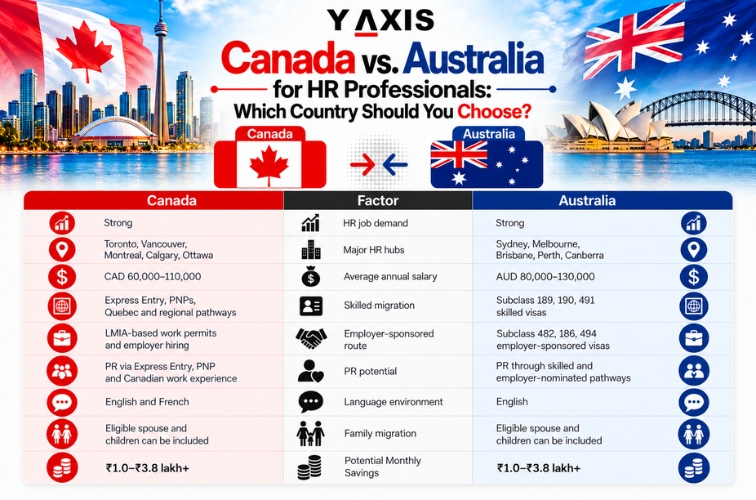
Canada vs. Australia for HR Professionals: Quick Comparison
|
Factor |
Canada |
Australia |
|
HR job demand |
Opportunities across HR management, recruitment, talent acquisition, employee relations, training and development, compensation and benefits |
Opportunities across HR management, recruitment, workplace relations, talent management, organisational development and people operations |
|
Major employment hubs |
Toronto, Vancouver, Calgary, Montreal, Ottawa, Edmonton, Winnipeg |
Sydney, Melbourne, Brisbane, Perth, Adelaide, Canberra, Gold Coast |
|
Popular HR roles |
Human resources managers, HR business partners, recruitment specialists, talent acquisition professionals, HR generalists, training and development professionals and compensation specialists |
Human resources managers, HR advisers, recruitment consultants, talent acquisition specialists, workplace relations professionals, HR business partners and organisational development professionals |
|
Skilled migration |
Express Entry, Provincial Nominee Programs (PNPs) and other eligible pathways |
Skilled and employer-sponsored pathways, including eligible subclass 189, 190 and 491 pathways |
|
English-language requirements |
English or French language requirements may apply for immigration; employers may also require strong English communication skills |
English-language requirements may apply for immigration and, depending on the pathway, skills assessment or employment |
|
Employer sponsorship |
Eligible Canadian employers may support eligible foreign workers through applicable work permit pathways |
Eligible employers can sponsor qualified professionals through applicable employer-sponsored visa pathways |
|
PR potential |
Express Entry, PNPs and other eligible permanent residence pathways |
Skilled and employer-sponsored permanent residence pathways |
|
Family migration |
Available through eligible immigration pathways |
Available through eligible immigration pathways |
|
Best suited for |
HR professionals seeking opportunities in Canada's diverse corporate and labour market and exploring long-term settlement pathways |
HR professionals seeking opportunities in Australia's corporate, professional-services and public-sector labour markets and exploring skilled migration options |
*Check your eligibility to Canada through the Y-Axis Canada CRS Score Calculator.
Canada vs. Australia: Which Country Offers Better Opportunities for Indian HR Professionals?
Both Canada and Australia offer career and migration opportunities for Indian Human Resources professionals. However, the right destination depends on your HR specialisation, educational qualifications, professional experience, English-language proficiency, occupation eligibility, immigration score, career goals and preferred lifestyle.
Canada may be a suitable option if you:
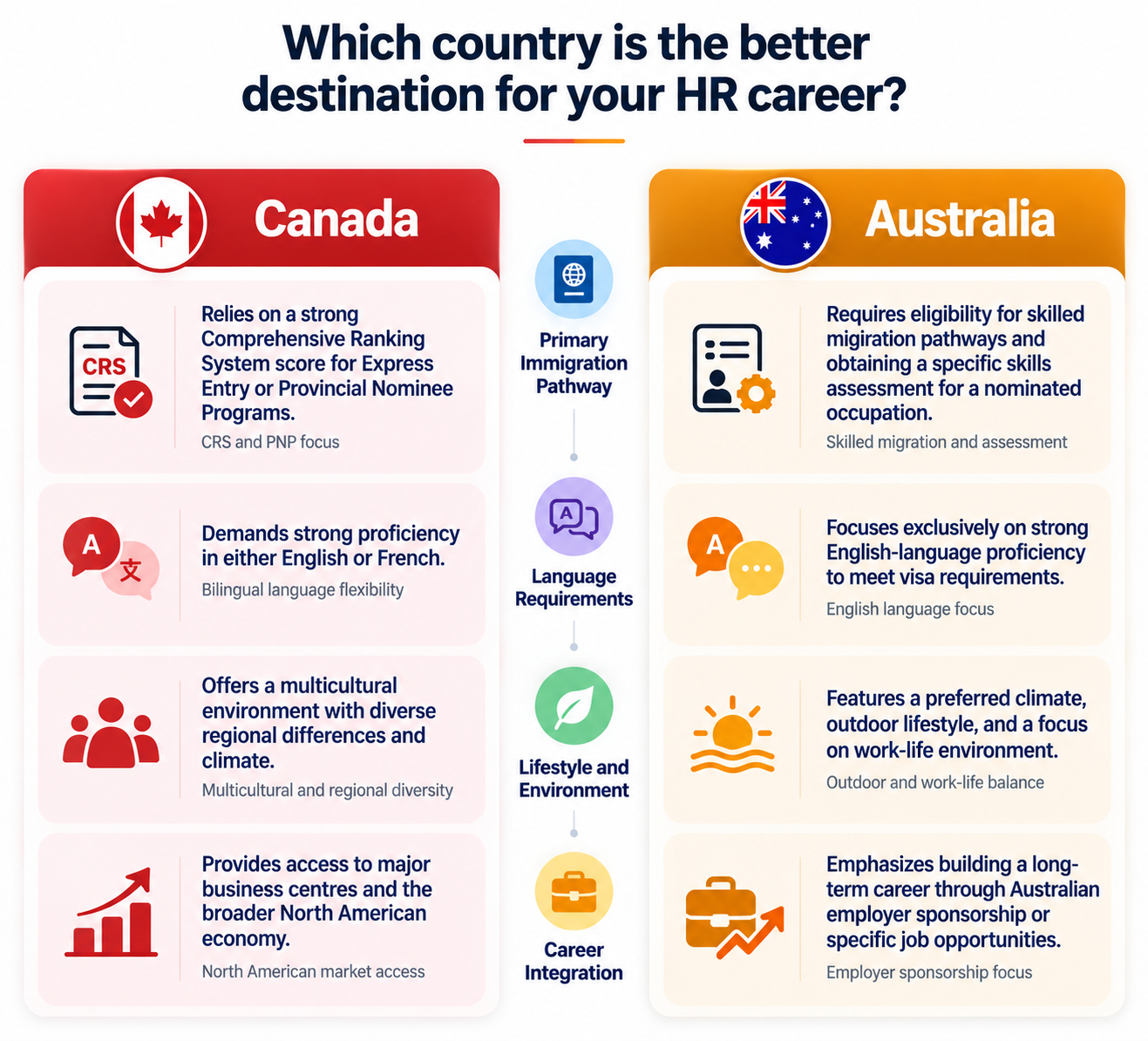
- Have a strong Comprehensive Ranking System (CRS) score for an eligible Express Entry pathway.
- Have HR, business administration, management or a related qualification that meets the requirements of your intended occupation and immigration pathway.
- Possess several years of relevant experience in human resources management, recruitment, talent acquisition, employee relations, compensation, training or related HR functions.
- Have strong English or French language proficiency.
- Meet the eligibility requirements for Express Entry or a Provincial Nominee Program (PNP).
- Work in an HR field with opportunities across corporations, professional services, technology companies, financial services, healthcare, manufacturing, retail, government and other sectors.
- Prioritise permanent residence and long-term settlement in Canada.
- Want to access employment opportunities in Canada's major business centres and broader North American economy.
- Are prepared to complete any applicable credential assessment or employment-related qualification recognition requirements.
- Prefer Canada's multicultural environment and are comfortable with its climate and regional differences.
*Want to migrate to Canada? Contact Y-Axis for complete guidance.
Australia may be a suitable option if you:
- Work in an HR occupation that is eligible for an applicable Australian skilled migration pathway.
- Can obtain the required skills assessment, where applicable, for your nominated occupation.
- Have strong English-language proficiency and can meet the applicable visa requirements.
- Have a competitive points score for skilled migration, where points-based eligibility applies.
- Have access to Australian employer sponsorship or an eligible HR job opportunity.
- Have substantial professional experience in areas such as human resources management, recruitment, workplace relations, talent management, organisational development, learning and development or people operations.
- Want to explore opportunities across Australia's corporate sector, professional services, technology companies, financial services, government organisations and other major employers.
- Prefer Australia's climate, outdoor lifestyle and work-life environment.
- Are looking to build a long-term career within Australia's HR and people-management sector.
*Want to migrate to Australia? Contact Y-Axis for complete guidance.
Canada vs. Australia: Salary, Living Costs & Savings for Human Resources Professionals
For Human Resources professionals, the financial benefit of working abroad depends on more than just salary. Taxes, housing, groceries, transportation and other daily expenses can significantly affect how much you can save each month. The table below compares HR salaries, estimated take-home pay, housing and daily living expenses in Canada and Australia. It also highlights potential savings for HR professionals at different income levels. Actual costs and savings vary depending on HR specialisation, experience, location, tax rates, employer, employment sector and individual lifestyle.
|
Factor |
Canada |
Australia |
|
Average HR Professional Salary |
₹45 lakh–₹90 lakh/year |
₹50 lakh–₹95 lakh/year |
|
Monthly Gross Salary |
₹3.75–₹7.50 lakh |
₹4.15–₹7.90 lakh |
|
Estimated Monthly Take-Home Salary |
₹3.0–₹5.7 lakh |
₹3.3–₹6.2 lakh |
|
Accomadation |
₹1.36–₹1.91 lakh/month |
₹1.70–₹2.42 lakh/month |
|
Monthly Grocery Expenses |
₹27,000–₹41,000 |
₹20,400–₹34,000 |
|
Public Transport Expenses |
₹6,800–₹10,600/month |
₹10,200–₹14,800/month |
|
Utilities |
₹12,300–₹20,900/month |
₹13,600–₹29,200/month |
|
Estimated Monthly Living Costs |
₹1.84–₹2.66 lakh |
₹2.24–₹3.26 lakh |
|
Potential Monthly Savings |
₹1.0–₹3.8 lakh+ |
₹1.0–₹3.8 lakh+ |
|
Lower-Cost HR Employment Cities |
Calgary, Edmonton, Winnipeg, Montreal |
Brisbane, Adelaide, Perth |
|
Major Expensive HR Employment Cities |
Toronto, Vancouver |
Sydney, Melbourne |
*Looking for assistance with overseas immigration? Contact Y-Axis , world’s number one immigration consultancy for immigration, job-search and visa assistance.
FAQs
Is Canada or Australia better for Human Resources professionals?
Both Canada and Australia offer career opportunities for Human Resources professionals. The right choice depends on your HR specialisation, qualifications, work experience, salary expectations, immigration eligibility, preferred city and lifestyle.
Are Human Resources professionals in demand in Canada?
Yes. HR professionals can find opportunities in areas such as HR management, recruitment, talent acquisition, employee relations, learning and development, compensation and benefits, and HR business partnering across multiple industries.
Are Human Resources professionals in demand in Australia?
Australia has opportunities for HR professionals in human resources management, recruitment, workplace relations, talent management, organisational development and people operations. Demand can vary by occupation, industry and location.
Which country offers higher salaries for HR professionals, Canada or Australia?
Salaries vary according to job title, seniority, qualifications, industry, employer and location. Both countries offer competitive salaries for experienced HR professionals, so comparing specific roles and after-tax income is more useful than comparing average salaries alone.
Can Indian HR professionals work in Canada?
Yes. Indian HR professionals can work in Canada if they meet the requirements of the relevant work permit, immigration pathway and employer, as well as any applicable qualification or employment requirements. Depending on the occupation and pathway, credential assessment and language requirements may also apply.
Can Indian HR professionals work in Australia?
Yes. Indian HR professionals may work in Australia through eligible skilled migration or employer-sponsored pathways, subject to the requirements of the relevant visa and occupation. Some pathways may also require a skills assessment and evidence of English-language proficiency.
Which country has better immigration options for HR professionals?
Canada offers pathways such as Express Entry and Provincial Nominee Programs (PNPs), while Australia has skilled and employer-sponsored visa pathways. Eligibility depends on factors such as occupation, age, qualifications, work experience, English-language ability and other immigration criteria.
Is the cost of living higher in Canada or Australia for HR professionals?
Living costs depend heavily on the city and lifestyle. Major cities such as Toronto and Vancouver can have high housing costs in Canada, while Sydney and Melbourne can be expensive in Australia. Comparing salary after tax with housing and everyday expenses can provide a more useful picture of potential savings.
Which cities are suitable for HR professionals in Canada and Australia?
In Canada, major HR employment markets include Toronto, Vancouver, Calgary, Montreal, Ottawa and Edmonton. In Australia, opportunities are concentrated in Sydney, Melbourne, Brisbane, Perth, Adelaide and Canberra. Regional locations can also offer employment opportunities depending on the HR role and industry.
What should HR professionals consider before choosing between Canada and Australia?
Consider salary and take-home pay, HR job opportunities, professional experience requirements, immigration eligibility, credential recognition, taxes, housing costs, healthcare, family considerations, career progression, climate and lifestyle. Comparing these factors against your individual career and settlement goals can help you determine which country aligns with your plans.
Tags:
Canada vs Australia for Human Resources Professionals
HR Jobs in Canada
HR Jobs in Australia
Canada Immigration for HR Professionals
Australia Immigration for HR Professionals
HR Salaries in Canada
HR Salaries in Australia
Share
Options for you by Y-Axis

Get it on your mobile

Get News alerts

Contact Y-Axis
Latest Article
Popular Post
Trending Article
Posted On September 25 2026
Canada vs. Australia for HR Professionals: Which Country Should You Choose?