

Don't know what to do ?
Get Free Counseling
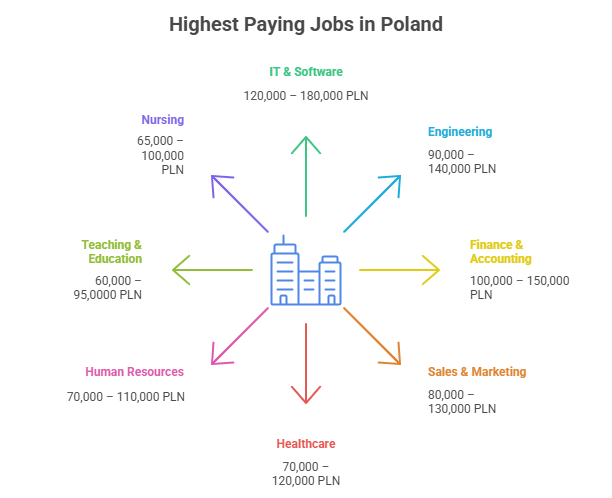
Highest paying Jobs in Poland
Poland is one of Europe’s fastest-growing economies with strong demand for skilled foreign professionals. The country offers affordable living, stable job growth, and increasing opportunities in IT, engineering, healthcare, manufacturing, and finance. According to Poland’s Central Statistical Office (GUS), there are over 120,000+ job vacancies across sectors, and salaries are steadily rising due to digital transformation and foreign investment.
The average monthly gross salary in Poland is around PLN 7,000 – 8,000 (approx. INR 1.3–1.5 lakhs). IT specialists, engineers, and healthcare professionals remain the highest-paid groups. Poland also offers work-life balance, safe working conditions, and strong employee rights. The below table shows some of the highest paying job opportunities in Poland:
|
Occupation |
Average Annual Salary (PLN) |
|
IT & Software |
120,000 – 180,000 |
|
Engineering |
90,000 – 140,000 |
|
Finance & Accounting |
100,000 – 150,000 |
|
Sales & Marketing |
80,000 – 130,000 |
|
Healthcare |
70,000 – 120,000 |
|
Human Resources |
70,000 – 110,000 |
|
Teaching & Education |
60,000 – 95,000 |
|
Nursing |
65,000 – 100,000 |
Job Vacancies in Poland
Poland currently has 120,000+ job openings, with the highest demand in IT, manufacturing, engineering, logistics, and healthcare. More than 55% of employers report skill shortages, creating strong opportunities for foreign workers. The below table shows the estimated number of job openings in Poland by 2030:
|
Occupation / Sector |
Estimated Openings by 2030 |
|
IT & Software |
70,000 |
|
Engineering & Manufacturing |
60,000 |
|
Healthcare & Nursing |
50,000 |
|
Logistics & Supply Chain |
40,000 |
|
Finance & Business Services |
30,000 |
|
Education & Training |
25,000 |
Step-by-Step Guide for Job Search in Poland from India
Step 1: Search for jobs on trusted platforms like LinkedIn, Pracuj.pl, Glassdoor, EURES, OLX Praca, and Jobs.pl.
Step 2: Shortlist companies in Poland that hire foreigners and provide visa sponsorship.
Step 3: Prepare a clear CV and cover letter in European format (Europass CV).
Step 4: Submit applications directly through company websites or job portals.
Step 5: Attend virtual interviews and highlight your skills, experience, and willingness to relocate.
Step 6: Once you receive a job offer, your employer will start the work permit process.
Step 7: Apply for a Poland Work Visa, get your residence permit, and move to Poland.
*Looking for jobs in Poland? Get expert assistance with Y-Axis resume marketing services.
In-demand Career in Poland
Information Technology (IT)
Poland is becoming one of Europe’s biggest IT hubs, with many international companies opening offices here. Because of this growth, there is a strong demand for skilled IT professionals. Companies are hiring Software Developers, Cloud Engineers, Cybersecurity Specialists, Data Scientists, and DevOps Engineers. These roles are needed to support digital transformation, build new systems, and protect companies from cyber threats. Most IT companies also work in English, making it easier for international workers.
Engineering
Engineering jobs are increasing as Poland invests heavily in manufacturing, renewable energy, and infrastructure projects. Skilled engineers are needed to improve factories, build new facilities, and support energy projects. The most in-demand job roles include Mechanical, Electrical, Civil, Production, and Maintenance Engineers. These professionals help design, build, and maintain high-quality systems and machinery for industries across the country.
Healthcare
Poland has a serious shortage of medical professionals due to an ageing population and a growing healthcare system. This has created opportunities for foreign workers in various medical roles. The most needed jobs include Doctors, Nurses, Medical Technicians, and Physiotherapists. Hospitals and clinics are actively hiring qualified staff to improve patient care and fill workforce gaps.
Logistics & Supply Chain
Because Poland is located at the heart of Europe, it has become a major logistics and distribution centre. Many global companies run their warehouses and transport operations from Poland. This has created high demand for jobs such as Warehouse Managers, Supply Chain Analysts, and Dispatch Coordinators. These roles are essential to ensure goods are stored, managed, and delivered smoothly across Europe.
Business & Finance
Poland is home to many multinational companies and global business service centres (BPO/KPO). These companies need skilled professionals to manage finance, HR, and operations. Popular job roles include Accountants, Financial Analysts, Auditors, and HR Specialists. English-speaking professionals have good opportunities in this sector as many companies support international clients.
Why apply for Job Opportunities in Poland?
- Affordable cost of living
- Fast-growing economy
- Shortage of skilled workers
- Excellent work-life balance
- High demand for IT, engineering, and healthcare professionals
- Safe and table work culture
- Strong employee rights and paid leaves
- Opportunities to move to EU countries later
Why Apply For Jobs In Poland
*Willing to work in Poland? Contact Y-axis for expert guidance
Migrate to Poland via Work Visa
Non-EU professionals require a Poland Work Visa (National D Visa) and a valid work permit. This allows skilled workers to live and work legally in Poland.
You must apply for the visa in your home country before traveling. A Schengen tourist visa cannot be converted into a work visa inside Poland.
Types of Poland Work Visas
- Type A Work Permit: For foreigners employed by a Polish employer registered in Poland.
- Type B Work Permit: For foreigners serving on management boards of a Polish company.
- Type C Work Permit: For foreign employees transferred from a foreign company to its Polish branch for over 30 days/year.
- Type D Work Permit: For workers seconded to Poland by a foreign employer that has no registered office in Poland (export service).
- Type E Work Permit: For workers performing other work not covered by other categories (for more than 30 days/year).
- Type S / Seasonal Work Permit: For seasonal work (e.g., agriculture, hospitality) up to a limited time.
- EU Blue Card: For highly skilled third-country nationals meeting salary and qualification thresholds (residence + work right).
- Business/Investor Visa: For business visits, investment, or self-employment, not a standard work permit but may allow work in certain conditions.
Requirements for a Poland Work Visa
- Valid passport
- Completed Poland Work Visa Application Form
- Recent passport-size photographs
- Employer-issued work permit (mandatory)
- Job contract or job offer letter
- Proof of accommodation
- Proof of qualification/education
- CV and work experience letters
- Bank statements or proof of financial support
- Travel insurance
- Police clearance certificate
- Visa fee payment proof
Steps to Apply for a Poland Work Visa
Step 1: Receive a job offer from a Polish employer.
Step 2: Employer applies for your work permit in Poland.
Step 3: Once approved, you receive the permit.
Step 4: Book an appointment at the nearest Polish Embassy/VFS.
Step 5: Submit documents and biometrics.
Step 6: Wait for visa approval.
Step 7: Travel to Poland and register for a residence card.
List of Shortage Occupations in Poland
- Software Developers
- Civil & Mechanical Engineers
- Electricians
- Welders
- CNC Operators
- Drivers (Truck/Delivery)
- Nurses & Caregivers
- Hospitality Professionals
- Accountants
- Construction Workers
- Medical Practitioners
- Teachers (STEM subjects)
Pathway from Poland Work Permit to Permanent Residency (PR)
If you work in Poland on a valid work permit, you can later apply for Permanent Residency (PR). To qualify, you must live in Poland legally for 5 years, or 3 years if you have an EU Blue Card. During this time, you must keep a stable job, have regular income, health insurance, and a place to live. After meeting these conditions, you can apply for PR at the local immigration office. With Poland PR, you can live and work freely, change employers easily, bring your family, and later apply for Polish citizenship.
How Can Y-Axis Help You?
Y-Axis provides complete support for Poland migration, Our services include:
- Resume Marketing services to find a job in Poland
- Document checklist creation
- Work permit & visa guidance
- Application form filling
- Profile marketing to employers
- Job search assistance
- Interview preparation
- Updates & follow-ups
Don't know what to do ?
Get Free Counseling
Looking for Inspiration
Explore what Global Indians have to say about Y-Axis in shaping their future
Frequently Asked Questions