

Don't know what to do ?
Get Free Counseling
Last Updated 06-May-2026
Why Work in Poland?
Important 2025 Update: Labour Market Test abolished as of June 1, 2025, Polish employers no longer need to conduct a labour market test before hiring foreign workers. This means your employer does not have to prove that no Polish candidate was available before offering you the job. This is the most significant simplification of Poland's work permit process in years — and a major advantage for Indian professionals applying in 2025–2026.
Poland is one of the fastest-growing economies in Europe, offering strong job opportunities, affordable living, and a safe environment for international professionals. With a skilled labor shortage across multiple industries, Poland actively hires foreign professionals, especially from countries like India. The country offers competitive salaries, good work–life balance, and a stable job market. Poland is known for its modern cities, growing IT sector, manufacturing strength, and excellent quality of life. Many companies communicate in English, making it easier for Indians to work and settle.
More than 1 million foreign workers are currently employed in Poland, making up about 6.8% of the country’s total workforce. In the past three years, Poland has issued over 2 million work visas to international workers. The Polish government’s 2025–2030 labor market plan states that foreign workers may need to make up around 12% of the workforce by 2030 to support the country’s economic growth. In early 2025, employers reported around 112,000 unfilled job vacancies. Because of this shortage, Poland may need about 1.5 million workers by 2026, and more than 80% of small and medium-sized businesses say they are struggling to find enough employees.
Capital: Warsaw | Population: 38 million | Language: Polish (English widely spoken in workplaces)
Benefits of Working in Poland
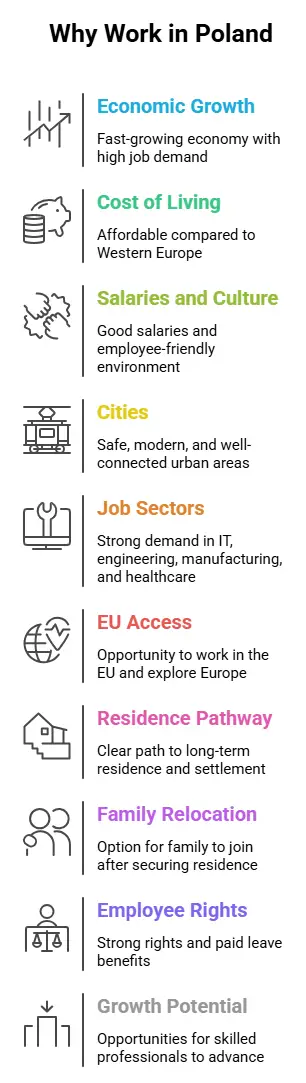
- Fast-growing economy with strong job demand
- Affordable cost of living compared to Western Europe
- Good salaries and employee-friendly work culture
- Safe, modern, and well-connected cities
- Strong demand in IT, engineering, manufacturing, and healthcare
- Opportunity to work in the EU and explore Europe
- Clear pathway to long-term residence and EU settlement
- Opportunity for family relocation after securing residence
- Strong employee rights and paid leave benefits
- Good growth potential for skilled professionals
Poland Work Visa
A Poland work visa is issued as a National D-type visa, which allows foreign nationals to live and work in Poland for more than 90 days. To work legally in Poland, you must have a pre-arranged job offer from a Polish employer.
Before you apply for the visa, your employer in Poland must initiate and obtain a valid work permit on your behalf. Once the work permit is approved, you can proceed with the National D-type visa application.
Applicants are required to register their visa application through the official e-Konsulat system. In many regions, the visa application and biometric submission are handled through VFS Global, as authorized by the Polish consulate.
Types of Poland Employment Visa
- Type A Work Permit: For foreigners employed by a Polish employer registered in Poland.
- Type B Work Permit: For foreigners serving on management boards of a Polish company.
- Type C Work Permit: For foreign employees transferred from a foreign company to its Polish branch for over 30 days/year.
- Type D Work Permit: For workers seconded to Poland by a foreign employer that has no registered office in Poland (export service).
- Type E Work Permit: For workers performing other work not covered by other categories (for more than 30 days/year).
- Type S / Seasonal Work Permit: For seasonal work (e.g., agriculture, hospitality) up to a limited time.
- EU Blue Card: For highly-skilled third-country nationals meeting salary and qualification thresholds. As of February 9, 2026, the minimum salary threshold for the EU Blue Card in Poland is PLN 13,355.34 per month. Applicants must also hold a recognised higher education qualification or at least 5 years of equivalent professional experience.
- Business/Investor Visa: For business visits, investment, or self-employment, not a standard work permit but may allow work in certain conditions.
Poland Work Visa Requirements
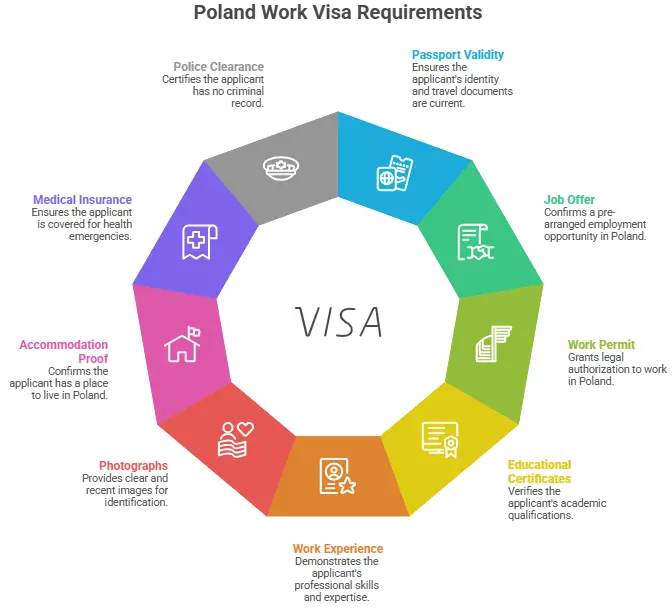
- Valid passport
- Pre-arranged job offer from a Polish employer
- Employer-approved work permit
- Educational certificates
- Work experience letters
- Passport-size photographs
- Proof of accommodation in Poland
- Proof of medical insurance
- Police clearance certificate
Note: A Poland National D-type work visa cannot be applied for without a job offer and employer-initiated work permit.
Top Jobs in Poland for Indians
Poland has many job openings and needs skilled professionals from other countries. Foreign professionals can find stable jobs with good salaries.
| Industry | Job Roles for Foreign Workers |
|---|---|
| IT & Software | Developers, Testers, Cybersecurity, Cloud Engineers, IT Support |
| Manufacturing | Machine Operators, Production Staff, Quality Inspectors |
| Engineering | Mechanical, Electrical, Industrial, Automation Engineers |
| Construction | Technicians, Supervisors, Civil Workers, Project Coordinators |
| Healthcare | Nurses, Caregivers, Medical Assistants |
| Logistics & Warehousing | Forklift Operators, Warehouse Workers, Supply Chain Staff |
| Customer Support | BPO Executives, Helpdesk Professionals |
| Finance & Business Services | Accountants, HR Staff, Admin Professionals |
*Know more about In-demand Jobs in Poland
Average Salary Ranges in Poland
Salaries in Poland vary based on experience, industry, and job role. Entry-level employees generally earn lower salaries, while professionals with more experience and specialized skills can earn higher pay. These salary ranges are common in sectors such as IT, healthcare, engineering, construction, manufacturing, and hospitality. Highly skilled professionals like AI engineers, cybersecurity experts, and senior IT specialists may earn even higher salaries.
Minimum Wage Floor (2026): PLN 4,806/month (PLN 57,672/year) — effective January 1, 2026. All work permit holders must receive at least this amount.
| Experience Level | Average Annual Salary |
|---|---|
| Entry Level | PLN 60,000 – PLN 96,000 per year (₹12 – ₹20 LPA) |
| Mid Level | PLN 72,000 – PLN 108,000 per year (₹15 – ₹23 LPA) |
| Senior Level | PLN 120,000 – PLN 300,000+ per year (₹25 – ₹62 LPA) |
Job Market & Trends in Poland
Poland’s job market is growing fast and offers strong opportunities for foreign professionals. Many companies are facing worker shortages and are actively hiring skilled international workers to support economic growth. With a stable economy, low unemployment, and increasing demand across key industries, Poland has become an important destination for professionals looking to work in Europe.
- Growing Foreign Workforce: Poland increasingly depends on international workers to fill labour shortages.
- Low Unemployment Rate: Many industries urgently need skilled workers.
- High Immigrant Participation: More than 1 million foreign workers contribute to the Polish economy.
- Skills Shortage: Major gaps exist in IT, engineering, manufacturing, and healthcare.
- Poland Work Permit Law Changes: Labour market test abolished as of June 1, 2025 — employers no longer need to prove no Polish candidate was available. Employer must now upload a signed employment contract to the gov.pl digital system before the worker begins employment. Type S seasonal permits now require employer e-submission.
- Strong Future Demand: Poland is expected to hire thousands of foreign workers yearly.
- Important Role in EU Workforce: Skilled migrants help strengthen Poland’s fast-growing economy.
*Read more about Poland Job Outlook
Top Companies in Poland Hiring Indian Professionals
Poland has many global companies that regularly hire international workers. The country is a major hub for IT, BPO, engineering, automotive, and manufacturing sectors.
| Industry | Job Roles for Foreign Workers | Typical Salary Range (PLN/month) |
|---|---|---|
| IT & Software | Developers, Testers, Cybersecurity, Cloud Engineers, IT Support | PLN 8,000 – 18,000 |
| Manufacturing | Machine Operators, Production Staff, Quality Inspectors | PLN 4,800 – 8,000 |
| Engineering | Mechanical, Electrical, Industrial, Automation Engineers | PLN 7,000 – 14,000 |
| Construction | Technicians, Supervisors, Civil Workers, Project Coordinators | PLN 5,500 – 10,000 |
| Healthcare | Nurses, Caregivers, Medical Assistants | PLN 6,000 – 12,000 |
| Logistics & Warehousing | Forklift Operators, Warehouse Workers, Supply Chain Staff | PLN 4,800 – 7,000 |
| Customer Support | BPO Executives, Helpdesk Professionals | PLN 5,00 |
Poland Work Permit Law Changes — June 2025: What Indian Applicants Must Know
June 2025 brought the most significant reforms to Poland's work permit system in years. If you are applying in 2025 or 2026, these changes directly affect your application.
- Labour Market Test Abolished — June 1, 2025 Previously, Polish employers had to advertise a vacancy locally and prove no suitable Polish or EU candidate was available before hiring a foreign worker. This process — called the labour market test — added weeks to the process and created uncertainty for employers. As of June 1, 2025, this requirement is completely abolished. Your Polish employer can now offer you a job and apply for your work permit directly — without any prior labour market test. This is the single biggest improvement to Poland's immigration process for Indian professionals.
- Employer Must Upload Signed Contract Digitally From June 2025, your employer must upload a copy of the signed employment contract to the gov.pl digital system before you can begin work. This is a new mandatory step. Make sure your employer completes this before your start date.
- Type S Seasonal Permit — Employer e-Submission Required Employers applying for Type S seasonal work permits must now submit applications electronically through the official e-government system. Paper submissions are no longer accepted for this category.
How to Apply for a Poland Work Visa from India?
Steps to apply for a Poland work visa as an Indian are as follows:
Step 1: Secure a job offer from a Polish employer
Step 2: Employer applies for and receives your work permit from Polish authorities
Step 3: Gather all required documents, including passport and medical insurance
Step 4: Register your visa application on the e-Konsulat portal
Step 5: Submit your Poland National D-type work visa application
Step 6: Attend biometrics and visa interview, if required
Step 7: Wait for visa approval
Step 8: Travel to Poland, register your residence, and start working
Post-Arrival Formalities
Once you arrive in Poland, you must complete the following within the timeframes stated:
- Register your address at the local gmina (commune) office within 30 days of arrival — this is mandatory for all foreign nationals.
- Apply for a Temporary Residence Card (TRC) at the voivode office if you are staying for more than 3 months. The TRC is your official residence document in Poland and is required for banking, signing a lease, and registering with a GP.
- Register for a NIP (tax identification number) through your employer or at the local tax office — required before you receive your first salary.
- Your employer must confirm your employment contract has been uploaded to the gov.pl digital system before you begin work
Poland Work Visa Processing Time
The total timeline from job offer to visa in hand is typically 3 to 5 months. There are two separate stages:
Stage 1 — Work Permit (Voivode Office, Poland) Your Polish employer applies for your work permit at the local voivode (regional governor) office. Processing time: 1 to 3 months, depending on the voivodeship. Note: Warsaw (Mazowieckie voivodeship) typically has longer wait times due to higher application volumes. Your employer must upload your signed employment contract to the gov.pl digital system as part of this process (new requirement from June 2025).
Stage 2 — National D-Type Visa (Polish Embassy / VFS Global India) Once your work permit is approved, you apply for the National D-type visa at the Polish embassy or through VFS Global India. Processing time: 4 to 8 weeks from submission. Book your VFS Global India appointment early — slots in major cities fill up fast. VFS Global India: vfsglobal.com/poland/india
| Stage | Who Applies | Processing Time |
|---|---|---|
| Work Permit | Your Polish employer (voivode office) | 1–3 months |
| National D-type Visa | You (via Polish embassy / VFS Global India) | 4–8 weeks |
| Total Practical Timeline | Job offer to visa in hand | 3–5 months |
Poland Work Visa Cost
The cost of applying for a Poland work visa typically ranges between PLN 440 and PLN 500, depending on the specific work permit category. This fee is paid when submitting the application and is non-refundable. Apart from the main visa fee, applicants may also need to pay for additional services such as document translation, biometrics, courier charges, and the residence card fee after reaching Poland. The total cost may vary slightly based on the applicant’s location and the type of visa being requested.
Best Cities in Poland for Indian Professionals
| City | Why Indian Professionals Choose It | Avg IT Salary (PLN/month) | Avg 1-BHK Rent (PLN/month) |
|---|---|---|---|
| Warsaw | Largest tech hub; highest salaries; most MNCs; largest Indian community in Poland | PLN 12,000 – 18,000 | PLN 3,500 – 5,500 |
| Krakow | Major IT and BPO hub; strong Infosys, IBM, Capgemini presence; lower cost than Warsaw | PLN 9,000 – 15,000 | PLN 2,800 – 4,200 |
| Wroclaw | Fast-growing tech hub; university city; lower rents; strong engineering sector | PLN 8,000 – 14,000 | PLN 2,500 – 3,800 |
| Gdansk | Manufacturing and tech; north coast; strong automotive and logistics sector | PLN 7,500 – 13,000 | PLN 2,500 – 3,800 |
| Poznan | Growing BPO and logistics hub; lower cost of living; strong Amazon and logistics presence | PLN 7,000 – 12,000 | PLN 2,200 – 3,500 |
Pathway from Poland Work Permit to Permanent Residency (PR) and Citizenship
Working in Poland on a valid work permit gives you a clear pathway to permanent residency and eventual Polish citizenship. Here is the full timeline:
Step 1 — Temporary Residence Card (TRC) If you are staying in Poland for more than 3 months, apply for a TRC at the voivode office. The TRC is valid for up to 3 years and is renewable. It confirms your legal right to live and work in Poland.
Step 2 — Permanent Residence Card (PRC) / EU Long-Term Resident Status After 5 continuous years of legal residence in Poland (or 3 years if you hold an EU Blue Card), you can apply for a Permanent Residence Card or EU Long-Term Resident status. Requirements: stable employment, regular income, valid health insurance, and suitable accommodation. Polish language at A1 level is required for the PRC application.
Step 3 — Polish Citizenship After 5 years of legal residence (for certain categories), you may apply for Polish naturalisation. Polish citizenship gives you full EU citizenship rights — the right to live and work anywhere in the EU without a visa.
| Stage | Requirement | Timeline |
|---|---|---|
| Temporary Residence Card (TRC) | 3+ months stay; applied at voivode office | Apply after arrival |
| Permanent Residence Card (PRC) | 5 years legal residence; A1 Polish language | After 5 years |
| EU Blue Card → PRC | 3 years legal residence with EU Blue Card | After 3 years |
| Polish Citizenship | 5 years legal residence (some categories) | After 5 years |
*Want to apply for Poland Work Permit? Contact Y-axis for complete guidance
Poland vs Germany vs UK — Which is Best for Indian Professionals in 2026?
| Feature | Poland | Germany | United Kingdom |
|---|---|---|---|
| Typical IT Salary | PLN 8,000–18,000/month (₹1.7L–3.8L) | €4,000–7,000/month (₹3.6L–6.3L) | £3,000–6,500/month (₹3.2L–7L) |
| Cost of Living | Low — 40–50% cheaper than Germany/UK | High | Very High |
| English in Workplace | High — especially Warsaw, Krakow, Wroclaw | Medium | Very High |
| Visa Processing Time | 3–5 months total | 2–4 months | 3–8 weeks (Skilled Worker) |
| Labour Market Test | Abolished June 2025 — not required | Not required | Not required |
| PR Pathway | 5 years (3 years with EU Blue Card) | 5 years (21 months with EU Blue Card) | 5 years (ILR) |
| Path to Citizenship | 5 years (some categories) | 8 years (5 years with integration) | 6 years (ILR + 1 year) |
| EU Travel Rights | Full EU freedom of movement after PR | Full EU freedom of movement after PR | No — UK left EU |
| Best For | Cost-effective EU entry; IT; BPO; engineering | Higher salaries; automotive; engineering | Higher salaries; English environment |
How Y-Axis Can Help You
As the world’s No. 1 overseas immigration consultant, Y-Axis provides expert support to help you work abroad successfully.
- Resume Marketing Services to help you secure opportunities in Poland
- Complete Work Visa Assistance
- Review of documents and applications
- End-to-end application processing
Y-Axis snapshot
1M
Successful applicants
1500+
Experienced counselors
20Y+
Expertise
50+
Offices
Don't know what to do ?
Get Free Counseling
Looking for Inspiration
Explore what Global Indians have to say about Y-Axis in shaping their future