

Don't know what to do ?
Get Free Counseling
Last Updated 26 May 2026
Poland Work Dependent Visa
Poland is one of the top choices for Indian workers who want a safe job, a good salary, and a happy family life in Europe. The country has strong jobs in IT, engineering, manufacturing, healthcare, logistics, finance, and BPO. Poland is also the 6th largest economy in the European Union and one of the fastest-growing countries in Europe, with a GDP growth of 3.5% in 2026. Thousands of Indian professionals are moving to Poland every year for better career growth and high quality of life. To help these workers, the Polish government gives a special visa called the Poland Work Dependent Visa. With this visa, your spouse and children can live with you in Poland. They can also study in free public schools, work in any job, and use Poland's public healthcare system. Below are the key highlights of Poland dependent visa
| Point | Details |
|---|---|
| Visa Name | Poland Family Reunification Visa (National Type D Visa) |
| Visa Category | Long-Stay Type D (Dependent / Family Visa) |
| Who Can Apply | Spouse, children below 18, dependent adult children |
| Main Applicant | Must hold a valid Polish work permit and residence card (2+ years legal stay) |
| Stay Duration | Up to 1 year on Type D visa, then 3 years on residence card (Karta Pobytu) |
| Visa Fee | €135 per applicant (long-stay national D visa) |
| Processing Time | 15 to 60 days for visa; 90 to 180 days for residence card |
| Right to Work | Yes, spouse can work without a separate work permit |
| Right to Study | Yes, free public schooling for children |
| Path to PR | Yes, after 5 years of continuous legal stay |
| Schengen Travel | Yes, free travel to 26 Schengen countries |
Why Apply for the Poland Dependent Visa?
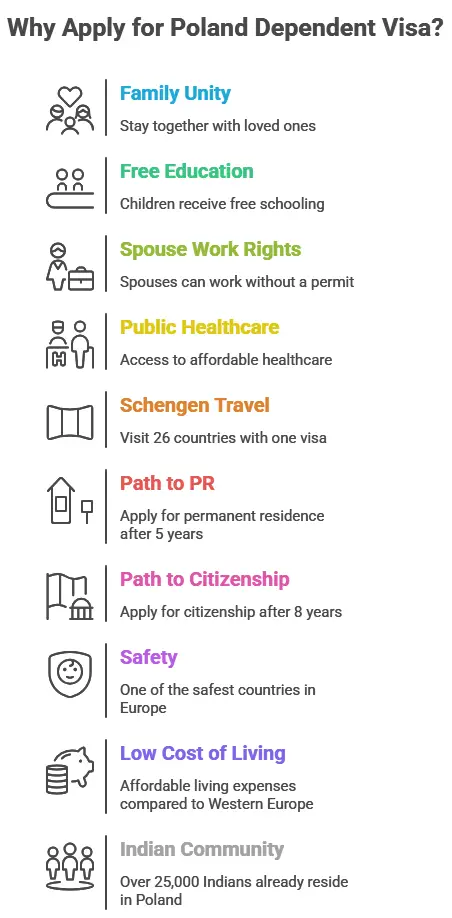
Poland is one of the fastest-growing economies in Europe and offers many career and lifestyle benefits. The cost of living in Poland is 30-40% lower than in Germany, France, or the UK. Poland is also home to over 25,000 Indians, including many IT and engineering workers in cities like Warsaw, Krakow, and Wroclaw. Here are the top reasons to apply for this visa:
- Live as a Family: Stay together with your loved ones in Poland and end long-distance separation due to work abroad.
- Free Public Schools: Children get free education in Polish public schools from age 6 to 18, with free books and meals in many schools.
- Spouse Work Rights: Your spouse can take up any job in Poland without a separate work permit if the visa is granted under family reunification.
- Public Healthcare: Get full access to Poland's public healthcare system (NFZ) through low monthly payments.
- Schengen Travel: Visit 26 Schengen countries like Germany, France, Italy, and Spain with a single visa.
- Path to PR: Apply for Polish Permanent Residence after 5 years of legal stay in Poland.
- Path to Citizenship: Apply for Polish citizenship after 8 years of legal stay (3 years with PR card).
- Safe Country: Poland is one of the safest countries in Europe with low crime rates and strong family laws.
- Low Cost of Living: Rent, food, and travel are very low when compared to Western Europe.
- Big Indian Community: Over 25,000 Indians already live in Poland, with many Indian shops, temples, and groups
What is the Poland Work Dependent Visa?
The Poland Work Dependent Visa is a long-stay visa (National Type D) given to the family members of a person who holds a valid Polish work permit and residence card. It is also known as the Family Reunification Visa under Article 159 of the Polish Act on Foreigners. With this visa, your family can join you in Poland and live with you for the same period as your residence card. After arriving in Poland, your family must apply for a Karta Pobytu, which can be issued for up to 3 years and can be renewed many times.
This visa is one of the easiest ways for Indian workers to bring their family to Poland. Your family does not need to stay apart from you for many years. They can join you, start a new life, and enjoy the same rights as you. Poland is part of the Schengen Area, so your family can also travel to 26 other European countries for short trips. The visa is open to Indians from all states and supports both small and large families. With low cost of living and friendly people, Poland is a great country for Indian families.
Who Can Apply for the Poland Dependent Visa?
The main visa holder, also called the sponsor, can bring the following close family members to Poland on this visa. The Polish government has clear rules to make sure only close family members can join the main worker.
- Spouse: Must be 18 years or older and legally married to the sponsor. The marriage must be recognized under Polish law.
- Children below 18: Both biological and legally adopted children of the main worker or spouse can join. The other parent must give written approval if they are not coming.
- Adult Children with Disabilities: Children above 18 years who cannot support themselves due to a medical or physical condition.
- Minor Children Under Sole Custody: If the sponsor has full custody, children from a previous marriage can also join.
Please note: Unmarried partners, live-in partners, siblings, cousins, in-laws, and friends are not eligible under this dependent visa. Parents are also generally not allowed unless there is a special humanitarian reason approved by the Polish authority.
*Want to work in Poland? Contact Y-Axis for complete guidance
Eligibility for Poland Dependent Visa
To apply for this visa, the main applicant in Poland must meet some basic rules set by the Polish government. These rules make sure the sponsor can properly take care of the family in Poland. The Polish authority checks each rule before giving the family reunification approval.
For the Main Applicant (Sponsor)
- Must hold a valid Polish residence permit (Karta Pobytu) for at least 2 years.
- Must have a steady job, a valid work contract, and a regular monthly income.
- Must show proof of stable income to support the family in Poland.
- Must have a valid health insurance for the family for the full stay.
- Must show proof of suitable housing in Poland for the whole family.
- Must not have any criminal record in Poland or India.
Monthly Income Requirement (2026)
| Family Status | Minimum Monthly Income Required |
|---|---|
| Single applicant | PLN 776 net (approx. ₹16,500) per month |
| Per family member (when in a family) | PLN 600 net (approx. ₹12,750) per person/month |
| Adult support amount | PLN 800 (approx. ₹17,000) per adult/month |
| Child support amount | PLN 640 (approx. ₹13,600) per child/month |
Housing Rules
The sponsor must show proof of proper housing in Poland that has enough space for the whole family. This can be a rental contract (umowa najmu) or a property ownership paper. The house must follow safety and hygiene rules under Polish law. The address must be properly registered with the local town hall (urząd gminy). Without a valid housing proof, the family reunification visa cannot be approved.
Benefits of the Poland Work Dependent Visa
This visa gives many strong benefits to your family. It is one of the best dependent visas in Eastern Europe because it allows full living, working, and studying rights. Here are the main benefits you should know:
- Live Together: Your family can stay with you in Poland for the full period of your residence card and end long-distance separation.
- Work Rights: Your spouse can work in any job, sector, or business in Poland without applying for a separate work permit (under family reunification).
- Free Education: Your children can study in Polish public schools at zero cost, including free books and meals in many schools.
- Healthcare Access: Your family gets full access to Poland's public healthcare system (NFZ) through low-cost monthly payments.
- Schengen Travel: Visit 26 Schengen countries like Germany, France, Spain, Italy, and the Netherlands for short trips without a new visa.
- Long Validity: The residence card (Karta Pobytu) can be issued for up to 3 years and renewed many times.
- Permanent Residency: Apply for Polish Permanent Residence after 5 years of continuous legal stay in Poland.
- Citizenship Path: Apply for Polish citizenship after 8 years of legal stay and get full EU rights.
- Equal Rights: Family members get the same rights as Polish residents in education, healthcare, and public services.
- EU Travel and Work: After PR, your family can live, work, and travel anywhere in the European Union.
*Know more about Poland Citizenship
Documents Required for Poland Work Dependent Visa
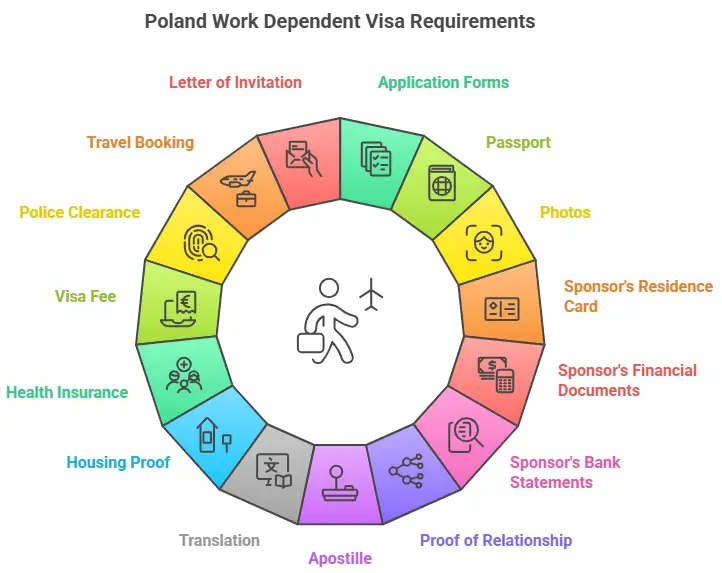
You will need to submit a full list of documents at the visa centre. Make sure all papers are correct, signed, and in the right format. Any wrong or missing paper can cause delay or rejection. The main documents are:
- Filled-in national Type D visa form, signed by the applicant.
- Valid passport with at least 2 blank pages and 3 months extra after the visa expiry.
- Two recent passport-size photos
- Sponsor's valid Polish residence card copy of both sides.
- Sponsor's Polish work contract, latest salary slips, and tax records.
- Sponsor's bank statements for the last 6 months.
- Proof of relationship – marriage certificate, birth certificate, or adoption papers.
- All Indian documents must be apostilled by the Ministry of External Affairs in India.
- All documents must be translated into Polish by a sworn translator.
- Sponsor's housing proof – rental contract or property papers.
- Family health insurance with minimum €30,000 cover for the full stay.
- Visa fee payment receipt, €135 per applicant.
- Police clearance certificate (PCC) for all adults above 18 years.
- Travel booking and proof of accommodation in Poland.
- Letter of invitation from the sponsor in Poland.
Steps to Apply for Poland Dependent Visa
The process has two parts. The main worker in Poland gets things ready first, and then the family applies from India. The full process takes 3 to 6 months. Here are the simple steps you should follow:
Step 1: Sponsor Prepares Documents in Poland
The main worker in Poland collects all needed papers, like the residence card, work contract, salary slips, tax records, housing proof, and bank statements. The sponsor also writes a formal invitation letter for the family and gets it signed.
Step 2: Family Books Visa Appointment in India
The family books an online appointment at VFS Global visa centres in Delhi, Mumbai, Chennai, Kolkata, Bengaluru, Hyderabad, or Pune. The appointment must be booked early as slots fill fast during the busy season.
Step 3: Get Indian Documents Apostilled
All Indian documents like marriage certificates, birth certificates, and police clearance must be apostilled by the Ministry of External Affairs (MEA) in New Delhi. After apostille, they must be translated into Polish by a sworn translator.
Step 4: Submit Documents at VFS
Visit the VFS Global office with the visa form, passport, photos, and all original documents along with photocopies. The applicant must also give biometric details such as fingerprints and a photo. A short interview may be conducted by the consular officer.
Step 5: Pay the Visa Fee
The current visa fee is €135 per person (around ₹12,500) for the national Type D visa. Pay this fee at the visa centre at the time of submission. Keep the payment receipt safe. The VFS service fee of ₹1,026 is paid separately at the time of booking.
Step 6: Wait for Visa Decision
The visa decision is given within 15 to 60 days from the date of submission. The Polish consulate may also call for an extra interview during the wait. Once approved, the long-stay national Type D visa is stamped on the passport.
Step 7: Travel to Poland
Your family can now plan their travel and book flights to Poland. The Type D visa is valid for 1 year and allows your family to enter Poland and start their new life there.
Step 8: Apply for Karta Pobytu in Poland
Within the first 45 days of arrival, the family must apply for the Karta Pobytu (temporary residence card) at the local Voivodeship Office (Urząd Wojewódzki). The card is given for up to 3 years and can be renewed. Without this card, the family cannot stay long-term in Poland.
Poland Dependent Visa Fees
| Fee Type | Amount in Euro / PLN | Amount in INR (approx.) |
|---|---|---|
| National Type D Visa | €135 | ₹12,500 |
| Karta Pobytu (Residence Card Application) | PLN 340 | ₹7,250 |
| Plastic Card Issue Fee | PLN 100 | ₹2,150 |
| VFS Service Fee | ₹1,026 | ₹1,026 |
| Sworn Translation of Documents | €15 to €25 per page | ₹1,350 to ₹2,250 per page |
| MEA Apostille (per document) | ₹50 to ₹500 | ₹50 to ₹500 |
| Health Insurance (Yearly) | €150 to €300 | ₹13,500 to ₹27,000 |
*Also read....
Poland is the first to offer Residency Visa to non-EU Immigrants
Poland Work Dependent Visa Processing Time
The full process takes between 3 to 6 months from start to end. The exact time depends on the season, the city where the family applies, and how complete the documents are. Here is a simple timeline you can plan for:
- Document Apostille and Translation: 15 to 30 days in India.
- Visa Submission and Decision: 15 to 60 days at the Polish Embassy or VFS in India.
- Travel to Poland: As per visa validity (within 1 year).
- Karta Pobytu Process: 90 to 180 days after arrival in Poland.
To save time, start the process early, book your VFS appointment in advance, and submit correct and complete documents from the first try. Y-Axis experts check every paper before submission to avoid delays.
Validity and Renewal of the Poland Work Dependent Visa
The Type D visa is valid for up to 1 year at first. After your family arrives in Poland, they must apply for a Karta Pobytu (temporary residence card), which can be issued for up to 3 years. The validity of the residence card depends on the sponsor's residence card. If the sponsor has a 3-year card, the family will get a 3-year card too. The renewal must be done at least 45 days before the old card expires.
The visa and residence card can be renewed many times as long as the below rules are still met:
- The sponsor's work permit and Karta Pobytu are still valid in Poland.
- The income, housing, and insurance rules are still met every year.
- The family continues to live together in Poland under the same roof.
- The family has no criminal record or pending legal case in Poland or India.
After 5 years of continuous legal stay in Poland, family members can apply for Polish Permanent Residence (Stały Pobyt), which gives the right to stay in Poland without a time limit. After 8 years of legal stay, they can also apply for Polish citizenship.
Work and Study Rights for Dependents in Poland
Poland gives strong rights to dependent visa holders. This is one of the best parts of moving to Poland as a family. Here are the main rights your family will enjoy:
- Work Rights: Spouse can work full-time or part-time in any sector like IT, healthcare, hotels, retail, or business. Under family reunification, no separate work permit is needed.
- Study Rights: Children can join Polish public schools for free with full books and meals. Older students can join top universities like the University of Warsaw, Jagiellonian University, and AGH University of Science and Technology.
- Healthcare: Family gets access to Poland's public healthcare (NFZ) through low monthly payments. This covers doctors, hospital care, and medicines at very low cost.
- Bank Account: Adult family members can open a Polish bank account, use credit cards, and apply for loans after a few months of stay.
- Driving Licence: An Indian driving licence is valid in Poland for the first 6 months. After that, your family must apply for a Polish driving licence.
- Public Transport: Family members get cheap or free travel passes for buses, trams, and trains in big cities.
Top Cities in Poland for Indian Families
Poland has many family-friendly cities with good schools, jobs, and Indian communities. Here are the best cities to settle in with your family:
- Warsaw – The capital and biggest IT and business hub. Many Indian IT workers live here.
- Krakow – A safe, beautiful city with top universities and a strong tech sector.
- Wroclaw – Home to many global tech companies and a big student community.
- Poznan – A trade and finance hub with low cost of living.
- Gdansk – A coastal city with a strong shipping and tech industry.
- Lodz – A growing city in central Poland with new IT and BPO jobs.
How can Y-Axis help you?
Y-Axis Overseas Careers is one of the leading immigration and overseas career consultants, helping individuals and families successfully move abroad for work and settlement. With expert guidance and personalised support, Y-Axis assists applicants throughout the Poland Work Dependent Visa process.
Our services include:
- Expert guidance for Poland Work Dependent Visa applications
- Complete support for spouse, child, and family dependent visa applications
- Free eligibility assessment for Poland immigration options
- Assistance with document preparation and application review
- Help with visa filing and appointment scheduling
- Support for apostille, translations, and document verification
- Guidance on health insurance and accommodation requirements
- Updates on Poland immigration rules and visa policy changes
- End-to-end support until your family settles in Poland
Y-Axis snapshot
1M
Successful applicants
1500+
Experienced counselors
25Y+
Expertise
50+
Offices
Don't know what to do ?
Get Free Counseling
Looking for Inspiration
Explore what Global Indians have to say about Y-Axis in shaping their future