


Don't know what to do ?
Get Free Counseling
Last Updated 07 August 2026
Highest paying Job Opportunities in Germany
There are several high-paying job opportunities in Germany for skilled Indians across different fields. The country has a strong economy and a growing demand for professionals in engineering, IT, and healthcare. The German Ambassador said that Indians in Germany earn more on average than Germans. This shows that Indian professionals are highly valued and well-paid for their skills. Employers offer good salaries, work visas, and chances for permanent residency, making Germany one of the best places for Indians to build a successful career.
Some of the highest paying careers in Germany are listed below:
| Occupation | Annual Salary Range (EUR) |
|---|---|
| AI / ML Engineer | EUR 70,000 – 120,000 |
| MLOps / AI Infrastructure Engineer | EUR 80,000 – 130,000 |
| Cloud Architect | EUR 80,000 – 115,000 |
| Cybersecurity Specialist | EUR 65,000 – 100,000 |
| Software Engineer | EUR 65,000 – 95,000 |
| Data Scientist | EUR 60,000 – 120,000 |
| Physician / Medical Doctor | EUR 80,000 – 150,000 |
| Healthcare / Biotech Professional | EUR 60,000 – 100,000 |
| Investment Banker / Quant Analyst | EUR 80,000 – 200,000+ |
| Financial Risk Manager | EUR 60,000 – 95,000 |
| Digital Marketing Manager | EUR 70,000 – 140,000 |
| Sales Manager | EUR 60,000 – 90,000 |
| HR Manager | EUR 55,000 – 85,000 |
Source: Talent site
Why apply for Jobs in Germany?
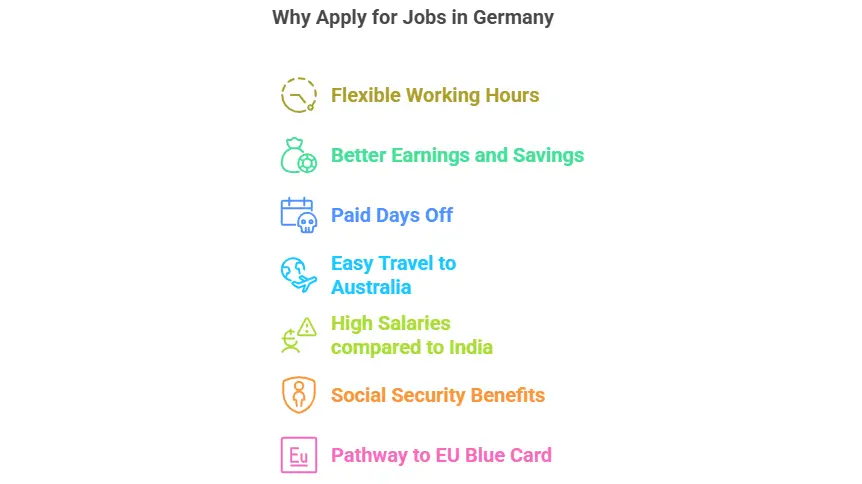
- Flexible working hours — standard full-time workweek is 36–40 hours (38–40 hours for office and corporate roles; 35–38 hours in unionised/industrial sectors under collective agreements)
- Better earnings and savings than in India, due to currency difference
- Employees in Germany can get 25 – 40 paid days off per year
- Free movement across 27 EU member states and the Schengen Area with a valid German residence permit
- Competitive salaries — the average gross annual salary in Germany is approximately €59,000 (Destatis, 2026), with high-demand roles in IT, engineering, and finance typically ranging from €64,000 to €81,000
- Social security benefits with high work-life balance
- Pathway to EU Blue Card and permanent residency
Top In-Demand Careers in Germany
IT and Software jobs in Germany
To get jobs in the IT sector, one should have a portfolio of relevant work experience. Germany offers cross-functional opportunities to switch domains. Currently, there is a high demand for qualified IT professionals in Germany. The average salary for IT employees is € 49 966 per annum. The average salary for Software employees is €60,000.
Engineering is an in-demand occupation in Germany and is regarded as one of the versatile fields. This occupation consists of many well-paid job profiles which will help in filling unoccupied jobs in Germany.
Most of the engineering fields provide better career prospects like automotive engineering, computer science engineering, electrical engineering, mechanical engineering, and Telecommunications. The average salary per annum for engineering profiles is €67,150.
Accounting and Finance jobs in Germany
Accounting and Finance are two different occupations in Germany that are in high demand around the globe. The different professions are Account Managers, Business Analysts, etc.
Finance jobs are also up in Germany and it is one of the in-demand professions in Germany. The average salaries per year in Germany for both Accounting and Finance professionals can get are between €39,195 and €49000.
Human Resources Management jobs in Germany
Human resources management jobs in Germany are expected to grow by 18% over the 10 years. Most German employers offer jobs to foreign immigrants who are skilled and possess professional training. HR professionals in Germany earn an average of €53,425 per year. Entry-level HR roles start around €38,000, while HR Specialists earn €43,500–€60,000 and HR Managers can earn €70,000–€101,000 annually. Senior HR Directors can earn €110,000 or more.
Germany has plenty of hospitality jobs if you know the German language. Germany is considered one of the highest-paying countries. It is said that Germany has a thriving hospitality industry. The average salary a hospitality professional can get for a year is €27,788.
Note: This salary is below the EU Blue Card minimum (€45,934.20). Hospitality professionals should look at the Skilled Worker visa instead.
Sales & Marketing jobs in Germany
Sales and Marketing jobs though share a similar type of responsibilities but some of the duties differ. There are huge sales jobs available in Germany and get around €45,990 average salary per year in the country. Even for marketing jobs, Germany has plenty of jobs available and earns around €36,000 per year on average.
Germany invests a high proportion of GDP (11.2%) in its health sector than any other European Union country. Around 77% of Germany’s health care system is funded by the government and the rest is privately funded.
Germany expects qualified and skilled professionals for the Healthcare system who is well-trained personnel. The average salary that a healthcare professional earns for a year is €39,000.
Germany is one of the leading countries with 36.9% graduates and yet there is a shortage of skills within the German job market. There has been a huge gap in STEM specialists or professionals.
There is a high need for STEM professionals to lead the German economy and the German industries and add great value.
Currently, 338,000 expert STEM professionals are required. The average salary that a STEM professional can earn for a year is €78,810.
Germany has a fair number of teaching jobs available for foreign immigrants. It is competitive and yet available at various levels. There is high demand for teachers who teach the English language in Germany. One should be licensed to teach in Germany. The average salary for a year that a Teaching professional can earn is €30,000.
Note: This salary is below the EU Blue Card minimum (€45,934.20). Teachers would need to look at a different visa, like the Skilled Worker visa or the Opportunity Card.
Nursing professional jobs are considered stable and growth-oriented occupations. Currently there is an acute shortage of qualified nurses. If you are looking for a nursing job in Germany, then this can be the right time for you.
As the country has introduced relaxed rules for professional nurses to work in Germany. The average salary that a Nursing professional can earn for a year is €39,519.
Job Openings in Germany
Germany is expected to see significant job opportunities by 2030 due to its growing economy, aging population, and high demand for skilled professionals across key sectors. In particular, the nursing sector will have strong demand, creating numerous nursing job vacancy in Germany. The table below shows the projected number of jobs in various occupations.
| Occupation | Number of Jobs by 2030 |
|---|---|
| Healthcare | 2,85,000 |
| Engineering | 2,00,400 |
| Nursing | 1,85,600 |
| Accounting & Finance | 1,15,700 |
| IT & Software | 1,10,500 |
| Hospitality | 95,200 |
| Teaching | 87,400 |
| Human Resources & Management | 80,100 |
| Marketing & Sales | 75,300 |
Step-by-Step guide for Job Search in the Germany
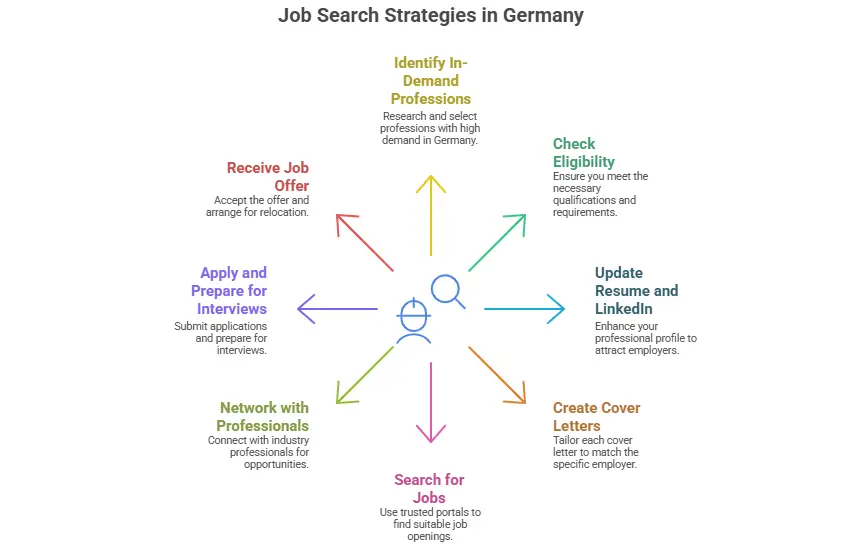
Step 1: Identify in-demand professions in Germany—IT, engineering, healthcare, research, skilled trades, etc.
Step 2: Check eligibility, qualifications, language requirements, and degree recognition (if needed).
Step 3: Update your resume and LinkedIn—highlight skills, projects, achievements, and German/European CV format.
Step 4: Create a strong cover letter tailored to each employer.
Step 5: Search for jobs on trusted portals like Make it in Germany, LinkedIn, Glassdoor, Indeed, EURES, or company websites.
Step 6: Network with recruiters, professionals, and alumni working in Germany.
Step 7: Apply for jobs that match your skills and prepare for interviews—research the company, culture, and role.
Step 8: Receive the job offer, sign the contract, and start visa, relocation, and documentation arrangements.
Migrate with Germany Work Visa
Germany is the 17th happiest country and the third-largest economy in the world (IMF, 2026). To immigrate to Germany, you need a valid reason. There are many ways that a foreign citizen can settle in Germany.
German immigration for employment: The most popular way of immigrating to the country is to find a job in Germany. Get a job in Germany that recruits foreign nationals, then apply for German work (employment) visa. Now move to the country and obtain a worked residence permit.
- German student visa
- Entrepreneur stream
- Family reunions
- Residence permits
- Job-seeker visa
Check your eligibility for Germany through Y-Axis Germany Immigration points calculator
Types of Germany Work Visas
The work visa in Germany is called a residence permit for the purpose of employment, whereas the terms change while usage. Other than these, there are D visas and C visas which are used by some foreign nationals.
D visa lets non-EU citizens come to Germany and then apply for a German work visa. Whereas the C visa is called a tourist or Schengen visa. This allows the visitors to come to Germany for a short stay like a holiday, business trip, or visit family. It cannot be transformed into a residence/work permit. The main types of visas are listed below:
Work Visa for Qualified Professionals
For individuals with recognized foreign qualifications and a specific job offer in Germany.
EU Blue Card
For highly skilled non-EU professionals with a university degree and a job offer. In 2026, you need a job that pays at least €50,700 a year. If your job is on Germany's shortage occupation list, or you graduated in the last 3 years, or you're an IT specialist without a degree, the minimum drops to €45,934.20 a year.
Visa for IT Professionals
Tailored for IT specialists from outside the EU/EEA and Switzerland, facilitating their entry into the German job market.
Visa for Professionally Experienced Workers
For individuals with significant work experience in their field, even without a formal university degree.
Researcher Visa:
For scientists and researchers working in Germany. Requires hosting agreement from a German institution.
Visa for Self-Employment
For entrepreneurs and freelancers wishing to start a business or work independently in Germany.
Willing to know more about Germany visas? Talk to Y-Axis for complete guidance.
Germany Opportunity card
The Germany Opportunity Card (Chancenkarte) is a residence permit introduced on June 1, 2024, allowing skilled professionals from non-EU countries to enter Germany without a job offer. Applicants can stay for up to 12 months to search for employment. To qualify, individuals must have at least two years of vocational training or a university degree, and basic knowledge of German (A1) or English (B2). A points system evaluates additional factors like age, work experience, and ties to Germany. During their stay, holders can work part-time (up to 20 hours per week) and undertake trial jobs lasting up to two weeks. This initiative aims to address Germany's skilled labor shortage by attracting qualified professionals.
*Want to apply for Germany Opportunity card? Contact Y-Axis for complete guidance.
Requirements for Germany Work Visa
To apply for a Germany Work Visa from India, you need:
- Valid passport
- Job offers from a German employer
- Degree/diploma recognized in Germany
- Proof of work experience
- Language skills (English or German; B1/B2 German is an advantage)
- Health insurance & financial proof
- Police clearance certificate
Steps to Apply for a German Work Permit
Following are the steps to apply for a work permit or visa to take up work in Germany:
Step 1: Check the requirements for your work visa, like Skilled Professional, IT Specialist, or EU Blue Card.
Step 2: You need to have a job offer in Germany from an authorized German employer.
Step 3: The job offer you have must be related to your education.
Step 4: The employer must be in Germany.
Step 5: Check the eligibility of the job, which you are willing to apply for.
Step 6: After checking everything, choose the right visa and submit the visa application.
Step 7: Gather all the required documents according to the instructions given.
Step 8: Attend the visa interview after taking an appointment.
Step 9: Pay the fees that are needed for a German work visa.
Step 10: After giving the interview, wait for the response.
Work Permit to Germany PR
To be eligible for this permit one should have lived in Germany at least for five years or even three years if you are married to a German citizen. Along with this you must have paid contributions of at least 60 months of pension insurance.
You need to provide your employment, proof of German language skills, and employment. You can obtain German Permanent Residence if you have provided all the above-mentioned.
How Can Y-Axis Assist You?
Y-Axis, the world’s best immigration company, provides unbiased immigration services for every client based on their interests and requirements. The impeccable services of Y-Axis include:
- Resume Marketing services to find suitable jobs in Germany
- Expert guidance/counseling for Germany Immigration
- Provides the best German language coaching in India.
- Free eligibility checks through German Immigration Points Calculator
- Build your path to Germany through Y-Path
- Expert Career Counseling
Other Work Visas:
Y-Axis snapshot
1M
Successful applicants
1500+
Experienced counselors
25Y+
Expertise
50+
Offices
Don't know what to do ?
Get Free Counseling
Looking for Inspiration
Explore what Global Indians have to say about Y-Axis in shaping their future