


Don't know what to do ?
Get Free Counseling
Top In demand Jobs in Austria
Austria has become one of Europe’s best destinations for skilled professionals, with over 170,000 job vacancies and a 4% job vacancy rate, one of the highest in Europe. Sectors like IT, engineering, healthcare, and construction are seeing strong demand for international professionals. The average salary in Austria is around €56,000 per year, with higher pay in tech and engineering roles. With a stable economy and high living standards, Austria offers great career opportunities for skilled Indian graduates and professionals looking to settle in Europe.
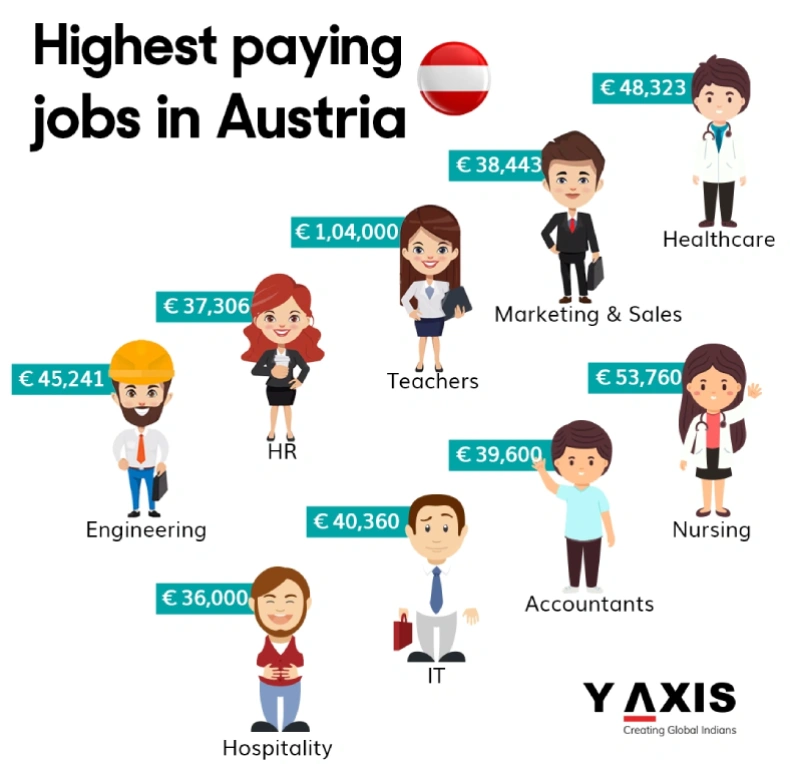
Some of the highest paying jobs in Austria are listed below:
| In Demand Occupations in Austria | Average Salaries (per annum) |
| Engineering | € 75,241 |
| IT | € 90,360 |
| Marketing & Sales | € 70,000 |
| HR | € 65,306 |
| Healthcare | € 78,323 |
| Teachers | € 70,000 |
| Accountants | € 68,600 |
| Hospitality | € 60,000 |
| Nursing | € 72,760 |
Source: Talent Site
Job Openings in Austria
Austria has great job opportunities for skilled professionals. There are more than 170,000 job vacancies in the country, and many companies are looking for foreign professionals to fill these positions. By 2030, the demand for workers in fields like IT, engineering, healthcare, and construction will keep growing. The table below shows the estimated number of job openings in Austria by 2030 in different sectors.
|
Occupation |
Estimated Job Openings by 2030 |
|
IT & Software |
65,000 |
|
Engineering |
60,000 |
|
Healthcare |
55,000 |
|
Construction & Technical |
50,000 |
|
Teaching & Education |
45,000 |
|
Hospitality & Tourism |
40,000 |
|
Marketing & Sales |
35,000 |
|
Nursing |
30,000 |
|
Accounting & Finance |
28,000 |
|
Human Resources & Management |
20,000 |
Step-by-Step Guide for Job Search in Austria
Step 1: Search for job openings in Austria on trusted websites like LinkedIn, EURES, StepStone, Karriere.at, and Glassdoor.
Step 2: Look for Austrian companies that hire international workers and offer visa sponsorship for skilled professionals.
Step 3: Prepare a Europe-style CV and cover letter highlighting education, work experience, skills, and language abilities (German language skills are a plus).
Step 4: Apply for jobs directly through company career pages or use licensed recruitment agencies that help foreign professionals find work in Austria.
Step 5: Attend online interviews and clearly present qualifications, work experience, and career goals for working in Austria.
Step 6: Once a job offer is received, the employer provides the documents needed to start the Red-White-Red Card or EU Blue Card visa process.
Step 7: After the work visa is approved, apply for a residence permit, make travel plans, and begin a new career in Austria.
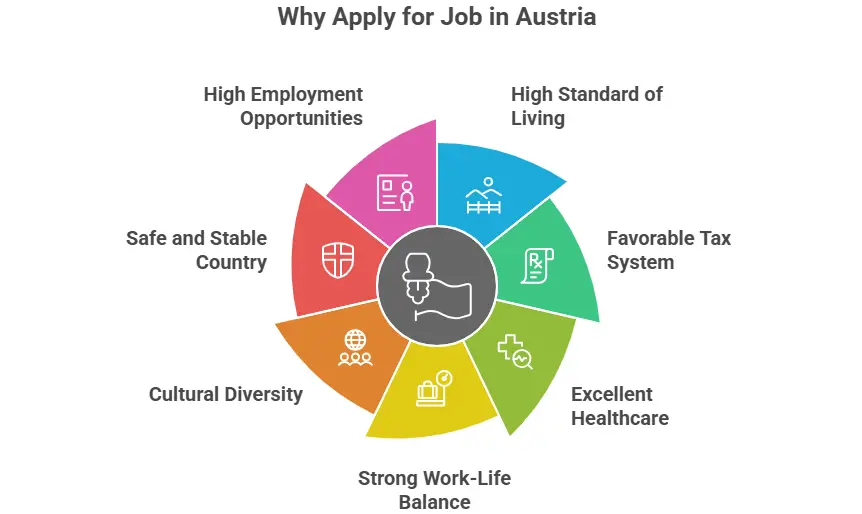
Why apply for Job in Austria?
- High Standard of Living
- Favorable Tax System
- Excellent Healthcare
- Strong Work-Life Balance
- Cultural Diversity
- Safe and Stable Country
- High Employment Opportunities
Austria has an ageing population, with an average age of 43.4 years and a low birth rate of 1.41. In recent years, the number of deaths has been higher than births, leading to a shortage of local workers. Because of this, Austria depends on foreign professionals to fill job gaps and support its economy. This gives international workers a great chance to work, live, and build a career in Austria.
Migrate to Austria via Work Visa
To work in Austria, residents from different countries need to apply for a D Visa, which is a long-term visa. The only exceptions to this rule are citizens from within the EU and EFA.
However, highly qualified employees from other countries who want to work and live in Austria can make a Red-White-Red card. This document guarantees its holder a job and residence permit for up to two years.
Travellers to Austria on a Schengen Visa are not eligible to work or convert their short-term visa into a long-term visa for work or other purposes. Foreign nationals should apply from their country of residence to be eligible to work in Austria.
Types of Austria work visa
Some of the main work permits that non-EU citizens may need in Austria are the following:
Red-White-Red Card: This is a combined work and residence permit that allows foreign professionals to live and work in Austria for up to two years. It is meant for highly qualified individuals and is based on a points system that considers factors like language skills, education, work experience, and age.
EU Blue Card: Similar to the Red-White-Red Card, this permit allows highly skilled employees to live and work in Austria with the same rights as Austrian citizens. However, it is not points-based and is mainly for professionals with higher qualifications and job offers in shortage occupations.
Job Seeker Visa: This visa is for qualified professionals who want to enter Austria to look for a job. It allows them to stay temporarily while searching for employment that matches their skills.
Seasonal Workers Visa: This is a short-term visa mainly for jobs in agriculture and tourism. The employer must apply for a quota to hire seasonal workers for a fixed time period.
Requirements of Austria work visa
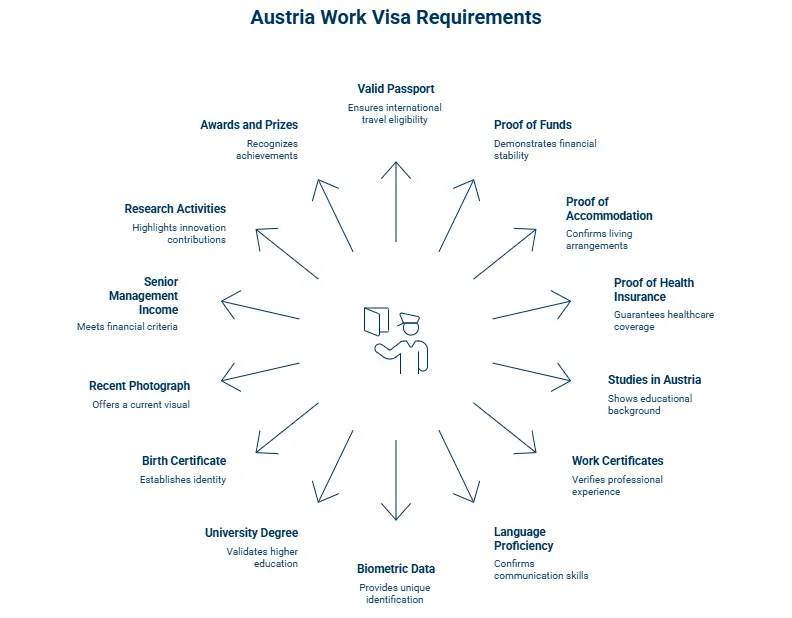
The requirements for the work visa in Austria are given as follows:
- Valid passport
- Proof of funds to manage your expenses
- Proof of accommodation
- Proof of health insurance
- Studies in Austria
- Work certificates and testimonials
- Proof of language proficiency
- Submission of biometric data
- A degree from an authorized university or higher education
- Birth certificate or any document that proves your identity
- A colour photograph taken within the last 6 months
- Average annual income for a senior management position
- Activities in research and innovation
- Awards and prizes
Top Careers in Austria
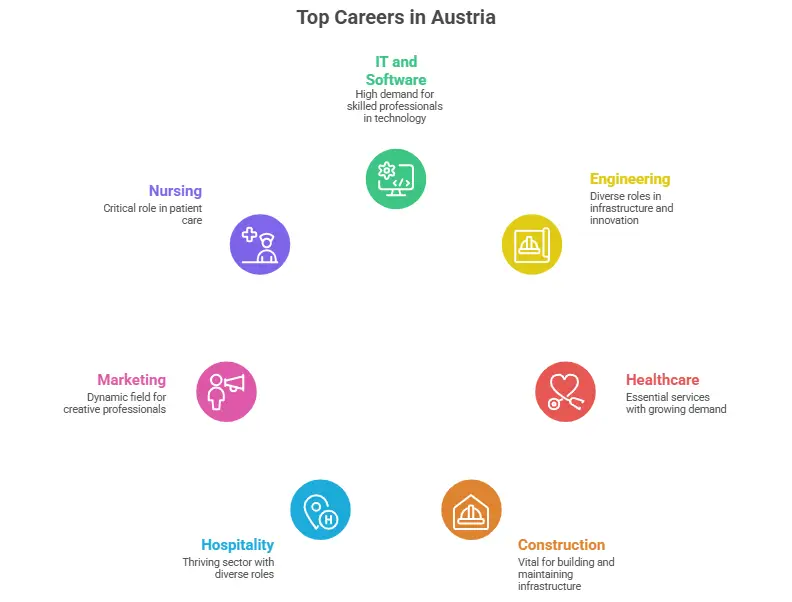
- IT and Software Jobs in Austria:
Austria’s tech industry is growing fast, with a strong demand for software developers, data analysts, and IT specialists. Many companies in Vienna and Linz are hiring skilled workers for roles in software engineering, cybersecurity, and AI. The average salary for IT professionals in Austria ranges between €50,000 and €80,000 per year, depending on experience and skill level. - Engineering Jobs in Austria:
Engineering remains one of the strongest sectors in Austria. There is a continuous need for mechanical, electrical, and civil engineers, especially in manufacturing, automotive, and renewable energy projects. Engineers in Austria earn an average of €50,000 to €70,000 per year and enjoy stable career growth and opportunities to work with top European firms. - Healthcare Jobs in Austria:
Austria’s healthcare system is among the best in Europe, and the country faces a steady shortage of healthcare professionals. There is high demand for doctors, nurses, and medical technicians, with salaries ranging from €40,000 to €100,000 per year depending on experience and specialization. International medical workers are highly valued in hospitals and clinics across the country. - Construction and Technical Jobs in Austria:
Austria needs more skilled workers in construction, logistics, and technical maintenance. Jobs like electricians, plumbers, truck drivers, and technicians are in strong demand across major cities. These roles typically pay between €35,000 and €55,000 per year, and many employers offer visa sponsorship for qualified foreign workers. - Hospitality and Tourism Jobs in Austria:
Tourism is a key part of Austria’s economy, especially in cities like Vienna, Salzburg, and Innsbruck. There is a constant demand for chefs, hotel staff, tourism clerks, and service managers. The average annual salary in this field ranges from €30,000 to €45,000, with seasonal jobs offering good entry points for international applicants. - Marketing and Communication Jobs in Austria:
Austria’s growing digital economy has created opportunities for professionals in marketing, PR, and communications. Companies seek experts in social media, branding, and digital marketing. The average salary in this sector is around €55,000 to €75,000 per year, especially for roles in Vienna’s expanding business and media hubs. - Nursing Jobs in Austria:
Nursing is one of the most needed professions in Austria due to the ageing population. Hospitals and care centers are actively hiring registered nurses, elderly care assistants, and midwives. Nurses can earn between €45,000 and €80,000 per year and benefit from job security, career growth, and a strong healthcare system.
List of shortage Job Opportunities in Austria
According to the EURES report on shortages and surpluses job opportunities in Austria, are as follows:
- Electrical mechanics and fitters
- Agricultural and industrial machinery mechanics and repairers
- Motor vehicle mechanics and repairers
- Sheet metal workers
- Welders and flame cutters
- Spray painters and varnishes
- Plumbers and pipefitters
- Roofers
- Carpenters and joiners
- Cooks
- Nursing associate professionals
- Construction supervisors
- Physical and engineering science technicians not elsewhere classified
- Mechanical engineering technicians
- Electronics engineering technicians
- Electrical engineering technicians
- Systems analysts
- Midwifery professionals
- Generalist medical practitioners
- Engineering professionals not elsewhere classified
How Much Does it Cost to Live in Austria?
Austria is grouped among European countries with better salaries and living conditions, but this comes with a cost: higher living costs. According to Numbeo, Austria is Europe's 7th most expensive country and the world's 19th.
Living costs in this country depend widely on location and the number of individuals living in your household. According to the same source, the estimated monthly fee for a single person is €1,055; this does not include the rent, and for a family of four, it is estimated €3,590 in monthly expenses.
Rent in Austria also varies depending on the location and size. The projected rent for a one-bedroom apartment in the city centre is €854, while a similar apartment outside the city centre costs €695.
The estimated cost for a three-bedroom apartment in the city centre is €1,540, and for an equivalent apartment outside the city centre, it is €1,215.
How can Y-Axis help you?
Y-Axis has been providing unbiased and personalized immigration-related assistance for more than 25 years. Our team of experienced immigration experts is here to provide end-to-end support to help you migrate to Austria. Our services include:
- Resume Marketing service which includes resume writing and resume marketing to find the best jobs in Austria.
- Identify and collect all your documents
- Complete the visa documents checklist
- Create your application package
- Fill the various forms and applications accurately
- Updates & follow up
- Interview preparation
Don't know what to do ?
Get Free Counseling
Frequently Asked Questions