

Don't know what to do ?
Get Free Counseling
Last Updated 13-May-2026
Australia Work Dependent Visa (482/485)
About the Australia Work Dependent Visa (482/485)
The Australia Work Dependent Visa allows the spouse or de facto partner and dependent children of skilled workers on a Skills in Demand (SID) visa (subclass 482) or a Temporary Graduate visa ( subclass 485) to migrate to Australia n. Dependants are included as secondary applicants on the primary visa holder's application and receive the same visa validity and conditions as the primary applicant.
For Indian families where one partner is working in Australia on a subclass 482 or 485 visa, the Work Dependent Visa is the recognised legal pathway to reunite the family and avoid years of separation. Dependent partners of 482 visa holders can typically work full-time in Australia without restriction which is a major advantage over equivalent dependent visa routes in the USA and Canada.
Key Facts: Australia Work Dependent Visa (482/485) at a Glance
| Key Facts: Australia Work Dependent Visa (482/485) at a Glance | |
|---|---|
| Visa Subclass | Secondary applicant under Subclass 482 (TSS) or Subclass 485 (Temporary Graduate) |
| Who Can Apply | Spouse, de facto partner (12+ months), and dependent children under 23 (or any age if unable to work due to disability) |
| Work Rights | Full — unrestricted work rights for secondary applicants under Subclass 482; same conditions as primary 482 holder |
| Study Rights | Full — any educational institution in Australia; children can attend government schools (state-funded) |
| Medicare Access | Yes — Australia's public healthcare system; available to nationals of countries with Reciprocal Health Care Agreements (RHCA), including India (limited), UK, New Zealand |
| Validity | Tied to primary applicant's visa grant period; same start and end date |
| Application Method | Online via ImmiAccount (Department of Home Affairs); included in or linked to primary application |
| Processing Time | Median 3–5 months for 482; 3–7 months for 485 (varies by stream and caseload) |
| Visa Application Fee | AUD 3,115 per adult secondary applicant (482 Short/Medium-term stream); AUD 1,730 for 485 secondary applicant |
| Skilling Australians Fund (SAF) Levy | Paid by the sponsoring employer — not the applicant; AUD 1,200 (small business) or AUD 1,800 (large business) per year |
| Financial Requirement | No specific savings requirement for secondary applicants — employer sponsorship covers primary; applicant should show genuine settlement capacity |
| Pathway to PR | 482 Medium-term stream: eligible to apply for Subclass 186 (ENS) after 2 years; 482 Short-term: limited PR pathways; 485: no direct PR route |
| Health Insurance | Requires adequate health insurance if not covered by RHCA |
*Want to apply for an Australia work dependent visa? Sign up with Y-Axis for end-to-end assistance.
What are the Benefits of the Australia Work Dependent Visa for Indian Families?
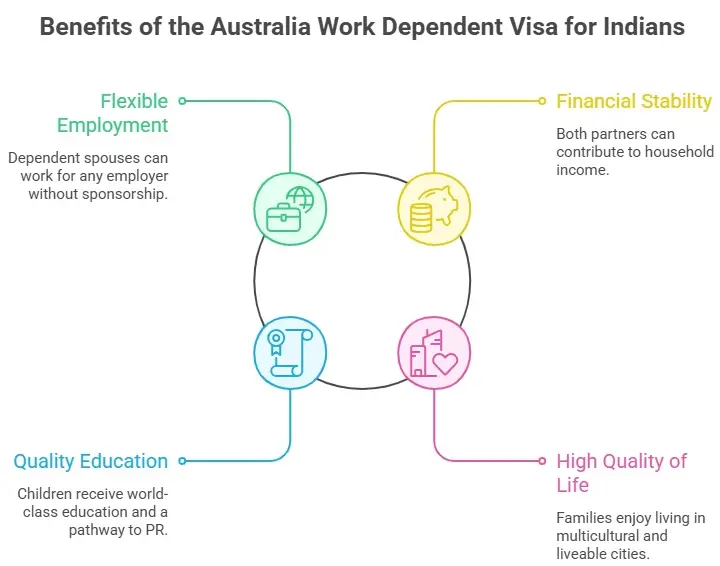
The Australia Work Dependent Visa provides Indian families with one of the most flexible dependent visa arrangements in the world. Dependent spouses of 482 visa holders can work for any Australian employer in any sector without requiring their own sponsorship or employer approval.
For Indian families, where one partner often works in IT, engineering, healthcare, or finance, sectors heavily represented in Australia's skills shortage list, the ability for the other partner to also work freely is financially and professionally significant.
Children attending Australian government schools receive a world-class education, access to NAPLAN assessments, and importantly, a pathway to long-term residency if the primary applicant transitions to PR. Australia's multicultural cities such as Sydney, Melbourne, Perth, Brisbane, and Adelaide are consistently rated among the most liveable in the world, making the family experience especially rewarding.
Who is Eligible for the Australia Work Dependent Visa (482/485)?
The following family members of an eligible 482 or 485 primary visa holder may apply as secondary applicants:
- Spouse in a valid marriage (legally registered and recognised under Australian law)
- De facto partner in a relationship of at least 12 months with documented evidence of cohabitation
- Dependent children under 23 years of age (biological, adopted, or step-children)
- Children aged 23 or above who are unable to work due to a recognised disability
Note: Parents, siblings, and non-dependent adult children of the primary visa holder are not eligible as secondary applicants under the 482 or 485 visa routes.
The primary applicant (482 or 485 visa holder) must meet the following requirements:
| Primary Applicant Requirement | Details |
|---|---|
| Visa Subclass | Must hold or be applying for Subclass 482 (TSS) or Subclass 485 (Temporary Graduate) |
| Sponsorship (482) | Must be sponsored by an approved Australian employer with a valid Standard Business Sponsorship (SBS) |
| Nomination (482) | Employer must nominate the primary applicant for an occupation on the relevant skills list (STSOL or MLTSSL) |
| Skills Assessment | Must have a positive skills assessment from the relevant Australian assessing authority for the nominated occupation |
| English Language (482) | Must meet minimum English requirement — generally IELTS 5.0 overall or equivalent; some occupations require higher |
| Degree Requirement (485) | Must hold an eligible Australian degree, diploma, or trade qualification to apply for the Temporary Graduate visa |
| Health and Character | Both primary and secondary applicants must pass health examinations and provide police clearance (character requirement) |
| Genuine Relationship | The relationship between primary applicant and each secondary applicant must be genuine, subsisting, and evidenced |
Can Australia Work Dependent Visa Holders Work in Australia?
Yes — without restriction. Dependent partners on a Subclass 482 visa have full work rights in Australia and can work for any employer in any industry or sector. There are no conditions limiting occupation, salary, or employer type for secondary applicants under this visa.
| Type of Work / Activity | Permitted for 482 Dependants? |
|---|---|
| Full-time employment (any sector) | Yes — unrestricted |
| Part-time employment | Yes — unrestricted |
| Self-employment or sole trader | Yes |
| Freelance or independent contractor | Yes |
| Work for a different employer than primary applicant | Yes — no requirement to work for the same sponsor |
| Start own business (as owner) | Yes — with applicable business registration |
| Work as a professional (doctor, lawyer, engineer) | Yes — subject to relevant professional registration in Australia |
| Work on different state or territory from primary applicant | Yes — no geographical restriction for secondary applicants |
| Remote work for Indian employer (from within Australia) | Permitted under 482 dependent conditions — tax obligations apply |
| 485 secondary applicant work rights | Yes — same full work rights as 482 secondary applicant |
Note: Dependent children under 18 do not have work rights but may undertake vocational or part-time work in line with Australian state labour laws. Secondary applicants do not require a separate work permit or Labour Market Testing as they can begin working immediately upon arrival in Australia on their 482 or 485 visa.
Also, read...
Highest paying Jobs in Australia for Indians
What Can You Do on an Australia Work Dependent Visa?
Australia's Work Dependent Visa (secondary applicant status under 482 or 485) offers the following rights and freedoms for family members:
- Work full-time or part-time for any Australian employer in any sector without the need for a work permit
- Study full-time or part-time at any Australian school, TAFE, or university
- Children can attend Australian government (state) schools which are free in most states/territories for visa holders
- Access Medicare (Australia's public health system) for nationals of RHCA partner
- Open an Australian bank account
- Apply for an Australian driver's licence (state/territory issued)
- Travel in and out of Australia freely with a valid 482 or 485 visa
- Switch to another visa category from within Australia (e.g., skilled migration visa or student visa)
- Apply for PR alongside the primary applicant provided primary visa holder transitions to Subclass 186 (ENS) or 187 (RSMS)
- Contribute to Australian superannuation (retirement fund) if employed
Documents Required to Apply for an Australia Work Dependent Visa (482/485)
All documents must be originals or certified copies. Documents not in English must be accompanied by a NAATI-certified English translation.
Spouse / De Facto Partner Documents
- Completed online Department of Home Affairs application (via ImmiAccount) — separate per applicant
- Valid passport — minimum 6 months' validity beyond intended period of stay
- Two passport-size photographs meeting Department of Home Affairs specifications
- Marriage certificate — registered, legalised, apostilled; NAATI-certified English translation if not in English
- For de facto partners: evidence of genuine relationship for at least 12 months — joint lease/rental agreements, joint bank statements, joint utility bills, photos, communication records, statutory declarations from people who know the couple
- Police clearance certificates from all countries of residence for 12 months or more since age 16 (character requirement)
- Completed health examination by a panel physician approved by the Australian Department of Home Affairs (HAP ID required)
- Health insurance policy confirmation — covering the full visa period (OHSC or private)
- Copy of primary applicant's 482 or 485 visa grant letter and passport
- Relationship statutory declaration
Children's Documents
- Valid passport for each child — separate online application per child
- Birth certificate — apostilled; NAATI-certified English translation if not in English
- Evidence of legal custody or court-approved arrangements if applicable
- If only one parent is applying: notarised consent from the non-travelling parent
- Health examination clearance (HAP ID required per child)
- Copy of primary applicant's visa
- School enrolment or education records (if applicable)
Financial / Supporting Documents
- Evidence of the primary applicant's employment contract or letter of offer confirming salary and conditions
- Bank statements for the previous 3–6 months confirming financial capacity to support the family in Australia
- Employer's Standard Business Sponsorship (SBS) approval and nomination approval letter
- Skills assessment certificate from the relevant Australian assessing authority
- English language test result (IELTS, PTE, OET — as applicable)
- Superannuation details (if transitioning from within Australia)
How to Apply for the Australia Work Dependent Visa (482/485) from India?
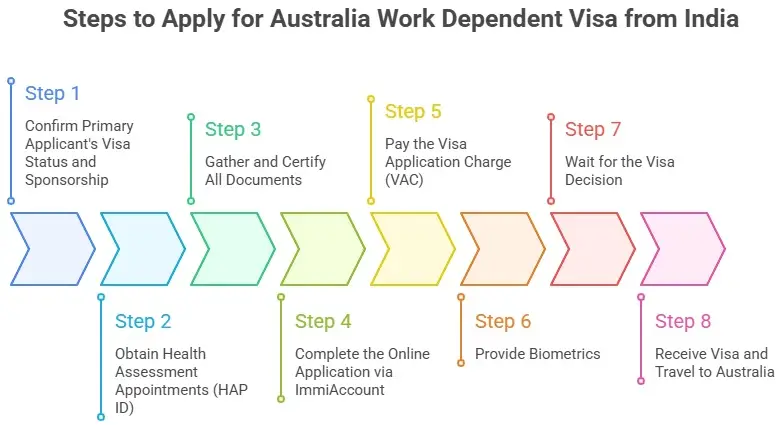
The steps to apply for an Australia work dependent visa from for Indians are as follows:
Step 1: Confirm Primary Applicant's Visa Status and Sponsorship
Confirm the primary applicant has a valid Subclass 482 visa with employer sponsorship (SBS + nomination approval) or a valid Subclass 485 visa.
Step 2: Obtain Health Assessment Appointments (HAP ID)
Register on the Immivisa Health Appointment Portal to receive a Health Assessment Pack (HAP) identification number for each secondary applicant.
Step 3: Gather and Certify All Documents
Collect necessary documents like marriage certificates, birth certificates, police clearances, bank statements, and relationship evidence.
Step 4: Complete the Online Application via ImmiAccount
Each secondary applicant must complete a separate online application form on the Australian Department of Home Affairs ImmiAccount portal.).
Step 5: Pay the Visa Application Charge (VAC)
Pay the required Visa Application Charge per secondary applicant at the time of lodgement.
Step 6: Provide Biometrics
Applicants must clear the biometrics (fingerprints and photograph) at the nearest Australian Visa Application Centre (AVAC) in India.
Step 7: Wait for the Visa Decision
Once the application is lodged and all supporting documents are submitted, wait for the Department of Home Affairs decision.
Step 8: Receive Visa and Travel to Australia
Upon visa approval, all secondary applicants will receive a grant notification to legally fly to Australia.
Also, read...
Highest Paying Jobs in Australia
Australia Work Dependent Visa (482/485) Processing Time
| Stage | Processing Time |
|---|---|
| Health Examination Completion (India Panel Physician) | 1–3 weeks (results uploaded to HAP portal) |
| Police Clearance from India (MEA) | 3–5 business days (online) to 2–3 weeks (offline) |
| Document Apostille (MEA India) | 3–7 business days (e-apostille); 2–4 weeks (offline) |
| Online Application Lodgement (ImmiAccount) | 1–2 days to complete |
| Standard Processing — 482 TSS (Short-term stream) | Median ~4 months from lodgement |
| Standard Processing — 482 TSS (Medium-term stream) | Median ~5 months from lodgement |
| Standard Processing — 485 Temporary Graduate | Median ~6 months from lodgement |
| Total Estimated Timeline (from preparation to decision) | 5–8 months end to end (standard) |
Note: Australia's Department of Home Affairs does not offer a paid priority processing service equivalent to the UK's Priority Visa service for most 482/485 applications. However, ensuring all documents are complete and correctly certified at the time of lodgement significantly reduces the risk of processing delays from Requests for Further Information (RFIs).
Australia Work Dependent Visa (482/485) Fees
| Fee Type | Amount (AUD) | Amount (INR approx.) |
|---|---|---|
| Subclass 482 Visa Application Charge — Secondary Applicant (Adult, 18+) | AUD 3,115 | INR 1,70,000 approx. |
| 482 Visa Application Charge — Secondary Applicant (Child, under 18) | AUD 780 | INR 42,500 approx. |
| 485 Visa Application Charge — Secondary Applicant (Adult) | AUD 1,730 | INR 94,500 approx. |
| 485 Visa Application Charge — Secondary Applicant (Child, under 18) | AUD 435 | INR 23,700 approx. |
| Skilling Australians Fund (SAF) Levy (paid by employer — 482 only) | AUD 1,200–1,800 per year | Employer-borne cost |
| Health Examination (per applicant — panel physician fee) | AUD 300–500 approx. | INR 16,000–27,500 approx. |
| Overseas Student Health Cover (OSHC) / Private Health Insurance | AUD 700–1,200 per year approx. | Varies by provider |
| NAATI-Certified Translation (per document) | AUD 80–150 per document | INR 4,500–8,000 approx. |
| Police Clearance (India — MEA) | INR 500–3,000 approx. | INR 500–3,000 |
| Y-Axis Professional Consultancy Fee | As per service package | As per service package |
Note: The Skilling Australians Fund (SAF) levy is a significant cost paid by the employer — not by the primary or secondary applicant. However, applicants should factor in the cost of health examinations for each family member, private health insurance for the full visa period, and document preparation costs when budgeting for the total application outlay from India.
Australia Work Dependent Visa (482/485): Validity and Extension
The secondary applicant's visa validity is identical to the primary applicant's visa grant period. When the primary applicant applies to renew, extend, or change their visa category, dependent secondary applicants must also apply to update their own visa status at the same time.
| Situation | Validity Rule |
|---|---|
| Initial Visa Grant | Same start and end date as the primary applicant's 482 or 485 visa |
| Primary Applicant Renews 482 Visa | Secondary applicant must apply for a new 482 secondary applicant visa — same process as initial application |
| Primary Applicant Changes Employer (482 — same occupation) | Secondary visa conditions remain unaffected; primary must be re-sponsored by new employer |
| Primary Transitions to Subclass 186 (ENS — PR) | Secondary applicant applies for Subclass 186 alongside primary applicant as a secondary applicant; granted PR simultaneously |
| Primary Transitions to 485 After 482 or Degree | Secondary must apply for 485 secondary applicant visa |
| Primary Applicant's Visa Cancelled or Lapsed | Secondary applicant's visa may also be cancelled; seek immediate immigration advice |
| Relationship Breaks Down | Secondary applicant's visa may be affected; seek legal immigration advice immediately — domestic violence provisions may apply |
| Child Turns 23 | Must apply for own visa before 23rd birthday — or demonstrate inability to work due to disability |
Can Australia Work Dependent Visa Holders Study Full-Time?
Yes. Secondary applicants on both Subclass 482 and 485 can study full-time at any registered Australian education provider — including universities, TAFEs, private colleges, and language schools — without changing their visa status. This is a significant advantage and a key reason many Indian families consider the 482 dependent route.
| Study Aspect | Details |
|---|---|
| Spouse / De Facto Partner | Can study full-time or part-time at any registered Australian education provider — no restriction |
| Children Under 18 | Can attend government (state) primary and secondary schools — free in most states/territories for visa holders |
| Children 18–22 | Can attend any TAFE, college, or university — must ensure their visa allows study at that level |
| Children 23 and Above | Must apply for own Student visa (subclass 500) or other qualifying visa to study |
| University / TAFE Enrolment | No restriction for secondary applicants — can enrol in any CRICOS-registered programme |
| Eligibility for Government Student Loans (HECS-HELP) | Generally not eligible on a temporary visa — must become a PR or citizen for HECS-HELP access |
| VET and Skills Training | Fully accessible — secondary applicants can complete Australian apprenticeships and vocational qualifications |
Pathway to Australian Permanent Residency (PR) from a Work Dependent Visa
The Australia Work Dependent Visa is often the critical first step in a long-term immigration journey for Indian families. The pathway to Australia Permanent Residency (PR) and ultimately citizenship is clearer from the 482 Medium-term stream than from most other temporary visa categories.
| Stage | Details |
|---|---|
| 482 TSS Visa (Short-term stream) | 2-year visa; limited direct PR pathway — must explore state/territory nomination or employer-sponsored options |
| 482 TSS Visa (Medium-term stream) | 4-year visa; eligible to apply for Employer Nomination Scheme (Subclass 186) after 2 years of employment with the sponsoring employer |
| 485 Temporary Graduate Visa | 18 months to 4 years (varies by qualification and region); no direct PR route — typically transitions to skilled migration or employer-sponsored route |
| Subclass 186 (ENS) — Temporary Residence Transition Stream | Primary applicant (and secondary applicants) apply for PR after 2 years of full-time employment with sponsor in the nominated occupation |
| Subclass 190 (State Nominated) | Primary can apply via state nomination — secondary applicants receive PR grant simultaneously |
| Subclass 491 (Skilled Regional) | 5-year provisional PR; must live and work in a designated regional area; secondary applicants included |
| Australian PR Grant | All secondary applicants receive PR at the same time as the primary — as part of the same application |
| Australian Citizenship | Eligible after 4 years of lawful residence including 12 months as a PR holder — secondary applicants also eligible on same timeline |
| Practical Pathway for Indian Families | 482 (TSS) → 186 (ENS PR) → Australian Citizenship; OR 485 → 482 → 186 → Citizenship |
Australia 482/485 Dependent Visa vs USA H-4: Key Comparison
| Feature | Australia 482/485 Dependent | USA H-4 Visa |
|---|---|---|
| Primary Applicant Visa | 482 (TSS) or 485 (Temp Graduate) | H-1B skilled worker visa |
| Dependent Work Rights | Full — any employer, any sector, no permit needed | Restricted — H-4 EAD required; only if H-1B in AC21 stage |
| PR Pathway (Dependent) | Via 186 ENS with primary; ~2–4 years from 482 | Green Card via primary's I-140; timeline 5–20+ years (India backlog) |
| Visa Fee (Secondary Adult) | AUD 3,115 (482); AUD 1,730 (485) | USD 370 approx. (H-4) |
| Processing Time | 3–5 months (482); 3–7 months (485) | 2–6 months approx. |
| English Requirement for Dependent | No — only primary applicant | No |
| Children's School Access | Government schools — free in most states | Public schools — free; no restriction |
| Healthcare | Medicare (RHCA countries); private health insurance recommended | Employer-based insurance or private; no public system |
| Citizenship Timeline | 4 years from arrival (inc. 1 yr as PR) | 5+ years from Green Card (Indian backlog may extend by 10–20 yrs) |
Important 2025 Rule Changes: Australia Work Visa (482/485) and Dependants
This section contains critical information for Indian applicants about recent and upcoming changes to the Australia 482 and 485 visa landscape in 2025.
| Update / Change | Impact on Applicants (2025) |
|---|---|
| New Core Skills Occupation List (CSOL) — replacing STSOL/MLTSSL | 482 nominations now assessed against the new Core Skills Occupation List; verify nominated occupation before applying — affects primary and secondary applicants equally |
| 482 Short-term stream: pathway restrictions | Short-term stream holders have limited PR pathways — consider the medium-term stream if PR is the long-term goal for the family |
| Skills in Demand (SID) visa — replacing 482 (from late 2025) | The new Skills in Demand visa will introduce three streams; secondary applicant conditions expected to mirror current 482 dependent provisions — confirm with Y-Axis |
| 485 eligibility changes | Post-study Graduate visa conditions updated — confirm eligibility based on qualification and institution type; regional visa holders get extended validity |
| SAF Levy increase (employer-borne) | SAF levy rates indexed — confirm with sponsoring employer; does not affect secondary applicant fees but reflects employer's true cost of sponsorship |
| State school fees for 482 dependants | Some states charge tuition fees for children of temporary visa holders; confirm with the relevant state education department before enrolling — varies by state/territory |
| Health insurance requirements | Adequate OHSC or private health cover is a visa condition for most 482 secondary applicants; verify coverage before and after arrival |
| Subsequent Entrant applications | If dependants are joining after the primary applicant has already arrived in Australia, they must apply as subsequent entrants — same visa class but separate ImmiAccount lodgement |
Market Trends: Australia Work Dependent Visa in 2026
- India is consistently one of the top three source countries for Subclass 482 visa grants in Australia — alongside the United Kingdom and the Philippines. Indian skilled workers in IT, healthcare, engineering, and accounting are among the highest-represented nationalities under the TSS programme.
- The Department of Home Affairs processed record numbers of secondary applicant 482 visas in 2024–25, reflecting the increased movement of Indian families following post-COVID normalisation of Australian immigration processing.
- The anticipated replacement of the 482 visa with the new Skills in Demand (SID) visa in late 2025 has created uncertainty — but secondary applicant rights are expected to be maintained or strengthened under the new framework.
- Healthcare and technology sectors continue to dominate 482 nominations from Indian applicants — and secondary applicants in these families benefit from the strongest Australia PR pathways through the employer nomination stream.
- Indian students completing degrees at Australian universities are increasingly transitioning to the 485 visa and then sponsoring family members as secondary applicants during the post-study period — a growing trend in 2025.
- AVAC appointment availability in Hyderabad, Chennai, and Bengaluru for biometrics has improved significantly in 2025 compared to the 2022–23 backlog period.
- The cost of living in major Australian cities has increased significantly in 2024–25 — primary applicants should ensure salary packages under the 482 are sufficient to support dependants without additional financial stress during the settlement period.
Also, read...
Australia Job Market in 2026-30
How Can Y-Axis Help with Your Australia Work Dependent Visa (482/485)?
As the world's No. 1 overseas immigration consultancy, Y-Axis has been providing reliable, personalised immigration services for 25+ years. Our team of Australian immigration experts offers comprehensive, end-to-end assistance for the Australia 482 and 485 Work Dependent Visa, including:
- Free eligibility assessment — confirm whether the primary applicant's occupation and employer sponsorship qualifies for secondary applicant inclusion
- Complete ImmiAccount application preparation and review for all secondary applicants
- Document checklist — marriage certificates, birth certificates, de facto relationship evidence, police clearances
- Health examination coordination and HAP ID registration at panel physicians across India
- NAATI-certified translation referrals and apostille guidance through MEA India
- Financial assessment and bank statement review for settlement capacity
- OHSC and private health insurance guidance for the full visa period
- Biometrics appointment support at nearest AVAC in India
- Subsequent entrant application management when dependants join after primary applicant
- 482 to 186 ENS (PR) transition planning for the whole family
- State school enrolment guidance and children's education support
- Long-term Australian immigration roadmap — 482 to 186 to citizenship
- Resume writing and Australian job search assistance for working dependants
- Superannuation and financial settlement support for newly arrived families
Y-Axis — the world's No. 1 immigration consultancy
Y-Axis snapshot
1M
Successful applicants
1500+
Experienced counselors
20Y+
Expertise
50+
Offices
Don't know what to do ?
Get Free Counseling
Looking for Inspiration
Explore what Global Indians have to say about Y-Axis in shaping their future