

Study MBBS in UK
Down Arrow
Down Arrow
Down Arrow

I accept the Terms & Conditions

15
Don't know what to do ?

Get Free Counseling

Study MBBS in UK

Studying MBBS in the UK is one of the most prestigious pathways for students aiming to build a global medical career. UK medical schools are known for their advanced teaching hospitals, clinical training, world-class faculty, and internationally recognized medical qualifications such as MBBS or MBChB.

The MBBS program in the UK is typically a 5-year full-time degree, designed to provide strong foundational knowledge, clinical exposure, and hands-on patient care experience. Some universities may extend the program to 6 years with a foundation year.

The major intake for UK MBBS programs is September, and all medicine applications must be submitted through the UCAS portal by 15th October of the previous year.

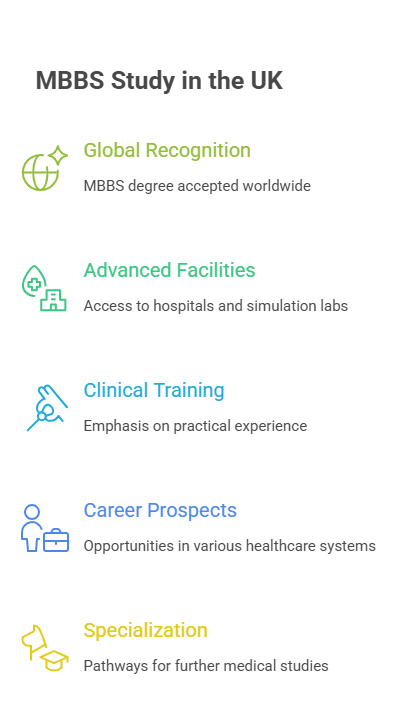
Why Study MBBS in the UK?

  • Globally recognized MBBS degree accepted in most countries
  • Access to advanced hospitals, simulation labs & patient-care facilities
  • Strong emphasis on clinical training from early years
  • Higher career prospects in the UK, India & international healthcare systems
  • Opportunity to specialize further through UK Foundation & Residency programs
  • Strong internship support and structured medical training pathways
Study MBBS in UK

*Want to Study in the UK? Get Personalized Counseling from Y-Axis.

Top Universities to Study MBBS in UK

The UK is home to some of the world’s most prestigious medical schools, known for their advanced clinical training, cutting-edge research facilities, and globally recognized MBBS degrees. These universities offer strong academic foundations, early clinical exposure, and excellent career opportunities through the NHS and international healthcare systems.

Below is a list of leading UK universities for MBBS, along with their QS ranking range and estimated annual tuition fees:

University Name

QS Rank Range

Estimated Annual Tuition Fees

University of Oxford

Top 5

£36,000 – £45,000

University of Cambridge

Top 5

£38,000 – £47,000

Imperial College London

Top 10

£48,000

University College London

Top 10

£39,000 – £47,000

King’s College London

Top 20

£41,000 – £44,000

University of Edinburgh

Top 20

£35,000 – £40,000

University of Manchester

Top 30

£35,000 – £38,000

Top Scholarships for MBBS in the UK

Pursuing an MBBS in the UK can be costly, but many international scholarships help reduce the financial burden for deserving students. These scholarships are offered by the UK government, universities, and global organizations, and they support students based on academic excellence, financial need, leadership potential, and overall merit. Funding may cover tuition fees, living expenses, travel, and other academic costs.

Below is a table listing some of the most popular scholarships available for MBBS students in the UK and the funding they offer:

Scholarship Name

Amount / Funding Covered

Chevening Scholarships

Fully funded – tuition, living expenses, travel

Commonwealth Scholarships

Fully funded – tuition + stipend

British Council GREAT Scholarships

£10,000 towards tuition

University of Oxford – Reach Oxford Scholarship

Tuition fees + living expenses + return airfare

Imperial College Medicine Scholarships

Partial to full tuition support (varies by program)

King’s College London Medical Scholarships

Tuition fee reduction (varies by scholarship type)

UCL Global Undergraduate Scholarships

Full tuition fee + maintenance allowance (varies)

Rhodes Scholarship (postgraduate)

Fully funded – tuition, living expenses, travel

*Need assistance to apply for scholarships to study MBBS in UK? Take help from Y-axis for end-to-end support.

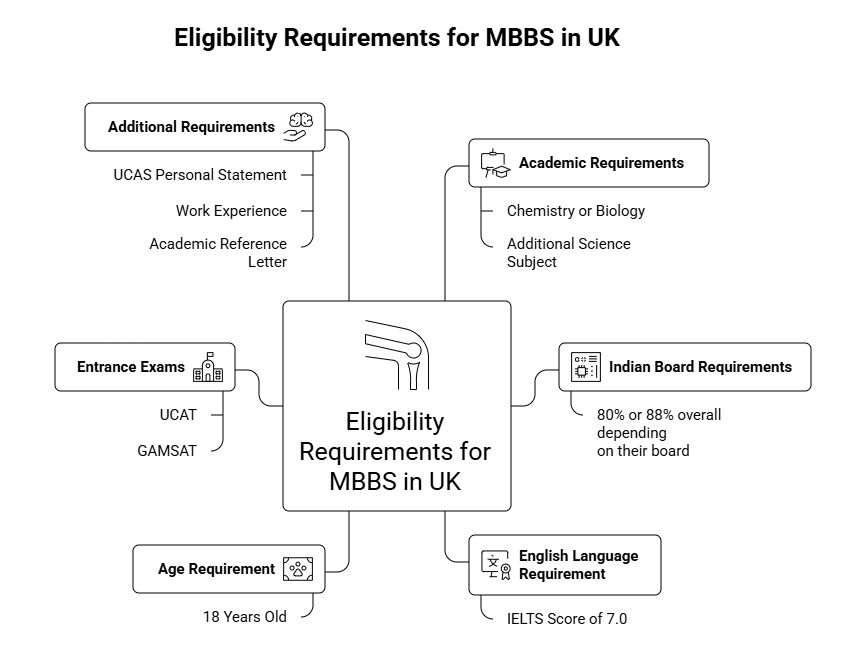
Eligibility Requirements for MBBS in UK

Students applying for an MBBS program in the UK must meet specific academic, language, and exam standards. Below is the structured eligibility criteria:

1. Academic Requirements

  • Chemistry or Biology at the highest level studied
  • One additional science subject: Chemistry, Biology, Physics, or Mathematics

2. Indian Board Requirements

Boards Accepted with 80% Overall

  • Maharashtra State Board
  • CBSE
  • CISCE
  • Tamil Nadu Board

Boards Accepted with 88% Overall

  • National Institute of Open Schooling
  • Karnataka State Board
  • Kerala State Board
  • West Bengal Board
  • Telangana State Board
  • Board of Intermediate Education Andhra Pradesh

Note: Boards not listed above are not accepted for MBBS entry.

3. English Language Requirement

  • IELTS score of at least 7.0 in each component (Listening, Reading, Writing, Speaking)

4. Age Requirement

  • Some universities require applicants to be 18 years old at the time of registration

5. Entrance Exams

  • Applicants must complete with UCAT or GAMSAT
  • Candidates scoring Band 4 in the SJT (Situational Judgement Test) are automatically rejected

6. Additional Requirements

  • UCAS Personal Statement
  • Work experience or medical-related internships (highly preferred)
  • Academic reference letter

Requirements to Study MBBS in UK

Documents required to Apply for MBBS in UK

  • Passport
  • Academic transcripts (10th, 12th)
  • A-level scores or equivalent
  • UCAT / GAMSAT scores
  • English proficiency test scores (IELTS)
  • UCAS personal statement
  • Letters of recommendation
  • Proof of work experience/shadowing
  • Passport-size photographs

How Indian Students Can Apply for MBBS in UK

Step 1: Shortlist medical universities in the UK

Step 2: Check eligibility & board requirements

Step 3: Register and prepare for UCAT or GAMSAT

Step 4: Take IELTS and meet minimum score

Step 5: Prepare UCAS application (max 4 medicine choices)

Step 6: Write UCAS personal statement

Step 7: Submit application by 15th October deadline

Step 8: Attend Virtual MMIs (Multiple Mini Interviews)

Step 9: Receive conditional/unconditional offers

Step 10: Accept offer, arrange funds, apply for student visa

Step 11: Travel to the UK and start MBBS program

*Need help applying for MBBS in the UK? Connect with Y-Axis for expert advice.

Overview of the MBBS Program in the UK

  • Duration: 5 years (full-time)
  • Intake: September
  • Application Mode: UCAS
  • Entrance Exams: UCAT / GAMSAT
  • English Requirement: IELTS 7.0 each band
  • Interview: Virtual Multiple Mini Interviews (MMIs)

Benefits of Studying MBBS in the UK

  • Globally recognized medical qualification
  • Early access to clinical training
  • Strong internship and residency opportunities
  • Exposure to advanced medical technologies
  • High employability in international healthcare systems
  • Pathway to UK Foundation Programme after MBBS
  • Opportunity for specialization (NHS training routes)

Career Opportunities After MBBS in the UK

Completing an MBBS from the UK opens doors to a wide range of medical and healthcare careers both within the UK and internationally. Graduates benefit from strong clinical training, hands-on experience in NHS hospitals, and globally recognized qualifications that make them highly competitive in the medical field. After completing the Foundation Programme, students can pursue specialist training, clinical roles, research positions, or move into public health and healthcare leadership.

Graduates can pursue careers such as:

  • Graduates can pursue careers such as:
  • Junior Doctor (Foundation Year 1 & 2)
  • Medical Practitioner
  • Specialist Doctor (after residency)
  • Surgeon
  • Clinical Researcher
  • Public Health Professional
  • Medical Consultant
  • Healthcare Administrator

How Y-Axis Can Help You

As India’s leading overseas education consultant, Y-Axis offers specialized guidance for students planning to pursue a PhD abroad, including:

  • University selection & eligibility guidance to study in UK
  • UCAT / GAMSAT exam support
  • Assistance with UCAS application & personal statement
  • IELTS coaching through Y-Axis Coaching
  • Guidance on work experience requirements
  • Documentation & admission support
  • Visa filing & pre-departure assistance
Sign up for a free expert consultation
Down Arrow
Down Arrow
Down Arrow

I accept the Terms & Conditions

15
Don't know what to do ?

Get Free Counseling

Looking for Inspiration

Explore what Global Indians have to say about Y-Axis in shaping their future

Frequently Asked Questions

What is the duration of an MBBS program in the UK?
plus

An MBBS program in the UK usually takes 5 years to complete. Some universities offer a 6-year program if a foundation year is included for students who need additional academic preparation. Throughout the course, students receive strong theoretical knowledge, clinical exposure, and hands-on training in hospitals. The program is designed to prepare students for medical practice, internships, and specialization pathways in the UK or abroad.

What is the eligibility criteria for MBBS admission in the UK?
plus

Students must meet academic, language, and entrance exam requirements. They should have strong grades in Biology or Chemistry and one more science subject. Accepted Indian boards require 80–88% overall, depending on the board. Students also need IELTS 7.0 in each band, and a valid UCAT or GAMSAT score. Many universities require applicants to be 18 years old at registration and may prefer relevant medical work experience.

Which Indian education boards are accepted for MBBS admissions in the UK?
plus

Most UK medical schools accept major Indian boards like CBSE, CISCE, Maharashtra, and Tamil Nadu with at least 80% overall. Other boards such as Kerala, Karnataka, West Bengal, Telangana, Andhra Pradesh, and NIOS require 88% overall for consideration. Boards not listed by universities are not accepted. Students should check specific requirements for each university before applying, as criteria may vary based on academic standards and competitiveness.

What entrance exams are required for MBBS in the UK?
plus

Most UK medical schools require students to take either the UCAT or GAMSAT exam. These tests measure logical reasoning, decision-making, problem-solving, and scientific knowledge. The Situational Judgement Test (SJT) score is also important, and students scoring Band 4 are usually rejected. A strong exam score improves your chances of receiving interview calls and offers. Preparing early helps students perform better and meet competitive cut-off requirements.

What English proficiency score is required for MBBS in the UK?
plus

Students must take an approved English proficiency test like IELTS Academic. Most universities require a minimum of 7.0 in each band, Listening, Reading, Writing, and Speaking. This ensures students can understand lectures, communicate with patients, and follow clinical instructions effectively. Some universities may accept alternative tests like TOEFL or PTE, but IELTS is the most commonly preferred option for medical programs in the UK.

What is the application deadline for MBBS programs in the UK?
plus

All MBBS applications in the UK must be submitted through UCAS by 15th October of the previous year. This early deadline applies to all medical schools. Students should prepare documents, entrance exam scores, personal statements, and recommendation letters well in advance. Missing this deadline means waiting for the next admission cycle. Early preparation and timely submission improve your chances of receiving interviews and offers from top universities.

How can Indian students apply for MBBS in the UK?
plus

Indian students must follow the steps given below to apply for MBBS in the UK:

  • Shortlist universities
  • Check eligibility
  • Register for entrance exam
  • Take English test
  • Gather all required documents
  • Write UCAS personal statement
  • Prepare recommendation letters
  • Submit UCAS application
  • Attend interviews
  • Accept offer & arrange funds
  • Apply for student visa & travel
What are the top universities to study MBBS in the UK?
plus

Top UK medical universities include:                

  • University of Oxford
  • University of Cambridge
  • Imperial College London
  • University College London (UCL)
  • King’s College London
  • University of Edinburgh
  • University of Manchester

These institutions are highly ranked globally and offer strong research facilities, advanced clinical training, and excellent career opportunities. Their graduates are respected worldwide, making them ideal for students aiming for global medical careers.

How much does it cost to study MBBS in the UK?
plus

The annual tuition fee for MBBS in the UK ranges from £35,000 to £48,000, depending on the university. Additional expenses include accommodation, food, transport, and personal costs, which may total £12,000–£15,000 per year. Medical programs are more expensive due to clinical training, lab usage, and hospital placements. Scholarships and financial aid can help reduce costs for deserving international students.

What scholarships are available for MBBS students in the UK?
plus

Several scholarships support international MBBS students, including Chevening, Commonwealth, GREAT Scholarships, Reach Oxford Scholarship, and university-specific medical scholarships. Funding can cover full tuition, living expenses, travel, and academic costs. Some scholarships are fully funded, while others provide partial fee reductions. Students with strong academic records, leadership skills, and financial need have higher chances of receiving these awards. Applying early increases success rates.

What is the MBBS course structure like in the UK?
plus

The MBBS program in the UK includes theoretical learning, clinical practice, laboratory sessions, and hospital placements. Students study basic sciences in the first years and move into hands-on clinical training in later years. They work with real patients under supervision in NHS hospitals. The course also includes assessments, practical exams, and communication training, preparing students for medical practice and specialization pathways.

What is the UCAS personal statement, and why is it important?
plus

The UCAS personal statement is a written essay where students explain why they want to study medicine, their motivation, academic strengths, and relevant experiences. It helps universities understand a student’s interest in the medical field. A strong personal statement highlights commitment, critical thinking, volunteer work, and communication skills. Since MBBS seats are highly competitive, a well-written statement can significantly improve your chances of receiving interview invitations.

What is the UK Foundation Programme after MBBS?
plus

The UK Foundation Programme is a two-year training program (FY1 and FY2) that all medical graduates must complete before specializing. During this period, junior doctors work in different medical departments, gain practical experience, and develop clinical skills. Successful completion allows graduates to progress into specialist training. The program is structured and well-supported, helping new doctors become confident and independent medical professionals.

Can Indian students work while studying MBBS in the UK?
plus

International students in the UK can work up to 20 hours per week during term time and full-time during holidays. However, MBBS is a demanding course with long study hours, clinical sessions, and hospital duties. Most students find part-time work challenging to manage. Still, some take up light jobs to support personal expenses. It is important to prioritize studies and maintain academic performance during the program.

Are MBBS degrees from the UK recognized in India?
plus

Yes, UK MBBS degrees are globally recognized, including in India. Graduates must clear the FMGE/NExT exam to practice medicine in India. The high-quality training, strong clinical exposure, and internationally respected curriculum make UK graduates well-prepared. Many Indian students choose the UK because it improves their global career flexibility and gives them an advantage in both local and international healthcare systems.

What career options are available after completing MBBS in the UK?
plus

After finishing MBBS and the Foundation Programme, students can work as junior doctors, specialize in various medical fields, become surgeons, clinical researchers, public health professionals, or medical consultants. They may also pursue academic medicine, hospital administration, or global health careers. The UK offers structured training pathways, and graduates are in high demand across healthcare systems worldwide due to their strong clinical skills and professional training.

Is work experience required to apply for MBBS in the UK?
plus

While not mandatory, most UK medical schools highly prefer applicants with medical-related work experience. This may include hospital shadowing, volunteering, internships, or community healthcare work. Such experience shows commitment to studying medicine and helps students understand patient-care responsibilities. It also strengthens the personal statement and improves the chances of receiving interview calls.

What is the interview process for UK MBBS admissions?
plus

Most universities conduct Multiple Mini Interviews (MMIs), where students move through short interview stations testing communication skills, decision-making, ethics, and medical awareness. MMIs are designed to evaluate how students think and behave in real-life scenarios. They are usually held online for international students. A strong performance in MMIs is essential to receiving final admission offers.

What is the minimum age to apply for MBBS in the UK?
plus

Most universities require students to be 18 years old at the time of course registration. This is because clinical training involves interacting with patients in hospitals, which requires maturity and responsibility. Students younger than 18 may need to consider courses with a foundation year or may delay their application until they meet the age requirement.

What are the living expenses for MBBS students in the UK?
plus

Living expenses for international students range from £12,000 to £15,000 per year, depending on the city and lifestyle. Costs include accommodation, food, travel, books, medical insurance, and personal expenses. Cities like London are more expensive than other parts of the UK. Students should plan finances carefully, as MBBS is a long course with additional clinical-related costs.