

University of Jena
Down Arrow
Down Arrow
Down Arrow

I accept the Terms & Conditions

15
Don't know what to do ?

Get Free Counseling

University of Jena: Admission, Fees & Top Courses

University of Jena also known as the Friedrich Schiller University Jena is one of Germany’s oldest and most prestigious public research universities, known for academic excellence, interdisciplinary learning, and strong global research collaborations. Located in Jena, Thuringia, Germany’s science and innovation hub, the university attracts international students from India, Asia, Europe, Africa, and the Middle East.

The university is well regarded for its affordable education, research-driven programs, modern campus facilities, experienced faculty, and strong industry connections. It is especially popular for degrees in sciences, medicine, biotechnology, humanities, linguistics, business, law, social sciences, and IT.

  • Acceptance Rate: 25–30%
  • Scholarships: Students can receive up to 100% tuition support and 20–50% living cost coverage, depending on the scholarship program and academic profile.

About the Friedrich Schiller University Jena

Founded in 1558, the University of Jena (Friedrich Schiller University Jena) is one of Germany’s oldest and most respected public universities. It is located in Jena, a modern and research-driven city in the state of Thuringia. The university is known for its strong academic reputation, world-class research, and global partnerships.

With 17,000+ students from over 110 countries, Jena is a popular destination for international students. The university is well known for excellence in optics, photonics, physics, biotechnology, humanities, social sciences, environmental sciences, and medicine.

Why Study at the University of Jena?

  • Strong Global Reputation: Ranked among Germany’s top research universities.
  • Excellent Research Culture: Known for optics, photonics, life sciences, medicine, and environmental sciences.
  • International Community: Welcomes thousands of international students every year.
  • Affordable Living: Jena is cheaper than major German cities like Munich and Berlin.
  • English-Taught Programs: Many master’s programs are offered fully in English.
  • Beautiful Campus & Safe City: Student-friendly, well-connected, and modern infrastructure.
  • Industry & Research Links: Collaboration with research institutes, labs, and top companies.
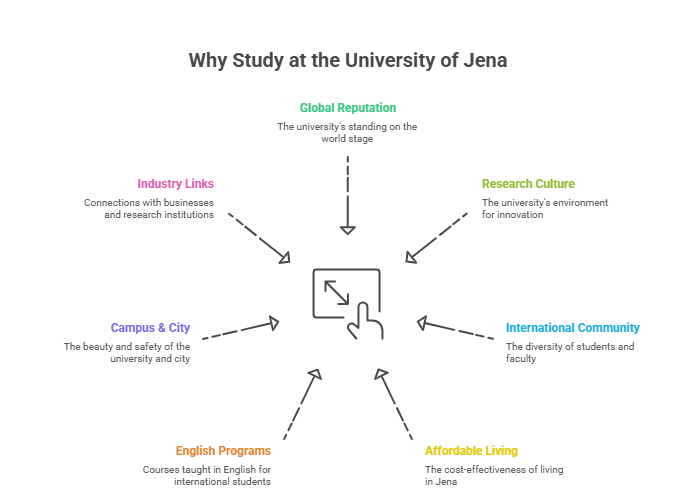
Benefits of University of Jena

*Planning to study in Germany? Cantact Y-Axis for end-to-end support

Friedrich Schiller University Programs

Popular Master’s Programs

  • Master of Physics / Optics & Photonics
  • Master of Data Science
  • Master of Biotechnology / Molecular Biology
  • Master of Computer Science
  • Master of Business Administration & Economics
  • Master of Environmental Sciences
  • Master of Psychology / Cognitive Science
  • Master of International Relations

Popular Bachelor’s Programs

  • Bachelor of Physics / Photonics
  • Bachelor of Life Sciences / Biotechnology
  • Bachelor of Business Administration / Economics
  • Bachelor of Computer Science
  • Bachelor of Psychology
  • Bachelor of Environmental & Earth Sciences
  • Bachelor of Social Sciences
  • Bachelor of Engineering Sciences

Scholarships for International Students to Study at University of Jena

Scholarship

Amount / Coverage

Deutschlandstipendium

€300 per month

DAAD Scholarships

Fully or partially funded (incl. €934–€1,300/month)

Merit Scholarships (University of Jena)

Partial tuition or €300–€1,000/month

Erasmus+ Mobility Grants

€900–€1,400/month

Heinrich Böll Foundation Scholarship

€934–€1,500/month

Konrad-Adenauer-Stiftung (KAS) Scholarship

€934–€1,200/month

Friedrich Ebert Stiftung (FES) Scholarship

€850–€1,500/month

Rosa Luxemburg Foundation Scholarship

€850–€1,350/month

Thuringia State Scholarships

€300–€1,350/month

Humboldt Foundation Scholarships

€2,000–€2,670/month

*Willing to apply for scholarships in Germany? Y-Axis is here to assist you in all the procedures.

Eligibility Requirements to apply for Friedrich Schiller University

For Bachelor’s Programs

  • 10+2 or equivalent (recognized by German authorities)
  • Minimum academic percentage as per course requirement
  • English or German proficiency depending on the program

For Master’s Programs

  • Bachelor’s degree in relevant field
  • Minimum 55–65% or equivalent (varies by program)
  • Proof of English or German proficiency
  • Motivation letter & CV
  • Letters of recommendation (if required)

Documents Required

  • Academic transcripts (10th, 12th, Bachelor’s)
  • Passport
  • English/German proficiency test score
  • Curriculum Vitae (CV)
  • Statement of Purpose (SOP)
  • Letters of Recommendation (if required)
  • Work experience certificates (if applicable)
  • Proof of health insurance
  • Proof of funds (for visa)

University of Jena Fees

Public universities in Germany, including the University of Jena, are government-funded, which means most programs have very low or no tuition fees, especially for international students. Students generally only pay a semester contribution, which helps cover administrative services and public transport.

Program Type

Approx. Annual Tuition Fee

Notes

Bachelor’s Programs

Mostly tuition-free

Students only pay a semester contribution of EUR 300–450, which includes public transport

Master’s Programs

EUR 1,500 – 4,000 (if applicable)

Some specialized or English-taught programs may charge tuition

Pathway/Foundation Courses

EUR 2,500 – 4,000

Fees vary based on program provider and duration

Steps to Apply for University of Jena

Step 1: Choose your preferred program
Step 2: Collect academic documents and language test results
Step 3: Apply through Uni-Assist or the university portal
Step 4: Wait for admission decision
Step 5: Receive your offer/acceptance
Step 6: Arrange student visa & health insurance
Step 7: Travel & register in Germany
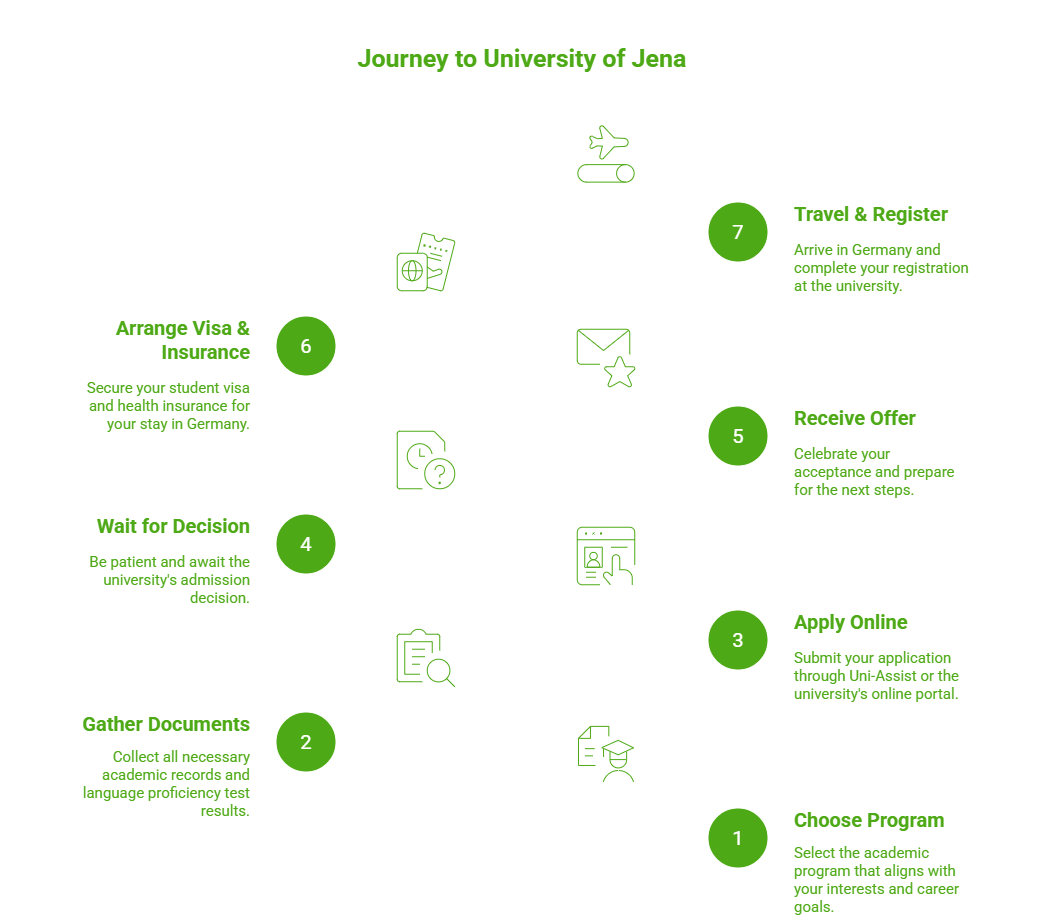
Steps to Apply for University of Jena

Career Opportunities After Graduation at University of Jena

University of Jena graduates enjoy high employability, especially in research and technology sectors.

Top Industries Hiring Friedrich Schiller University Graduates

  • Optics & Photonics
  • Biotechnology & Life Sciences
  • Information Technology
  • Sustainability & Environmental Engineering
  • Business & Management
  • Health Sciences & Psychology

Career Services Include

  • Career counselling
  • Resume & cover letter support
  • Job and internship fairs
  • Industry networking events

Cost of Living in Jena

Living in Jena is relatively affordable for international students compared to other German cities. On average, monthly expenses include:

  • Accommodation: EUR 350–550
  • Food: EUR 200–300
  • Transport: EUR 30–50
  • Miscellaneous: EUR 100–200

Students can work 120 full days or 240 half days per year.

Intakes at the University of Jena

The University of Jena offers two admission periods during the year. Most international students apply for the winter semester, while some programs are available in summer. It’s important to apply early to secure admission, visa, and accommodation.

  • Winter Semester (October): Major intake
  • Summer Semester (April): Limited programs

Apply early for visa and accommodation.

Why Indian Students Prefer Friedrich Schiller University

  • Low or no tuition fees
  • Safe, multicultural student city
  • English-taught courses
  • Strong research focus
  • Affordable living
  • Great post-study career options

Your Future at the University of Jena

The University of Jena is a great place for students who want good education, international experiences, and strong career opportunities in Germany. It is well known for its quality teaching, modern research, friendly campus, and safe student environment. International students receive support with academics, housing, jobs, and integration. After graduation, students can find internships, research roles, or full-time jobs in Germany, especially in science, technology, healthcare, and business. It is a university that helps you grow personally, professionally, and globally.

How Y-Axis Can Help You

Y-Axis provides complete guidance for students aspiring to study at Griffith University, including:

  • Program and university selection
  • Application and documentation support
  • Scholarship guidance
  • Assistance in applying for Germany study visa.
  • Y-Axis Coaching will help you learn German and English, and prepare for tests like IELTS, TOEFL, and PTE.
  • Pre-departure and post-arrival support
Sign up for a free expert consultation
Down Arrow
Down Arrow
Down Arrow

I accept the Terms & Conditions

15
Don't know what to do ?

Get Free Counseling

Looking for Inspiration

Explore what Global Indians have to say about Y-Axis in shaping their future

Frequently Asked Questions

Is the University of Jena a public university?
plus

Yes. The University of Jena, also called Friedrich Schiller University Jena, is a public research university funded by the German government. This means most programs, especially bachelor’s degrees, do not charge tuition fees for international students. The university follows Germany’s public education model, which focuses on providing high-quality, affordable education, strong research support, and fair access to students from around the world. Because it is public, academic standards and facilities are well maintained.

What is the acceptance rate at the University of Jena?
plus

The University of Jena has an estimated acceptance rate of 25–30%, meaning admissions are selective and competitive. Acceptance depends on academic performance, relevant subject background, language proficiency, and program requirements. Highly demanded programs, especially in sciences and research fields, may receive more applications. However, well-prepared international students with strong academic records, complete documents, and good motivation letters have a good chance of getting admitted. Applying early also increases admission success.

Are English-taught programs available at the University of Jena?
plus

Yes. The University of Jena offers several English-taught master’s programs, especially in sciences, data-related fields, business, medicine, environmental studies, and research-based disciplines. These programs are designed for international students who may not speak German yet. However, many bachelor’s programs are still taught in German. Students planning long-term study or work in Germany are encouraged to learn German, as it helps in daily life, part-time jobs, internships, and future career opportunities.

What are the popular courses at the University of Jena?
plus

Popular programs at the University of Jena include physics, optics and photonics, biotechnology, life sciences, medicine, environmental sciences, psychology, data science, computer science, business, economics, humanities, and social sciences. The university has a strong global reputation in scientific and research fields, especially physics and biotechnology. Many programs also provide hands-on training, research opportunities, and industry connections, helping students gain practical skills. Both bachelor’s and master’s students choose Jena for its academic quality.

How much does it cost to live in Jena as a student?
plus

Living in Jena is affordable compared to major German cities like Munich, Hamburg, or Frankfurt. On average, international students need around EUR 700–900 per month. This includes EUR 350–550 for accommodation, EUR 200–300 for food, EUR 30–50 for transport, and EUR 100–200 for personal or miscellaneous expenses. Costs may vary depending on lifestyle, housing type, and city area. Shared apartments, student housing, and early bookings help reduce expenses further.

Are scholarships available for international students at the University of Jena?
plus

Yes. International students at the University of Jena can apply for several scholarships offered by the university, German government, private organizations, and research foundations. Popular options include DAAD, Deutschlandstipendium, Erasmus+, Heinrich Böll, Friedrich Ebert, KAS, Rosa Luxemburg, and Thuringia State Scholarships. These scholarships may cover living expenses, monthly stipends, tuition support, research funding, or study materials. Eligibility usually depends on academic performance, motivation, community involvement, or financial need.

How much scholarship can students receive?
plus

Scholarship amounts vary depending on the provider and program. Students may receive between EUR 300 and EUR 2,670 per month. Deutschlandstipendium offers EUR 300 monthly, while DAAD scholarships can provide EUR 934–1,300 or full funding. Research-focused scholarships, including Humboldt, may offer even higher monthly support. Some scholarships also cover tuition fees, travel costs, health insurance, or research expenses. Students with strong academics, research interests, or community involvement have better chances.

Do Indian students need IELTS or TOEFL to apply?
plus

Yes. Indian students applying for English-taught programs at the University of Jena usually need to submit proof of English proficiency, such as IELTS, TOEFL, or PTE scores. Minimum score requirements depend on the program but typically range from IELTS 6.0–7.0. For German-taught programs, students must provide German language proof, such as TestDaF or DSH. English-medium schooling alone is usually not accepted unless specifically mentioned in program requirements.

When are the University of Jena intakes?
plus

The University of Jena has two admission intakes each year. The main intake is the Winter Semester, starting in October, offering the most program options and seats. The Summer Semester begins in April and offers limited programs, mostly at the master’s level. Deadlines vary by course and nationality, so students must check program-specific dates. International students should apply early to allow enough time for document processing, visa approval, and accommodation arrangements.

Can international students work while studying in Jena?
plus

Yes. International students in Germany can work part-time during their studies. They are legally allowed to work 120 full days or 240 half days per year. Part-time jobs may be available in restaurants, retail stores, research labs, universities, or companies. German language skills can improve job opportunities. Students must maintain academic performance while working. Income limits apply for tax exemptions, so students should check employment rules before accepting job offers.

Does the semester contribution include transportation?
plus

Yes. The semester contribution at the University of Jena, usually EUR 300–450, includes a public transportation ticket for local buses, trains, and regional travel within the Thuringia area. It also covers student services, administrative fees, and student union support. This makes transportation very affordable and convenient for students living in or near the city. Because of this system, many students do not need to spend extra money on daily travel.

Is Jena a safe city for international students?
plus

Yes. Jena is known as a safe, peaceful, and student-friendly city. Crime rates are low, and the community is welcoming to international students. The city offers clean surroundings, good public transportation, affordable living, and a supportive environment. Many students feel comfortable walking or traveling alone. The presence of universities, research institutes, and young professionals contributes to a lively yet secure atmosphere. Safety makes Jena a popular study destination in Germany.

What documents are required for admission?
plus

The documents required for to apply for University of Jena are listed below:

  • Academic transcripts (10th, 12th, and Bachelor’s, if applicable)
  • School or college completion certificates
  • Valid passport
  • Proof of English or German language proficiency
  • Curriculum Vitae (CV)
  • Statement of Purpose (SOP)
  • Letters of Recommendation (if required)
  • Proof of financial support/funds
  • Health insurance document
  • Work experience certificates (if applicable)
  • Entrance exam results or portfolio (if required by the program)
Does the University of Jena offer on-campus accommodation?
plus

Student accommodation is available, but most housing is managed by student services or private providers rather than directly by the university. Options include student dormitories, shared apartments, and private rentals. Because housing demand is high, students should apply early. Dormitories are usually affordable and located near campus or public transport. The university also provides guidance to help international students find suitable accommodation after admission and arrival.

Can international students get post-study work opportunities in Germany?
plus

Yes. After completing a degree in Germany, international students can apply for an 18-month post-study work visa, allowing them to search for full-time employment related to their studies. Graduates from the University of Jena often find opportunities in research, technology, biotechnology, optics, environment, healthcare, and business. Work experience gained during this period can lead to long-term residence or an EU Blue Card. Germany’s strong job market benefits skilled graduates.