


Don't know what to do ?
Get Free Counseling
Last Updated: 12-June-2026
Scholarships in Germany for Indian Students in 2026: DAAD, Erasmus+ & How to Apply
Germany is one of the most popular study destinations for international students. It is known for its high-quality education system, strong research programs, and globally recognized degrees. One of the biggest advantages of studying in Germany is that most public universities do not charge tuition fees. Students usually only pay a small semester fee. This makes Germany more affordable compared to countries like the USA, UK, or Australia.
However, students still need money for living expenses, accommodation, health insurance, and travel. This is where scholarships in Germany play an important role. Many scholarships are available for international students at Bachelor’s, Master’s, and Ph.D. levels. These scholarships are funded by the German government, private organizations, foundations, and universities. Some scholarships cover full tuition and living costs, while others provide partial financial support or monthly stipends.
Scholarships not only reduce financial burden but also help students focus on their studies and career goals. With proper planning and early application, international students can make their dream of studying in Germany affordable and achievable.
*Are you looking to study in Germany? Y-Axis is here to guide through the entire process!
Types of Scholarships in Germany for Indian Students
Germany offers a wide range of scholarship opportunities for Indian students who wish to pursue their Bachelor’s, Master’s, or Ph.D. degrees. Since most public universities in Germany charge little to no tuition fees, scholarships mainly help students manage their living expenses such as accommodation, food, health insurance, travel, and study materials. For many Indian students, scholarships make studying in Germany more affordable and financially manageable.
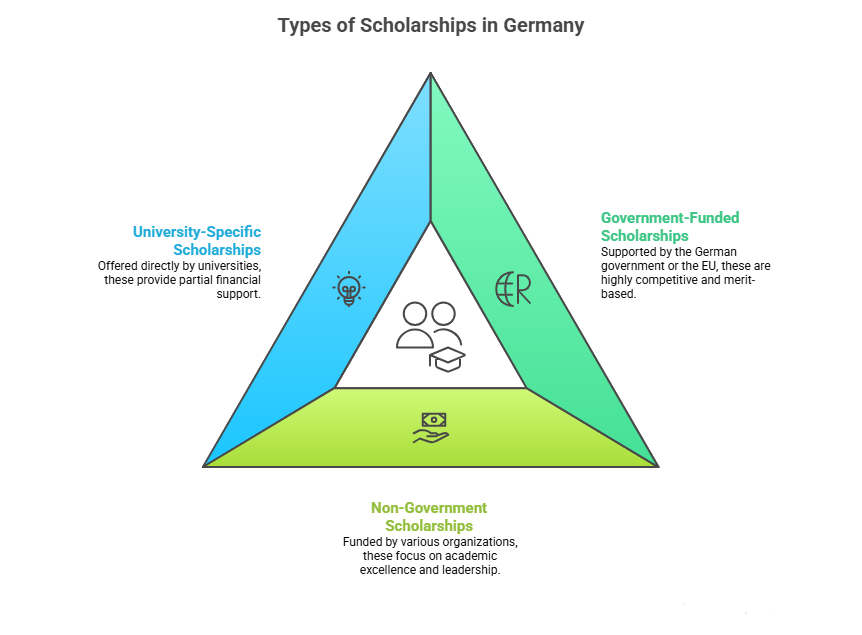
Scholarships in Germany are generally divided into three main categories based on the source of funding and eligibility criteria:
- Government-funded scholarships are supported by the German government or the European Union. These are usually highly competitive and merit-based. They often provide monthly stipends, travel allowances, health insurance, and sometimes full funding. Programs like DAAD and Erasmus+ fall under this category and are very popular among Indian students.
- Non-government scholarships are funded by political foundations, research organizations, religious institutions, or private companies. These scholarships may focus on academic excellence, leadership qualities, social commitment, or specific fields of study. Some also support research and innovation projects.
- University-specific scholarships are offered directly by German universities to attract talented international students. These scholarships are usually merit-based or need-based and provide partial financial support for a limited duration.
Top Scholarships in Germany for Indian Students
Germany offers a wide range of scholarships for international students, including fully funded and partially funded programs. These scholarships are provided by the German government, universities, foundations, and international organizations to help students cover tuition fees, living expenses, travel costs, and health insurance. Indian students can apply for scholarships at the bachelor's, master's, PhD, and research levels based on their academic performance, financial need, leadership skills, or research achievements.
| Scholarship | Funding body | Monthly amount (2026) | Level | Covers |
|---|---|---|---|---|
| DAAD EPOS (Development-Related Postgraduate Courses) | DAAD, funded by the Federal Ministry for Economic Cooperation (BMZ) | €992 (Master's), €1,400 (PhD) | Master's, PhD | Stipend, insurance, travel, rent & family allowances |
| DAAD Research Grants — Doctoral Programmes | DAAD | €1,400 | PhD | Stipend, insurance, travel, research allowance |
| Erasmus Mundus Joint Masters | European Commission (Erasmus+) | Up to ≈ €1,400 contribution | Master's | Tuition, travel, living costs across 2+ EU countries |
| Deutschlandstipendium | BMBF (Federal Ministry of Education and Research) + private sponsors | €300 | Bachelor's, Master's | Merit stipend, nationality-neutral |
| Heinrich Böll Foundation | Heinrich-Böll-Stiftung (Green Party-affiliated) | €992 + allowances (PhD higher) | All levels | Stipend, insurance, networking |
| Konrad-Adenauer-Stiftung (KAS) | CDU-affiliated foundation | €992 (Master's), €1,400 (PhD) | Master's, PhD | Stipend, seminars, alumni network |
| Friedrich-Ebert-Stiftung (FES) | SPD-affiliated foundation | €992 (degree), €1,400 (PhD) | All levels | Stipend, insurance, family benefits |
| Hans-Peter Wild Talent Scholarship | Heidelberg University | €1,000 | Master's (sciences) | Merit stipend |
| STIBET | TU Dresden (DAAD-financed) | €300 | All levels | Completion grants for internationals |
| RWTH Aachen exchange scholarships | RWTH Aachen University | ≈ €1,500 (one-time) | Exchange | One-off support |
*Want to study in Germany for free? Contact Y-Axis for complete guidance
DAAD Scholarship: Amount, Eligibility, Application Process and Timeline
What is the DAAD Scholarship?
The DAAD (German Academic Exchange Service) is Germany’s largest organization that supports international students, researchers, and academics. Every year, it provides funding to more than 100,000 students and researchers worldwide. In India, DAAD has a Regional Office in New Delhi and Information Centres in Bengaluru, Chennai, and Pune. DAAD scholarships are financial grants, which means students do not have to repay the money they receive.
DAAD Scholarship Amount in 2026
DAAD scholarship recipients receive financial support to help cover their living expenses in Germany. In 2026, Master's students can receive a monthly stipend of €992, while PhD students can receive €1,400 per month. The scholarship may also cover health insurance, accident insurance, travel expenses, and, in some cases, rent and family allowances. Some research and internship programs also provide additional financial support.
DAAD Eligibility for Indian Students
To apply for a DAAD scholarship, Indian students must have a relevant bachelor's degree with good academic performance. For many programs, applicants should have completed their degree within the last six years. Some courses, especially EPOS programs, require at least two years of professional work experience. Students must also meet English or German language requirements, depending on the course. In most cases, applicants should not have lived in Germany for more than 15 months before applying.
DAAD Application Process
Students can search for suitable scholarships through the official DAAD scholarship database. Applications are submitted either through the DAAD portal or directly to the university, depending on the program. Applicants must submit documents such as academic transcripts, a CV, a motivation letter, language test scores, and other supporting documents. Shortlisted candidates may be invited for an interview before the final selection.
DAAD Scholarship Timeline
DAAD scholarship applications usually open about one year before the course begins. For many programs, application deadlines fall between September and December. After submitting the application, the review process generally takes a few months. Interviews are conducted for selected candidates, and final results are announced several months before the start of the academic program, giving students enough time to apply for a visa and make travel arrangements.
DAAD Master's vs DAAD PhD Scholarships
| Feature | DAAD Master's Scholarship | DAAD PhD Scholarship |
|---|---|---|
| Monthly Stipend (2026) | €992 | €1,400 |
| Duration | 12–24 months | Up to 48 months |
| Work Experience | Usually required for some programs | Not usually required |
| Main Document | Motivation Letter and CV | Research Proposal and Supervisor Letter |
| Application Period | Usually September–December | Usually October (varies by program) |
| Additional Benefits | Insurance, travel allowance, rent and family support | Insurance, travel allowance, research support, language courses |
*Want to apply for DAAD scholarship? Contact Y-Axis for complete guidance
Government-Funded Scholarships in Germany
Government-funded scholarships are supported by the German government or the European Union. These scholarships are usually highly competitive and awarded to students with strong academic performance and leadership potential. They are designed to reduce the financial burden on international students by covering important expenses such as living costs, tuition fees, travel expenses, and health insurance.
For Indian students, these scholarships are very beneficial because they make studying in Germany more affordable and secure.
Deutschlandstipendium
The Deutschlandstipendium is a merit-based scholarship funded jointly by the German government and private sponsors. It is awarded to talented and high-performing students studying at German universities.
Scholarship Amount: €300 per month
This scholarship is open to Bachelor’s and Master’s students. Selection is based on academic excellence, achievements, and sometimes social involvement. The application process is handled directly by the university where the student is enrolled.
Although the amount is smaller compared to DAAD, it still helps students manage part of their living expenses.
Erasmus+ Scholarship
Erasmus+ is funded by the European Commission and supports students who study in European countries, including Germany. It is especially popular for students enrolled in Erasmus Mundus Joint Master’s Programs.
Scholarship Amount:
- Full tuition fee coverage
- €1,100 – €1,400 per month for living expenses
- Travel costs
- Installation grant (to help with initial setup costs)
This scholarship allows students to study in multiple European countries during their program. It is a fully funded scholarship and is highly competitive. It is mainly available for master's students.
Helmut-Schmidt Programme
The Helmut-Schmidt Programme is specially designed for students from developing countries, including India, who want to pursue a master's degree in public policy and Good Governance.
Scholarship Amount:
- Full tuition fee coverage
- Monthly stipend of around €934
- Health insurance
- Travel allowance
- Family support (if eligible)
This scholarship aims to support future leaders who want to contribute to social and political development in their home countries. It is ideal for students interested in government, administration, public policy, and development studies.
| Scholarship Name | Scholarship Type & Financial Support |
|---|---|
| DAAD Scholarships | €934 per month (Master’s) |
| €1,300 per month (Ph.D.) | |
| Deutschlandstipendium | €300 per month |
| Erasmus+ Scholarship | Full tuition fee coverage |
| Helmut-Schmidt Programme | Full tuition fee coverage |
*Read more....
How Indian Students Can Get Free Education in Germany
Non-Government Scholarships in Germany
Non-government scholarships are funded by private foundations, political organizations, research institutions, or independent bodies. These scholarships are not directly funded by the German government, but they are highly respected and well-recognized.
Most of these scholarships focus not only on academic excellence but also on leadership qualities, social involvement, research potential, and commitment to certain values such as democracy, sustainability, or community service.
For Indian students, these scholarships are a great opportunity to receive strong financial support while also becoming part of an international academic and professional network.
Heinrich Böll Foundation Scholarship
The Heinrich Böll Foundation supports international students who show excellent academic performance and active social involvement. This foundation is closely linked to values like democracy, environmental sustainability, and human rights.
Scholarship Amount:
- Up to €934 per month for Master’s students
- Around €1,200 per month for Ph.D. students
- Additional allowances may be provided in certain cases
This monthly amount helps cover living expenses such as rent, food, and transport. Students are expected to show strong academic records and active participation in social or community work. Knowledge of the German language is usually required.
Konrad-Adenauer-Stiftung (KAS) Scholarship
The Konrad-Adenauer-Stiftung (KAS) Scholarship supports international Master’s and Ph.D. students who show leadership potential and interest in political or social issues.
Scholarship Amount:
- €934 per month for Master’s students
- €1,400 per month for Ph.D. students
- Research allowance for study-related expenses
- Partial support for health insurance
This scholarship is suitable for Indian students who have above-average academic performance and are actively involved in social or voluntary activities. Applicants must also show interest in political and social development topics.
Friedrich Ebert Stiftung Scholarship
The Friedrich Ebert Foundation offers scholarships to students who believe in social justice, democracy, and equality. It supports both German and international students, including Indians.
Scholarship Amount:
- Up to €934 per month
- Health insurance coverage
- Family allowance, if the student has dependents and qualifies
This scholarship mainly supports living expenses. Students must demonstrate strong academic performance and commitment to social democracy values. German language skills are usually required.
Marie Skłodowska-Curie Actions (MSCA)
The Marie Skłodowska-Curie Actions (MSCA) scholarship is mainly designed for Ph.D. students and postdoctoral researchers who want to conduct high-level research in Europe, including Germany.
Scholarship Amount:
- €3,400 – €4,000 per month
- Mobility allowance
- Research funding to cover project-related costs
This is a fully funded research scholarship and provides a higher monthly amount compared to many other scholarships. It is ideal for Indian students who want to build a strong research career in science, engineering, medicine, social sciences, or other advanced fields.
Bayer Foundation Scholarship
The Bayer Foundation Scholarship supports international students who are interested in research, especially in the fields of science, medicine, life sciences, and related disciplines. It is mainly suitable for Master’s and Ph.D. students who want to work on innovative research projects.
Scholarship Amount:
- Up to €10,000 depending on the research project and duration
The funding amount may vary based on the nature and length of the research work. This scholarship helps cover research-related expenses, living costs, and sometimes travel expenses.
Indian students who have strong academic backgrounds and are working on impactful or innovative research topics are encouraged to apply.
Mawista Scholarship
The Mawista Scholarship is designed for international students who are studying abroad while taking care of a child. Managing studies and family responsibilities at the same time can be challenging, and this scholarship aims to support such students financially.
Scholarship Amount:
- One-time payment of €3,000
This financial support can help cover part of the living expenses such as rent, childcare, or daily needs. This scholarship is especially helpful for Indian students who are parents and want to continue their education in Germany without putting too much financial pressure on their family.
| Scholarship Name | Scholarship Type & Financial Support |
|---|---|
| Heinrich Böll Foundation Scholarship | Up to €934 per month (Master’s) |
| Around €1,200 per month (Ph.D.) | |
| Konrad-Adenauer-Stiftung (KAS) Scholarship | €934 per month (Master’s) |
| €1,400 per month (Ph.D.) | |
| Friedrich Ebert Stiftung Scholarship | Up to €934 per month |
| Marie Skłodowska-Curie Actions (MSCA) | €3,400 – €4,000 per month |
| Bayer Foundation Scholarship | Up to €10,000 |
| Mawista Scholarship | One-time payment of €3,000 |
*Want to study master’s in Germany? Take help from Y-Axis for complete guidance
University-Specific Scholarships in Germany
University-specific scholarships are offered directly by German universities to support talented and deserving international students. These scholarships are usually based on academic performance, financial need, or both.
Unlike government scholarships, students must apply directly through the university where they are studying. The funding amount and eligibility criteria may vary from one university to another. These scholarships mainly help students manage their living expenses such as rent, food, books, and transportation.
TUM Technical University of Munich Scholarship
The Technical University of Munich (TUM) offers financial support to international students who are academically strong but facing financial difficulties.
Scholarship Amount:
- €500 – €1,800 per semester
The exact amount depends on the student’s financial situation and available funds. This scholarship does not usually cover full expenses, but it helps reduce financial stress.
Students must show good academic performance and provide proof of financial need to qualify.
Heidelberg University – Hans-Peter Wild Scholarship
Heidelberg University offers the Hans-Peter Wild Talent Scholarship to support talented international students.
Scholarship Amount:
- €1,000 per month
This scholarship is mainly for students studying subjects like Mathematics, Computer Science, Natural Sciences, and Technology (MINT fields).
The monthly amount helps cover living expenses during the course duration. Students must demonstrate excellent academic results and strong motivation in their chosen field.
LMU Munich – Study Scholarship
Ludwig Maximilian University (LMU) Munich provides study scholarships to international students, especially those enrolled in full-time and doctoral programs.
Scholarship Amount:
- €650 per month (for 10 months)
This financial support helps students manage daily expenses such as accommodation and food. Selection is generally based on academic excellence and financial need.
Universität Hamburg Merit Scholarship
The University of Hamburg offers merit scholarships to outstanding international students at all degree levels.
Scholarship Amount:
€850 per month
This scholarship supports students who have shown excellent academic performance and active participation in social or intercultural activities.
The funding helps cover living costs and allows students to focus more on their studies without financial pressure.
Ulm University – STIBET Scholarship
Ulm University offers the STIBET Scholarship to support international students who are close to completing their degree. This scholarship is mainly designed to help students who are in their final stage of studies and may be facing financial difficulties.
Scholarship Amount:
- €250 per month
- Given for 6 months
Leibniz University Hannover – Degree Completion Grant
Leibniz University Hannover (LUH) is a public research university located in Hannover, Germany. Founded in 1831, it is known for its strong programs in engineering, natural sciences, architecture, economics, and social sciences. The university has a strong research focus and good industry connections. The Degree Completion Grant supports international students who are in the final stage of their degree and facing financial difficulties.
Scholarship Amount:
- The funding amount and duration vary based on financial need and available funds.
- It is usually provided for a short period during the final phase of study.
Students may need to attend a short interview as part of the selection process. This grant helps students complete their degree without financial stress.
Ruhr University Bochum Scholarships
Ruhr University Bochum (RUB) is a large public research university located in Bochum, Germany. It was established in 1966 and is one of the biggest universities in Germany. The university is well known for its strong focus on research and offers programs in engineering, natural sciences, economics, social sciences, and humanities.
RUB provides financial support to international students through various scholarship programs.
Scholarship Amount:
- Monthly stipend for 6 months
- The amount can be used to cover living expenses such as rent, food, and study-related costs
These scholarships are mainly intended to help students manage their expenses during their studies. Applications must be submitted online through the university portal. Students should carefully check the eligibility criteria because in most cases, only one scholarship can be applied for at a time.
| Scholarship Name | Scholarship Type & Financial Support |
|---|---|
| TUM (Technical University of Munich) Scholarship | €500 – €1,800 per semester |
| Heidelberg University – Hans-Peter Wild Scholarship | €1,000 per month |
| LMU Munich – Study Scholarship | €650 per month (for 10 months) |
| Universität Hamburg Merit Scholarship | €850 per month |
| Ulm University – STIBET Scholarship | €250 per month Given for 6 months |
| Leibniz University Hannover – Degree Completion Grant | Funding amount varies based on financial need Provided for a short period during final study phase |
| Ruhr University Bochum Scholarships | Monthly stipend for 6 months Amount varies and can be used for living expenses |
*Read about....
Universities in Germany for Indians to Study Abroad
Germany vs the USA, UK, Canada & Australia: What Indian Students Pay
| Factor (2025/26) | Germany | USA | UK | Canada | Australia |
|---|---|---|---|---|---|
| Tuition (public/typical, per year) | €0 at public universities (BW state: €3,000) | US$25,000–55,000 | £17,000–25,000 | CAD 25,000–40,000 | AUD 30,000–45,000 |
| Living-cost proof required | €11,904/year (Sperrkonto, 2026) | ≈ US$25,000+ | £12,000–15,600 | CAD 20,635 | AUD 29,710 |
| Flagship scholarship for Indians | DAAD: €992–1,400/month | Fulbright-Nehru (limited seats) | Chevening/GREAT (very competitive) | Vanier (PhD only) | Australia Awards (restricted fields) |
| Post-study work | 18-month job-seeker residence permit | OPT 12–36 months (lottery-dependent H-1B after) | 2-year Graduate Route | PGWP up to 3 years | 2–4 years (485 visa) |
| Part-time work while studying | 140 full days/year | 20 hrs/week on-campus | 20 hrs/week | 24 hrs/week | 48 hrs/fortnight |
Read more....
Cost of doing master’s in Germany for Indian Students
How to Apply for Scholarships in Germany from India?
Step 1: Choose Your Course and University
First, decide which course you want to study in Germany and at which level. Then shortlist universities that offer your chosen program. Check the eligibility criteria, required academic scores, and language requirements such as IELTS, TOEFL, or German language tests. Choosing the right course and university is important because some scholarships are linked to specific programs.
Step 2: Research Available Scholarships
After selecting your university, search for scholarships available for international students. Look for government, private foundation, and university-specific scholarships. Carefully read the eligibility criteria, benefits, and deadlines on the official websites before applying.
Step 3: Check Eligibility Requirements
Before applying, make sure you meet all the requirements. This may include minimum academic marks, language proficiency, work experience, age limits, or proof of financial need. Checking eligibility early helps avoid rejection.
Step 4: Prepare Required Documents
Most scholarships require documents such as academic transcripts, certificates, passport copy, language test scores, Statement of Purpose (SOP), Letters of Recommendation (LOR), and a CV. Some may also require work experience or financial proof. Keep all documents updated and properly scanned.
Step 5: Apply for University Admission
In many cases, you must first secure admission to a German university. Submit your application through the university website or Uni-Assist portal and wait for the admission letter, which may be required for scholarship applications.
Step 6: Submit the Scholarship Application
Once your documents are ready, apply through the official scholarship portal. Fill out the form carefully and write a clear motivation letter explaining your goals and why you deserve the scholarship. Submit the application before the deadline.
Step 7: Attend Interview
Some scholarships may conduct an online interview. You may be asked about your academic background, future plans, and reasons for choosing Germany. Answer confidently and clearly.
Step 8: Receive Scholarship Confirmation
If selected, you will receive an official award letter with details about the funding amount and duration. Keep this letter safe for future use.
Step 9: Apply for a German Student Visa
After receiving your admission and scholarship confirmation, you can apply for a German student visa from India. The scholarship letter helps as proof of financial support during the visa process.
*Want to apply for Germany student visa? Contact Y-Axis for end-to-end guidance
Requirements to Apply for Scholarships in Germany
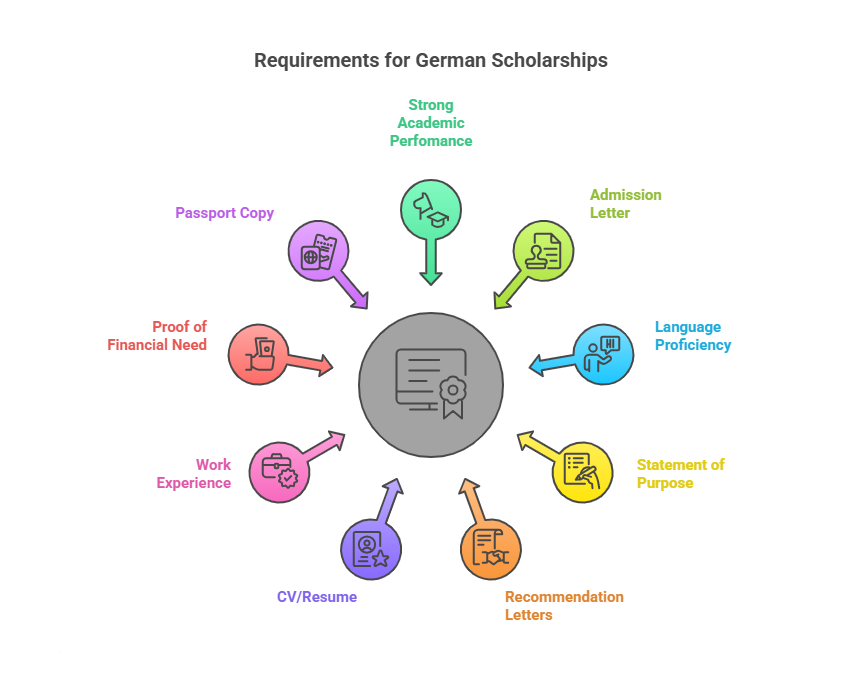
- Strong academic records with good marks in previous studies
- Admission letter from a German university.
- English language test score like IELTS or TOEFL, or German language test like TestDaF or DSH.
- Statement of Purpose (SOP) explaining your study goals and why you need the scholarship.
- One or two recommendation letters from your teachers or employer.
- Updated CV or resume with your education and work details.
- Work experience certificate if the scholarship asks for it.
- Proof of financial need such as income certificate or bank statement (for need-based scholarships).
- Valid passport copy.
*Get expert coaching services from Y-Axis professionals to ace your scores.
Tips to Improve Your Chances of Selection
To increase your chances of getting a scholarship in Germany, follow these simple and practical tips:
- Choose a course that clearly matches your previous education and background. The scholarship committee should easily understand why you selected that program.
- If you have done any research projects, internships, or published papers, make sure to mention them clearly in your application.
- Learn about the German university you are applying to and understand its strengths, ranking, and special programs.
- Explain your future career plans clearly. Show how studying in Germany will help you achieve your goals.
- Write a strong and honest motivation letter. It should explain why you deserve the scholarship and how you stand out from other students.
- Apply for more than one scholarship at the same time to improve your chances of selection.
Final Thoughts
Studying in Germany is a great opportunity for Indian students who want high-quality education at a lower cost. Germany offers many scholarship options, including well-known programs like DAAD, foundation scholarships, and university-specific funding. Most scholarships provide monthly support between €850 and €1,200, along with extra benefits such as travel allowance, health insurance, and sometimes language course support.
However, these scholarships are competitive, and only a small percentage of students are selected. This means you need to prepare carefully. Make sure you meet all eligibility requirements, submit complete and correct documents, and clearly show your academic strengths and career goals. It is a good idea to start preparing at least 12–15 months before your course begins so you have enough time to apply properly.
Apart from DAAD, there are many other options like the Deutschlandstipendium and scholarships offered by foundations such as Heinrich Böll and Friedrich Ebert. There are opportunities available for almost every field of study and at different academic levels. Many Master’s scholarships in Germany offer strong financial support that covers most living expenses.
Start your preparation early, check deadlines carefully, and apply to multiple scholarships to improve your chances. With proper planning and dedication, your dream of studying in Germany with a scholarship can become a reality.
How Can Y-Axis Help You Secure Scholarships in Germany?
Y-Axis provides complete support for students who want to apply for scholarships in Germany and reduce their financial burden while studying abroad. We guide you at every step, from selecting the right scholarship program to successfully obtaining your student visa.
At Y-Axis, we offer:
- Y-Path Guidance to help you choose the right scholarship programs such as DAAD, Erasmus+, and university-specific funding based on your academic background
- Y-Axis Coaching Centre to improve your IELTS, TOEFL, or German language test scores
- Complete assistance with scholarship applications, including form filling and document submission
- Support in preparing strong SOPs, LORs, CVs, and research proposals to improve your selection chances
- Guidance for university admission, APS certification, and Germany student visa process
- Blocked account and financial documentation support for visa requirements
Don't know what to do ?
Get Free Counseling
Looking for Inspiration
Explore what Global Indians have to say about Y-Axis in shaping their future