

Posted on February 20 2026
How to Migrate to Germany as a Registered Nurse?

By , Editor
Updated March 24 2026
You can migrate to Germany as a registered nurse by securing a nursing qualification recognised by the relevant state health authority in Germany (Anerkennung), a valid job offer, and having at least B1/B2 level proficiency in German. Registered nurses migrating to Germany can apply for a work visa after having their documents translated, their profession recognised, and obtaining a valid license. For foreign nurses with partially recognised qualifications, a knowledge test (Kenntnisprüfung) and an adaptation program of 6-12 months (Anpassungslehrgang) are mandatory for legal licensure to practice nursing in the country. The immigration pathways through which registered nurses can migrate to Germany include the Skilled Workers visa and the Recognition Partnership Visa, along with the Triple Win Program, which is specifically for qualified nurses from abroad.
*Want to work in Germany? Let Y-Axis assist you with the process.
Immigration Pathways in Germany for Registered Nurses
Immigration pathways for registered nurses in Germany include the Skilled Worker Visa, the Recognition Partnership Visa, and the Triple Win Program. Registered nurses from abroad need to acquire a recognised nursing qualification (Anerkennung), a job offer, and a minimum of B1/B2 level German language proficiency to migrate to Germany.
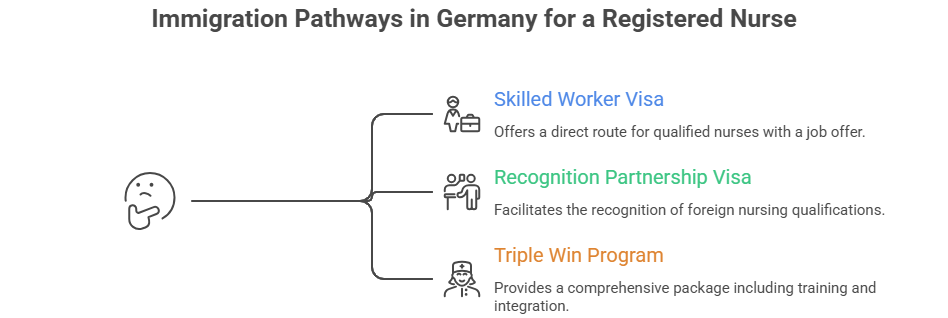
The immigration pathways and programs for registered nurses to Germany are as follows:
Germany Skilled Worker Visa
The Skilled Worker Visa is a suitable immigration pathway for registered nurses to migrate to Germany if they have a valid job offer. With a demand for over 30,000-40,000 registered nurses in Germany, the country is one of the best choices for nursing professionals. Registered nurses with international qualifications must secure full licensure to practice in Germany through Anerkennung, a recognition procedure administered by the state health authority.
Upon full recognition (Anerkennung), nurses can apply for a Skilled Worker Visa, followed by a residence permit for long-term employment in Germany, valid for up to 4 years. Upon completing 4 years of legal residence and employment in the country, nurses can apply for permanent residence (Settlement Permit).
Also, read...
Germany Faces Shortage of 40,000 Nurses; Indians in Strong Demand. Apply now!
Recognition Partnership Visa
The Recognition Partnership Visa in Germany is designed for registered nurses whose qualifications are not fully recognised by the country's state health authorities. Registered nurses from abroad with partial qualification recognition, of at least 2 years of vocational training, can migrate to Germany and work as nursing assistants, after which they can complete their qualification recognition to be fully employed. Upon arriving in Germany with a Recognition Partnership Visa, you will be required to complete the Knowledge test (Kenntnisprüfung) or "adaptation program" (Anpassungslehrgang) for full licensure.
A Recognition partnership pathway provides an opportunity for foreign registered nurses to transition from partial recognition to full qualification for authorised practice in Germany. Such a visa for nurses in Germany is granted for 24 months to complete the recognition requirements and secure a legal license.
*Want to apply for the Recognition Partnership Visa? Let Y-Axis assist you with the process.
Triple Win Program
The Triple Win Program is a government-sponsored recruitment drive for registered nurses to migrate to Germany. The recruitment initiative is coordinated by relevant German state health authorities to hire qualified registered nurses from partner countries, such as India.
More than 900 registered nurses were deployed in Germany in the last year through the Triple Win Program, creating opportunities for more nursing professionals to seek job offers in the country. The Triple Win Program is an ethical pathway for the structured integration of nurses from abroad into critical healthcare sectors, with up to 4 years of employment on a renewable basis.
Also, read...
500,000 Nurses needed in Germany by 2030. Apply via Triple Win Programme
Eligibility Criteria for Registered Nurses to migrate to Germany
To migrate to Germany as a registered nurse, you need to have your qualification (GNM, BSc/MSc) recognised by a relevant state health authority in Germany (Anerkennung) and demonstrate proficiency in German (B1/B2). After passing the Anerkennung (recognition) process, registered nurses from abroad must secure a valid job in Germany, which is essential for applying for a work visa. For nurses whose qualifications are not fully recognised, a knowledge test (Kenntnisprüfung) or an adaptation program of 6-12 months (Anpassungslehrgang) is mandatory to secure full licensure.
The eligibility requirements to migrate to Germany as a registered nurse are as follows:
- Relevant nursing qualification (General Nursing and Midwifery (GNM) or a Bachelor's/Master's of Science in Nursing (B.Sc/M.Sc)).
- Recognition (Anerkennung) through the German State Health Authority to meet Pflegefachfrau/-mann qualification standards.
- Valid nursing license from the home country.
- Proficiency in the German language (minimum B1 level needed for visa application, while B2 level is mandatory for complete nursing licensure).
- Valid job offer from a German employer.
- Knowledge test" (Kenntnisprüfung) or "adaptation program" (Anpassungslehrgang) for full licensure (for Recognition Partnership Visa)
- Police Clearance Certificate.
- Medical health report.
Also, read...
What are the fast-track hiring options in Germany for skilled professionals?
Nursing Jobs and Average Salary of Registered Nurses in Germany
Germany has more than 40,000 registered nurse vacancies for foreign candidates across sectors such as general nursing, elderly care, child care, and intensive care. Registered nurses with high qualifications, work experience, and skills are in high demand for their ability to support critical medical teams. Additionally, an ageing population has created an increasing need for foreign nurses to address the workforce shortage.
The average salary of nurses in Germany ranges from €2,500 (2,26,350 INR) to €3,800 (3,44,052 INR) per month, depending on qualifications and work experience.
The table below highlights the average salary offered to registered nurses in Germany as per their level of experience:
| Experience Level | Tenure of Work | Average Salary (Annually) |
|---|---|---|
| Entry-Level Registered Nurse | Less than 1 Year | €30,257 = Rs. 27,39,468 |
| Early Career Registered Nurse | 1–4 Years | €35,618 = Rs. 32,24,853 |
| Mid-Career Registered Nurse | 5–9 Years | €37,323 = Rs. 33,79,224 |
| Experienced Registered Nurse | 10–19 Years | €38,000 = Rs. 34,40,520 |
Some of the in-demand nursing jobs in Germany are as follows:
- Intensive care nurses.
- Operating room nurses.
- Geriatric nurses (Elderly Care)
- Anesthesia nurses.
- Pediatric nurses.
- Psychiatric nurses.
Also, read...
Top 10 Countries for Nursing Professionals: Salary, Demand & PR Opportunities Compared
How to migrate to Germany as a Registered Nurse from India?
Migrating to Germany as a registered nurse requires you to secure official recognition of your nursing qualification through Anerkennung, and to have a valid job offer and B1/B2 level of German language proficiency to apply for a work visa.
The steps to migrate to Germany as a registered nurse are as follows:
Step 1: Check your eligibility for different immigration pathways for registered nurses in Germany.
Step 2: Select a suitable German immigration pathway based on your qualifications, language proficiency, and experience.
Step 3: Gather the necessary documents, including an educational degree/diploma, a work experience letter, language proficiency documentation, and training certificates.
Step 4: Translate and certify all official documents from an authorised translator.
Step 5: Complete the recognition (Anerkennung ) process with the state health authority to compare your training with German standards. (if not fully qualified for complete licensure/recognition, undergo knowledge test (Kenntnisprüfung )and adaptation program).
Step 6: Secure a job offer from an authorised German employer recruiting internationally registered nurses.
Step 7: Submit your visa application with relevant documents, such as a job offer letter, proof of recognition approval, and a language proficiency certificate.
Step 8: Upon work visa approval, legally enter Germany as a registered nurse.
Step 9: On arrival, complete your final licensing process, which allows you to work as a registered nurse (Gesundheits- und Krankenpfleger or Pflegefachfrau/-mann).

*Are you looking for step-by-step assistance with German immigration? Contact Y-Axis, the world’s No. 1 overseas immigration consultancy, for end-to-end assistance!
FAQs
Are registered nurses in demand in Germany?
Yes, registered nurses are in high demand in Germany, as the country's ageing population requires extensive healthcare assistance. With an estimated 30,000 to 40,000 vacancies and a projected need of up to 500,000 by 2030, Germany offers long-term employment opportunities for foreign-registered nurses across hospitals, specialized clinics, and elderly care facilities (Altenpflegeheim).
How to migrate to Germany as a registered nurse?
You can migrate to Germany as a registered nurse by having your qualification recognised by the relevant state health authorities in the country through Anerkennung. Registered nurses from abroad need to secure a valid job offer from an authorised German employer and have at least a B1/B2 level of German language proficiency to apply for a work visa in Germany immigration.
What are the work visa options for registered nurses migrating to Germany from India?
Registered nurses can migrate to Germany from India through work visa options like the Skilled Worker Visa and the Recognition Partnership Visa. It is also possible to apply through the Triple Win Program, a recruitment drive for registered nurses to migrate to Germany after securing a job and getting a nursing qualification recognised (Anerkennung).
Is a job offer mandatory for registered nurses to migrate to Germany?
Yes, it is mandatory to secure a valid nursing job offer from an authorized German employer to migrate to Germany as a registered nurse. You need to present a legal work contract, proof of German language proficiency, and recognition of your nursing qualification at the German Embassy to apply for a work visa for German immigration.
How much does it cost to relocate to Germany as a registered nurse?
The average cost of relocation to Germany as a registered nurse is roughly ₹4.5–8 lakh (approx. €5,000–€9,000) for self-funded immigration. However, many employers sponsor visas, flights, language training, and recognition fees, reducing the initial cost of migration. The monthly lifestyle expenses for a registered nurse can range from €1,200 to € 1,800, depending on expenditure.
Which German cities offer the most job opportunities for registered nurses?
German cities like Berlin, Munich, Hamburg, and Frankfurt offer strong job prospects for registered nurses migrating from abroad, thanks to large hospital networks and strong demand for healthcare staff. Other regions of Germany with significantly high demand for registered nurses include Bavaria and North Rhine-Westphalia, where steady nursing career growth, modern healthcare facilities, and high salary potential are common.
What are the language requirements for registered nurses migrating to Germany?
To migrate to Germany as a registered nurse, you need to have at least a B1/B2 level of German language proficiency. While a B1 proficiency level is sufficient for a work visa application, a B2-level German certificate (CEFR) is mandatory for professional recognition and full licensure. Registered nurses migrating to Germany can take language tests, such as the Goethe or TELC, to obtain B1/B2 certification.
What documents are required to migrate to Germany as a registered nurse?
To migrate to Germany as a registered nurse, you need to secure proof of recognised qualification (GNM/BSc), a B1/B2 level of German language proficiency, a valid nursing licensure from the home country, and a signed job contract. The documents required for Germany immigration as a registered nurse are as follows:
- Nursing qualification certificate/degree/diploma(GNM/BSc).
- Recognition Documents (Anerkennung).
- Nursing licensure from the home country.
- "Certificate of Good Standing" from your nursing council.
- Valid job offer letter/employment contract.
- German language proficiency (B1/B2) certificate.
- Medical health report.
- Police Clearance Certificate.
- Valid passport.
Can I apply for permanent residence in Germany as a registered nurse?
Yes, you can apply for a permanent residence permit (Settlement Permit) for long-term employment and stay in Germany as a registered nurse. Registered nurses from abroad need to work about 3 to 4 years in Germany in a suitable nursing role to be eligible for a German PR. The process requires complete recognition of your nursing qualification by the country's state health authorities (Anerkennung), B2 German language proficiency, an existing job contract, and a valid work permit.
Tags:
migrate to Germany as a registered nurse
registered jobs in Germany
Jobs in Germany
Work in Germany
German work visa
Skilled worker visa
Recognition Partnership visa
Triple Win Program
German immigration pathways for Registered nurses
Share
Y - Axis services

Get it on your mobile

Get News Alerts

Contact Y-Axis
Latest Article
Popular Post
Trending Article

Posted On April 02 2026
190 Skilled Jobs in Denmark Eligible for Work Visa (2026) – Check If You Qualify