

Posted on December 18 2025
Do you qualify for a 2-year special work permit in Manitoba?

By , Editor
Updated December 26 2025
Highlights: Manitoba Offers Special 2-Year Work Permit for Qualifying PNP Candidates
- The 2-year special work permit announced by Manitoba allows qualifying PNP candidates to apply through the temporary public policy.
- A Manitoba support letter, a valid MPNP profile created on or after January 15, 2025, and a work permit that has expired on or after May 7, 2024, or is about to expire in 2025, are mandatory for the application.
- Interested candidates can apply for the two-year work permit through the official IRCC secure account.
- The application fees for the special work permit include $155 as standard work permit fees, $100 as the OWP holder fee, and $246.25 as the cost of status restoration.
- The last date to apply for the 2-year open work permit (OWP) in Manitoba is December 31, 2025.
*Want to apply for the Manitoba Provincial Nominee Program? Contact Y-Axis to guide you through the steps.
Who qualifies for a 2-year open work permit in Manitoba?
MPNP candidates can qualify for the 2-year open work permit under Canada's "Temporary Public Policy laid down by the federal government.
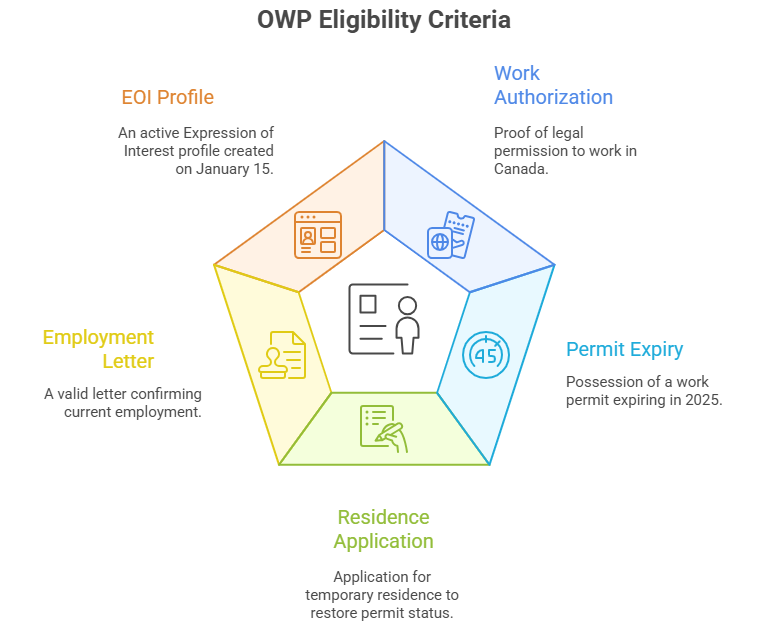
The eligibility requirements for the 2-year open work permit are as follows:
- Proof of authorisation to work in Canada.
- Possession of a work permit that expired/about to expire in 2025.
- Proof of application for temporary residence upon work permit expiry on May 7, 2024, to restore permit status.
- Valid letter of employment.
- A valid EOI profile was created on January 15 and has been active since then.
*Want to work in Canada? Contact Y-Axis for complete assistance.
Steps to apply for a 2-year work permit through the Temporary Public Policy
You can follow the steps below to apply for a 2-year work permit:
Step 1: Review the Instruction Guide 5553 before applying for a Canadian work permit.
Step 2: Sign up or log in to the IRCC Secure Account to complete the preliminary questionnaire and receive a personalised document checklist.
Step 3: Answer questions on the work permit application form, such as” Does any of the following apply to you?” and questions related to the work permit type you are applying for and the job description.
Step 4: Upload the necessary documents as per the personalised checklist.
Step 5: Pay the application fees, which include $155 as the standard work permit fee, $100 as the OWP holder fee, and $246.25 for status restoration.
Step 6: Submit your application for the special open work permit.
*Are you looking for step-by-step assistance with Canada immigration? Contact Y-Axis, the world's No. 1 overseas immigration consultancy.
For recent Canadian immigration updates, check out the Y-Axis Canada Immigration News Page.
FAQs
What is the special two-year open work permit available for Manitoba PNP candidates?
The special two-year open work permit is a temporary immigration measure designed to help eligible Manitoba Provincial Nominee Program (MPNP) candidates remain and work legally in Canada while pursuing permanent residence. Unlike employer-specific permits, this open work permit allows holders to work for almost any employer without needing a Labour Market Impact Assessment (LMIA). It mainly supports candidates whose previous work permits may have expired or are close to expiring and who are still in the MPNP process. This policy helps prevent job loss, supports workforce stability in Manitoba, and provides candidates with continued legal status.
Who is eligible to apply for the Manitoba support letter under the temporary public policy?
Eligibility for the Manitoba support letter is limited to specific MPNP candidates who meet both provincial and federal criteria. Generally, applicants must have an active Expression of Interest (EOI) profile with Manitoba, demonstrate a clear intention to live and work in the province, and meet residency or employment requirements. They must also satisfy IRCC’s conditions under the temporary public policy, such as having held valid work authorization in the past. Candidates who already have permanent resident status or do not meet federal admissibility requirements are usually excluded.
What are the provincial requirements for qualifying under this temporary PNP work permit program?
From a provincial perspective, Manitoba requires candidates to be actively engaged in the MPNP process. This typically includes maintaining a valid EOI profile, meeting program eligibility criteria, and demonstrating genuine ties to Manitoba through work, residence, or community connections. Applicants must show they are contributing to Manitoba’s labour market and intend to settle permanently in the province. The province also assesses whether the candidate aligns with Manitoba’s economic needs. Meeting provincial requirements alone is not sufficient; candidates must also comply with federal immigration rules to receive the work permit.
What federal conditions must MPNP candidates meet to receive a support letter and work permit?
At the federal level, candidates must qualify under IRCC’s temporary public policy for work permits. This generally includes having held valid temporary resident status in the past and being eligible to restore or extend their ability to work in Canada. Applicants must also be admissible to Canada, meaning they meet health, security, and background requirements. The work permit application must align with IRCC guidelines, and supporting documentation must be accurate and complete. Federal approval ultimately determines whether the open work permit is issued, even if Manitoba provides a support letter.
How does the Manitoba support letter help candidates get a two-year open work permit?
The Manitoba support letter acts as official confirmation that the province supports the candidate’s continued stay and employment while pursuing permanent residence. This letter is a key document required when applying to IRCC under the temporary public policy. It shows that the province recognizes the applicant as a genuine MPNP candidate and endorses their work authorization. Without this support letter, candidates cannot access the special two-year open work permit. While the letter does not guarantee approval, it significantly strengthens the application by confirming provincial backing.
What documents are required when applying for a Manitoba support letter?
Applicants typically need to submit identification documents, proof of current or previous work authorization, evidence of their active MPNP Expression of Interest profile, and documents showing their ties to Manitoba, such as employment records or residence history. Additional documents may include passport copies, previous permits, and forms requested by the province. Accuracy and completeness are critical, as missing or incorrect documents can delay processing or lead to refusal. Manitoba reviews these documents to confirm eligibility before issuing a support letter for the federal work permit application.
Can candidates who already received a PNP nomination use this temporary work permit policy?
In most cases, candidates who have already received a provincial nomination may not be eligible under this specific temporary work permit policy. The policy is generally intended for individuals still in the MPNP pipeline who need work authorization while awaiting further progress. Nominated candidates may instead qualify for other options, such as employer-specific permits or bridging work permits, depending on their situation. Each case is assessed individually, and eligibility depends on both provincial and federal criteria. Candidates should carefully review their status before applying under this policy.
What is the purpose of the federal temporary public policy for PNP candidates?
The temporary public policy exists to prevent skilled workers from falling out of legal status while transitioning from temporary residence to permanent residence through a Provincial Nominee Program. It supports provinces like Manitoba by helping retain workers who fill labour shortages and contribute to the local economy. By offering an open work permit option, the policy reduces employment disruptions for both workers and employers. It also provides flexibility to candidates who may not qualify for standard work permit extensions, ensuring continuity in Canada’s immigration and labour systems.
How is this special work permit different from a Bridging Open Work Permit (BOWP)?
The special two-year open work permit differs from a Bridging Open Work Permit in eligibility and purpose. A BOWP is usually available only after a permanent residence application has been submitted and acknowledged by IRCC. In contrast, this special permit targets candidates who are still in the provincial nomination stage and may not yet qualify for a BOWP. It fills a gap for workers who need legal authorization to remain employed while progressing through the PNP process. Both permits are open, but they serve different stages of immigration.
What happens after receiving a Manitoba support letter and how do candidates apply for the work permit?
After receiving the Manitoba support letter, candidates must submit an open work permit application to IRCC under the applicable temporary public policy. This involves completing the required forms, paying the necessary fees, and uploading the support letter along with other supporting documents. IRCC then reviews the application for eligibility and admissibility. If approved, the candidate receives a two-year open work permit allowing continued employment in Canada. During this period, candidates are expected to continue progressing through the Manitoba PNP toward permanent residence.
Tags:
Canadian immigration
Immigrate to Canada
Canada visas
Manitoba support letter
Manitoba provincial nominee program
Manitoba PNP
immigrate to Canada through MPNP
Canada immigration news
Canada PR
work in Canada
Share
Options for you by Y-Axis

Get it on your mobile

Get News alerts

Contact Y-Axis
Latest Article
Related Post
Trending Article

Posted On April 02 2026
Canada Introduces Eight Major Immigration Changes from April 1, Impacting PR Applicants and Newcomers. Check Your Eligibility Now!