

Posted on November 05 2026
India-EU Trade Deal Eases Access to 4 Million Job Opportunities Across 27 EU Countries. Apply Now!

By , Editor & Director
Updated November 05 2026
Highlights: Europe to Ease Mobility Rules for Indian Skilled Workers Under New India-EU Agreement
- India and the EU’s proposed FTA is set to introduce a structured framework for the temporary mobility of Indian professionals to Europe.
- The agreement covers four categories: intra-corporate transferees, contractual service suppliers, independent professionals and business visitors.
- India-EU Trade Deal opens access to 4 million job opportunities across 27 EU countries, expanding career prospects for Indian professionals.
- Complete applications for intra-corporate transfers are expected to be processed within 90 days under the proposed provisions between EU and India.
- Eligible Indian professionals and business visitors may benefit from more transparent procedures and simplified entry requirements for permitted activities.
- The agreement focuses on facilitating temporary professional mobility, while work visas, permanent residency, post-study work rights and recognition of Indian qualifications remain subject to existing eligibility requirements and procedures.
*Get your profile on Europe’s top 10 job portals for just ₹2,500 (save ₹2,500).
View package: https://www.y-axis.com/lp/europe-work-indians/
India-EU FTA to facilitate temporary mobility of Indian professionals to Europe
The proposed India-European Union (EU) Free Trade Agreement (FTA) could simplify the temporary entry and stay of Indian professionals and business representatives travelling to Europe. The agreement includes provisions for skilled professionals, employees transferred within companies, contractual service suppliers and business visitors.
Negotiations for the trade agreement concluded on January 27, 2026. It is expected to be signed on December 16 during Prime Minister Narendra Modi’s visit to Belgium. However, the mobility provisions are not intended to create unrestricted immigration or an automatic right to work and settle in EU countries.
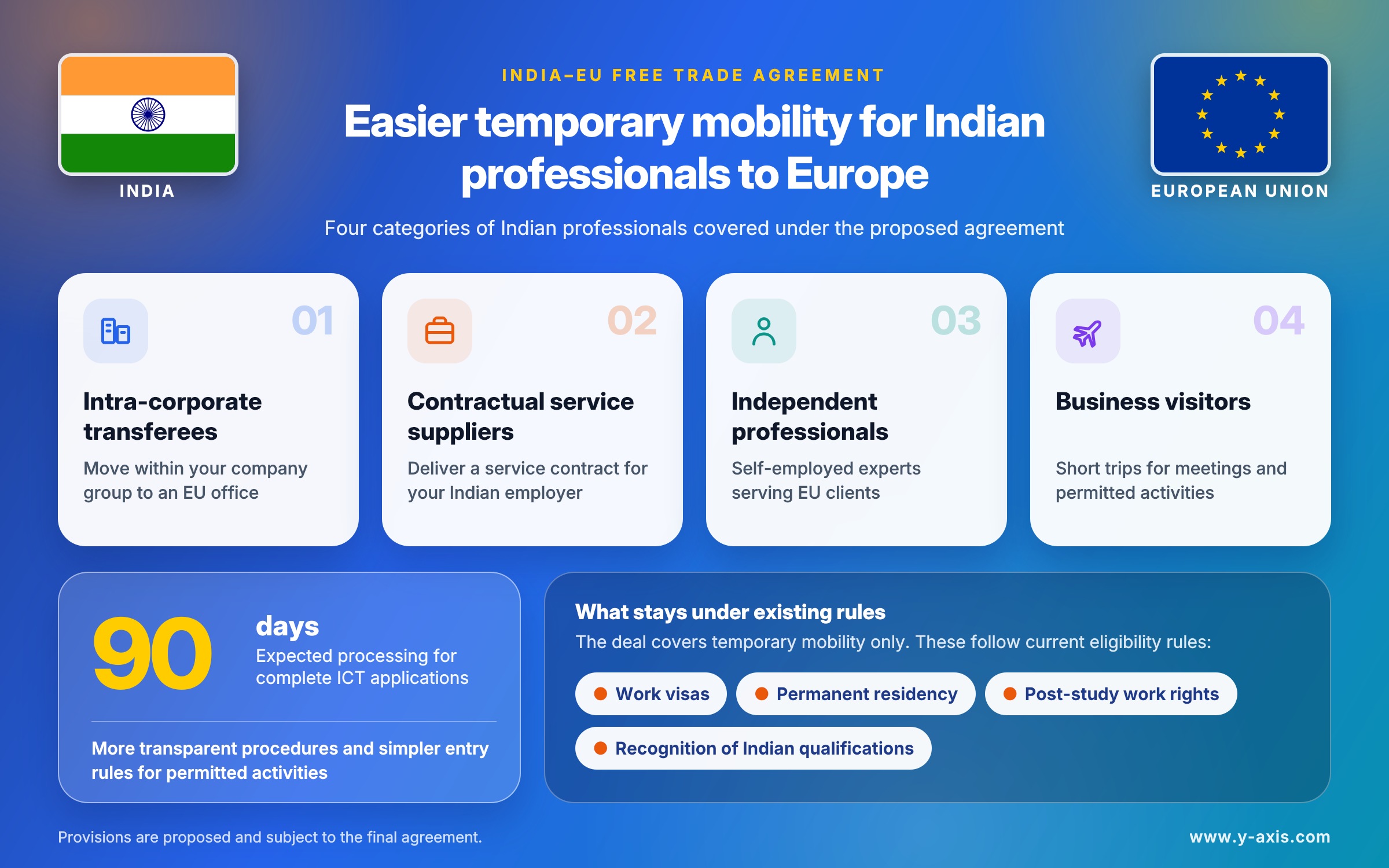
The proposed FTA outlines provisions for four categories of Indian nationals seeking temporary entry and stay in the EU for professional or business-related purposes.
- Intra-corporate transferees: Employees transferred by an organisation to its branch or associated business in an EU country. This category may benefit Indian companies sending managers, specialists and other eligible employees to their European offices.
- Contractual service suppliers: Professionals employed by an Indian company and sent to Europe to fulfil a service contract. Their entry and stay will depend on the sectors, qualifications and conditions specified in the agreement.
- Independent professionals: Individuals providing services on their own account. They will be subject to the eligibility requirements and sector-specific conditions established under the agreement.
- Business visitors: Indian nationals travelling to Europe for permitted short-term commercial activities. In specified circumstances, they may not require a work permit or similar prior approval.
The agreement also provides for complete intra-corporate transfer applications to be decided within 90 days. Eligible family members of Indian employees transferred to EU countries may receive temporary entry and stay rights under the applicable EU rules.
Also, read...
EU Immigrant Employment Hits Record High of 68.7% in 2025, New Study Finds
India-EU Trade Deal Opens Access to 4 Million Job Opportunities Across 27 Countries
The India-EU Trade Deal is expected to expand career opportunities for Indian professionals by improving access to 4 million job opportunities across 27 EU countries. With simplified mobility provisions for skilled professionals, intra-company transferees, contractual service suppliers and business visitors, the agreement aims to strengthen professional mobility, encourage cross-border collaboration and create new avenues for Indian talent in the European job market.
Will Indian professionals receive automatic work visas in EU nations?
Indian applicants must continue to follow the immigration procedures and meet the requirements of their destination country and professional category. The FTA aims to make the process more transparent and predictable by requiring authorities to process complete applications promptly, provide application-status information and communicate decisions without undue delay.
The agreement also does not introduce a blanket post-study work entitlement for Indian students or guarantee automatic recognition of Indian qualifications across Europe. It will become legally binding only after India and the EU complete their respective domestic approval procedures.
|
Professional Category |
Key Provision |
|
Intra-corporate transferees |
Temporary transfers to branches or associated businesses in EU countries; complete applications to be decided within 90 days |
|
Contractual service suppliers |
Temporary entry to fulfil service contracts, subject to specified conditions |
|
Independent professionals |
Temporary stay for eligible self-employed service providers under defined requirements |
|
Business visitors |
Facilitation of short-term commercial visits; work permit exemptions in specified circumstances |
|
Family members |
Temporary entry and stay rights for eligible family members under relevant EU rules |
*Want to check your eligibility to work in the EU? Avail Y-Axis Immigration Points Calculator to assess your profile.
How India-EU FTA benefit Indians in 2027?
The proposed India-EU FTA could create more predictable opportunities for Indian professionals and businesses seeking to expand their operations and service delivery across Europe. Its mobility provisions may offer the following benefits:
- Simplified corporate transfers: Indian companies may find it easier to deploy eligible managers and specialists to their European branches.
- Faster processing timelines: The 90-day decision period for complete intra-corporate transfer applications could improve planning for businesses and employees.
- Improved business mobility: Eligible contractual service suppliers and independent professionals may benefit from a more structured framework for temporary service delivery.
- Facilitated business visits: Indian business representatives may experience fewer administrative hurdles for permitted short-term commercial activities.
- Greater procedural transparency: Clearer application-status updates and timely decisions could help professionals plan their travel and assignments more effectively.
- Support for family mobility: Eligible family members of transferred Indian employees may benefit from temporary entry and stay provisions.
- Expanded European business opportunities: Indian businesses could find it easier to engage with EU clients, fulfil service contracts and strengthen cross-border operations.
*Are you looking for step-by-step assistance with overseas immigration? Contact Y-Axis, the world's No. 1 overseas immigration consultancy.
For recent European immigration updates, check out the Y-Axis Immigration News Page.
FAQs
How will the India-EU FTA benefit Indian professionals?
The proposed India-EU Free Trade Agreement could make temporary professional mobility to Europe more structured and predictable. It covers intra-corporate transferees, contractual service suppliers, independent professionals and business visitors. Indian professionals may benefit from clearer application procedures and improved transparency. However, the agreement does not provide unrestricted employment rights or automatic work visas. Applicants must still meet the immigration requirements and conditions applicable to their professional category and destination EU country.
Which categories of Indian professionals are covered under the India-EU FTA?
The proposed agreement covers four categories of Indian nationals seeking temporary entry and stay in the European Union. These include intra-corporate transferees, contractual service suppliers, independent professionals and business visitors. Each category has its own eligibility conditions, permitted activities and requirements. The provisions are designed to facilitate professional and business-related mobility rather than establish a general immigration route. Applicants must comply with the relevant conditions specified in the agreement and the destination country’s immigration procedures.
What is an intra-corporate transferee under the India-EU FTA?
An intra-corporate transferee is an employee moved by a company to its branch, subsidiary or associated business in another country. Under the proposed India-EU FTA, this category could benefit Indian companies transferring eligible managers, specialists and other employees to European offices. The agreement provides for complete applications to be decided within 90 days. Eligible family members may also receive temporary entry and stay rights under the applicable EU rules.
Will Indian professionals receive automatic work visas under the India-EU FTA?
No. The proposed India-EU FTA does not grant Indian professionals automatic work visas or unrestricted employment rights in Europe. Applicants will continue to follow the immigration procedures of their destination country and meet the eligibility conditions for their category. The agreement aims to improve transparency and predictability in processing applications. It is intended to facilitate temporary professional mobility, not create a new general route for permanent immigration or settlement in EU countries.
What is the 90-day processing provision under the India-EU FTA?
The proposed agreement provides for decisions on complete intra-corporate transfer applications to be made within 90 days. This provision could help Indian companies and employees plan overseas assignments with greater certainty. The timeline applies to complete applications within the specified category and should not be interpreted as a guarantee of visa approval. Applicants must still meet the applicable eligibility requirements, and the relevant immigration procedures of the destination EU country will continue to apply.
Can Indian contractual service suppliers work in Europe under the proposed FTA?
The proposed India-EU FTA includes contractual service suppliers, who are professionals employed by an Indian company and sent to Europe to fulfil a service contract. Their temporary entry and stay will depend on the sectors, qualifications and conditions specified in the agreement. The provisions may help Indian businesses deliver services to European clients more efficiently. However, professionals must satisfy the relevant requirements and cannot assume that every service contract qualifies.
Are independent professionals covered under the India-EU FTA?
Yes. Independent professionals providing services on their own account are included in the proposed mobility framework. Their temporary entry and stay in EU countries will be subject to the sectors and eligibility conditions specified in the agreement. This could create opportunities for eligible Indian self-employed professionals to provide services in Europe. The agreement does not establish unrestricted access to the EU labour market, and applicants must comply with the applicable immigration and professional requirements.
Will Indian business visitors need work permits under the India-EU FTA?
The proposed agreement aims to facilitate short-term visits by Indian business representatives for permitted commercial activities. In specified circumstances, business visitors may not need a work permit or similar prior approval. However, exemptions will depend on the nature of the visit and the conditions established under the agreement. Business visitors cannot use this provision to undertake unrestricted employment in Europe. They must follow the applicable entry requirements and comply with the permitted activities.
Does the India-EU FTA provide post-study work rights for Indian students?
No. The proposed India-EU FTA does not establish a blanket post-study work entitlement for Indian students graduating from European educational institutions. Students seeking employment after completing their studies will continue to depend on the relevant immigration rules and post-study work options available in their destination country. The agreement’s mobility provisions primarily address temporary professional and business-related activities. Indian students should review the individual country’s immigration requirements before planning their education and employment pathways.
When will the India-EU FTA become legally binding?
The proposed India-EU Free Trade Agreement will become legally binding only after India and the European Union complete their respective domestic approval procedures. Although negotiations concluded on January 27, 2026, and signing is expected on December 16, the mobility provisions should not be treated as fully operational until the required processes are completed. Indian professionals and businesses should monitor official announcements for updates on ratification, implementation timelines and the specific conditions governing temporary entry and stay.
Tags:
India EU Free Trade Agreement
India-EU FTA
work in Europe
jobs in Europe
Indian professionals in Europe
Mobility Provisions India EU
overseas immigration
migrate to Europe
settle in Europe
Share
Options for you by Y-Axis

Get it on your mobile

Get News alerts

Contact Y-Axis
Latest Article
Related Post
Trending Article
Posted On November 05 2026
India-EU Trade Deal Eases Access to 4 Million Job Opportunities Across 27 EU Countries. Apply Now!