


Posted on July 28 2026
EU Immigrant Employment Hits Record High of 68.7% in 2025, New Study Finds

By , Editor & Director
Updated August 01 2026
Highlights: EU Immigrant Employment Reaches Record High of 68.7% in 2025
- The European Union's immigrant employment rate hit a record high in 2025, narrowing the gap with native-born workers, according to a new study published on July 23, 2026.
- EU immigrant employment rose to a record 68.2% in 2025, up from 67.8% in 2024
- Non-EU immigrant employment climbed from 59.4% in 2017 to 66.0% in 2025, a gain of 6.6 percentage points
- EU immigrant employment rose from 71.1% to 74.8% over the same period, while native-born employment rose from 67.2% to 71.6%
- Malta, the Czech Republic, and Ireland recorded the highest non-EU immigrant employment rates.
- In Germany, non-EU immigrant employment stood at 66.1%, compared with 79.6% among native-born workers.
*Want to check your eligibility to work in the EU? Avail Y-Axis Immigration Points Calculator to assess your profile.
Non-EU Immigrants Post the Biggest Employment Gains as EU Labour Shortages Persist
Immigrant employment across the European Union rose to a record high in 2025, narrowing the gap with native-born workers. The employment rate among immigrants increased to 68.2% in 2025, up from 67.8% in 2024, according to the study by the Centre for Research and Analysis of Migration (CReAM) at RFBerlin.
The proportion of immigrants in employment has been rising for many years with outcomes moving closer to those of the native-born population.
The most significant improvement came from non-EU immigrants, whose employment rate increased by 6.6 percentage points between 2017 and 2025, rising from 59.4% to 66.0%. EU-born immigrants also benefited from 71.1% to 74.8%, while native-born employment rose from 67.2% to 71.6% over the same period.
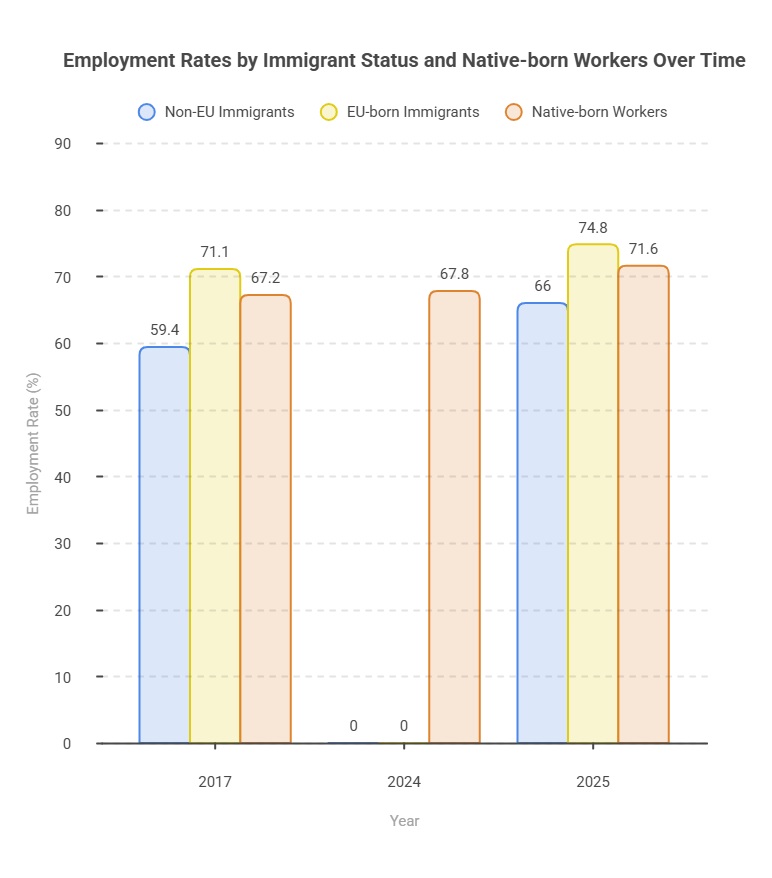
The table below highlights the key employment findings from the study:
|
Metric |
2024 |
2025 |
Change |
|
Total Immigrant Employment Rate |
67.8% |
68.2% |
+0.4pp |
|
Non-EU Immigrant Employment Rate |
— |
66.0% |
+6.6pp (since 2017) |
|
EU Immigrant Employment Rate |
— |
74.8% |
+3.7pp (since 2017) |
|
Native-Born Employment Rate |
— |
71.6% |
+4.4pp (since 2017) |
Employment Outcomes Vary Widely Across EU Member States
Non-EU immigrant employment outcomes differ significantly across the EU, reflecting differences in labour market integration, language requirements, and national policy frameworks.
|
Highest Non-EU Immigrant Employment |
Lowest Non-EU Immigrant Employment |
|
Malta |
Belgium |
|
Czech Republic |
Finland |
|
Ireland |
— |
In Germany, the non-EU immigrant employment rate stood at 66.1% in 2025, compared with 79.6% among native-born workers, according to the study. Researchers noted that remaining gaps are concentrated among non-EU women and highly educated migrants, and that the focus is shifting toward ensuring immigrant skills are fully used in the labour market rather than simply securing employment.
*Are you looking for step-by-step assistance with overseas immigration? Contact Y-Axis, the world's No. 1 overseas immigration consultancy.
For recent European immigration updates, check out the Y-Axis Immigration News Page.
FAQs
What is the EU immigrant employment rate in 2025?
The employment rate among immigrants in the European Union reached a record 68.2% in 2025, up from 67.8% in 2024. This is according to a study by the Centre for Research and Analysis of Migration (CReAM) at the ROCKWOOL Foundation Berlin, based on Eurostat data.
How much did non-EU immigrant employment improve between 2017 and 2025?
Non-EU immigrant employment in the EU rose by 6.6 percentage points between 2017 and 2025, increasing from 59.4% to 66.0%. This was the largest improvement among all groups tracked in the study, significantly narrowing the employment gap with native-born workers.
Which EU countries have the highest non-EU immigrant employment rates?
Malta, the Czech Republic, and Ireland recorded the highest non-EU immigrant employment rates in the European Union in 2025, reflecting strong labour market integration for foreign-born workers.
Which EU countries have the lowest non-EU immigrant employment rates?
Belgium and Finland recorded the lowest non-EU immigrant employment rates in 2025. The study suggests that language requirements, labour market structures, and national integration policies contribute to these differences.
How does Germany's non-EU immigrant employment rate compare to native-born workers?
Germany recorded a 66.1% employment rate for non-EU immigrants in 2025, compared to 79.6% among native-born workers. This highlights that employment gaps remain despite overall improvements in labour market integration.
What is driving the rise in EU immigrant employment?
The increase in immigrant employment is driven by persistent labour shortages across sectors such as healthcare, IT, construction, and hospitality, combined with improving integration policies and favourable labour market conditions across many EU member states.
Where do employment gaps remain for immigrants in the EU?
According to the study, employment gaps continue to be concentrated among non-EU women and highly educated migrants. Researchers note that the challenge is increasingly about ensuring immigrants can work in jobs that match their qualifications and skills.
What does this record employment rate mean for skilled workers considering migrating to the EU?
A record immigrant employment rate of 68.2% reflects strong demand for skilled professionals across the EU. Indian workers in sectors such as healthcare, engineering, IT, construction, and hospitality may benefit from expanding opportunities, although employment prospects vary by country and occupation.
How can I apply for a work visa in an EU country?
- Choose the EU country where you wish to work.
- Check your eligibility for the relevant work visa or permit.
- Secure a valid job offer from an approved employer.
- Prepare the required documents.
- Submit your application through the country's embassy or consulate.
- Complete biometrics or interviews if required.
- Receive your visa approval and travel to the destination country.
How can Y-Axis help me migrate to the EU?
Y-Axis provides comprehensive assistance for professionals planning to work in Europe, including eligibility assessment, country selection, job search guidance, documentation support, visa application assistance, and advice on pathways such as the EU Blue Card and country-specific skilled worker programs.
Tags:
EU immigration
EU work visa
immigrant employment EU
non-EU workers
EU labour market
Germany work visa
Ireland work visa
Malta work visa
migrate to EU
EU immigration news
Share
Options for you by Y-Axis

Get it on your mobile

Get News alerts

Contact Y-Axis
Latest Article
Related Post
Trending Article

Posted On October 15 2026
India-Switzerland Mobility Pact Opens New Work, Study and Travel Opportunities for Indians. Check Your Eligibility!