

Posted on April 13 2026
Canada Removes Co-Op Work Permit Requirement for International Students, Expanding Work Opportunities for Graduates. Apply Now!

By , Editor
Updated April 13 2026
Highlights: Canada to Simplify Employment Pathways With New Work Rules for International Students and Graduates
- Canada has simplified its work authorization system for international students and graduates under the new immigration policies.
- International post-graduate students will no longer require a co-op work permit effective from April 1, 2026.
- International students in Canada are now eligible to use their study permits as work authorization for internships, co-ops, and practicums.
- Work authorization rules will be expanded for students applying for a Post-Graduation Work Permit (PGWP).
- Under the new rules, post-secondary students in Canada are allowed to complete mandatory internships and work placements that make up no more than 50% of the total course duration.
*Want to apply for a Canada student visa? Let Y-Axis guide you with the process.
Canada Introduces New Work Permit Rules to Boost Post-Study Opportunities
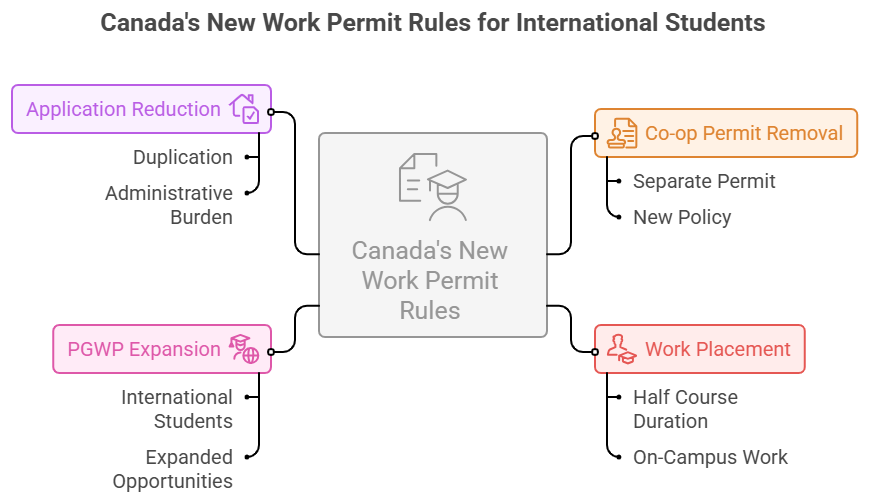
Canada officially updated its work permit rules for international students and graduates, simplifying study and employment from April 1, 2026. The new work permit policies remove the requirement for a separate co-op permit for pursuing internships during the study program.
Earlier, international students required a separate study and co-op permit to engage in internships, co-ops, and practicums during the course. The new work permit rules are part of Canada’s broader plans to expand work authorization for foreign nationals in 2026.
IRCC announced new work authorization rules for the current year to streamline study and work rights in Canada. The Canadian government is still deciding on wider changes to aid applicants waiting for permit approval.
The following are the new work authorization policies implemented for foreign graduates in Canada:
- Post-secondary students can complete work placements while studying, provided they account for half of the course duration.
- A valid study permit with on-campus work conditions is acceptable for pursuing internships/co-ops.
- Students awaiting approval of their co-op work permit can withdraw their applications.
- Post-Graduation Work Permit (PGWP) will be expanded for international students.
- Reduction in the number of permit applications to avoid duplication, administrative burden, and operational inefficiency.
Also, read...
Benefits of the Latest Work Access Rules in Canada for Foreign Graduates in 2026
The new work authorization rules from April 1, 2026, reduce duplicate applications for work and study permits to clarify work rights for international students in Canada.
The benefits of Canada’s revised work rules for foreign graduates in the current year are as follows:
- No need to apply separately for a co-op work permit and a study permit for internships and placement programs.
- Faster access to work opportunities without having to wait for work approval.
- Simplified documentation process for single permit applications.
- Students can continue working after course completion while their PGWP is in process.
- Continuous Canadian work experience improves eligibility for Express Entry and Provincial Nominee Programs (PNPs).
*Are you looking for step-by-step assistance with Canada immigration? Contact Y-Axis, the world's No. 1 overseas immigration consultancy.
For recent Canadian immigration updates, check out the Y-Axis Canada Immigration News Page.
FAQs
What changed for international students in Canada regarding co-op work permits as of April 2026?
Effective April 1, 2026, post-secondary international students in Canada are no longer required to obtain a separate co-op work permit to participate in mandatory work placements such as internships, co-ops, or practicums. A valid study permit with on-campus work authorization is now sufficient, provided the placement is a mandatory component of the academic program and does not exceed 50% of the total program duration. This change eliminates the need to file multiple permit applications for what is effectively a single educational pathway.
Who is eligible to benefit from the removal of the co-op work permit requirement?
Post-secondary international students with a valid study permit are the primary beneficiaries of this change, provided their work placement is a required part of their program and does not constitute more than 50% of the total program duration. Secondary school students are not covered under this update and still require a co-op work permit. Students who had already applied for a post-secondary co-op work permit may withdraw their application, as it is no longer a requirement under the revised framework.
Can international graduates work in Canada while waiting for their Post-Graduation Work Permit (PGWP) decision?
Graduates applying for a PGWP can already work full-time while awaiting a permit decision, provided they meet certain conditions — namely, completing their studies, having prior work authorization during their studies, and submitting the PGWP application before their study permit expires. This provision helps bridge the gap between the end of studies and the receipt of a formal work permit, ensuring graduates are not left without income or work authorization during what can be a lengthy processing period.
What additional reforms to student work authorization are currently being proposed by IRCC?
Immigration, Refugees and Citizenship Canada (IRCC) is considering several further reforms, including allowing international students to continue working while awaiting decisions on study permit extensions, extending work authorization to graduates who have applied for a PGWP but are still awaiting approval, eliminating the co-op work permit requirement entirely across all student categories, removing study permit requirements for foreign apprentices who already hold valid work permits, and introducing standardized processes for work authorization during scheduled academic breaks. These proposals are currently in the consultation phase.
How does the removal of the co-op work permit requirement benefit students practically?
The removal of the co-op work permit requirement represents a significant reduction in paperwork and processing time for international students. By allowing a single permit to cover both academic study and required work placements, the system becomes more efficient and easier to navigate. Students no longer need to budget additional time or money for a secondary permit application, and the risk of experiencing a gap in work authorization due to processing delays is considerably reduced, making the overall academic experience more streamlined and administratively manageable.
What are the PGWP eligibility requirements for college and diploma program graduates?
As of June 25, 2025, international graduates enrolled in college or diploma programs must complete one of 920 approved programs to qualify for a PGWP. This field-of-study requirement was introduced to align post-study work opportunities with sectors facing long-term labour shortages in Canada. College graduates must also meet minimum language proficiency standards in addition to program eligibility criteria. University-level degree students, however, retain automatic PGWP access regardless of their field of study and are not subject to the same field-based restrictions.
Are students already enrolled in affected programs protected from PGWP eligibility changes?
Students who applied for their study permit before the June 25, 2025 policy update retain PGWP eligibility even if their program is no longer on the approved list. This grandfathering provision applies equally to students already studying in Canada at the time of the change. The measure is intended to prevent mid-program disruptions and to honour the academic commitments students made under earlier policy conditions, ensuring that regulatory changes do not penalise those who could not have anticipated them when choosing their program.
How have Canada's international student arrival numbers changed in recent months?
Recent data reflects a continued and significant decline in international student arrivals. In January 2026, new arrivals were 28% lower compared to the same period in 2025, with study permit issuances falling by 37% year-over-year. Foreign worker arrivals also declined by 20% during the same timeframe. Over the full year 2025, total arrivals were 53% lower than in 2024. These figures align with Canada's stated policy objective of reducing its temporary resident population to below 5% of the total national population by the end of 2026.
What are the language proficiency requirements for obtaining a PGWP?
Language proficiency standards are now a mandatory component of PGWP eligibility for students who applied for their study permit on or after November 1, 2024. University graduates must achieve a Canadian Language Benchmark (CLB) Level 7 across all four language areas, while college graduates must meet a CLB Level 5 in reading, writing, speaking, and listening. These requirements apply to both English and French language assessments, depending on the language of instruction. Meeting these benchmarks is a non-negotiable condition for PGWP approval under the current framework.
How do the proposed PGWP gap-filling changes affect permanent residency pathways?
Graduates who experience a lapse in work authorization while awaiting a PGWP decision may face difficulties demonstrating continuous, authorized work experience — a key requirement for permanent residency programs such as the Canadian Experience Class and various Provincial Nominee Programs. Proposed measures to close this gap would therefore have direct implications beyond temporary work access. A clean and uninterrupted work authorization record strengthens both Express Entry profiles and provincial nomination applications, making the continuity of work status a matter of significant long-term consequence for graduates pursuing permanent residency in Canada.
Tags:
Canada immigration
study in Canada
Canada student visa
Canada immigration news
work in Canada
Post Graduates Work Permit PGWP
Co-op work permit Canada
migrate to Canada
foreign graduates in Canada
Canada visas
Canada work permit
Share
Options for you by Y-Axis

Get it on your mobile

Get News alerts

Contact Y-Axis
Latest Article
Related Post
Trending Article
Posted On April 13 2026
Canada Removes Co-Op Work Permit Requirement for International Students, Expanding Work Opportunities for Graduates. Apply Now!