

Posted on January 30 2026
Canada Issues 10,000+ Working Holiday Visas in First IEC 2026 Draw. Apply Today!

By , Editor
Updated February 02 2026
Highlights: Canada Opens 2026 Working Holiday Visa Season with Over 10,000 ITAs Issued
- Canada has officially launched the 2026 International Experience Canada (IEC) Working Holiday season, issuing over 10,000 Invitations to Apply (ITAs) in the first selection round.
- The first IEC draw was held in January 2026, confirming the early start of selections for the year.
- Canada has allocated more than 42,000 Working Holiday permits for 2026, indicating strong demand for international youth workers.
- Over 35,000 visa spots remain available, with multiple IEC draws expected throughout the year.
- The Working Holiday Visa is issued as an open work permit, allowing applicants to work for any employer in Canada without a prior job offer.
*Want to apply for a Canada Working Holiday Visa? Let Y-Axis guide you with the steps.
Canada Conducts First 2026 Working Holiday Visa Draw, Issues Over 10,000 ITAs
Canada has officially launched the International Experience Canada (IEC) Working Holiday Visa program for 2026, issuing over 10,000 Invitations to Apply (ITAs) in its first selection round. This marks one of the largest early-year IEC draws, clearly signalling Canada’s growing reliance on young international workers to support key sectors facing labour shortages.
The early start and high number of invitations highlight strong hiring demand across hospitality, tourism, retail, logistics, and service industries, where temporary foreign workers play a crucial role in sustaining economic growth.
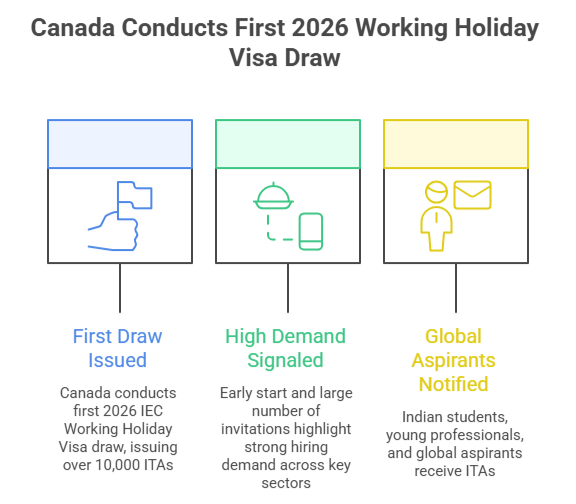
For Indian students, young professionals, and global aspirants seeking overseas work exposure, this development reinforces Canada’s position as a preferred destination for short-term employment, international experience, and future immigration pathways. The Working Holiday Visa is issued as an open work permit, allowing holders to work for multiple employers without a job offer, making it one of the most flexible ways to enter the Canadian labour market.
*Want to work in Canada? Let Y-Axis assist you with the process.
What Is Canada’s Working Holiday Visa and How Does the Draw Work?
The Working Holiday Visa is part of Canada’s International Experience Canada (IEC) program. It allows young foreign nationals from eligible countries to live and work in Canada temporarily on an open work permit.
Unlike Express Entry, the IEC program:
- Does not use CRS points
- Does not require a job offer
- Selects candidates through periodic random draws from the IEC pool
The visa is usually valid for 12 to 24 months, depending on the applicant’s nationality. Once invited, candidates must submit documents, pay fees, complete biometrics, and meet medical or police requirements before receiving approval.
Although Indian passport holders are not directly eligible for the Working Holiday stream, Indians can still benefit indirectly through:
- Partner-country citizenship
- Other IEC categories
- Employer-supported work permits
- Work-to-PR pathways after gaining Canadian experience
*Want to apply for Canada PR? Talk to experts at Y-Axis to help you with the steps.
Why This Matters for Indian Aspirants Planning to Work in Canada
Canada is facing long-term workforce shortages due to an ageing population and rising demand in service-driven industries. Temporary work programs like IEC help fill these gaps while offering international candidates a chance to gain Canadian work exposure, improve employability, and strengthen future permanent residence (PR) prospects.
Canadian work experience gained through open work permits can significantly boost eligibility under:
- Canadian Experience Class (CEC)
- Provincial Nominee Programs (PNPs)
- Employer-driven PR pathways
With thousands of IEC spots still open in 2026, this is a strong signal that Canada remains open to international talent and flexible work visas.
*Are you looking for step-by-step assistance with Canada immigration? Contact Y-Axis, the world's No. 1 overseas immigration consultancy.
For recent Canadian immigration updates, check out the Y-Axis Canada Immigration News Page.
FAQs
What is Canada’s Working Holiday Visa under the IEC program?
Canada’s Working Holiday Visa is part of the International Experience Canada (IEC) program that allows young foreign nationals from eligible countries to live and work in Canada on an open work permit. The visa lets applicants work for almost any employer without a job offer in advance. It is mainly designed to promote cultural exchange while helping Canada meet short-term labour needs. The visa is valid for up to 12 or 24 months depending on nationality and provides an excellent opportunity to gain Canadian work experience.
Was a Working Holiday Visa draw conducted in 2026?
Yes, Canada conducted its first International Experience Canada (IEC) Working Holiday selection round for 2026 in January. During this round, more than 10,000 Invitations to Apply (ITAs) were issued to eligible candidates. This confirms that the IEC season for 2026 has officially started. Unlike Express Entry, IEC draws are conducted periodically throughout the year until country-specific quotas are filled. Candidates already in the pool are randomly selected based on available spots and program rules.
How many ITAs were issued in the first 2026 Working Holiday round?
In the first IEC Working Holiday round for 2026, Canada issued over 10,000 Invitations to Apply. This represents a significant portion of the total annual quota allocated for the Working Holiday category. The high number of ITAs issued early in the year indicates strong demand for temporary foreign workers and highlights Canada’s continued reliance on international youth mobility programs to address labour shortages across hospitality, tourism, retail, and service sectors.
Who is eligible to apply for Canada’s Working Holiday Visa?
Eligibility for the Working Holiday Visa depends on nationality, age, and compliance with IEC requirements. Applicants must be citizens of an IEC-partner country, usually aged between 18 and 30 or 35, depending on bilateral agreements. Candidates must hold a valid passport, show proof of funds, obtain health insurance, and meet admissibility requirements. A job offer is not required at the time of application, making it one of the most accessible ways for young professionals to work in Canada legally.
Is the Working Holiday Visa an open work permit?
Yes, the Working Holiday Visa is issued as an open work permit. This allows visa holders to work for any eligible employer in Canada without being tied to a single job or location. Open work permits provide flexibility to change employers, explore different industries, and travel within Canada while working. However, certain restricted occupations, such as jobs involving childcare or healthcare, may require additional medical examinations before employment.
How is the IEC Working Holiday draw different from Express Entry?
The IEC Working Holiday draw is completely different from Express Entry. IEC is a temporary work permit program focused on youth mobility and cultural exchange, while Express Entry is a permanent residence system based on skills and points. IEC draws do not use CRS scores or ranking systems. Instead, candidates are randomly invited from the pool based on country quotas and program availability. IEC work experience can later help candidates qualify for permanent residence pathways.
Can the Working Holiday Visa lead to Canada PR?
While the Working Holiday Visa itself is temporary, it can help applicants transition to permanent residence. Canadian work experience gained through IEC can improve eligibility under Express Entry programs such as the Canadian Experience Class or Provincial Nominee Programs. Many IEC participants use their time in Canada to secure employer support, improve language scores, and strengthen their overall immigration profile. It is often considered a practical stepping stone toward long-term settlement in Canada.
How long is the Canada Working Holiday Visa valid?
The validity of the Working Holiday Visa depends on the applicant’s country of citizenship. Most participants receive a visa valid for 12 or 24 months. During this period, holders can live and work anywhere in Canada. The visa duration cannot usually be extended beyond the permitted limit for each country, but participants may explore other work permits or immigration options before their visa expires to continue staying in Canada legally.
Are more Working Holiday draws expected in 2026?
Yes, Canada conducts multiple IEC Working Holiday selection rounds throughout the year until all country-specific quotas are filled. After the first 2026 round, thousands of spots remain available across participating countries. Candidates who are already in the IEC pool but did not receive an ITA in the first round still have a chance to be invited in upcoming draws. The frequency of draws depends on demand and remaining quotas.
What should applicants do after receiving an ITA?
Once an applicant receives an Invitation to Apply, they must submit a complete work permit application within the given deadline. This includes uploading required documents, paying applicable fees, completing biometrics, and meeting medical or police clearance requirements if applicable. Timely and accurate submission is crucial, as incomplete applications can be refused. After approval, applicants receive a Port of Entry letter, which allows them to activate their Working Holiday work permit upon arrival in Canada.
Tags:
Working Holiday Program
Canada immigration
Migrate to Canada
Canada visas
Canada work visas
Work in Canada
Jobs in Canada
Canada immigration news
Working Holiday visa draw
Canada Working Holiday visa
Canada PR
Share
Options for you by Y-Axis

Get it on your mobile

Get News alerts

Contact Y-Axis
Latest Article
Related Post
Trending Article

Posted On April 02 2026
Canada Introduces Eight Major Immigration Changes from April 1, Impacting PR Applicants and Newcomers. Check Your Eligibility Now!