


Don't know what to do ?
Get Free Counseling
Last Updated 06 September 2026
Kuwait Job Market: Trends and Opportunities
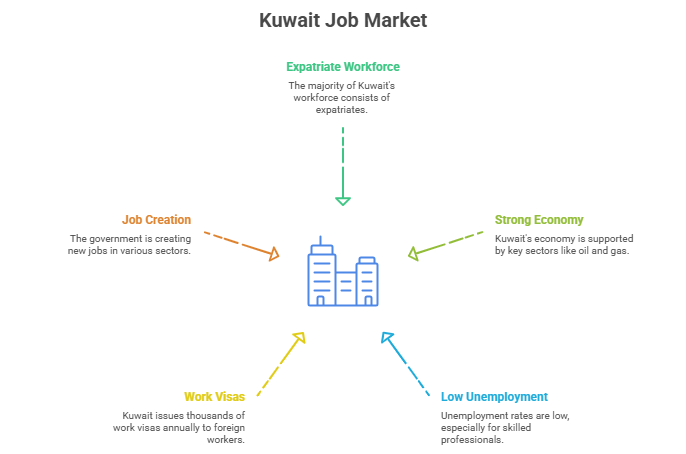
- Most of Kuwait's workforce is made up of expatriates. Non-Kuwaitis make up approximately 79% of the total workforce, with Kuwaiti nationals comprising just 21%. Indian nationals remain the largest expatriate group, with approximately 579,000 workers in Kuwait (PACI, June 2026).
- The country has a strong economy supported by oil, gas, logistics, construction, and healthcare.
- The unemployment rate is low, especially for skilled professionals.
- Kuwait issues thousands of work visas every year to foreign workers.
- The government is creating new jobs in IT, finance, healthcare, logistics, and engineering as part of diversification plans.
Want to apply for Kuwait work visa? Let Y-Axis assist you with the steps.
Job Outlook in Kuwait
Kuwait's job market is growing steadily. The total workforce reached 3.212 million in 2025, reflecting 8.9% growth with the addition of approximately 263,000 workers year-on-year. Government reforms, infrastructure development, and rising demand for skilled foreign workers continue to drive this expansion. The country offers tax-free salaries, safe working environments, modern infrastructure, and attractive employee benefits. With major investments in oil, technology, and healthcare, Kuwait continues to attract professionals seeking long-term career growth. Kuwait is seeing rising job demand in IT, engineering, finance, and healthcare. Digital transformation, smart city initiatives, and new infrastructure projects are opening opportunities for skilled professionals. Companies in Kuwait City, Hawalli, Al Ahmadi, and Farwaniya are expanding across various industries. Kuwait's ICT market alone was valued at USD 22.48 billion in 2023 and is projected to reach USD 39.83 billion by 2028.
Indian Professionals in Kuwait
Indian nationals are the largest expatriate group in Kuwait, with approximately 579,000 workers — the biggest national group in the entire labour market (PACI, June 2026). Indians work across oil and gas, construction, IT, healthcare, engineering, finance, and retail. The strong India-Kuwait economic relationship means Indian professionals are actively recruited by Kuwaiti companies and government-linked entities.
Indian workers benefit from Kuwait's tax-free salaries, accommodation allowances, and established Indian community infrastructure including schools, religious institutions, and community associations. Professionals from Indian cities including Hyderabad, Kerala, Mumbai, and Tamil Nadu have long-established presence in Kuwait, and demand for Indian skilled talent continues to grow across technical and managerial roles.
Also, read...
Kuwait Opens 15-Year Residency Pathway for Foreign Investors. Check Your Eligibility Now!
Factors Influencing Job Creation or Reduction in Kuwait
- Economic diversification creates new jobs in non-oil sectors.
- Infrastructure and mega projects increase demand for skilled workers.
- Foreign investments help generate new employment opportunities.
- Technology adoption boosts jobs in IT, automation, and digital fields.
- Kuwaitization policies set minimum Kuwaiti workforce quotas by sector. Banking and finance now require 70–80% Kuwaiti staff; national oil companies (KPC, KOC) exceed 87% and target full Kuwaitization in core roles, while private oil contractors face quotas rising toward 60%. Skilled expats in technical and specialist roles — engineering, IT, healthcare — remain in high demand as these sectors face local talent shortages.
- High demand for skilled professionals continues in technical and specialist roles.
- Oil prices and global market trends influence hiring in engineering and energy sectors.
- Revised Kuwait Vision 2035 strategy targeting USD 32 billion in foreign investment is accelerating hiring across infrastructure, logistics, and technology sectors
Planning to work abroad? Y-Axis will guide you step-by-step.
In-Demand Jobs in Kuwait
Kuwait continues to offer strong job opportunities in high-growth sectors.
The table below highlights some popular roles and their average annual salaries:
| Occupation | Average Monthly Salary (KWD) |
|---|---|
| IT & Software | 800 – 1,500 |
| Engineering | 800 – 1,500 |
| Accounting & Finance | 1,000 – 1,800 |
| Healthcare (Doctors/Specialists) | 1,200 – 3,000+ |
| Nursing | 600 – 1,200 |
| Human Resources | 700 – 1,400 |
| Manufacturing & Industry | 500 – 1,000 |
| Sales & Marketing | 1,200 – 2,500 |
| Data Science / Analytics | 1,000 – 2,200 |
| Teaching & Education | 500 – 1,100 |
| Project Management | 1,500 – 2,500 |
Job Vacancy in Kuwait
Kuwait is experiencing steady growth in job opportunities due to government-led development plans and expansion across key industries. Sectors such as construction, oil and gas, healthcare, IT, engineering, logistics, and education continue to hire skilled professionals throughout the year.
Major national projects under Kuwait Vision 2035 (also known as New Kuwait) are driving employment growth. Kuwait currently has close to 300 active projects valued at approximately USD 115 billion, with large infrastructure projects making up nearly half of that total. In 2025, Kuwait approved 124 projects worth USD 5.6 billion under the 2025–2026 draft budget. Two major works — the Mubarak Al Kabeer Port and a large expansion to the country's electrical grid — are expected to contribute to the creation of 50,000 jobs. Key projects include Silk City (Madinat Al Hareer), Kuwait International Airport Terminal 2 expansion (designed to handle up to 25 million passengers annually), and the Kuwait National Railroad Network.
The table below shows the estimated number of job openings in Kuwait by 2030, highlighting sectors with the highest demand.
| Sector | Demand Level | Key Demand Driver |
|---|---|---|
| Healthcare & Nursing | Very High | Population growth and hospital expansion under Vision 2035 |
| IT & Software | High | Digital transformation, smart city initiatives, and ICT market growth |
| Engineering | High | Over 300 active infrastructure projects worth approximately USD 115 billion |
| Construction & Infrastructure | High | Mubarak Port, Airport T2, National Railroad, and Silk City projects |
| Accounting & Finance | Moderate–High | Banking sector expansion and economic diversification |
| Hospitality & Tourism | Moderate–High | Vision 2035 tourism initiatives and Silk City development |
| Teaching & Education | Moderate | Growth of international schools and expatriate population |
| Marketing & Sales | Moderate | Private sector expansion and growth in digital commerce |
Impact of Kuwait’s Oil & Gas Industry on Workforce Demand
Kuwait’s oil and gas industry is the backbone of the country’s economy, and it has a major impact on job creation. Since oil is Kuwait’s main source of income, the government and private companies invest heavily in exploration, drilling, refining, maintenance, and export operations. This creates continuous demand for skilled professionals such as engineers, technicians, safety officers, project managers, and equipment operators.
The industry also supports many indirect jobs. Logistics companies, construction firms, transport services, finance departments, and IT teams all depend on the oil sector. New oilfield projects, refinery upgrades, and energy infrastructure developments lead to thousands of new job openings every year.
Because of Kuwait’s strong reliance on energy production, the oil and gas sector remains one of the most secure and high-paying fields. It offers long-term career growth for both local and foreign professionals, making it a key driver of workforce demand across the country.
Also, read...
Kuwait to Launch New Freelance Visa for Foreign Workers – Check If You Qualify!
Skills In-Demand in Kuwait
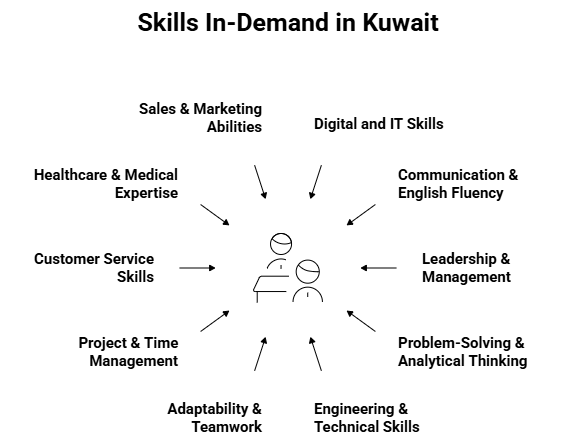
Kuwait’s fast-growing economy and modernization plans have increased the need for skilled workers across different industries. Employers look for candidates who can handle new technologies, work well in teams, communicate clearly, and adapt to changing business needs. Professionals with strong technical knowledge, problem-solving skills, and leadership abilities have better job opportunities in Kuwait. Some of the most in-demand skills include:
- Digital and IT skills
- Communication & English fluency
- Leadership & management
- Problem-solving & analytical thinking
- Engineering & technical skills
- Adaptability & teamwork
- Project and time management
- Customer service skills
- Healthcare and medical expertise
- Sales and marketing abilities
Also, read...
Kuwait Introduces Multiple-Trip Exit Permits for Foreign Workers – Check Your Eligibility Now!
Kuwait Work Visa for Indians
Indian professionals can work in Kuwait on an employer-sponsored work visa (Iqama). The employer applies for the visa on behalf of the candidate and takes responsibility for sponsorship, permit renewals, and any transfer requirements.
Key points Indian applicants should know:
- The employer must be registered with the Kuwait Ministry of Interior and Ministry of Social Affairs and Labour.
- Applicants typically need a valid passport, educational certificates (attested), medical fitness certificate, and a signed employment offer.
- Work visas are usually issued for one to two years and are renewable based on the employment contract.
- Kuwait's Kuwaitisation policy (mandating a minimum percentage of Kuwaiti nationals in some sectors) does not significantly affect skilled foreign professionals in technical or specialist roles.
- Dependents (spouse and children) can be sponsored provided the primary applicant meets the minimum salary requirement set by the employer category.
Also, read...
In-demand Job Opportunities in Kuwait
Tips to Help You Find the Right Job Opportunities in Kuwait
- Build a strong Kuwait-style CV
- Improve English and basic Arabic
- Gain industry-relevant certifications
- Research companies and job requirements
- Network with professionals and recruiters
- Maintain an updated LinkedIn profile
- Apply early and prepare well for interviews
Also, read...
Kuwait Launches New E-Services to Simplify Visa and Residency Transfers for Immigrants
Kuwait Residency Options for Professionals
Kuwait offers several residency options for skilled professionals who want to live and work in the country. The most common pathway is the work visa residency (Iqama), where the employer sponsors the professional’s stay, permits, and renewals. Professionals can also sponsor their spouse and children for dependent residency if they meet the income requirements. Some highly skilled professionals in fields like engineering, healthcare, oil & gas, and IT may receive longer residency validity based on employer needs. Residency can also be transferred to a new employer, allowing professionals to switch jobs within Kuwait.
Those working on large government or private projects may receive project-based residency, which can later be upgraded or transferred. These options make it easier for professionals to build stable, long-term careers in Kuwait.
As of June 2026, Kuwait has introduced a 15-year residency pathway for foreign investors meeting capital requirements. A freelance visa is also expected to launch soon; check y-axis.com/news for the latest updates.
Summary of Kuwait Job Outlook
Kuwait provides excellent job opportunities in oil & gas, engineering, IT, healthcare, finance, education, construction, and logistics. With a workforce of 3.2 million and 8.9% growth in 2025, Kuwait's labour market is one of the most active in the Gulf. Tax-free salaries, modern infrastructure, and strong employer demand make Kuwait one of the top destinations for Indian professionals. With USD 32 billion in targeted foreign investment and 50,000 jobs expected from infrastructure projects alone, long-term career opportunities in Kuwait remain strong across both public and private sectors.
Looking to work in Kuwait? Connect with Y-Axis, world’s number one immigration consultancy, for expert guidance on job search, visas, and resume building.
| S.NO | Country | URL |
|---|---|---|
| 1 | UK | www.y-axis.com/job-outlook/uk/ |
| 2 | USA | www.y-axis.com/job-outlook/usa/ |
| 3 | Australia | www.y-axis.com/job-outlook/australia/ |
| 4 | Canada | www.y-axis.com/job-outlook/canada/ |
| 5 | UAE | www.y-axis.com/job-outlook/uae/ |
| 6 | Germany | www.y-axis.com/job-outlook/germany/ |
| 7 | Portugal | www.y-axis.com/job-outlook/portugal/ |
| 8 | Sweden | www.y-axis.com/job-outlook/sweden/ |
| 9 | Italy | www.y-axis.com/job-outlook/italy/ |
| 10 | Finland | www.y-axis.com/job-outlook/finland/ |
| 11 | Ireland | www.y-axis.com/job-outlook/ireland/ |
| 12 | Poland | www.y-axis.com/job-outlook/poland/ |
| 13 | Norway | www.y-axis.com/job-outlook/norway/ |
| 14 | France | www.y-axis.com/job-outlook/france/ |
Y-Axis snapshot
1M
Successful applicants
1500+
Experienced counselors
25Y+
Expertise
50+
Offices
Don't know what to do ?
Get Free Counseling
Looking for Inspiration
Explore what Global Indians have to say about Y-Axis in shaping their future