


Don't know what to do ?
Get Free Counseling
Last Updated 15 July 2026
Why Work in Kuwait?
A Kuwait work visa is an employer-sponsored document that allows foreign nationals including Indians to legally live and work in Kuwait under the kafala (sponsorship) system. The visa is tied to the employer and converts into a renewable Iqama (residency permit) after arrival. Multiple visa categories exist including private sector, government, project-based, and the upcoming freelance permit (2026), , and the new 15-year investor residency (announced June 2026). From July 2025, all private sector workers — including Indians — must obtain employer approval via the Ashal portal before leaving Kuwait.
Kuwait is one of the wealthiest countries in the Middle East, known for high, tax-free salaries, strong job demand, and a growing economy. The country has a GDP of approximately USD 134–145 billion, modern infrastructure, reliable healthcare, and a large expatriate workforce. More than 70% of workers in Kuwait are foreigners, including many Indians.
Kuwait offers safe cities, easy travel access to GCC countries, and employer-sponsored benefits such as accommodation, transportation, flights, and health insurance, making it an attractive destination for skilled professionals.
Capital: Kuwait City | Population: 4.5 million | Language: Arabic (English widely used at work)
*Want to work in Kuwait? Let Y-Axis guide you with the process.
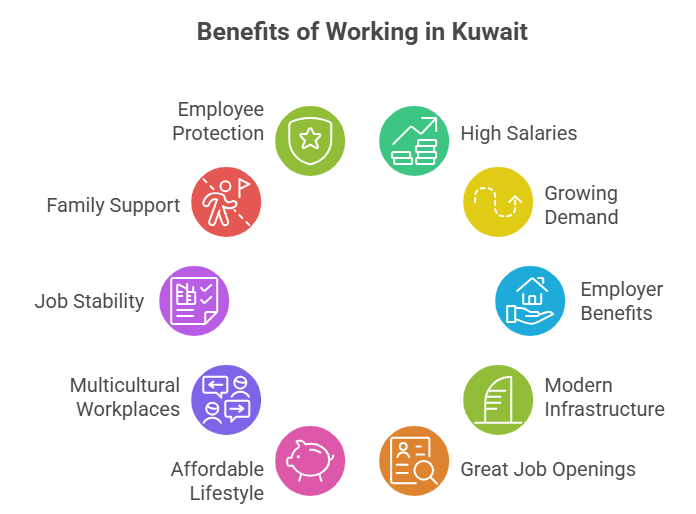
Benefits of Working in Kuwait
- High, tax-free monthly salaries
- Growing demand for skilled professionals
- Employer benefits: housing, transport, flights & medical insurance
- Modern infrastructure and safe living environment
- Strong job openings in IT, oil & gas, healthcare & engineering
- Affordable lifestyle with high savings potential
- Multicultural workplaces and large Indian community
- Renewable work contracts and long-term job stability
- Family visa and dependent sponsorship options (for workers earning KWD 800/month or above)
- Paid annual leave and employee protection under labor laws.
Note — GCC Unified Tourist Visa (Expected 2026): Kuwait and other (Saudi Arabia, the UAE, Qatar, Oman, and Bahrain) GCC member states are developing a unified tourist visa — known as the GCC Grand Tours visa — that would allow holders to visit all six GCC countries on a single visa. Once launched, this would benefit Indian workers based in Kuwait who travel across the Gulf region. Monitor GCC Secretariat announcements for the official launch date.
*Planning to work in Kuwait? Y-Axis can guide you step-by-step.
Why should Indians migrate to Kuwait?
Here are some reasons why Indians should migrate to Kuwait on a work permit:
- Largest Indian community in the Gulf, with approximately 1.1–1.2 million Indians working in diverse sectors.
- The absence of a personal income tax allows for greater savings.
- Kuwait's Vision 2035 (New Kuwait) development plan is creating sustained high demand for Indian professionals. Key projects driving this demand include:
(1) Smart City technology for Kuwait City infrastructure modernisation;
(2) 150+ healthcare infrastructure projects including new hospitals;
(3) Energy diversification — renewables alongside oil;
(4) Financial services expansion including the Kuwait Stock Exchange;
(5) Logistics infrastructure, particularly the Mubarak Al-Kabeer Port development..
- Kuwait's work visa comes with a renewable residency permit sponsored by the employer, creating a long-term employment opportunity.
- Kuwait offers strong, high Gulf-standard salaries with an affordable cost of living for everyday expenses.
IMPORTANT NOTICE — Kuwait Exit Permit Rule (Effective July 1, 2025)
Since July 1, 2025, ALL private sector foreign workers in Kuwait — including 1.1+ million Indians — must obtain employer approval via the Ashal portal (ashal.pam.gov.kw) or the Sahel smartphone app before leaving Kuwait, including for routine annual leave travel to India.
- How to apply: Log in to the Ashal portal or Sahel app and submit an exit permit request to your employer.
- Multi-Trip Exit Permit — Now Available From July 1, 2026, multi-trip exit permits are operational. Indian workers can now acquire a single permit covering multiple exits and re-entries within a defined period, instead of applying separately for every trip.
- Key points:
- Apply via the Sahel app (individuals) or Ashal portal (company HR)
- Employer permission is still required unless your employer has enabled automatic pre-approval
- Dependents not required exit permits — primary worker only required
- Apply a few days prior to your travel date
- If employer denies: Workers may file a complaint with the Public Authority for Manpower (PAM) at pam.gov.kw.
IMPORTANT NOTICE — Indian Embassy Kuwait: Services Suspended July 11–19, 2026
The Embassy of India in Kuwait has suspended all routine passport and consular services from July 11 to July 19, 2026.
Only these emergency services are available — between 9:00 AM and 12:00 PM only, with documented proof of urgency:
Tatkal passport applications
Emergency Certificates
NRI certificates for expiring Civil IDs
All routine services resume on July 19, 2026.
The Kafala System — Essential Reading for Indian Workers in Kuwait
The kafala (sponsorship) system is the foundational legal framework governing all foreign worker employment in Kuwait. Understanding it before accepting a job offer is essential.
What kafala means: Your work visa and residency (Iqama) are legally tied to your sponsor (employer). You cannot change jobs or leave Kuwait without employer consent under standard conditions.
Job change process: To transfer to a new employer, you require either a formal sponsor release from your current employer or approval from the Ministry of Interior. Leaving without release can result in a ban.
Iqama renewal: Your residency permit must be renewed every 1–3 years, and renewal depends on your employer maintaining your sponsorship.
Exit permits: Since July 2025, employer approval via the Ashal portal is required before you can leave Kuwait (see Exit Permit section below).
Employer obligations: Employers are prohibited from using an expat worker for purposes other than the role they were originally recruited for (Amiri Decree No. 114/2024).
If your employer violates your rights: File a complaint with the Public Authority for Manpower (PAM) — pam.gov.kw. The Indian Embassy Kuwait helpline is also available for emergency assistance.
Also, read...
Kuwait Launches New E-Services to Simplify Visa and Residency Transfers for Immigrants
Kuwait Work Visa
A Kuwait Work Visa allows foreign professionals including Indians to legally live and work in Kuwait under the sponsorship of an employer. Most companies manage the visa process and provide supporting documents. The visa is usually issued before travel and becomes valid once the employee arrives in Kuwait and completes residency formalities.
Work visas are typically linked to one employer and can be renewed as long as employment continues.
Types of Kuwait Work Visas
- Private Sector Work Visa: This visa is issued to foreign professionals hired by private companies in Kuwait. The employer must sponsor the applicant, request a work permit, and complete all legal paperwork. Most Indian expats in Kuwait work under this visa. It allows long-term employment and can be renewed every year.
- Government Work Visa: This visa is for individuals working in Kuwait’s public-sector organizations, ministries, or government-run institutions. The hiring process is handled directly by government authorities, and employees receive benefits based on public-sector rules.
- Project Visa: Issued to workers employed on government-approved or contract-based projects such as construction, infrastructure, or oil & gas. The visa remains valid only for the duration of the assigned project. Switching employers usually requires government permission.
- Dependent Visa (Family Visa): This visa allows expat workers to sponsor immediate family members, such as a spouse and children, to live in Kuwait. The primary applicant must meet the minimum income requirement and hold a valid residency permit (Civil ID). Dependents cannot work unless they receive their own work visa.
- Business Visa: A short-term entry visa for foreign nationals visiting Kuwait for business meetings, negotiations, corporate training, or trade-related activities. It does not allow paid employment, and applicants must leave before the visa expires.
- Temporary Work Visa: Issued for short-term or seasonal employment, often lasting up to 90 days. It may be used for urgent company requirements, consultancy assignments, or temporary labor needs. Extension depends on employer approval.
- Kuwait Freelance Residency Permit (2026): Announced in February 2026 by Kuwait's First Deputy Prime Minister, this new permit allows skilled freelancers and independent consultants to work in Kuwait without a kafala employer sponsor. Key details: annual fee of KD 750–1,000; targets skilled freelancers and consultants; full regulations are pending official launch. This is the most significant Kuwait immigration development of 2026 for independent professionals.
- Kuwait 15-Year Investor Residency (2026): Announced on June 15, 2026, Kuwait's long-term investor residency allows eligible foreign investors and their immediate families to obtain residency in Kuwait for up to 15 years. This is Kuwait's most significant long-term residency pathway for high-net-worth individuals and represents a major shift from the standard employer-tied Iqama system. Unlike the kafala-based work visa, this residency is tied to the investor's financial commitment rather than an employer sponsor. Full eligibility criteria, investment thresholds, and application procedures are subject to official gazette publication — Indian investors interested in this pathway should contact Y-Axis for the latest guidance as regulations are finalised.
Note (July 2026): Freelance Residency Permit regulations are pending official publication. Monitor pam.gov.kw for the official launch announcement.
Also, read...
Kuwait to Launch New Freelance Visa for Foreign Workers – Check If You Qualify!
What is the Eligibility Criteria for Kuwait Work Visa
To apply for a Kuwait work visa, you must hold a relevant degree in high-demand fields such as engineering, healthcare, IT, or construction, along with professional work experience. Employers also prioritize candidates with Gulf experience, while a clean background record (PCC) is mandatory for all applicants.
| Category | Details |
|---|---|
| Ideal Candidate Profile | Civil/Mechanical/Electrical Engineers, Healthcare Professionals (Doctors, Nurses), IT Professionals, Accountants, Teachers, and Skilled Tradespeople in oil & gas and construction sectors. |
| Education Requirements | Bachelor's degree in a relevant field for professional roles. Diploma or vocational certification accepted for skilled or technical trades. The degree must be attested by the Ministry of External Affairs (MEA) in India and the Kuwaiti Embassy. |
| Work Experience | Minimum 2–3 years of experience preferred for professional roles. Oil & gas and healthcare sectors may require 5+ years of relevant experience. |
| Language Requirements | English is the primary working language for most professional and corporate roles. Arabic language skills are an added advantage, especially in government-linked jobs. No formal language certification is typically required. |
Also, read...
Kuwait Introduces Multiple-Trip Exit Permits for Foreign Workers – Check Your Eligibility Now!
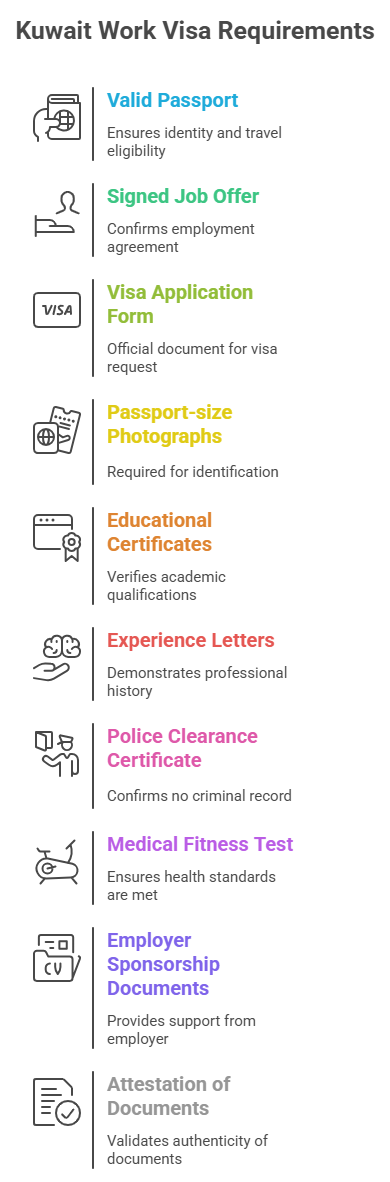
Kuwait Work Visa Requirements
- Valid passport
- Signed job offer or employment contract
- Completed visa application form
- Passport-size photographs
- Educational qualification certificates
- Professional experience letters
- Police clearance certificate
- Medical fitness test results
- Employer sponsorship documents
- Attestation of required documents
How to Apply for a Kuwait Work Visa
Step 1: Secure a confirmed job offer from a Kuwait-based employer
Step 2: Employer applies for work authorization through Kuwait’s Ministry of Interior.
Step 3: Complete medical tests and gather required documents.
Step 4: Submit visa application at the Kuwait Embassy or VFS center.
Step 5: Wait for application review and processing.
Step 6: Receive visa approval and travel to Kuwait.
Step 7: Employer arranges residency stamping and issues Civil ID after arrival.
Processing Time for Kuwait Work Visa
The processing time for a Kuwait Work Visa usually ranges from 2 to 8 weeks. However, the duration can vary based on several factors, such as how quickly the employer receives government approval, how fast medical tests and police clearance are completed, and the workload at the Kuwait Embassy or VFS center. Delays may occur if documents are missing, incorrect, or require extra verification. Applying early, keeping documents ready, and staying in touch with the employer can help speed up the visa process.
| Stage | Estimated Time |
|---|---|
| Employer obtains work permit approval (MOCI) | 2–4 weeks |
| Medical fitness test & Civil ID registration through PACI (post-arrival in Kuwait) | 1–2 weeks |
| Visa stamping at Kuwaiti Embassy in India | 1–2 weeks |
| Total Estimated Processing Time | 4–8 weeks |
India-specific total timeline: From Kuwait employer offer to Indian worker's arrival in Kuwait: approximately 8–16 weeks, including MOCI approval, medical fitness tests, embassy visa stamping, and Indian travel document preparation.
What is the cost of Kuwait Work Visa
The total cost of a Kuwait Work Visa can differ based on the applicant’s country of residence, employer policies, and document requirements.
| Fee Component | Estimated Cost |
|---|---|
| Kuwait work visa stamping fee | ₹3,000 – ₹5,000 |
| Document attestation (MEA + Embassy) | ₹2,000 – ₹5,000 |
| Medical fitness test (India) | ₹1,500 – ₹3,000 |
| Police Clearance Certificate (PCC) | ₹500 – ₹1,000 |
| Iqama (residency permit) fee – paid in Kuwait | KWD 30–70 (~₹8,000 – ₹19,000) |
| Total Estimated Cost | ₹10,000 – ₹25,000 |
Note: Some applicants may also require to spend extra on translations, passport renewals, or travel for document submission.
Job Market in Kuwait
Kuwait offers strong job opportunities for skilled professionals in oil & gas, engineering, healthcare, construction, finance, and IT sectors. The country’s economy is highly dependent on foreign workers from countries including India. Additionally, the Kuwait's Vision 2035 plan also targets major infrastructure projects, creating high demand for foreign professionals.
Also, read...
Kuwait Job Market: Trends and Opportunities
Top Jobs in Kuwait for Indians
Kuwait has a strong and growing job market, especially for Indian professionals with the right skills and experience. Many industries are expanding due to infrastructure development, digital transformation, and demand for specialized workers. Employers in Kuwait regularly hire foreign talent and often provide visa sponsorship, good salaries, and additional benefits. Skilled workers in IT, engineering, healthcare, construction, finance, hospitality, and logistics have excellent job opportunities and long-term career growth in the country.
| Industry | Job Roles |
|---|---|
| IT & Software | Developers, Cloud Engineers, Cybersecurity, IT Support |
| Oil & Gas | Petroleum Engineers, Drilling Crew, Safety Officers |
| Engineering | Mechanical, Civil, Electrical, Project Engineers |
| Healthcare | Doctors, Nurses, Lab Technicians, Pharmacists |
| Construction | Site Engineers, Supervisors, Technicians |
| Hospitality | Chefs, Hotel Staff, Guest Relations, Housekeeping |
| Logistics | Drivers, Warehouse Assistants, Supply Chain Staff |
| Finance & Business Services | Accountants, HR, Admin & Sales Executives |
Also, read...
In-demand Job Opportunities in Kuwait
The salaries of foreign skilled workers in Kuwait are tax-free, which increases their annual take-home income.
The table below shows the salaries of foreign professionals by work experience.
| Experience Level | Average Salary (KWD / Year) | Approx. Salary (INR / Year) |
|---|---|---|
| Entry-Level | KWD 3,600 – 6,000 | ≈ ₹11–₹19 LPA |
| Mid-Level | KWD 7,200 – 12,000 | ≈ ₹22–₹37 LPA |
| Senior-Level | KWD 15,000 – 24,000+ | ≈ ₹47–₹74 LPA |
Note: 1 KWD ≈ INR 308–311 as of July 2026. Verify current rate before financial planning.
Note: The average income of foreign skilled workers in Kuwait also includes additional benefits such as housing allowances, transport coverage, and even annual flight tickets to the home country.
Dependent benefits for Kuwait work visa holders
Dependents like children and spouses of Kuwait work visa holders can benefit in the following ways:
| Category | Details |
|---|---|
| Dependent Benefits | Spouses and children can accompany the main applicant through the family visa (dependent Iqama) sponsorship process, provided the applicant meets the minimum salary requirement of KWD 800/month. Workers earning below KWD 800/month are barred from sponsoring a spouse or children. |
| Family / Spouse Work Rights | A separate work permit and employer sponsorship is required for the spouse to take up employment. |
| Children's Education | Children of Kuwait work visa holders can attend private or Indian CBSE-affiliated schools in the country. School fees are partially covered by the employer. |
| Family Financial Support | Many employers provide housing and transport allowances as part of the salary package, which helps support family expenses. |
Kuwait Permanent Residence (PR) Pathways
Indian professionals can live and work in Kuwait on renewable work visas (Iqama) tied to their employer sponsorship.
| Category | Details |
|---|---|
| Permanent Residency (PR) | Residency is tied to employment and must be renewed periodically through employer sponsorship. |
| Citizenship / Naturalisation | Naturalisation is possible after 30 years of continuous legal residence. |
| Special Pathways | Kuwait introduced a Civil ID residency system for long-term foreign residents. Certain high-net-worth investors may explore long-term stay options. |
| PR Eligibility Timeline | Existing work visa holders must renew their Iqama every 1–3 years depending on their employment contract and employer's sponsorship status. |
Kuwait New Foreigners' Residency Law: Key Changes for Indian Workers
On November 28, 2024, Kuwait replaced its 1959-era residency law with Amiri Decree No. 114/2024. The following changes apply to all expat workers, including Indians:
| Change | What It Means for Indian Workers | Effective Date |
|---|---|---|
| Employment-based residency capped at 5 years per term | Residency must be renewed after 5 years; long-term workers should plan renewals proactively. | Nov-24 |
| Mandatory health insurance — KWD 100/year | Residency will not be issued or renewed without valid health insurance proof. | Nov-24 |
| Maximum absence from Kuwait: 6 months (domestic workers: 4 months) | Staying outside Kuwait for more than 6 months may result in residency cancellation. | Nov-24 |
| Anti-visa-trading penalties | Using or facilitating illegal visa trading is now a criminal offence. | Nov-24 |
| Employer restricted from using expat outside recruited role | Employers cannot assign workers to roles different from those on the visa. | Nov-24 |
Kuwait Worker Rights and Employer Obligations
Indian workers making life-changing employment decisions in Kuwait should understand the following rights before signing any contract:
- PAM complaints: If your employer violates your rights, file a complaint with the Public Authority for Manpower (PAM) — pam.gov.kw
- Contract review: Before signing, verify job title, salary in KWD, working hours, accommodation terms, and annual leave entitlement match exactly what was verbally promised.
- Employer release for job transfer: You have the right to request a formal release from your employer to transfer to a new sponsor.
- Prohibited employer practices under Decree 114: Employers cannot deploy you outside your contracted role or use your visa for third-party assignments.
- Indian Embassy Kuwait Helpline: For emergencies, contact the Embassy of India in Kuwait — available 24/7 for distressed Indian nationals.
How Y-Axis Can Help You
As India’s leading overseas career expert, Y-Axis provides:
- Resume Marketing Services to find a suitable job in Kuwait
- Complete Kuwait Work Visa Assistance
- Document preparation & guidance
- Medical test and PCC support
- End-to-end application processing
- Interview readiness and career consulting
Y-Axis snapshot
1M
Successful applicants
1500+
Experienced counselors
25Y+
Expertise
50+
Offices
Don't know what to do ?
Get Free Counseling
Looking for Inspiration
Explore what Global Indians have to say about Y-Axis in shaping their future