


Don't know what to do ?
Get Free Counseling
Last Updated 05 September 2026
China Job Market
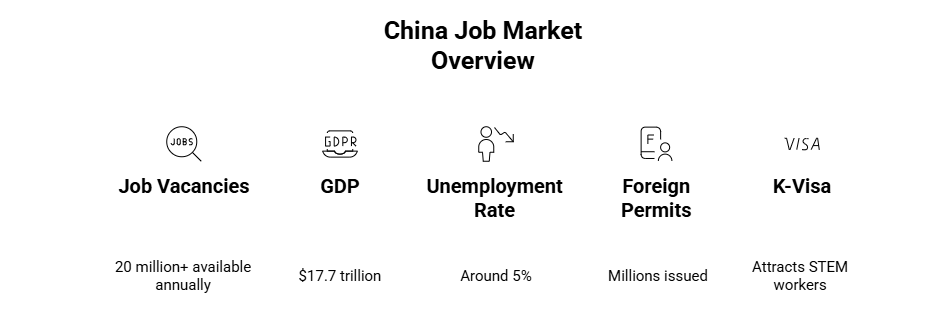
- Over 20 million job vacancies are available across various sectors annually
- China's GDP reached $20.01 trillion in 2025 (National Bureau of Statistics), making it the second-largest economy in the world. GDP growth target for 2026 is 4.5–5%
- The unemployment rate has stayed around 5% in recent years
- Millions of work permits and residence permits have been issued to foreign professionals
- China's new K-Visa attracts young STEM professionals and researchers as it requires no employer sponsorship, allows multiple entries, and covers research, entrepreneurship, and related activities
*Planning to work abroad? Y-Axis will guide you step-by-step.
Job Outlook in China
Understanding the job outlook for job seekers and employers
China has one of the world’s most dynamic and fast-growing job markets, offering strong opportunities for skilled foreign professionals. The country continues to attract global companies and foreign investment, creating stable employment opportunities across advanced industries. China is known for its strong infrastructure, modern lifestyle, innovative technology sector, and large-scale industrial ecosystem. With rising demand for STEM professionals, IT experts, teachers, engineers, and healthcare workers, China provides excellent career growth for skilled workers.
General employment trends for the year
China's employment landscape is evolving rapidly in 2026. The government has set a target of creating more than 12 million new urban jobs this year (State Council, Q1 2026). Key growth sectors include AI, EV manufacturing, green energy, high-tech manufacturing, and healthcare. High-tech manufacturing grew 9.4% year-on-year in 2025; IT and software services grew 11.1% (National Bureau of Statistics). Hiring is becoming more selective — white-collar roles require specific, demonstrable technical skills. Beijing and Shanghai raised minimum salary thresholds for foreign work permits by approximately 50% in February 2026, meaning only skilled professionals with market-rate offers now qualify easily. Salary growth in 2025 averaged 4.1% for frontline workers, while technical specialist roles saw stronger differentiated increases.
Factors influencing job creation or reduction
Job creation in China is influenced by economic growth, global trade demand, digital innovation, new technologies, and government policies. Factors like international trade agreements, AI expansion, semiconductor development, EV production, and infrastructure projects drive job growth. On the other hand, automation and economic slowdowns may reduce demand for low-skilled roles. The shift toward high-tech industries increases opportunities for skilled foreign workers.
*Want to work in China? Sign up with Y-Axis for end to end assistance.
In-Demand Industries and Occupations in China
China’s fast-growing economy creates strong demand for skilled professionals across multiple industries. With rapid development in technology, engineering, manufacturing, healthcare, and education, many sectors face a shortage of qualified workers. Foreign professionals with the right skills, experience, and qualifications can find excellent career opportunities and competitive salaries. The table below highlights the top in-demand occupations and their average annual salary ranges.
|
Occupations |
Salary (annually) |
|
Engineering |
180,000 – 300,000 CNY |
|
IT & Software |
200,000 – 350,000 CNY |
|
Marketing & Sales |
220,000 – 350,000 CNY |
|
Human Resource Management |
180,000 – 260,000 CNY |
|
Healthcare |
200,000 – 320,000 CNY |
|
Teachers |
360,000 CNY |
|
Accounting & Finance |
250,000 – 380,000 CNY |
|
Manufacturing & Industry |
150,000 – 250,000 CNY |
|
Nursing & Medical Support |
140,000 – 220,000 CNY |
*Want to apply for China work visa? Let Y-Axis assist you with the process.
Job Vacancies in China
China continues to generate large-scale job opportunities due to rapid industrial expansion, digital transformation, and government-led development programs. Key sectors such as manufacturing, IT, artificial intelligence, healthcare, construction, and logistics are driving employment growth.
National initiatives including China's 15th Five-Year Plan (2026–2030), smart city development, high-speed rail expansion, low-altitude economy programmes, and advanced manufacturing projects are creating millions of jobs across major cities and industrial zones. These programs are increasing demand for skilled professionals, including engineers, IT specialists, and healthcare workers. The below table shows the estimated number of job openings in China by 2030:
|
Occupation |
Estimated number of Job by 2030 |
|
Healthcare |
2,000,000 |
|
Nursing |
1,500,000 |
|
Manufacturing |
2,200,000 |
|
IT & Software |
1,200,000 |
|
Engineering |
1,000,000 |
|
Construction |
1,400,000 |
|
Logistics & Supply Chain |
900,000 |
|
Teaching & Education |
800,000 |
|
Accounting & Finance |
600,000 |
What Can Foreign Professionals Expect to Earn in China?
Salaries for foreign professionals in China vary significantly by city, sector, and experience level. Tier-1 cities (Beijing, Shanghai, Shenzhen) pay 50–80% above the national average.
|
Sector |
Average Annual Salary for Foreign Professionals (CNY) |
|
IT & Software (Senior) |
400,000 – 1,000,000 CNY |
|
Engineering (Mid–Senior) |
300,000 – 600,000 CNY |
|
Finance & Accounting |
350,000 – 700,000 CNY |
|
Healthcare (Hospital/Research) |
300,000 – 550,000 CNY |
|
International School Teaching |
180,000 – 360,000 CNY |
|
Marketing & Sales (MNC) |
280,000 – 500,000 CNY |
|
AI / Data Science |
450,000 – 1,200,000 CNY |
Average across all foreign workers in China: approximately CNY 350,000/year (Source: HiredChina, 2025–2026 data). Note: Beijing and Shanghai raised Category B work permit salary thresholds to approximately CNY 47,748/month in February 2026 — this is now the effective minimum for most professional roles in those cities.
Workforce Demand in China
Examination of the job market in China
China’s job market is vast and diverse, offering strong opportunities for skilled professionals across major cities like Beijing, Shanghai, Shenzhen, Guangzhou, and Hangzhou. Each city specializes in different economic sectors such as finance, IT, manufacturing, research, logistics, EV technology, robotics, education, and international trade. These industries create a strong demand for foreign workers with technical expertise, English skills, and global experience.
Top cities Providing Excellent Career Opportunities
Cities such as Beijing, Shanghai, Shenzhen, Guangzhou, Tianjin, and Suzhou offer high-paying roles across IT, engineering, AI, healthcare, teaching, manufacturing, finance, HR, marketing, and logistics. China’s focus on innovation, R&D, green energy, EV technology, and advanced manufacturing creates a continuous demand for skilled professionals. The multicultural work environment and strong economic growth attract foreign talent, especially in STEM fields.
Impact of Technology and Automation in China
Technological advancements and automation shaping the job market
China is a global leader in technology, robotics, AI, machine learning, and industrial automation. These advancements are reshaping the workforce and creating new job opportunities in IT, engineering, smart factories, semiconductor manufacturing, and energy sectors. Automation increases productivity and creates high-value job roles requiring analytical, technical, and problem-solving skills. China’s heavy investment in innovation allows foreign workers to access advanced tech industries.
Potential opportunities and challenges in the evolving landscape
Technology-driven industries offer huge opportunities for skilled workers in AI, big data, cloud, EV technology, manufacturing, healthcare, and STEM. China’s strong infrastructure and global trade position attract international talent. However, workers must continuously reskill and upskill to match the fast-evolving job environment. Foreign workers with strong technical, digital, and engineering skills have a clear advantage in securing high-paying roles.
Also, read...
What are the eligibility requirements for China work visa?
Skills In-Demand in China
Key skills sought by employers in China
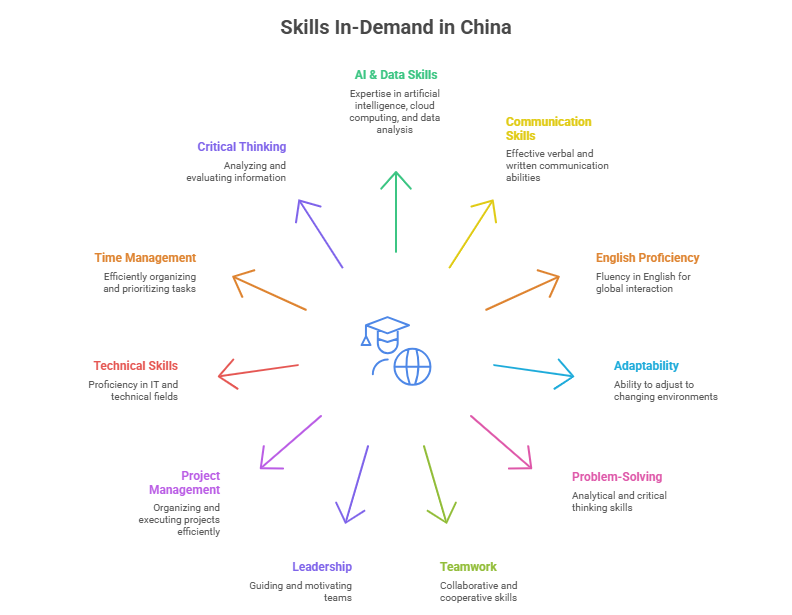
- Digital literacy
- AI, cloud, and data-related skills
- Communication skills
- English language proficiency
- Adaptability and flexibility
- Problem-solving and analytical skills
- Teamwork and collaboration
- Leadership skills
- Project management
- Technical and IT skills
- Time management
- Critical thinking
Why Continuous Learning Matters for Job Seekers?
Job seekers need continuous upskilling due to rapid technological changes, automation, and industry innovation. Learning new tools, gaining certifications, and improving language skills increases employability. Upskilling helps workers stay competitive, while reskilling allows them to shift to high-demand careers. Constant learning supports job stability, better career growth, and long-term success in a fast-changing job market.
Also, read...
Is a job offer mandatory for China work visa
How Flexible Work Benefits Companies and Employees in China?
Remote and hybrid work models are growing quickly across sectors like IT, education, digital marketing, and customer support. These flexible arrangements help employees manage work–life balance while giving companies access to global talent. Many employers use hybrid systems to improve productivity and reduce operational costs. For workers, flexible schedules lead to higher efficiency, better job satisfaction, and more international job opportunities. These modern work models also support inclusion, mental well-being, and stronger global collaboration, making them beneficial for both employees and organizations.
China’s New K-Visa Policy and Talent Recruitment Initiatives
The introduction of the China K-Visa has become a major part of the country’s strategy to attract highly skilled foreign professionals. This visa is designed for experts in fields like AI, engineering, IT, robotics, EV technology, and scientific research. The policy offers easier work visa approvals, faster processing, and smoother pathways to long-term residence. Along with the K-Visa, talent-friendly zones, simplified residency rules, and supportive government programs encourage global professionals to work and settle in China. These initiatives boost innovation, create new jobs, and strengthen the country’s position as a leading destination for skilled international talent.
Also, read...
What are the fast-track hiring options in China for skilled professionals
China's New K-Visa Policy and Talent Recruitment Initiatives
China launched the K-Visa on October 1, 2025, under State Council Order No. 814 — a landmark change to the country's foreign talent strategy. Unlike the existing Z visa (work visa), the K-Visa requires no employer sponsorship or local invitation letter, removing the biggest entry barrier for foreign professionals.
Who is eligible:
- Young professionals with at least a bachelor's degree in a STEM field (science, technology, engineering, mathematics) from a recognised university or research institution
- Researchers and academics in related teaching or research roles
- Early-career entrepreneurs in STEM-adjacent fields
Key benefits over the Z visa:
- No employer sponsorship required — enter China first, then search for jobs, conduct research, or start a business
- Multiple-entry visa with longer validity and extended stay periods
- Access to tax incentives and grants in designated talent zones
- Holders can switch employers freely, unlike the standard Z visa which ties the holder to a specific employer
Current status (2026): Seven months since launch, the K-Visa is operational across major Chinese embassies and consulates. Early data shows K-Visa holders often secure salaries 10–15% higher than Z-visa applicants, partly due to their bargaining position as pre-screened talent. The visa sits alongside China's existing R-Visa (high-level specialists, requires sponsorship) and Z-Visa (standard work visa). Source: State Council; National Immigration Administration; China Briefing.
Work Permit and Visa Requirements for Foreign Professionals in China
Foreign professionals need a valid work permit and residence permit to work legally in China. The main route is the Z Visa (work visa), which requires employer sponsorship. From 2026, salary thresholds for work permits have been updated significantly.
|
Permit Category |
Who It Is For |
2026 Minimum Monthly Salary (Beijing) |
|
Category A |
High-end foreign talent, including executives, top researchers, and individuals with exceptional skills |
CNY 71,622/month |
|
Category B |
Skilled professionals, including engineers, IT specialists, healthcare workers, and management personnel |
CNY 47,748/month |
|
Category C |
Other foreign workers under quota-based or skill-based categories |
Set by local quota requirements |
|
K-Visa |
Young STEM professionals who do not require employer sponsorship |
No fixed salary threshold – market rate applies |
Key requirements for a standard Z-Visa work permit:
- Minimum bachelor's degree in a relevant field
- Minimum 2 years of relevant work experience (waived for K-Visa holders and some top university graduates)
- Valid employment contract from a registered Chinese employer
- Criminal background check (PCC from India)
- Health certificate
- Employer must hold a valid foreign expert hiring licence
Note on English teaching: Since 2021, strict regulations apply to foreign English language teachers. A TEFL/TESOL certificate and a bachelor's degree are the minimum; qualified teacher status from your home country is required for many school roles. Verify current requirements before applying.
Also, read...
Can I convert my China work visa to permanent residency?
Tips to help you find the right Job in China
- Create a clear, skills-focused China-style CV
- Improve your English and basic Mandarin
- Gain certifications in in-demand skills
- Build a professional network online
- Keep learning and upgrading skills
- Research employers and job roles
- Prepare for virtual interviews
- Maintain a strong LinkedIn presence
- Learn conversational Mandarin to expands your job options outside the K-Visa and MNC sectors
- Check current work permit salary thresholds for your target city before accepting offers.
Summary of China Job Outlook
China’s job outlook is highly promising, offering excellent opportunities for skilled professionals across IT, engineering, education, manufacturing, finance, HR, healthcare, and logistics. The country provides strong career growth, competitive salaries, world-class infrastructure, and a high standard of living. With its $20 trillion economy, advanced technology, government-backed talent programmes including the K-Visa, and rising demand for skilled foreign professionals, China is one of the strongest destinations for Indian professionals in IT, engineering, healthcare, and education looking to build a global career.
*Looking for jobs in China? Talk to Y-Axis for expert guidance.
Don't know what to do ?
Get Free Counseling
Looking for Inspiration
Explore what Global Indians have to say about Y-Axis in shaping their future