


Don't know what to do ?
Get Free Counseling
Last Updated 24 July 2026
China Work Visa for Indians Z Visa (Employer-Sponsored) | K Visa (STEM — No Job Offer Required) | R Visa
China is one of the world’s fastest-growing economies and a global leader in manufacturing, technology, engineering, and innovation. The country offers high-paying jobs, advanced infrastructure, and strong career opportunities for foreign professionals. With rapid development in IT, AI, robotics, automotive engineering, and international trade, China actively recruits international talent, including skilled workers from India.
China plans to create over 12 million new urban jobs in 2026, but the country is facing a major shortage of skilled professionals. It is expected that China will lack around 30 million skilled professionals in key manufacturing sectors in 2026. To attract global talent, China introduced the “K-Visa for Talent” in October 2025, which allows young STEM professionals to enter the country without a job offer. Skilled foreign professionals can earn between ¥300,000 and ¥1,000,000 per year and may also receive benefits such as housing support, research grants, health insurance, and education support for children. China plans to become a major global destination for scientific and technical talent by 2030.
China also provides modern cities, an efficient transport system, and excellent workplace benefits. English-speaking jobs are increasing in multinational companies, making it easier for foreign workers to build a successful career.
Capital: Beijing | Population: 1.4 billion | Language: Mandarin (English spoken in workplaces & MNCs)
Jump to: Z Visa | K Visa | Visa Types | Requirements | Jobs | Salaries | Companies | Apply | Processing | Cost | PR | FAQs
Benefits of Working in China
- Strong global economy and high-paying job roles
- Modern cities with world-class infrastructure
- Huge demand for skilled foreign workers
- Fast-growing sectors: IT, engineering, manufacturing, AI, education
- Opportunity to work with global companies
- Clear work visa process, especially with the new China K-Visa
- Pathway to long-term residence for skilled talent
- Excellent public transport, safety, and lifestyle
- Career growth, international exposure, and competitive salaries
China Work Visa
To work legally in China, foreign nationals must obtain a China Work Visa (Z Visa). The China Work Visa (Z Visa) is a single-entry entry visa issued by a Chinese embassy or consulate to foreign nationals who have a confirmed job offer from a Chinese employer and an approved Work Permit Notification. Before applying for the Z Visa, the Chinese employer must apply for and secure an official work permit on behalf of the applicant — this process is generally managed by the employer in China.
The Z Visa allows entry into China. It is not, by itself, authorisation for long-term stay or employment.
China K-Visa
The China K-Visa is designed to attract highly skilled foreign professionals, including experts in IT, engineering, AI, R&D, healthcare, and advanced manufacturing. While the Z Visa remains mandatory for standard employment, eligible professionals may benefit from faster processing and easier residence permit conversion under the K-Visa route.
Who can apply for the China K-Visa?
The China K-Visa (launched October 1, 2025, under State Council Order No. 814) is a new talent visa for young STEM professionals that allows entry into China without a job offer or employer sponsorship. To be eligible, applicants should have:
- At least a bachelor's degree in a STEM field — computer science, AI, engineering, data science, robotics, biotechnology, mathematics, physics, or electrical/mechanical/chemical engineering
- Early-to-mid career standing in a STEM profession
- No employer sponsorship or job offer required
- Intent to pursue work, research, entrepreneurship, or employment exploration in China
Applications are submitted through the COVA (China Online Visa Application) system — not through an employer-led process.
Benefits of the K-Visa
- Faster approval process
- Longer permitted stay
- Easier residence permit conversion
- Priority for skilled workers
- Opportunities to work in China’s tech and innovation sectors
Applying for China K-Visa: COVA System Guide
The K-Visa is applied for through the China Online Visa Application (COVA) system, not through an employer. The typical process is:
Step 1: Visit the official COVA portal and create an applicant account
Step 2: Complete the digital application form
Step 3: Upload your STEM degree transcript and certificate, passport, and relevant work samples or publications (if applicable)
Step 4: Submit the digital application and receive confirmation
Step 5: Attend in-person biometric verification at your nearest CVASC in India (New Delhi, Mumbai, or Kolkata)
Step 6: Await your visa decision — K-Visa applications typically receive priority processing
Types of China Work Visas
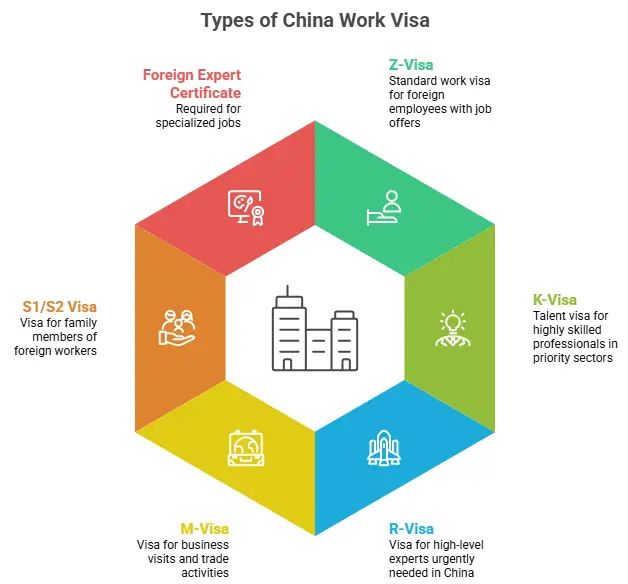
China offers different visa types based on the nature of work, skill level, and purpose of stay. Among these, the Z Visa is the primary visa required for foreigners entering China for employment, while other visa types support talent mobility, business activities, and family reunification.Z-Visa (Standard Work Visa): For foreign employees with a job offer in China
- K-Visa (Talent Visa): For highly skilled professionals in priority sectors
- R-Visa: For internationally recognised high-level experts — typically requiring internationally recognised awards or certifications (comparable to top-tier global recognition in their field), senior academic positions at globally ranked institutions, or annual income meeting Chinese government thresholds. Unlike the K-Visa, which targets early-career STEM graduates, the R-Visa is intended for individuals at the top of their field globally.
- M-Visa: For business visits and trade activities
- S1/S2 Visa: For family members of foreign workers
Note: A Foreign Expert Certificate is not a visa — it is a work permit category issued inside China after arrival, for specialised positions. After arrival, some foreign experts may apply for a Foreign Expert Certificate as part of their residence and employment registration.
China Employment Visa Requirements
- Valid passport
- Job offer or signed employment contract
- Educational certificates
- Work experience letters
- Passport-size photos
- Proof of accommodation
- Medical examination certificate
- Non-criminal record (police clearance)
- Employer-issued work permit notice
- Health insurance (after arrival)
Major In-Demand Jobs in China
China has one of the largest and fastest-growing job markets in the world. Industries such as artificial intelligence, electric vehicles, renewable energy, advanced manufacturing, and digital services are growing quickly and creating many job opportunities. Technology, finance, biotech, and green energy sectors are also expected to see salary growth of about 8–12% each year, making China an attractive destination for skilled professionals.
The table below shows some in-demand jobs in China and their average yearly salaries.
| Occupation | Average Annual Salary (CNY) | Approx. INR Equivalent (Per Year) |
|---|---|---|
| Software Developers & IT Engineers | ¥350,000 | ≈ ₹38–42 lakh |
| AI / Machine Learning Engineers | ¥500,000–¥800,000 | ≈ ₹55–88 lakh |
| Cybersecurity Specialists | ¥300,000–¥450,000 | ≈ ₹33–49 lakh |
| Nurses & Nursing Care Workers | ¥279,400 | ≈ ₹31 lakh |
| Civil & Mechanical Engineers | ¥120,000–¥180,000 | ≈ ₹13–20 lakh |
| Construction Workers & Supervisors | ¥123,192 (≈ ¥10,266/month) | ≈ ₹13.5 lakh |
| Manufacturing / Automation Engineers | ¥120,000–¥200,000 | ≈ ₹13–22 lakh |
| Data Analysts | ¥150,000–¥280,000 | ≈ ₹16.5–31 lakh |
| English Language Teachers | ¥72,000–¥150,000 | ≈ ₹8–16.5 lakh |
| Hospitality & Food Service Managers | ¥80,000–¥120,000 | ≈ ₹9–13 lakh |
Average Salary Levels in China
Salaries in China depend on experience, industry, job role, and city. People who are new to a job usually earn lower salaries, while professionals with more experience and special skills can earn higher pay. These salary ranges are common in industries such as IT, finance, engineering, manufacturing, healthcare, and logistics. Highly skilled roles like AI engineers, software developers, and senior finance professionals, especially in cities like Beijing and Shanghai, can earn much higher salaries.
| Experience Level | Average Annual Salary (CNY) | Approx. INR Equivalent (Per Year) |
|---|---|---|
| Entry Level | ¥60,000–¥90,000 | ≈ ₹6.6–9.9 lakh |
| Mid Level | ¥100,000–¥200,000 | ≈ ₹11–22 lakh |
| Senior Level | ¥250,000–¥600,000+ | ≈ ₹27.5–66 lakh+ |
Top Jobs in China for Indians
China’s large economy needs skilled workers in multiple global industries. Indian professionals with the right skills can find high-demand, stable careers.
| Industry | Job Roles for Foreign Workers |
|---|---|
| IT & Software | Developers, Testers, Cybersecurity, Cloud Engineers, AI Specialists |
| Manufacturing | Production Staff, Quality Inspectors, Machine Operators |
| Engineering | Mechanical, Electrical, Industrial, Automation Engineers |
| Automotive | EV Engineers, Battery Technicians, R&D Engineers |
| Education | English Teachers, Trainers, University Lecturers |
| Healthcare | Nurses, Analysts, Lab Technicians (where foreign qualification accepted) |
| Logistics & Supply Chain | Warehouse Staff, Supply Chain Coordinators |
| Business & Trade | Account Managers, Marketing Staff, Sales Executives |
*Read more......
What are the Most In-Demand Jobs in China for the Next 10 Years?
Top Companies in China Hiring International Professionals
Many global and Chinese companies hire foreign professionals in sectors such as technology, finance, electric vehicles, biotech, media, and education. These companies often offer competitive salaries, international work environments, and visa sponsorship for skilled workers.
| Company | Industry | Why It Is Good for International Professionals |
|---|---|---|
| Huawei Technologies | Telecom / Technology | A large global tech company that hires foreign professionals in engineering, marketing, communication, and technology roles. |
| Alibaba Group | E-commerce / Cloud / AI | A major technology company that hires international talent in data science, technology, operations, and global business roles. |
| Tencent Holdings | Technology / Gaming / AI | One of China’s biggest tech companies hiring foreign professionals in AI, gaming, product management, and software development. |
| ByteDance (TikTok) | Social Media / Technology | A fast-growing company that hires international staff in engineering, content development, and product roles. |
| BYD Company | Electric Vehicles / Green Energy | A leading electric vehicle company hiring engineers and technical experts in automotive and energy sectors. |
| WuXi AppTec | Biotech / Healthcare | A global biotech company hiring researchers, scientists, and healthcare professionals. |
| Ant Group | FinTech / Digital Payments | A major financial technology company hiring professionals in digital payments, finance, and blockchain technology. |
| SHEIN | E-commerce / Fashion Technology | A fast-growing online fashion company hiring engineers, data scientists, and AI specialists. |
| Microsoft China | Technology / Software | A global technology company hiring foreign professionals in cloud computing, software development, and product management. |
| Apple China | Consumer Electronics / Technology | Offers roles in product development, marketing, retail, and technology teams. |
| Pony.ai | Autonomous Driving / AI | A technology company developing self-driving vehicles and hiring AI and robotics engineers. |
| China Global Television Network (CGTN) | Media / Broadcasting | Offers jobs for foreign writers, reporters, presenters, and translators. |
| Tata Consultancy Services (TCS) China | IT Services / Consulting | A global IT company with operations in China, offering opportunities for IT professionals and consultants. |
| Accenture China | Consulting / IT | A global consulting firm hiring professionals in digital transformation, AI, and cloud technology. |
| VIPKid / Good Future | Education / EdTech | Online education companies hiring teachers and curriculum specialists. |
Steps to Apply for a China Work Permit
Step 1: Secure a job offer with a Chinese employer
Step 2: Employer submits your work permit application
Step 3: Complete medical test and gather documents
Step 4: Apply for the China Z-Visa or K-Visa
Step 5: Receive visa approval and travel to China
Step 6: Register residence after arrival
Step 7: Convert your visa to a work-residence permit

Processing Time for China Work Visa
China’s work visa processing usually takes 2–6 weeks, but the exact time can change based on different factors. The processing speed depends on the type of work permit, whether you apply for a Z-Visa or K-Visa, and how quickly your documents are verified. The location of your employer and the workload at the Chinese Embassy also affect the timeline. K-Visa applicants often receive faster processing because this visa is given priority for highly skilled professionals.
China Work Visa Cost
The cost for a China Work Visa generally ranges from INR 7,000 to 12,000, depending on location and visa type. Additional costs may include:
- Document translation
- Medical exam
- Police clearance
- Courier charges
- Residence permit fee after arrival
Pathway from China Work Permit to Permanent Residency (PR)
Foreign professionals working in China can later apply for long-term residence if they meet eligibility rules. In most cases, applicants must work in China for several years, show stable income, clean records, and employer support.
Highly skilled workers on K-Visa or R-Visa may qualify for faster PR pathways.
China PR allows:
- Long-term stay
- Easy job changes
- Family reunification
- Access to business and investment opportunities
Read more....
Comparing China Work Visa Types: Z Visa vs K Visa vs R Visa
| Criteria | Z Visa | K Visa | R Visa |
|---|---|---|---|
| Job Offer Required? | Yes | No | Usually |
| Employer Sponsorship? | Required | Not required | Usually |
| Target Applicant | All skilled workers with a job offer | Young STEM professionals with a bachelor's degree or higher | Internationally recognised high-level experts |
| STEM Degree Required? | No | Yes, bachelor's degree minimum | No, but an internationally recognised qualification is typically required |
| Processing Speed | Standard (2–4 weeks) | Priority processing | Priority/expedited processing |
| Entry Type | Single-entry; convert to a residence permit within 30 days | Multiple-entry; longer stay | Multiple-entry; priority stay |
| Best Suited for Indian Applicants | Indian professionals with a valid China job offer | Indian STEM graduates in IT, AI, engineering, biotechnology, and related fields | Indian academics, researchers, and senior professionals with international recognition |
How Y-Axis Can Help You
Y-Axis has been providing unbiased, personalized services for 25 years. Our team of experts are here to provide end-to-end assistance to ensure a smooth immigration journey. Our impeccable services include:
- Resume marketing services to find jobs in China
- Complete China Work Visa Assistance
- Help with China K-Visa eligibility
- Document review and verification
- End-to-end application support
- Guidance on settlement and residence permits
Y-Axis snapshot
1M
Successful applicants
1500+
Experienced counselors
25Y+
Expertise
50+
Offices
Don't know what to do ?
Get Free Counseling
Looking for Inspiration
Explore what Global Indians have to say about Y-Axis in shaping their future