


Posted on January 07 2026
What are the new rules for Canada PR?

By , Editor
Updated January 09 2026
The new rules for Canada PR (2026-28) focus on increasing PR admissions and improving the Canadian immigration system. Under the new IRCC Immigration Levels Plan, Canada has set a total of 380,000 PR admission target between 2026 and 28. The PR admission allotment in the new Immigration Levels Plan (2026-28) emphasizes the transition of people who are already in Canada into permanent status. IRCC also plans to streamline the transition process for nearly 115,000 Protected Persons in Canada, in addition to its regular targets, and aims to fast-track the PR transitions of nearly 33,000 temporary workers in 2026–27. The latest Canadian PR rules will also prioritize economic immigration pathways, such as Express Entry and PNP programs, while introducing new community programs for skilled workers in specific rural areas, including the Rural Community Immigration Pilot (RCIP).
*Want to apply for Canada PR? Talk to experts at Y-Axis to guide you with the steps.
New Rules for Canada Permanent Residence (PR)
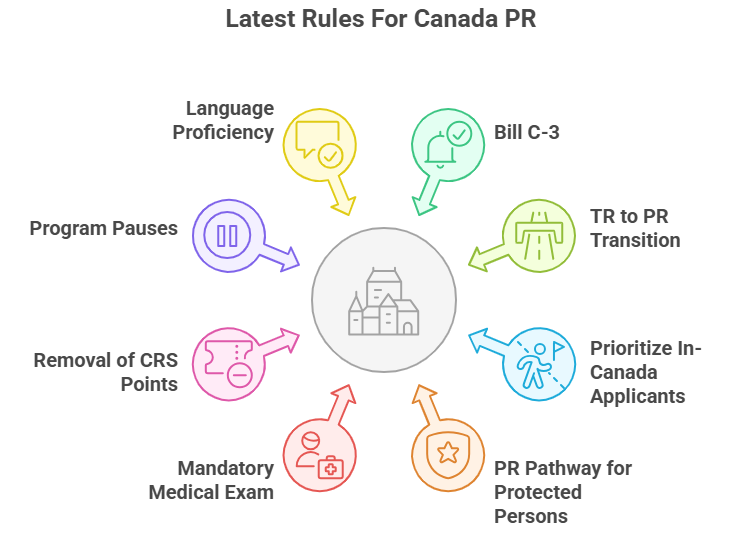
The new rules announced for Canada Permanent residence (PR) are as follows:
- Stabilizing PR admissions: Canada has announced new PR admission targets under the Immigration Levels Plan (2026-28), set at 380,000 per year. The goal is to focus on long-term sustainability.
- Transition of TR to PR for skilled workers: The new PR policies aim to transition nearly 33,000 temporary workers (who are already in the country) to permanent residency in Canada during 2026-2027.
- Prioritizing in-Canada applicants: The updated PR rules will give more priority to transitioning skilled professionals who are already residing and working in Canada, as well as to candidates from abroad.
- Continued demand for Express Entry & PNP: Canadian immigration pathways like Express Entry and Canada PNP will continue to select eligible candidates, both from outside the country and those that are currently in Canada, under various streams.
- PR pathway for Protected Persons: Canada has announced a 2-year initiative (2026-2027) that will focus on streamlining the PR process for 115,000 protected persons in the country, along with established PR targets.
- Exclusion of CRS points for arranged employment: The Comprehension Ranking System (CRS) has eliminated CRS points for arranged employment, which also includes LMIA-supported job offers.
- Mandate Medical Examination Requirement: Candidates applying for the Express Entry program will now be required to undergo a mandatory Independent Medical Examination (IME) before the submission of their PR application, post-receiving an Invitation to Apply (ITA).
- Rural Community Immigration Pilot (RCIP): The RCIP has introduced a new PR pathway for skilled workers in specific rural communities. RCIP applicants must also meet the minimum language requirements, which range from CLB 4 to CLB 6, based on their occupation and the criteria set by the rural Canadian community.
*Want to check your eligibility to Canada? Try the FREE Y-Axis Canada immigration points calculator to get an instant score!
Requirements for Canada permanent residence (PR)
The requirements to apply for Canadian PR depend on the immigration program you choose. To qualify for permanent residence in Canada, you must apply through programs like Express Entry, PNP, Canada PNP, and other pathways, meeting general criteria such as work experience, age, education (ECA), language proficiency (IELTS/CELPIP), proof of funds, and clearing medical and criminal clearance tests. Once you are issued a Canada PR visa, you will be required to meet specific residency criteria, such as residing in Canada for at least 730 days in a total of 5 years, to maintain your PR status.
While the requirements for Canada PR vary based on the immigration program, the general eligibility criteria for most of the Canada immigration programs are as follows:
- Educational qualifications: Must have an ECA (If you have completed your studies from outside Canada), or a recognized Canadian education credential (if done from within Canada)
- Work experience: Most economic PR programs in Canada require prior work experience, typically under NOC TEER 1, 2, or 3; the exact work experience required may vary depending on the immigration program you have selected.
- Language proficiency: PR applicants must submit proof of language proficiency in English or French through tests such as IELTS or CELPIP for English, and TEF/TCF for French.
- Age: While there are no strict age limits to apply for Canada PR, “age” is one of the scoring or ranking factors if you are applying through the Express Entry system, which rewards higher points for younger applicants.
- Funds proof: Proof of sufficient settlement funds is not mandatory for all PR applicants; however, it is required when applying through specific PR programs.
- Medical and criminal tests: Canada PR applicants must undergo a medical examination and have a clean criminal record to be admissible to Canada.
*Are you looking for step-by-step assistance with Canadian immigration? Contact Y-Axis, the world’s No. 1 overseas immigration consultancy, for end-to-end assistance!
FAQs
What are the new rules announced for Canada PR?
New PR rules in Canada focus on targeted pathways for skilled workers in labour shortage sectors, such as healthcare, IT, and engineering. The major changes include the introduction of new Express Entry routes for doctors, the permanent Economic Mobility Pathways Pilot, and an increased provincial focus through applications to the Provincial Nominee Program (PNP). The new policies aim to convert 33,000 temporary workers to permanent residence by 2027. The revised PR policies in Canada are also making adjustments for caregivers and applicants for Post-Graduation Work Permits (PGWPs).
What are the updated PR rules for international students in Canada?
Canada introduced updated PR rules for international students with a primary focus on mandatory Canadian work experience gained through a Post-Graduation Work Permit (PGWP). The candidates can also qualify for programs like the Canadian Experience Class (CEC) to meet the revised policy criteria. The fund requirements and study permit caps are stricter for the upcoming year for CEC candidates, with some leniency shown for Master's/PhD students who have off-campus work hours of 24/week.
The following are the key criteria under the new rules introduced by Canada for international students:
- Qualify for a PGWP
- Work in (TEER 0, 1, 2, 3) skilled jobs.
- Meet language proficiency criteria.
- Apply for Express Entry or PNP.
Is Canada giving PR to Indians now?
Yes, Canada offers permanent residency to Indians through various pathways, including the Express Entry (Federal Skilled Worker) program, Provincial Nominee Programs (PNPs), and family sponsorship. Indian skilled workers are in high demand in various skill-shortage sectors of Canada that face high labour demand. This makes the country seek qualified Indian professionals to work in different job roles, such as engineering, healthcare, and trades, provided they qualify in terms of language proficiency, age limit, and relevant years of work experience.
What is the new TR-to-PR pathway in Canada?
Canada offers a new pathway for foreign workers to convert from temporary residence (TR) to permanent residence (PR). The TR to PR pathway is not a single new program but a collective approach focusing on temporary workers and graduates to PR. New streams for the PR pathway are anticipated for specific skill shortage categories according to the 2026-2028 Immigration Levels Plan. Additionally, existing PR applicants will receive a longer Open Work Permit (OWP) until December 31, 2026, while their PR application is being processed.
What is the minimum bank balance required for a Canada PR?
The minimum bank balance for a Canadian PR depends on the family size and is mostly required for certain PNP programs and the Express Entry program. Submitting proof of funds is not necessary for all Canada PR applicants, like those applying through the Canadian Experience Class (CEC) program or those with work authorization in Canada.
The table below has the list of minimum funds required for Canada PR, while applying through Express Entry:
| Number of family members | Proof of funds |
|---|---|
| 1 | $15,263 |
| 2 | $19,001 |
| 3 | $23,360 |
| 4 | $28,362 |
| 5 | $32,168 |
| 6 | $36,280 |
| 7 | $40,392 |
| If more than 7 people, for each additional family member | $4,112 |
What are the new Express Entry changes for Canada PR applications?
Canada Express Entry pathway observed significant changes with the introduction of new rules for permanent residence in the country. Extra points were removed for LMIA-supported job offers to create a sense of fairness among applicants and reduce fraud. The focus shifted to category-based selections targeting specific skilled workers in sectors such as healthcare, trades, IT, and engineering. Additionally, high language proficiency has been made mandatory through the TOEFL as an accepted English test.
What is the revised work experience requirement for Canada PR applicants?
The work experience requirements for different programs have not been revised under the new rules introduced for permannet residency in Canada. The updated policies emphasize Canadian work experience for specific categories, such as healthcare and pharmaceuticals. However, employers in Ontario cannot look for professionals with Canadian work experience in job posting apps to encourage newcomers to apply in the Canadian job market. Most economic immigration programs through Express Entry which ask for work experience in specifically designated TEER (0, 1, 2, 3) categories, have remained unchanged.
How will the new Canada PR rules impact spousal sponsorship eligibility?
The new rules for Canada PR focus on stricter scrutiny of the relationship to verify authenticity. The revised policies for permanent residence of spouses in Canada have more stringent open work permit (OWP) eligibility criteria for partners with enhanced sponsor obligations. This means that the new spousal application for PR needs solid proof of a partner relationship and enhanced financial support. Under the updated policies, the in-Canada applicants will be given more priority for family reunification.
Will Canada PR processing times change under the revised immigration rules?
The processing time for Canada permanent residence will change under the revised rules for the upcoming year. Candidates through Express Entry are expected to receive faster approval for PR, while other pathways, such as Base PNP or Family Sponsorship, take longer. IRCC will focus on clearing backlogs in Express Entry and aligned Provincial Nominee Programs (PNPs) from last year, aiming for 100% inventory clearance for specific streams. The overall processing time for each stream, however, will vary based on the volume of applications and the complexity of the documents.
How do the updated PR rules for Canada PR benefit foreign skilled workers?
The updated PR rules in Canada will benefit skilled workers by creating targeted pathways and prioritizing in-demand skills. Candidates are expected to get faster PR approval through Express Entry's category-based draws (like healthcare, trades, STEM) and pilots (Caregivers, Agri-Food). The rules for Canada PR aim to offer approval for permanent residence in a shorter timeframe, allowing temporary workers and graduates to access healthcare, public services, and other citizenship benefits in Canada.
Tags:
Permanent residence in Canada
Canada permanent residence
requirements for Canada PR
new rules for Canada PR
Canada permanent resident eligibility
Canada PR news
work in Canada
Provincial nominee program
Canada Express Entry
Canada immigration
Share
Options for you by Y-Axis

Get it on your mobile

Get News alerts

Contact Y-Axis
Latest Article
Popular Post
Trending Article

Posted On April 01 2026
Study vs Work Abroad – Which is Better for Indians in 2026?