


Posted on May 26 2026
Work and PR Visa Options Abroad for Indians with Career Gaps

By , Editor & Director
Updated May 30 2026
Migrate Abroad with a Career Gap: Can Indians with Employment Gaps Get a Work or PR Visa?
Moving abroad is a dream for many Indian professionals. Higher salaries, better lifestyle, career growth, and permanent settlement opportunities encourage thousands of people to migrate every year. However, many people feel unsure about applying because they have gaps in their work history. Today, career gaps are very common. People may take breaks because of higher studies, family responsibilities, health issues, job loss, career changes, business attempts, or skill improvement courses. Many countries understand these situations and still accept skilled professionals who meet the visa requirements.
According to the OECD International Migration Outlook 2025, India is the largest source of skilled migrants in the world. Nearly 600,000 Indians moved to OECD countries in 2023, which was an 8% increase from the previous year. As of 2025, more than 15.85 million Indians are living and working abroad. Many of them also had career gaps before moving overseas. This guide is for Indian professionals who want to move abroad for work or permanent residency but are worried about employment gaps. It explains how countries like Canada, Australia, the UK, Germany, New Zealand, the UAE, and Ireland look at career gaps during the visa process.
*Planning to migrate abroad with a career gap? Sign-up to Y-Axis experts for complete work visa and PR guidance.
What Is a Career Gap and Why Does It Matter for Migration Visas?
A career gap, also known as an employment gap, is a period when a person is not working in a regular paid job after previously being employed. For work visas and PR visas, this becomes important because many countries ask applicants to show recent and genuine work experience.
There are many common reasons why Indian applicants may have career gaps, such as:
- Job loss, company shutdown, or layoffs
- Taking care of parents, children, or family members
- Health problems or medical treatment
- Running a small business or doing freelance work
- Preparing for exams like IELTS, PTE, or skills assessments
- Waiting for visa results or immigration processing
- Taking a personal break, travelling, or reducing work stress
- Returning to India after working abroad
Immigration officers mainly want to understand what you were doing during the gap period and whether you can provide proof for it. If the career gap is explained properly with supporting documents and fits your migration plans, it usually does not become a major problem.
*Looking to work abroad? Get in touch with experts at Y-Axis for end-to-end assistance.
Why Indians Choose to Migrate Abroad?
Many Indians still plan to move abroad even if they have a career gap because global demand for skilled workers is very high. Many countries are facing worker shortages in industries such as IT, healthcare, engineering, construction, and finance. For example, Germany has more than 400,000 vacant skilled jobs. Australia has announced 185,000 permanent migration places for 2026–27, and Canada continues to invite thousands of skilled workers through Express Entry every month. Indian professionals are among the largest groups applying for these opportunities.
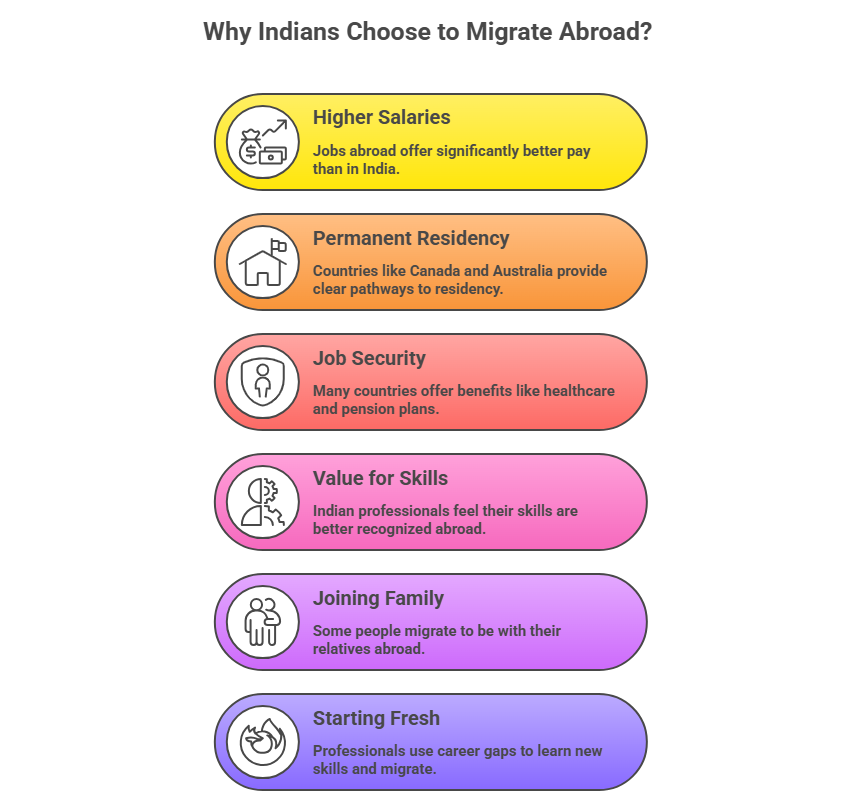
Some of the main reasons Indians choose to migrate abroad even after a career break include:
- Higher salaries: Many jobs abroad offer much better pay compared to India. For example, an IT professional earning ₹12 lakh per year in India may earn AUD 90,000–120,000 in Australia or EUR 55,000–75,000 in Germany.
- Permanent residency opportunities: Countries such as Canada, Australia, Germany, and New Zealand provide clear pathways to permanent residency and citizenship within a few years.
- Better job security and benefits: Many countries offer benefits like free or affordable healthcare, unemployment support, pension plans, and quality education for children.
- Better value for skills and experience: Many Indian professionals feel their education, skills, and work experience receive better recognition and career growth opportunities abroad.
- Joining family members abroad: Some people migrate because their relatives or family members are already settled in another country.
- Starting fresh after job loss: Some professionals use their career gap period to learn new skills, improve their language test scores, and prepare for migration opportunities abroad.
Does a Career Gap Affect Your Chances of Getting a Work or PR Visa?
A career gap can affect your work visa or PR application, but it does not automatically lead to rejection. The impact mainly depends on the country you choose, the visa type, and how clearly you explain the gap period. For work visas and PR visas, immigration authorities usually focus on your work experience, skills, and current employability. Because of this, a career gap may affect your application in two main ways.
Lower Points in Points-Based Immigration Systems
Countries like Canada, Australia, and New Zealand use points-based systems for skilled migration. In these systems, applicants receive points for factors such as age, education, language scores, and skilled work experience. If you have a career gap, your total years of work experience may become lower, which can reduce your points score. However, this does not mean you become ineligible to apply.
For example, in Canada’s Express Entry system, candidates receive more CRS points as their skilled work experience increases. A person with one year of foreign work experience receives fewer points compared to someone with three or five years of experience. So, if an applicant has a two-year career gap, they may not be able to claim points for those years. Still, they can remain competitive if they have strong language test scores, higher education, a provincial nomination, or a valid job offer.
Questions About Recent Work Experience
For employer-sponsored visas such as the UK Skilled Worker Visa, Germany Skilled Worker Visa, or UAE Employment Visa, immigration officers and employers usually want to see recent and relevant work experience. If there is a long unexplained career gap, they may ask questions about your current skills or job readiness. In most cases, this issue can be handled properly by submitting a clear explanation letter along with supporting documents such as medical records, course certificates, freelance proof, or family-related documents.
Best Countries to Migrate with a Career Gap
1. Canada — Express Entry
Canada is one of the most popular countries for Indians who want to settle abroad. The Express Entry system manages major immigration programs such as the Federal Skilled Worker Program (FSWP), Canadian Experience Class (CEC), and Federal Skilled Trades Program (FSTP).
How Career Gaps Affect Your Canada PR Application
A career gap does not stop you from applying for Express Entry. You can still create a profile if you meet the minimum requirement of at least one year of continuous full-time skilled work experience in an eligible occupation. However, career gaps can reduce your total years of work experience, which may lower your CRS score. Immigration authorities in Canada may also ask for a Letter of Explanation (LOE) to explain the gap period. It is important to provide correct details about your work history. Giving false information or fake experience can lead to visa refusal or future immigration bans.
Ways to Improve Your Express Entry Profile
- Provincial Nominee Program (PNP): A provincial nomination adds 600 CRS points, which greatly increases your chances of getting PR. Provinces like Saskatchewan, Manitoba, and Nova Scotia often have suitable options for skilled workers.
- Category-Based Draws: Canada now conducts special draws for sectors such as healthcare, STEM, trades, and French-speaking applicants. These draws usually have lower CRS cut-off scores.
- Job Offer from Canada: A valid job offer from a Canadian employer can add extra CRS points.
- Higher IELTS or CELPIP Scores: Better language test scores can improve your CRS score and strengthen your application.
Important Canada Updates for 2026
Canada has reintroduced CRS points for valid job offers in some categories. The government is also planning changes to the Express Entry system, with updated CRS rules expected later in 2026.
*Check your eligibility to Canada through the Y-Axis Canada CRS Score Calculator.
2. Australia — Skilled Independent Visa
Australia has announced 185,000 permanent migration places for 2026–27, with most places reserved for skilled migrants. Indians continue to be one of the top groups receiving invitations for Australian PR.
How Career Gaps Affect Australia PR Applications
Australia uses a points-based immigration system. Points are given based on age, education, English language ability, and skilled work experience. Career gaps may reduce the number of years of work experience you can claim. This can lower your total points score, but it does not make you ineligible.
For example:
| Overseas Work Experience | Points |
| Less than 3 years | 0 |
| 3–4 years | 5 |
| 5–7 years | 10 |
| 8+ years | 15 |
The minimum score to apply is 65 points, but many occupations currently need around 85–95 points to receive an invitation.
Ways to Improve Your Australia PR Chances
- Skills Assessment: A positive skills assessment from approved authorities such as ACS, Engineers Australia, or AHPRA can strengthen your profile.
- Australian Work Experience: Previous work experience in Australia can give additional points and improve your PR opportunities.
- Better English Scores: High IELTS or PTE scores can add more points to your application.
- Specialist Skills Pathway: Australia has introduced faster visa processing for highly skilled workers in selected occupations.
Important Australia Updates for 2026
Australia is reviewing its points system and may give more importance to Australian work experience and job relevance in the future. Healthcare, IT, construction, engineering, and aged care remain high-demand sectors in Australia.
*Want to work in Australia? Start here to get expert guidance with Migrate to Australia Flipbook.
3. United Kingdom — Skilled Worker Visa
The UK Skilled Worker Visa is an employer-sponsored visa. This means you must first get a job offer from a UK employer before applying for the visa. In the UK, career gaps are mainly checked by employers rather than immigration authorities.
How Career Gaps Are Viewed in the UK
There is no fixed limit for career gaps under the UK Skilled Worker Visa. Having a gap in your work history does not automatically affect your eligibility. The main requirement is that you must qualify for the job offered by the UK employer. From July 2025, many sponsored jobs require skills equal to graduate-level qualifications (RQF Level 6). If you have a career gap between jobs, it usually does not affect your visa status. However, a long unexplained gap in your CV may make some employers less confident while hiring. In most cases, the challenge comes during the job search stage rather than during the visa process.
Important UK Updates for 2026
- The minimum salary requirement has increased to £41,700.
- From July 2025, many jobs require graduate-level qualifications.
- The English language requirement has increased from B1 to B2 level from January 2026.
- Indian applicants continue to receive a large number of UK Skilled Worker Visas every year.
Tips for Applicants with Career Gaps
- Keep your CV updated and clearly explain your career gap.
- Use a cover letter or Letter of Explanation (LOE) to explain the reason for the gap honestly.
- Apply for jobs in high-demand sectors such as healthcare, IT, engineering, finance, and education.
*Want to work in the UK? Let Y-Axis guide you with the process.
4. Germany
Germany is considered one of the best countries for professionals with career gaps. The country has a large shortage of skilled workers and is actively hiring international professionals, including Indians.
How Germany Treats Career Gaps
German immigration authorities usually do not treat career gaps as a major problem if they are explained properly with documents.
Germany mainly focuses on:
- Your educational qualifications
- Recognition of your degree
- Your skills and work experience
- Salary offered by the employer
Germany introduced the Opportunity Card (Chancenkarte) in 2024. This visa allows skilled professionals to enter Germany and search for jobs for up to one year without having a job offer before travelling. Because of this system, career gaps become less important during the initial visa process.
The EU Blue Card is for skilled professionals with a job offer in Germany.
Minimum salary requirements for 2026:
- Standard occupations: around EUR 50,700 per year
- Shortage occupations and recent graduates: around EUR 45,934 per year
Important Germany Updates for 2026
- Germany has increased work visa opportunities for Indian professionals.
- The India–Germany Migration and Mobility Partnership Agreement has made the hiring and visa process easier for skilled workers.
- High-demand sectors include IT, software development, data science, nursing, physiotherapy, mechanical engineering, and electrical engineering.
*Want to work in Germany? Let Y-Axis guide you with the process.
5. New Zealand - Accredited Employer Work Visa
New Zealand is welcoming skilled workers from India, especially in healthcare, IT, engineering, construction, and agriculture. The country mainly offers two migration options — the Accredited Employer Work Visa (AEWV) for people with a job offer and the Skilled Migrant Category (SMC) for permanent residency.
How Career Gaps Are Viewed in New Zealand
For the AEWV, the main focus is whether you meet the job requirements and have a valid job offer. Career gaps usually do not become a major issue. For the Skilled Migrant Category (SMC), work experience is important because it affects your points score. Career gaps may reduce your total years of experience, but they do not stop you from applying.
From August 2026, New Zealand is introducing new PR pathways:
- Skilled Work Experience Pathway: Requires 5 years of related work experience, including 2 years of work experience in New Zealand.
- Trades and Technician Pathway: Requires a Level 4 qualification and 4 years of work experience after qualification.
Important New Zealand Updates for 2026
- Indian bachelor’s degree holders are now exempt from additional qualification assessments in many cases.
- Eligible graduates can receive a 3-year open work visa after studies.
- High-demand sectors include nursing, engineering, construction, software development, and agriculture management.
*Want to work in New Zealand? Let Y-Axis guide you with the process.
6. UAE / Dubai - Employment Visa
The UAE, especially Dubai and Abu Dhabi, is one of the easiest and fastest countries for Indians with career gaps to move to for work. Unlike countries that use points-based immigration systems, the UAE mainly focuses on your current job offer, skills, and qualifications.
How Career Gaps Are Viewed in the UAE
There are no strict rules against career gaps in UAE work visas. Once you get a valid job offer, career gaps usually do not affect the visa approval process. However, employers may ask questions during recruitment if the gap is long. The UAE also offers a Job Seeker Visa, which allows skilled professionals to stay in the country for up to 120 days to search for jobs without having a job offer before travelling.
Popular UAE Visa Options
| Visa Type | Duration | Sponsor Needed | Main Benefit |
| Employment Visa | 2 years | Yes | Most common work visa |
| Green Visa | 5 years | No | Self-sponsored visa |
| Golden Visa | 10 years | No | For skilled professionals and investors |
| Job Seeker Visa | 120 days | No | Search for jobs after arriving |
| Freelance Permit | 1–2 years | No | For freelancers and consultants |
Important UAE Updates for 2026
- Dubai employment visa applicants must complete a health check at approved centres.
- The Golden Visa now covers more professionals in IT, AI, healthcare, education, and research.
- Employment visa processing has become faster, with approvals often completed within 7–10 working days.
*Want to apply for a Dubai work visa? Let Y-Axis guide you with the process.
7. Ireland - Critical Skills Employment Permit
Ireland is a popular destination for skilled Indian professionals because many global companies like Google, Meta, Apple, and Pfizer have offices there. Ireland mainly offers employer-sponsored work permits, meaning you usually need a job offer before applying.
How Career Gaps Are Viewed in Ireland
Ireland does not have strict penalties for career gaps in work permit applications.
The main focus is on:
- Your job offer
- Salary offered
- Skills and qualifications
- Demand for your occupation
Career gaps may be discussed during employer interviews, but they usually do not become a major problem during visa approval if your job offer is genuine.
PR Pathway in Ireland
After legally living and working in Ireland for 5 years, many workers can apply for long-term residency or citizenship. Students who graduate from Irish universities may also stay back and work for 1–2 years under the Third Level Graduate Scheme.
Important Ireland Updates for 2026
- Ireland continues to hire skilled workers in software development, data science, finance, healthcare, and pharmacy.
- Cities like Dublin and Cork have strong demand for Indian IT and pharma professionals.
Country Comparison Table: Migration with a Career Gap at a Glance
| Country | Visa Type | Gap Impact | Career Gap Flexibility |
| Canada | Express Entry / PNP | Reduces CRS points (not disqualifying) | Moderate – LOE required |
| Australia | Subclass 189/190 | Reduces points score | Moderate – points-based |
| UK | Skilled Worker Visa | No formal penalty (employer-driven) | High – employer sponsor focus |
| Germany | Blue Card / Opportunity Card | No penalty – well-documented gaps accepted | Very High – most flexible |
| New Zealand | AEWV / SMC | Reduces SMC points | High – AEWV employer-led |
| UAE / Dubai | Employment / Green / Golden | No formal penalty | Very High – fastest access |
| Ireland | Critical Skills Permit | No formal penalty | High – permit-based |
*Want to apply for an Ireland work visa? Sign up with Y-Axis to help you with the process.
What to Do During a Career Gap to Improve Your Migration Chances?
If you are currently on a career break and planning to move abroad, the steps you take during this time can improve your work visa or PR application. Using your gap period wisely can make your profile stronger for both employers and immigration authorities.
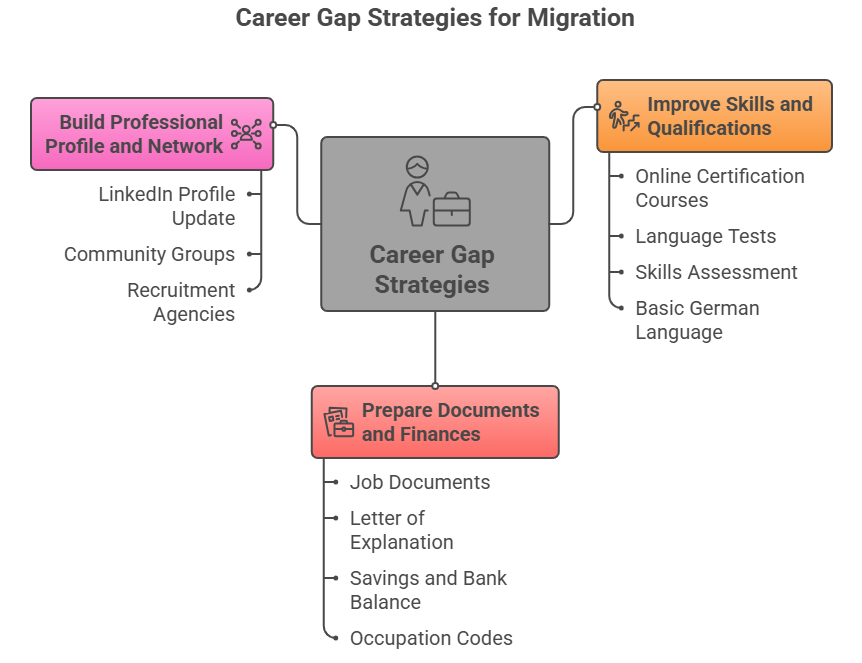
Improve Your Skills and Qualifications
- Take online certification courses related to your field. Certifications like AWS, Google Cloud, PMP, CFA, CISSP, and other industry-related courses can improve your job opportunities abroad.
- Prepare for language tests early. Exams such as IELTS, PTE, and OET are required for many migration programs. Higher scores can increase your immigration points.
- Complete your skills assessment if you are applying for countries like Australia or New Zealand. Skills assessments from approved authorities can usually be completed during your career gap period and remain valid for several years.
- Learn basic German if you are planning for Germany. Even beginner-level German language skills can improve your chances of finding a job.
Prepare Your Documents and Finances
- Collect all important job documents such as experience letters, offer letters, relieving letters, salary slips, and tax documents from your previous jobs.
- Prepare a clear Letter of Explanation (LOE) explaining the reason for your career gap honestly and professionally.
- Build your savings and maintain a healthy bank balance. Some countries like Canada require proof of settlement funds during the PR process.
- Learn about occupation codes such as NOC codes for Canada and ANZSCO codes for Australia. Choosing the correct occupation code is important for skilled migration applications.
Build Your Professional Profile and Network
- Update your LinkedIn profile and job portal accounts such as Indeed, Seek, Glassdoor, and Naukri Gulf with your latest skills and experience.
- Join Indian communities abroad through Facebook groups, Reddit communities, and WhatsApp groups. These groups can help you with job referrals, migration guidance, and networking.
- Connect with recruitment agencies in countries like the UK, Germany, and the UAE that regularly hire Indian professionals for overseas jobs.
*Check your eligibility to migrate abroad instantly for FREE through the Y-Axis eligibility points calculator.
How to Write a Letter of Explanation (LOE) for a Career Gap?
A Letter of Explanation (LOE) is an important document used to explain your career gap during a work visa or PR application. Unlike a student visa SOP, an LOE is usually shorter, more direct, and focused mainly on explaining your employment gap clearly and honestly.
Paragraph 1: Explain the Career Gap
In the first paragraph, clearly mention the period of your career gap and explain the reason for it in simple and direct words. Instead of using unclear phrases like “personal reasons,” mention the actual reason such as health issues, family responsibilities, job loss, higher studies, business activities, or exam preparation.
Paragraph 2: Explain What You Did During the Gap
In the second paragraph, explain how you used your gap period productively. You can mention online certifications, freelance work, business activities, language test preparation, skills assessments, job searching, or taking care of family responsibilities. If you have supporting documents for these activities, mention that you are attaching them with the application.
Paragraph 3: Show That You Are Ready to Continue Your Career
The third paragraph should explain that you are now fully ready to continue your professional career. You can mention completed certifications, language test scores, updated skills, or recent professional activities that show your readiness to work abroad.
Paragraph 4: Mention Supporting Documents
In the final paragraph, mention the documents you are submitting along with the LOE. These may include experience letters, offer letters, relieving letters, tax documents, course certificates, medical records, freelance proofs, business documents, or any other papers that support your explanation for the career gap.
Best Occupations to Migrate Abroad with a Career Gap: High-Demand Fields for Indians
Choosing the right job field is very important when planning to migrate abroad. Some industries have a high demand for skilled workers, and in these sectors, career gaps are usually less of a problem. Many countries focus more on your skills, qualifications, and experience rather than short employment breaks.
Information Technology (IT)
The IT industry is one of the best options for Indians planning to move abroad with a career gap. Countries like Germany, Canada, Australia, and the UK are facing a shortage of skilled tech professionals. Jobs such as Software Engineer, Cloud Architect, Data Scientist, Cybersecurity Analyst, AI/ML Engineer, and Full Stack Developer are in high demand. Germany offers good opportunities through the EU Blue Card and Opportunity Card, while Canada regularly conducts STEM category draws under Express Entry. Australia and the UAE also continue to hire skilled IT workers. If you completed online certifications like AWS, Azure, or Google Cloud during your career gap, it can improve your profile. Freelancing work, open-source projects, and personal projects can also help show your technical skills.
Healthcare and Nursing
Healthcare is another field with strong international demand. Countries like the UK, Canada, Australia, Germany, and New Zealand actively hire Indian healthcare professionals because of worker shortages in hospitals and healthcare services. Popular healthcare jobs include Registered Nurse, Doctor, Pharmacist, Physiotherapist, Radiologist, and Medical Laboratory Scientist. Even if you worked in private hospitals or clinics in India during your career gap, that experience can still be useful if properly documented. Many countries value practical healthcare experience and offer fast-track migration pathways for medical professionals.
Engineering
Engineering professionals are also highly needed in countries like Australia, Canada, and Germany. Growing infrastructure projects and construction activities have increased demand for Civil Engineers, Mechanical Engineers, Electrical Engineers, Structural Engineers, and Construction Project Managers. Countries such as Australia and Canada have dedicated skills assessment systems for engineers, while Germany offers good opportunities through the EU Blue Card. If you worked on freelance projects, consulting work, teaching, or project management during your career gap, it can still strengthen your engineering profile.
Finance and Accounting
Finance and accounting professionals have strong opportunities in countries like the UK, UAE, Canada, and Singapore. Indian professionals with qualifications such as CA, CFA, ACCA, or CPA are highly valued in international financial companies. Common roles include Financial Analyst, Chartered Accountant, Risk Manager, Tax Consultant, and Investment Banker. Using your career gap period to prepare for professional exams like CFA, CPA, or ACCA can improve your migration chances and make your profile more competitive.
Common Mistakes Indians Make When Applying for Migration Visas with a Career Gap
Not Mentioning the Career Gap
One of the biggest mistakes applicants make is hiding or not mentioning their career gap. Immigration authorities expect complete and honest employment history from every applicant. A declared career gap is usually acceptable if explained properly, but hiding it can create serious problems. It may lead to visa rejection, cancellation of visa status, or even a ban from applying again for several years.
Showing Unverified Work Experience
Some applicants try to show freelance work, business activities, or temporary work during the gap period as official employment without proper proof. Immigration departments often verify work history carefully. It is always safer to mention only the work experience that you can support with documents such as invoices, contracts, bank statements, tax records, or experience letters.
Ignoring the Impact on Immigration Points
For countries like Canada and Australia, career gaps can reduce the total immigration points because they lower the number of years of work experience. Some applicants apply without calculating their updated score properly. Before applying, it is important to check whether your score is competitive. If your points are lower, you may need better IELTS scores, a provincial nomination, or a valid job offer to improve your chances.
Delaying the Skills Assessment
Many applicants with career gaps delay their skills assessment process for countries like Australia and New Zealand. However, a skills assessment is required before submitting an Expression of Interest (EOI) in many cases. Since the assessment process can take several months, delaying it can slow down the entire migration process.
Not Submitting a Letter of Explanation (LOE)
Some applicants think they only need to provide a Letter of Explanation if immigration authorities ask for it. In reality, it is better to include an LOE for any career gap longer than a few months. A clear and honest explanation helps immigration officers understand your situation and shows transparency in your application.
Waiting Too Long to Start the Migration Process
Many people delay their migration plans because they feel their profile is not perfect. However, PR and work visa processing can already take many months or even years. Waiting too long can increase the total gap period further. Starting early gives you more time to improve your profile, complete language tests, collect documents, and explore job opportunities abroad.
*Want to migrate overseas? Talk to Y-Axis for further guidance
Final Thoughts
A career gap is not the barrier it might seem when it comes to migrating abroad. The world's major immigration destinations Canada, Australia, UK, Germany, New Zealand, UAE, and Ireland all have pathways for skilled Indian professionals, and none of them automatically exclude you because of an employment break.
What they do require is honesty, documentation, and strategy. A well-written Letter of Explanation, strong language scores, a current skills assessment, and the right occupation choice can turn a career gap from a concern into a non-issue. And for destinations like Germany and UAE, your gap may not even come up as a meaningful factor in the visa decision.
India is the world's largest source of skilled migrants. The global demand for Indian talent has never been higher. Your career gap is a chapter in your story, not the end of it.
*Start your overseas career journey with confidence. Contact Y-Axis, the world’s No. 1 overseas immigration consultancy, for end-to-end support!
FAQs
Can I apply for Canada PR through Express Entry if I have a career gap?
Yes, you can apply for Canada PR through Express Entry with a career gap. Express Entry does not disqualify you for having employment breaks. However, a gap reduces the total skilled work experience you can claim, which lowers your CRS score. You must provide a Letter of Explanation for any gaps in your employment history. Strategies like a Provincial Nominee Program nomination or a valid job offer can compensate for a lower score.
How does a career gap affect my CRS score for Canada Express Entry?
A career gap reduces the number of qualifying years of work experience you can claim. For example, if you have 6 years of skilled work history but a 2-year gap, you can claim 4 qualifying years. This places you in a lower CRS work experience bracket. The impact depends on your overall profile — strong education, language, and job offer points can more than offset a reduction in work experience points.
Does Australia's points test penalise career gaps?
Australia's points test does not directly penalise career gaps, but gaps reduce your total years of qualifying overseas work experience. Australia only counts experience in your nominated occupation from the past 10 years. You need a minimum of 65 points to lodge an EOI. A career gap may lower your overseas experience points, so you should compensate through stronger language scores, Australian work experience, or specialist qualifications.
Can I get a UK Skilled Worker Visa with a career gap?
Yes. The UK Skilled Worker Visa does not have a formal penalty for career gaps. It is employer-sponsored, so the key requirement is a valid job offer from a licensed UK sponsor employer. The gap may affect your ability to secure that job offer from an employer, but once you have the offer and meet the salary threshold (£41,700 in 2026) and skill level requirements, your visa application can proceed normally.
Which country is the easiest to migrate to with a career gap from India?
Germany and the UAE are the most accessible migration destinations for Indians with career gaps. Germany's Opportunity Card allows you to enter without a job offer and search for work on arrival. The UAE has no formal points system and multiple self-sponsored visa options including the Green Visa and Job Seeker Visa. Both countries focus on your skills and qualifications rather than penalising employment breaks.
What is a Letter of Explanation (LOE) and when do I need one?
A Letter of Explanation (LOE) is a brief, formal document that explains any unusual aspects of your immigration application — including career gaps. You should include an LOE for any employment break longer than 3 months in your work history. It should state when the gap occurred, why it happened, what you did during the period, and confirm that the situation is resolved. Supporting documents like medical records, tax returns, or certification letters should accompany it.
Can I use freelance or self-employment work to fill a career gap in my migration application?
Yes, freelance and self-employment experience can be claimed as work experience in immigration applications for most countries, including Canada, Australia, and New Zealand. However, you must provide strong documentation: client contracts, invoices, bank statements showing payments, business registration documents, and tax filings. For skills assessments in Australia, authorities like ACS accept freelance ICT work if it is properly evidenced.
How does a career gap affect my Australia PR points score?
A career gap reduces the number of years of skilled work experience you can claim in your nominated occupation. Australia awards points for 3–4 years, 5–7 years, and 8+ years of overseas experience. If a 2-year gap drops you from the 5-year bracket to the 3-year bracket, you lose 5 points. You should compensate by targeting a higher IELTS or PTE score, claiming Australian work experience if available, or applying for a state nomination (Subclass 190) which adds 5 extra points.
What documents do I need to explain a career gap in a migration visa application?
Documents needed to explain a career gap include: a notarised Letter of Explanation; experience letters and salary slips from employers before and after the gap; income tax returns (ITR) for the gap years; medical records if the gap was due to illness; caregiving records if due to family responsibility; freelance contracts and invoices if you worked independently; business registration documents if you ran a business; and certification completion letters for any courses taken during the gap.
Can a career gap affect my Germany Blue Card application?
A career gap does not automatically affect a Germany Blue Card application. German immigration authorities focus primarily on your qualifications (APS certificate), the relevance of your experience to the offered role, and whether your salary meets the Blue Card threshold (EUR 50,700 for standard occupations in 2026). If your gap was due to work in a different country or sector, it may need to be briefly explained in your cover letter to the German embassy.
Is there an age limit for skilled worker visas in countries like Canada, Australia, and the UK?
There is no official age limit that disqualifies you from applying for a skilled worker visa in Canada, Australia, the UK, Germany, or the UAE. However, points-based systems like Canada (CRS) and Australia do award fewer points for older applicants — CRS age points peak at 20–29, and Australia's age points zero out at 45. This means older applicants need to compensate through stronger language scores, education, or specific program selection such as PNP or state nomination.
Can I migrate to Canada without a job offer if I have a career gap?
Yes, you can migrate to Canada through Express Entry without a job offer, even with a career gap. A valid job offer adds 50–200 CRS points, but it is not mandatory. Many candidates receive Invitations to Apply (ITA) through category-based draws (STEM, healthcare, French language, trades) or through Provincial Nominee Programs (PNP) without employer-sponsored job offers. A strong overall profile — good language scores, higher education, and a relevant occupation — can offset the absence of a job offer.
How do I migrate to Germany with a career gap and no job offer?
Germany's Opportunity Card (Chancenkarte), fully operational in 2026, is designed precisely for this situation. It is a job-seeker visa that allows skilled Indian professionals to enter Germany for up to 1 year without a prior job offer, search for employment actively, and apply for a work permit or Blue Card upon securing a role. To qualify, you need a recognised qualification (APS certificate for Indian graduates), relevant work experience, and basic financial proof.
What is the minimum work experience required to migrate to Canada through Express Entry?
The Federal Skilled Worker Program (FSWP) requires at least 1 year of continuous, full-time (or equivalent part-time) skilled work experience in a single NOC TEER 0, 1, 2, or 3 occupation within the past 10 years. Career gaps do not break this continuity requirement as long as the total qualifying experience adds up to at least 1 year. However, gaps directly reduce the total work experience points you earn in the CRS.
Do I need to explain every gap in my work history, or only long ones?
Best practice is to explain every gap in your work history that is longer than 3 months. For very short gaps (1–4 weeks between jobs), no explanation is typically required. For gaps of 1–3 months, a brief note in your CV or LOE is sufficient. For gaps longer than 6 months, a formal Letter of Explanation with supporting documents is strongly recommended regardless of the country you are applying to.
How does a career gap affect the UAE Green Visa or Golden Visa?
The UAE Green Visa requires you to be a skilled professional earning AED 15,000 per month or more — it does not assess your historical career gaps. The Golden Visa requires you to qualify as an exceptional talent, investor, or top professional in your field. Neither visa type reviews your work history the same way a points-based PR system does. A career gap does not directly disqualify you from either visa as long as you currently meet the relevant criteria.
Can Indians get New Zealand PR with a career gap?
Yes, Indians can obtain New Zealand permanent residency with a career gap. The Skilled Migrant Category (SMC) uses a points-based system where work experience earns points. A career gap reduces total qualifying experience, but does not disqualify you. The new 2026 residence pathways under the SMC focus on New Zealand work experience and wage levels rather than lifetime work history. Many Indian professionals start on an AEWV work visa, build local NZ experience, and then apply for PR.
Will a previous visa refusal plus a career gap make it impossible to migrate abroad?
A previous visa refusal combined with a career gap does make your application more complex, but it does not make migration impossible. You must declare any previous refusals in your new application. Both the refusal and the gap need clear, honest explanation in your LOE. Working with an experienced immigration consultant is strongly recommended in this situation to ensure the new application is substantially stronger than the refused one.
Can I migrate to the UK with a career gap if I was laid off?
Yes, you can migrate to the UK with a career gap caused by redundancy or layoff. The UK Skilled Worker Visa is employer-sponsored — as long as you secure a valid job offer from a licensed UK sponsor and meet the salary and skills requirements, your previous employment break due to layoff does not affect your eligibility. A brief LOE explaining the layoff and confirming you are now seeking new employment in the UK can be included in your application for completeness.
Is German language proficiency required to migrate to Germany with a career gap?
German language proficiency is not required for the initial EU Blue Card or the Opportunity Card. However, learning German (A1–B1 level) significantly improves your chances of finding employment in Germany — most employers beyond the IT sector prefer German-speaking candidates. For permanent residency (Niederlassungserlaubnis), B1 German is required within 33 months of arriving on the Blue Card (or 21 months for advanced B1 speakers).
How long does it take to get Australian PR if I have a career gap?
The timeline for Australian PR with a career gap depends on your points score and the visa subclass. The Subclass 189 (Skilled Independent) invitation is issued through SkillSelect based on your points rank. High-scoring applicants with 90+ points may receive invitations within weeks. After the invitation, application processing typically takes 8–14 months. A career gap may lower your initial points score, extending the time you wait for an invitation — but this can be mitigated by targeting state nomination (Subclass 190) streams.
What is the settlement fund requirement for Canada PR with a career gap?
Canada's Federal Skilled Worker Program requires proof of settlement funds unless you have a valid Canadian job offer or are currently working in Canada. The settlement fund requirement is updated regularly by IRCC. As of 2026, a single applicant needs approximately CAD 14,690 in settlement funds. For a family of four, this rises to approximately CAD 27,000. Career gaps do not affect the fund requirement — the amount is fixed regardless of employment history.
Can an immigration consultant improve my PR chances if I have a career gap?
Yes, significantly. A qualified immigration consultant — such as a Y-Axis RCIC (Regulated Canadian Immigration Consultant) or a registered migration agent (MARA agent for Australia) — can identify the most career-gap-friendly pathway for your profile, calculate the precise CRS or points impact of your gap, recommend compensating strategies such as PNP streams or language score improvements, draft a strong Letter of Explanation, and verify your entire application for consistency before submission.
What is the single most important thing to do when migrating abroad with a career gap?
The most important step is to take your career gap seriously as a documentation challenge not a dealbreaker. Every day you spend in a gap is an opportunity to add something to your file: a certification, a language test result, a freelance project, a professional development course. When the time comes to apply, present your gap honestly, explain it thoroughly, and support every claim with a document. Immigration authorities respond to transparency and preparation. A career gap managed well becomes just another part of your story.
📞 Call: +91-7670800000
📩 Email: info@y-axis.com
🌐 Visit: https://www.y-axis.com
Tags:
Career gap migration
Work visa abroad
PR visa abroad
Canada PR
Australia PR
Germany Opportunity Card
UK Skilled Worker Visa
New Zealand AEWV
Immigration Guide
Y-Axis
Share
Options for you by Y-Axis

Get it on your mobile

Get News alerts

Contact Y-Axis
Latest Article
Popular Post
Trending Article

Posted On October 08 2026
The Things Indians Abroad Export That Never Appear on a Customs Form