


Posted on July 09 2026
Life in Ireland for Immigrants: Jobs, Housing, Healthcare & PR

By , Editor
Updated July 15 2026
Ireland offers immigrants a welcoming community and a thriving professional environment. It has become one of Europe's most sought-after destinations for skilled professionals, students, and families looking to build a future abroad. With a booming tech and pharmaceutical sector, English as the primary language, and a clear pathway to long-term residency, Ireland offers immigrants a stable and welcoming environment. From Dublin's thriving job market to smaller cities offering a lower cost of living, the country caters to a range of lifestyles and career goals.
Quick Facts About Ireland
| Fact | Detail |
|---|---|
| Population | Approximately 5.1 million |
| Capital | Dublin |
| Official Languages | English, Irish |
| Currency | Euro (EUR) |
| Immigrant Population | Around 20% of residents are foreign-born |
| Popular Immigrant Hubs | Dublin, Cork, Galway |
| Economy | One of the EU's strongest economies, with major technology and pharmaceutical sectors |
| Typical Route to PR | Several years of continuous legal residence (typically 2–5 years, depending on the immigration route) |
*Want to start a life in Ireland? Sign up with Y-Axis to assist you with the process.
Why Choose Ireland?
Ireland stands out among European immigration destinations for its strong economy, English-speaking environment, and immigrant-friendly policies. Multinational companies, a growing job market, and a high quality of life make it an attractive choice for foreign professionals and families.
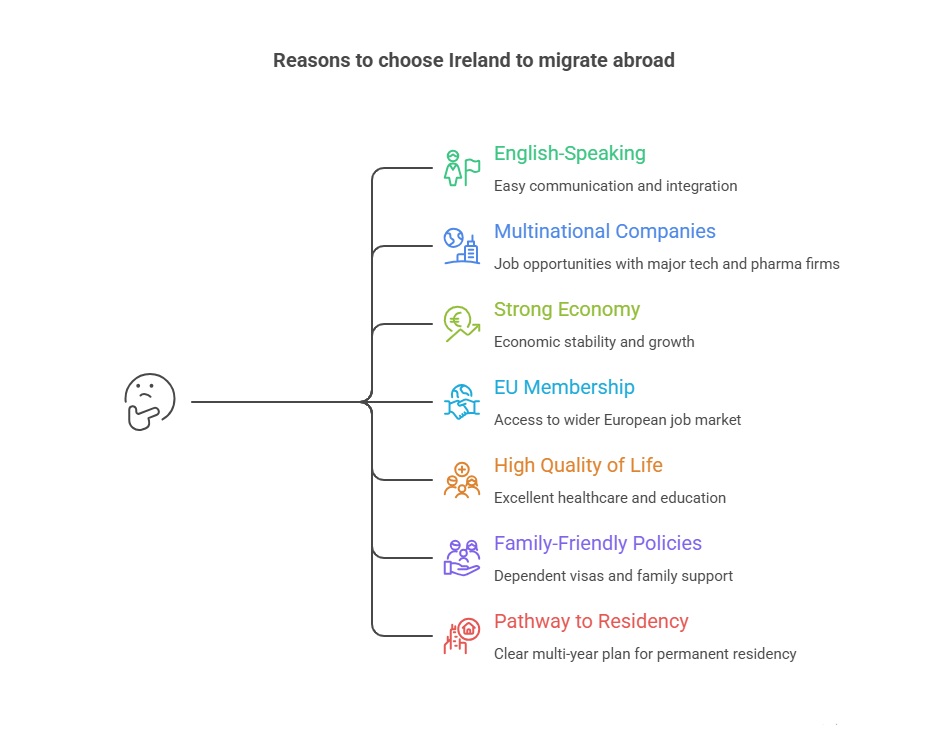
Here is why you should choose a life in Ireland:
- English-speaking country offering easy communication and integration
- Home to European headquarters of Google, Meta, Apple, and Pfizer
- Strong GDP growth and comparatively low unemployment
- EU membership opens access to the wider European job market
- High standard of healthcare and education
- Family-friendly immigration policies with dependent visa options
- Clear multi-year pathway to permanent residency
*Want to work in Ireland? Let Y-Axis guide you with the steps.
Can I Move to Ireland?
Most Indian nationals can move to Ireland through employment, study, or family sponsorship routes, provided they meet the eligibility requirements set by Ireland's immigration authorities. Eligibility depends on your occupation, qualifications, and the visa category you apply under.
Here is what you need to do to migrate to Ireland:
- Secure a valid job offer from an Ireland-based employer for work visas
- Your occupation must be listed on Ireland's Critical Skills Occupations List to improve eligibility
- Find an acceptance letter from a recognised Irish institution to streamline Ireland student visa routes
- Meet the minimum financial requirements to prove self-sufficiency
- Maintain a clean criminal record and a valid passport
- Meet English language proficiency requirements
- Explore family sponsorship route available for spouses and dependents of Irish residents
Also, read...
Ireland Strengthens Post-Study Work Pathways for International Graduates. Apply Now!
Best Visa Options to Live in Ireland
Ireland offers several visa categories depending on your purpose of travel such as work, business, or family reunification.
The table below summarises the most relevant options for skilled professionals and their pathway toward permanent residency.
| Visa Type | Best For | Duration | PR Pathway |
|---|---|---|---|
| Critical Skills Employment Permit | Highly skilled professionals in in-demand occupations | 2 years (renewable) | Eligible for long-term residence after 2 years (Stamp 4); long-term residence/PR typically after about 5 years of legal residence |
| General Employment Permit | Skilled workers outside the Critical Skills Occupations List | Up to 2 years (renewable) | Typically eligible for long-term residence/PR after about 5 years of legal residence |
| Stamp 4 Permission | Long-term residents transitioning to unrestricted work and residence | Usually granted for a specified period and renewable | Provides unrestricted residence and employment rights; can support eligibility for long-term residence or citizenship |
| Start-up Entrepreneur Programme (STEP) | Entrepreneurs launching an innovative business | Initial 2 years | May lead to long-term residence after meeting residence and programme requirements |
| Intra-Company Transfer Employment Permit | Employees transferred within the same multinational company | Up to 3 years | Time spent may contribute toward certain residence requirements, subject to Irish immigration rules |
| Dependent / Partner Permission | Spouses and dependants of eligible employment permit holders | Matches the primary permit holder's permission | Residence eligibility depends on the primary applicant's immigration status and applicable Irish immigration rules |
Also, read...
Ireland becomes a top study choice for Indian students with strong career outcomes. Apply now!
Best Cities to Live in Ireland
Ireland's job market and lifestyle vary significantly from city to city. Where you settle can shape your career prospects, cost of living, and overall experience.
The table below highlights the major Irish cities and their best qualities for settlement abroad:
| City | Best For | Sightseeing Attractions | Average Rent | Job Market | Savings Potential |
|---|---|---|---|---|---|
| Dublin | Tech & finance professionals | Trinity College, Guinness Storehouse | €1,900–€2,400/month (1BR) | Strongest; major technology and finance hub | Moderate due to the high cost of living |
| Cork | Pharma & manufacturing professionals | Blarney Castle, English Market | €1,300–€1,600/month (1BR) | Growing; strong pharmaceutical and biotechnology sectors | Higher than Dublin |
| Galway | Medtech & creative industries | Galway Cathedral, Cliffs of Moher (nearby) | €1,200–€1,500/month (1BR) | Steady; driven by medtech, tourism, and education | Good savings potential |
| Limerick | Manufacturing & logistics professionals | King John's Castle, University of Limerick | €1,100–€1,400/month (1BR) | Moderate; expanding industrial and logistics base | Good due to lower living costs |
| Waterford | Emerging technology & education sectors | Waterford Crystal Factory, Reginald's Tower | €1,000–€1,300/month (1BR) | Smaller but steadily growing | Highest savings potential among the listed cities |
Also, read...
Ireland Offers ₹75 Lakh Scholarships for Indian Students – Apply Now!
Cost of Living in Ireland
Ireland's cost of living varies significantly by city, due to variable lifestyle and accommodation costs. Dublin is estimated as the most expensive cities in Ireland with high standards of living.
Below is a breakdown of average monthly expenses for a single adult in Ireland:
| Expense | Average Cost |
|---|---|
| Rent (1-bedroom apartment, city centre) | €1,200–€2,400/month |
| Utilities (electricity, heating, water) | €150–€250/month |
| Groceries | €250–€350/month |
| Public transport pass | €90–€130/month |
| Health insurance | €80–€150/month |
| Dining out (per meal) | €15–€25 |
| Mobile & internet | €50–€70/month |
| Entertainment & leisure | €100–€150/month |
Also, read...
Ireland Announces €10,000 Scholarships for International Students Starting January 29 – Apply Now!
Is Ireland Expensive Compared to Other EU Nations?
Ireland ranks among the relatively expensive countries in the European Union, particularly for housing, largely due to Dublin's high demand and limited rental supply. Compared to nations like Germany, France, or Spain, everyday costs such as groceries and dining out are noticeably higher in Ireland.
However, wages in Ireland, especially in tech, pharma, and finance, tend to be higher than the EU average, which helps offset the elevated cost of living for skilled professionals. Cities outside Dublin, such as Waterford and Limerick, offer a more balanced cost-to-income ratio.
For immigrants earning in sectors with strong demand, Ireland's overall value proposition remains competitive despite the higher price tags on housing and everyday goods.
Also, read...
Germany, Ireland and UAE Gain Popularity Among Indian Students in 2026 — Apply now!
Work in Ireland
Ireland's job market is mainly driven by technology, pharmaceuticals, financial services, and healthcare.
The table below highlights some of the most in-demand occupations in Ireland for immigrants.
| Occupation | Average Annual Salary | Demand Level | Average Annual Savings |
|---|---|---|---|
| Software Engineer | €55,000–€85,000 | Very High | €10,000–€18,000 |
| Registered Nurse | €35,000–€48,000 | High | €5,000–€9,000 |
| Data Analyst | €45,000–€65,000 | High | €7,000–€13,000 |
| Pharmaceutical Technician | €38,000–€52,000 | High | €6,000–€10,000 |
| Financial Accountant | €45,000–€70,000 | Moderate to High | €7,000–€14,000 |
| Civil Engineer | €42,000–€60,000 | Moderate | €6,000–€11,000 |
*Interested to apply for Ireland visa? Contact Y-Axis for end-to-end assistance.
Explore Career Opportunities in Ireland: 32 New Critical Skills Work Permit Roles Added
Ireland has expanded its Critical Skills Employment Permit by adding 32 new occupations across high-demand sectors such as technology, healthcare, engineering, and specialist professional services. The update creates new opportunities for skilled foreign professionals looking to build a career in one of Europe's fastest-growing economies.
The Critical Skills Employment Permit offers several advantages over the standard work permit, including exemption from the Labour Market Needs Test, eligibility for spouses to receive an open work permit, and a faster pathway to long-term residence after just two years. With Ireland serving as the European headquarters for global companies like Apple, Google, Meta, Pfizer, and LinkedIn, the expanded occupation list opens the door to exciting career prospects in a thriving international job market.
If you're planning to live and work in Ireland, check whether your occupation is included in the updated Critical Skills Employment Permit list and explore your eligibility before applying.
Watch to Know More: Ireland just added 32 new work permit roles Apply Now
Settling in Ireland
Once you arrive in Ireland, settling into daily life involves finding housing, registering for healthcare, enrolling children in school, and setting up banking.
Here is a quick overview of what to expect during your initial settlement phase in the country:
| Housing | Healthcare | Education for Children | Banking & Financial Essentials |
|---|---|---|---|
| Search for accommodation through Daft.ie or Rent.ie; Ireland has a competitive rental market. | Register with the Health Service Executive (HSE) to access public healthcare services. | Enrol children in local primary or secondary schools through the relevant education authority. | Open a bank account with providers such as AIB, Bank of Ireland, or digital banks like Revolut. |
| Landlords typically require a security deposit equal to 1–2 months' rent, plus the first month's rent in advance. | Public healthcare is free or subsidised for eligible residents; private health insurance can help reduce waiting times. | Public education is free, although schools may charge for books, uniforms, and extracurricular activities. | A PPS Number and proof of address are generally required to open a bank account. |
| Allow 4–8 weeks to secure accommodation in high-demand cities such as Dublin. | Apply for a PPS Number first, then complete healthcare registration if required. | Apply for school admissions as early as possible, as some schools have waiting lists. | Most basic bank accounts can be opened within a week of arrival once the required documents are available. |
Also, read...
Jobs in Ireland for Indians: How to Land a Job & Apply for a Work Visa
Permanent Residence in Ireland
Ireland Permanent residence (PR), is a form of long-term residency, granted after several years ( 2-5 years) of continuous legal residence in the country.
The table below highlights the average timeline of securing an Ireland permanent residence:
| Stage | Requirement | Approx. Timeline |
|---|---|---|
| Work Permit Holder | Hold a valid employment permit and maintain legal residence in Ireland. | Years 1–2 |
| Stamp 4 Eligibility | Continuous legal residence; eligibility timelines vary depending on the employment permit held. | Years 2–5 |
| Long-Term Residency Application | Submit an application with proof of legal residence, income, and a clean immigration record. | From the 5th year onward (subject to eligibility) |
| Citizenship Eligibility | After meeting the required period of reckonable residence, applicants may apply for Irish citizenship by naturalisation. | Typically from Year 5 onward (subject to eligibility) |
Also, read...
Ireland Startup Entrepreneur Program
Dependent Benefits for Immigrants in Ireland
Ireland allows eligible visa holders to bring immediate family members such as spouses and children upon meeting dependent visa criteria.
Here are the benefits of securing an Ireland dependent visa:
- Spouses and partners may apply for their own work permit under certain conditions
- Children can access free primary and secondary public education
- Family members are eligible for public healthcare registration
- Dependents can open bank accounts and access financial services
- Family reunification visas simplify long-term settlement together
Also, read...
Ireland PR Dependent Visa: Requirements, Application Process, Cost and Eligibility
Practical Settlement Checklist for Indians Moving to Ireland
Moving to Ireland involves several administrative steps that are best completed in order to avoid delays.
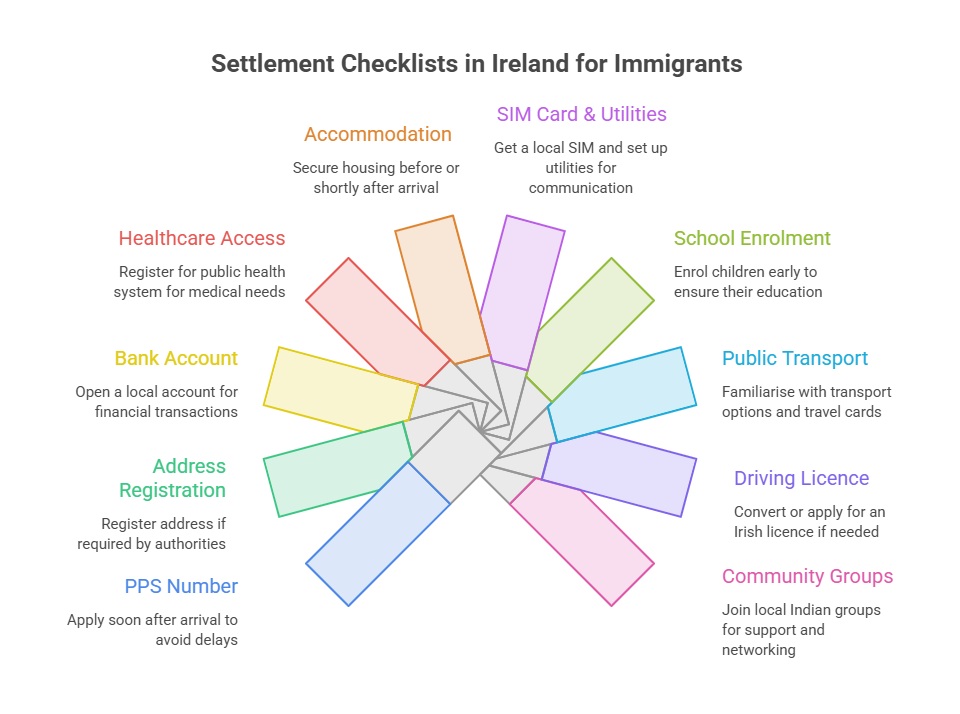
Follow the steps below for a smooth transition as you migrate to Ireland:
Step 1: Apply for a Personal Public Service (PPS) number soon after arrival
Step 2: Register your address with the relevant authorities if required
Step 3: Open a local bank account
Step 4: Register for healthcare access through the public health system
Step 5: Secure accommodation before or shortly after arrival
Step 6: Get a local SIM card and set up household utilities
Step 7: Enrol children in school as early as possible
Step 8: Familiarise yourself with public transport and travel cards
Step 9: Convert or apply for an Irish driving licence if needed
Step 10: Join local Indian community groups for support and networking.
*Are you looking for step-by-step assistance with overseas immigration? Contact Y-Axis, the world’s No. 1 overseas immigration consultancy!
FAQs
What is the easiest way for Indians to move to Ireland?
For most Indian professionals, the easiest route is through an employment permit, particularly the Critical Skills Employment Permit, which is designed for occupations on Ireland's in-demand skills list. This requires a valid job offer from an Ireland-based employer and relevant qualifications. Study visas followed by a graduate work permit are another common pathway. Family sponsorship is available for spouses and dependents of existing visa holders. The right route depends on your qualifications, work experience, and long-term goals, so it helps to assess eligibility against each visa category before applying.
How long does it take to get PR in Ireland?
Permanent residency, referred to as long-term residency in Ireland, generally becomes available after several years of continuous legal residence, most commonly around five years for employment permit holders. The exact timeline depends on the type of permit held and whether residence has been continuous and lawful throughout. Applicants must demonstrate a clean record, financial stability, and compliance with immigration conditions. After qualifying for long-term residency, individuals may later become eligible to apply for Irish citizenship, provided they meet the required residence and character criteria set by Irish immigration authorities.
Is healthcare free for immigrants in Ireland?
Ireland operates a public healthcare system through the Health Service Executive (HSE), which is subsidised rather than entirely free. Immigrants who are legally resident can register with the HSE and access public healthcare services, often at reduced cost compared to private care. Some services carry a fee unless the individual holds a medical card, which is income-tested. Many employers also provide or subsidise private health insurance, which can reduce waiting times for certain treatments. Registering for a PPS number is typically the first step before accessing public healthcare services in Ireland.
What is the average salary for skilled workers in Ireland?
Average salaries in Ireland vary significantly by occupation and sector. Technology roles such as software engineers typically earn between €55,000 and €85,000 annually, while healthcare professionals like registered nurses earn around €35,000 to €48,000. Finance and pharmaceutical roles also offer competitive pay, often exceeding €45,000 per year. Dublin generally offers higher salaries than other cities but comes with a higher cost of living. Skilled professionals in high-demand sectors like IT, pharma, and healthcare tend to command the strongest salaries and have access to more employer-sponsored visa options.
Can I bring my family to Ireland on a work visa?
Yes, most employment permit holders in Ireland can apply for their spouse, partner, and dependent children to join them through family reunification provisions. Dependents typically need to meet certain conditions, and processing times can vary based on the permit type held by the primary applicant. Once in Ireland, spouses and partners may, under certain conditions, apply for their own permission to work. Children of visa holders can access free public education, and the whole family becomes eligible to register with the public healthcare system once legally resident in the country.
Which city in Ireland is best for Indian immigrants?
Dublin is the most popular choice due to its strong job market in technology, finance, and pharmaceuticals, along with a large existing Indian community. However, it also has the highest cost of living. Cities like Cork and Galway offer strong job opportunities in pharma and medtech with comparatively lower rents. Limerick and Waterford are good options for those prioritising affordability and a quieter lifestyle. The best city ultimately depends on your industry, budget, and whether you prioritise career opportunities or overall cost of living and quality of life.
How much does it cost to live in Ireland?
Monthly living costs in Ireland vary by city, with Dublin being the most expensive. A single person can expect to spend roughly €1,200 to €2,400 on rent for a one-bedroom apartment in a city centre, along with €150 to €250 on utilities and €250 to €350 on groceries. Additional costs include public transport, health insurance, and dining out. Overall, a single person's monthly expenses excluding rent typically range from €600 to €900. Cities outside Dublin generally offer a noticeably lower cost of living while still providing solid job opportunities.
What is the Critical Skills Employment Permit?
The Critical Skills Employment Permit is Ireland's flagship work visa for highly skilled professionals in occupations facing skills shortages, such as IT, engineering, and healthcare. It requires a job offer from an Irish employer, typically with a minimum salary threshold, and the role must appear on or align with Ireland's Critical Skills Occupations List. This permit offers a faster pathway toward long-term residency compared to other employment permits and allows holders to apply for family reunification more readily. It is generally considered the most favourable work permit route for skilled foreign professionals.
Do I need to speak Irish to live in Ireland?
No, English is the primary language used in daily life, business, education, and government services throughout Ireland, making it accessible for English-speaking immigrants. While Irish (Gaeilge) is an official language and taught in schools, it is not required for employment, healthcare, banking, or general communication. Some government documents and place names appear in both languages, but this does not affect day-to-day living. This is one of the reasons Ireland is a popular destination for Indian professionals, as language barriers are minimal compared to many other European countries.
Can I apply for Irish citizenship after getting PR?
Yes, once you have accumulated sufficient reckonable residence in Ireland, generally around five years of legal and continuous residence, you may become eligible to apply for naturalisation as an Irish citizen. Requirements include good character, an intention to reside in Ireland, and meeting residency conditions in the years immediately preceding the application. Permanent or long-term residency status strengthens an application but citizenship is a separate process with its own criteria. Irish citizenship also grants the right to live and work freely across the European Union.
Tags:
Life in Ireland for Immigrants
Ireland immigration
Ireland work visa
Ireland PR
Living in Ireland
Cost of living in Ireland
Best cities in Ireland
Jobs in Ireland for Indians
Healthcare in Ireland
Housing in Ireland
Settle in Ireland
Share
Options for you by Y-Axis

Get it on your mobile

Get News alerts

Contact Y-Axis
Latest Article
Popular Post
Trending Article
Posted On October 16 2026
Australia Updates Health Insurance Guidance for Visa Holders: What You Need to Know