


Don't know what to do ?
Get Free Counseling
Last Updated 04 June 2026
Ireland PR Dependent Visa: Requirements, Application Process, Cost and Eligibility
Ireland is one of the best countries in Europe for Indian families who want a safe life, a strong career, and a bright future for their children. The country is home to the European base of top companies like Google, Microsoft, Meta, Apple, Pfizer, and Intel. Ireland is also one of the richest countries in Europe with a GDP per person of over USD 1,03,000 and a low jobless rate of about 4.3%. Today, more than 91,000 Indians live in Ireland, and the number is growing every year. To help Permanent Residents (PR) settle with their loved ones, the Irish government gives a special visa called the Ireland PR Dependent Visa. With this visa, your spouse and children can join you in Ireland. They can also study in free public schools, get free healthcare for kids, and your spouse can work in any job with the right permit.
|
Point |
Details |
|
Visa Name |
Ireland Join Family (Long Stay D) Visa for PR Sponsors |
|
Visa Category |
Long-Stay D Visa (Family Reunification) |
|
Sponsor Type |
Ireland PR Holder (Stamp 4 / Stamp 5 / Long-Term Residency) |
|
Who Can Apply |
Spouse, civil partner, children below 18, dependent adult children, and dependent parents. |
|
Stay Permission |
Stamp 3 (no work rights) or Stamp 4 (full work rights). |
|
Visa Fee |
€60 (single entry) / €100 (multi-entry). |
|
IRP Card Fee |
€300. |
|
Processing Time |
6 to 12 months. |
|
Right to Work |
Yes (under Stamp 4 or with a Dependant/Partner/Spouse Employment Permit, where applicable). |
|
Right to Study |
Yes – access to free primary and secondary public education. |
|
Path to PR |
Direct pathway as family members are linked to the sponsor’s permanent residence status. |
|
Path to Citizenship |
Eligible after 5 years of legal residence, subject to Irish citizenship requirements. |
|
Common Travel Area |
Allows travel within the Common Travel Area, subject to applicable immigration conditions. |
*Want to apply for a Ireland PR Dependent Visa? Sign up with Y-Axis to guide you with the process.
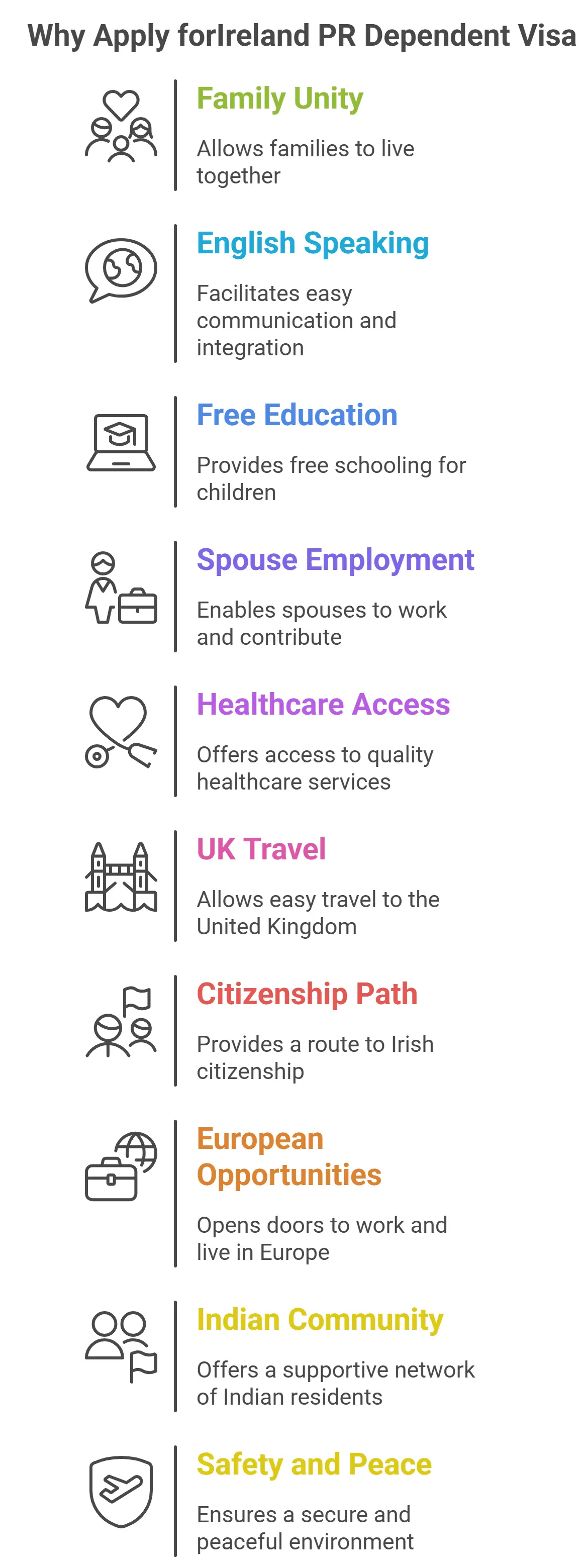
Why Apply for the Ireland PR Dependent Visa?
Ireland is one of the best countries in Europe for families. It offers good salaries, a safe environment, quality education, and many job opportunities in fields like IT, healthcare, engineering, finance, and pharmaceuticals. Many Indians already live in cities like Dublin, Cork, Limerick, and Galway.
Here are the main reasons to Apply for the Ireland PR Dependent Visa:
- Live Together as a Family: Your spouse and children can stay with you in Ireland instead of living separately in India.
- English-Speaking Country: English is the main language in Ireland, so Indian families can easily adjust to daily life, work, and school.
- Free Education for Children: Children can study for free in Irish public schools from age 4 to 18.
- Spouse Can Work: Your spouse may get permission to work in Ireland and can apply for jobs in different sectors.
- Good Healthcare Services: Families can use Ireland’s public healthcare system. Children under 8 may also get free GP medical care.
- Easy Travel to the UK: Ireland is part of the Common Travel Area, so your family can visit the UK for short trips without a separate visa.
- Path to Irish Citizenship: After living legally in Ireland for several years, your family may become eligible to apply for Irish citizenship.
- Future Opportunities in Europe: Irish citizens can later live and work in many European countries.
- Large Indian Community: Thousands of Indians live in Ireland, with Indian restaurants, grocery stores, temples, mandirs, and gurudwaras available in many cities.
- Safe and Peaceful Country: Ireland is known as one of the safest and most peaceful countries in the world.
What is the Ireland PR Dependent Visa?
The Ireland PR Dependent Visa is a long-term visa for the close family members of Indians who already have Permanent Residency (PR) in Ireland through Stamp 4, Stamp 5, or Long-Term Residency. It is also known as the Join Family Visa under Ireland’s Family Reunification Policy. This visa allows your family members to move from India to Ireland and live with you for a long time. After reaching Ireland, they must register with the Garda National Immigration Bureau (GNIB) and get an Irish Residence Permit (IRP) card.
This visa helps Indian PR holders bring their families to Ireland so they can stay together instead of living separately because of work. Your family can settle in Ireland and enjoy a good quality of life. Ireland is an English-speaking country and is known for being safe and welcoming to Indian families. Although Ireland is not part of the Schengen Area, it is part of the Common Travel Area with the UK. This allows your family to travel to the UK for short visits easily.
*Also, read...
Highest-paying jobs in Ireland for Indians
Who Can Apply for the Ireland PR Dependent Visa?
As an Ireland PR holder, you can bring the following close family members from India to live with you. The Irish Department of Justice has clear rules about who counts as a "qualifying family member".
- Spouse / Civil Partner: Must be legally married or in a registered civil partnership with the sponsor. The marriage must be recognised under Irish law.
- De Facto Partner: Must have lived together with the sponsor for at least 2 years in a stable, committed relationship.
- Children Below 18: Biological, step-children, or legally adopted children of the sponsor or spouse.
- Dependent Adult Children (18 to 22): Must be unmarried, in full-time education, and fully dependent on the sponsor.
- Dependent Parents: Only if the sponsor earns over €60,000 a year (or €75,000 for both parents). Parents must be fully dependent on the sponsor.
Eligibility for the Ireland PR Dependent Visa
To apply for this visa, the Ireland PR holder and the family members in India must meet some basic rules set by the Irish Department of Justice. These rules make sure the sponsor can take care of the family in Ireland.
For the Sponsor (Ireland PR Holder)
- Must hold a valid Ireland PR through Stamp 4, Stamp 5, or Long Term Residency permission.
- Must have completed the minimum required stay in Ireland (1 year on Stamp 4 before sponsoring family).
- Must have a steady job or business and a regular monthly income in Ireland.
- Must have not been on social welfare support in the last 2 years.
- Must show proper housing in Ireland for the full family.
- Must have full private health insurance for all family members joining.
- Must have a clean police record in Ireland and India.
For the Family Member (Applicant in India)
- Must be a close family member (spouse, child, dependent parent) of the PR sponsor.
- Must have a valid Indian passport with at least 12 months extra after the visa date.
- Must show proof of relationship – marriage certificate, birth certificate, or adoption papers.
- Must give biometric data at the VFS centre in India.
- Must have a clean police record (PCC from India).
Income Requirement (2026)
|
Family Type |
Minimum Yearly Income (Sponsor) |
|
Sponsor + Spouse |
€40,000 (approx. ₹37.5 lakh) |
|
Sponsor + Spouse + 1 Child |
€44,300 (approx. ₹41.5 lakh) |
|
Sponsor + Spouse + 2 or more Children |
€45,000+ (approx. ₹42 lakh) |
|
To bring one dependent parent |
€60,000 (approx. ₹56.2 lakh) |
|
To bring both dependent parents |
€75,000 (approx. ₹70.3 lakh) |
*Want to apply for Ireland work visa? Let Y-Axis guide you with the process.
Benefits of the Ireland PR Dependent Visa
This visa gives many strong benefits to your family. Since the sponsor already holds Ireland PR, the family has a smooth and clear path to long-term life in Ireland. Here are the main benefits you should know:
- Long Stay with Family: Your family can live with you in Ireland for the same period as your PR status.
- Work Rights: Spouse of a Stamp 4 PR holder can also get a Stamp 4 and work in any job, business, or sector without an extra work permit.
- Free Education: Your children can join Irish public primary and secondary schools for free (age 4 to 18).
- University Access: Older children can study in top Irish universities like Trinity College Dublin, UCD, and University of Cork.
- Free Healthcare for Kids: Children below 8 years get a free GP visit card and free hospital care.
- HSE Healthcare: All family members can use Ireland's public health service (HSE) at low cost.
- Easy Travel to UK: Family can travel to and stay in the UK without a visa under the Common Travel Area (CTA).
- Path to Citizenship: Family members can apply for Irish citizenship after 5 years of legal stay in Ireland.
- EU Rights Later: Once Irish citizens, your family can live, study, and work anywhere in the European Union.
- Direct Family Status: No need to wait years, family joins the PR holder's status straight away.
Also read.....
Documents Required for Ireland PR Dependent Visa
You will need to submit a full list of documents at the VFS Ireland Visa Application Centre. Make sure all papers are correct, signed, and in English. Any wrong or missing paper can cause delay or rejection. The main documents are:
- Filled-in online visa application form (AVATS) with signed summary sheet.
- Two recent colour passport-size photos (35x45 mm, white background, not older than 6 months).
- Valid Indian passport with at least 12 months extra and 2 blank pages.
- Copies of all past passports.
- Sponsor's valid Irish Residence Permit (IRP) card (front and back).
- Sponsor's PR / Stamp 4 / Stamp 5 / Long Term Residency letter from Irish Department of Justice.
- Sponsor's last 3 years of P60s, payslips, and Revenue tax records (Form 11 / Notice of Assessment).
- Sponsor's bank statements for the last 6 months.
- Proof of relationship, marriage certificate, civil partnership certificate, or birth certificate.
- All Indian certificates must be apostilled by the Ministry of External Affairs (MEA), New Delhi.
- Sponsor's housing proof in Ireland, tenancy agreement or property papers.
- Letter of invitation from the sponsor.
- Family private medical insurance with full cover for stay in Ireland.
- Visa fee payment receipt (€60 or €100).
- Police clearance certificate (PCC) for all family members above 18 years.
- Letter explaining why the family wants to join the sponsor in Ireland.
- For children: school records, written consent from the other parent if not coming.
- For dependent parents: proof of full financial dependence on the sponsor.
Step to Apply for Ireland PR Dependent Visa
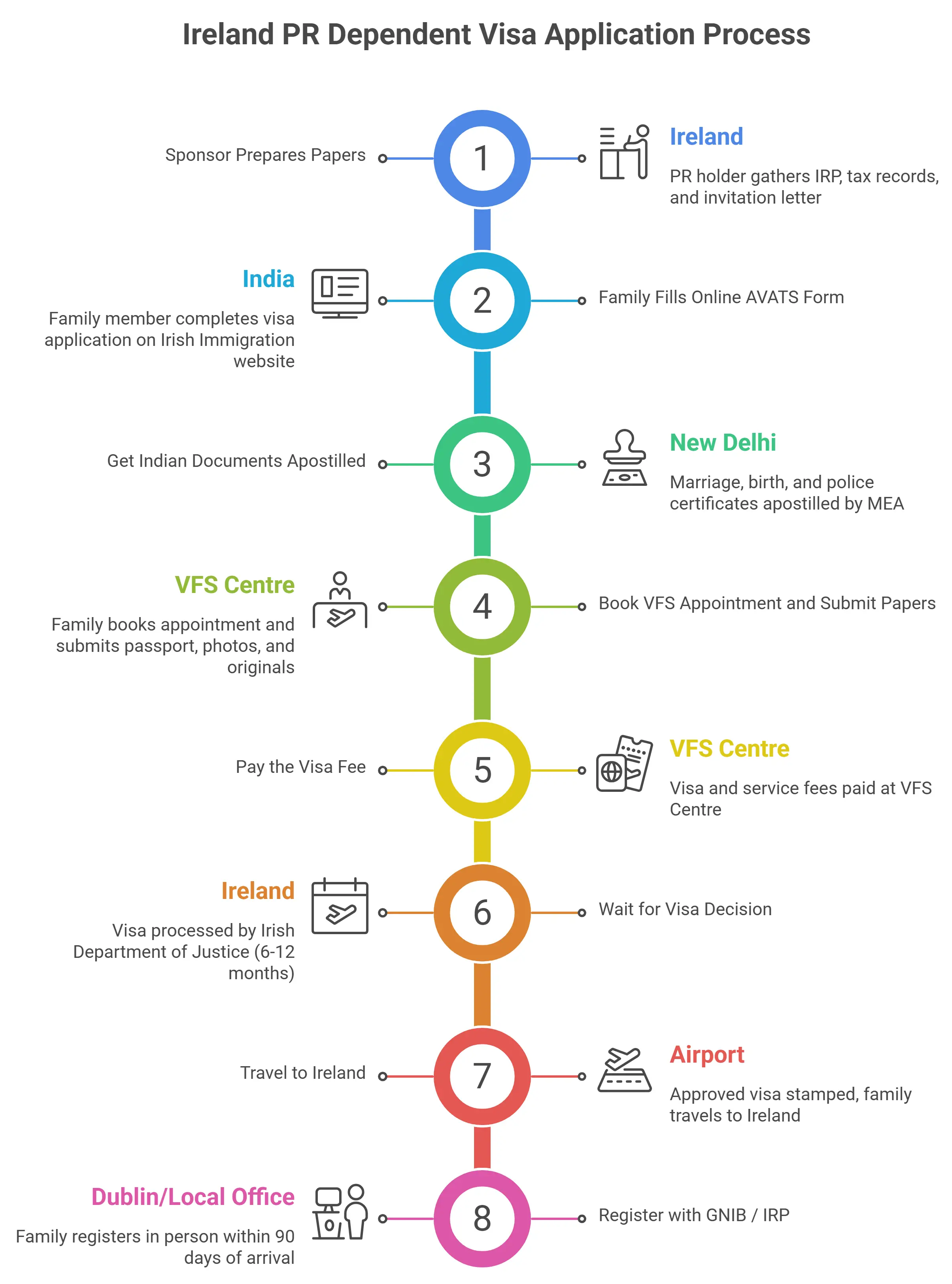
The full process has steps in both Ireland and India. The Ireland PR sponsor gets the papers ready, and the family applies online from India. The full process takes 6 to 12 months. Here are the simple steps you should follow:
Step 1: Sponsor Prepares Papers in Ireland
The Ireland PR holder collects all needed papers like the IRP card, PR / Stamp 4 / Stamp 5 letter, payslips, P60s, Revenue tax records, bank statements, tenancy agreement, and housing proof. The sponsor also writes a signed invitation letter.
Step 2: Family Fills Online AVATS Form in India
The family member in India fills the online visa application form (AVATS) on the official Irish Immigration website. They will get a summary sheet and an application reference number after the form is submitted.
Step 3: Get Indian Documents Apostilled
All Indian documents like marriage certificates, birth certificates, and police clearance must be apostilled by the Ministry of External Affairs (MEA) in New Delhi. This is a must for Ireland.
Step 4: Book VFS Appointment and Submit Papers
The family member books an appointment at the VFS Global Ireland Visa Application Centre in Delhi, Mumbai, Chennai, Bengaluru, Kolkata, Chandigarh, Pune, or other cities. On the day, they submit the signed AVATS summary, passport, photos, and all original documents with copies. Biometric data (fingerprints and photo) is also taken.
Step 5: Pay the Visa Fee
The single-entry D visa fee is €60 (around ₹5,500) and the multi-entry D visa is €100 (around ₹9,150). The VFS service fee is paid separately. Keep the payment receipt safe.
Step 6: Wait for Visa Decision
The visa is processed by the Irish Department of Justice. The processing time is 6 to 12 months for family of non-EEA sponsors. Some cases can take a bit more time during busy seasons. Updates can be checked online with the application number.
Step 7: Travel to Ireland
Once approved, the Long-Stay D visa is stamped on the passport. Your family can now plan their travel and fly to Ireland (Dublin, Cork, or Shannon airport).
Step 8: Register with GNIB / IRP
Within 90 days of arrival, the family must register in person at the Burgh Quay Registration Office in Dublin or the local Garda National Immigration Bureau (GNIB) office outside Dublin. They will get an Irish Residence Permit (IRP) card with a Stamp 3 or Stamp 4. The IRP fee is €300 per person.
Ireland PR Dependent Visa Fees
|
Fee Type |
Amount in Euro |
Amount in INR (approx.) |
|
Long-Stay D Visa (Single Entry) |
€60 |
₹5,500 |
|
Long-Stay D Visa (Multi Entry) |
€100 |
₹9,150 |
|
Irish Residence Permit (IRP) Card |
€300 |
₹27,500 |
|
VFS Service Fee |
₹1,300 to ₹1,800 |
₹1,300 to ₹1,800 |
|
MEA Apostille (per document) |
₹50 to ₹500 |
₹50 to ₹500 |
|
Police Clearance Certificate (PCC) |
₹500 to ₹1,000 |
₹500 to ₹1,000 |
|
Private Health Insurance (Yearly) |
€600 to €1,200 |
₹55,000 to ₹1,10,000 |
Ireland PR Dependent Visa Processing Time
The full process takes around 6 to 12 months from start to end. The exact time depends on the season, the city, and how complete the papers are. Here is a simple timeline you can plan for:
- Document Apostille and Setup: 20 to 30 days in India.
- AVATS Form and VFS Booking: 5 to 10 days.
- Visa Decision by Irish Embassy: 6 to 12 months.
- Travel to Ireland: Within 90 days of visa stamping.
- IRP Card Registration: Same day to 30 days after arrival.
To save time, start the process early, get all your documents apostilled, and submit complete and correct papers from the first try. Y-Axis experts check every paper before submission to avoid delays.
*Read about...
Validity and Renewal of the Ireland PR Dependent Visa
The Ireland PR Dependent Visa is linked to the sponsor's PR status. After arrival, the family gets a Stamp 3 or Stamp 4 IRP card, which is usually valid for up to 3 years at first. The card is renewed at the local immigration office before it ends.
The visa and IRP card can be renewed as long as:
- The sponsor's Ireland PR is still active and valid.
- The family lives together with the sponsor in Ireland.
- The income and housing rules are still met.
- The family has not been on social welfare in the last 2 years.
- The family has no criminal record in Ireland.
After 5 years of legal stay in Ireland, the family can apply for Irish citizenship through naturalisation and get an Irish passport. After 8 years on Stamp 4, family members can also apply for Stamp 5 (Without Condition as to Time), which removes all time limits on their stay.
Ireland Dependent Visa Renewal Process
The Irish Residence Permit (IRP) card given to your family is not for lifetime. It must be renewed before it ends. The renewal is now done fully online through the Irish Immigration Service portal. The good news is the process is simple, fast, and can be done from home in Ireland. Here is the full renewal process for Indian families:
When to Renew the IRP Card
You can apply to renew the IRP card up to 12 weeks (3 months) before the expiry date on the card. Do not wait until the last week, as late renewals can lead to a gap in legal stay. The Irish Department of Justice does not allow a stay in Ireland with an expired IRP card.
Step-by-Step Renewal Process
Step 1: Check the Expiry Date Find the expiry date on the front of the IRP card. Mark your calendar 3 months before this date.
Step 2: Create an Online Account Go to the official Irish Immigration online renewals portal at inisonline.jahs.ie and create an account using a working email ID.
Step 3: Fill the Renewal Form Fill in all the personal details, sponsor details (PR holder), current address, and the type of stamp you want to renew (Stamp 3 or Stamp 4).
Step 4: Upload Documents Upload scanned copies of:
- Current IRP card (front and back)
- Valid Indian passport
- Sponsor's IRP card and PR proof
- Sponsor's latest payslips and P60s
- Proof of address (utility bill, bank statement, or tenancy agreement)
- Marriage / birth certificate (if not already on file)
- Private health insurance cover
Step 5: Pay the Renewal Fee Pay €300 online through credit or debit card. Children under 18 do not pay any fee.
Step 6: Wait for Approval and New Card The renewal is normally processed in 2 to 8 weeks. After approval, the new IRP card is sent to your Ireland address by post in about 10 to 15 working days.
Renewal Fees (2026)
|
Family Member |
Renewal Fee |
|
Spouse / Adult Dependent |
€300 (approx. ₹27,500) |
|
Child below 18 years |
Free (no IRP card needed) |
|
Child 16 to 18 years |
€300 |
|
Dependent Parent |
€300 |
Healthcare in Ireland for Indian Families
Ireland has a modern healthcare system managed by the Health Service Executive (HSE). Indian families living in Ireland on a dependent visa can use both public and private healthcare services. Once your family becomes a legal resident in Ireland, many healthcare services are available at free or low cost. The HSE manages public hospitals, clinics, and health centres across the country. Families can use services such as child vaccinations, emergency treatment, maternity care, and regular medical support. Ireland is known for providing good healthcare facilities and safe medical services for families and children. Indian families may also qualify for a GP Visit Card, which allows free visits to a family doctor. Children under 8 years and adults above 70 years usually get this benefit. Some low and middle-income families may also receive the card after an income check.
Families with lower income can apply for a Medical Card, which provides mostly free healthcare services. This card covers:
- Free doctor visits
- Low-cost medicines
- Public hospital treatment
- Maternity and baby care
- Basic dental and eye check-ups
Many Indian families also choose private health insurance to get faster treatment and shorter waiting times in hospitals. Popular insurance providers in Ireland include VHI Healthcare, Laya Healthcare, and Irish Life Health. Private insurance for a family usually costs between €2,500 and €4,500 per year. Healthcare costs in Ireland without a medical card can be expensive. A normal doctor visit may cost around €50 to €70, while emergency hospital visits can cost about €100. Ireland also offers free maternity care through its public healthcare system. Pregnant women can receive free pregnancy check-ups, hospital delivery services, and post-birth care for both mother and baby. This is a major advantage for Indian families planning to have children in Ireland.
Families can apply for HSE healthcare cards online by submitting documents such as:
- IRP card
- PPS number
- Passport
- Payslips
- Address proof
Top Cities in Ireland for Indian Families
Ireland has many family-friendly cities with good schools, jobs, and Indian communities. Here are the best cities to settle in with your family:
- Dublin: The capital and biggest tech and finance hub. Home to Google, Meta, LinkedIn, and most Indian families.
- Cork: Big pharma and tech city. Home to Pfizer, Apple, and Johnson & Johnson.
- Galway: A safe and pretty city with strong medical device and IT jobs.
- Limerick: Growing tech hub with low rent and good schools.
- Waterford: Smaller city with low cost of living, great for first-time families.
- Athlone: Central Ireland, home to many BPO jobs and Indian families.
*Looking to work abroad? Get top consultation from experts at Y-Axis.
Cost of Living in Ireland for Indian Families
Ireland is one of the high-income countries in Europe, so the cost of living is higher than in India. However, salaries in Ireland are also good, and many Indian families are able to save money every month. The total monthly living cost for a family of 4 in Ireland usually ranges between €3,000 and €5,400 depending on the city, lifestyle, and type of housing. The biggest expense is house rent. A 2 BHK apartment may cost around €1,500 to €2,800 per month based on the location. Utility bills such as electricity, gas, water, and internet usually cost between €250 and €350 per month. Families generally spend around €500 to €700 per month on groceries, including Indian and local food items. Public transport for the family may cost around €120 to €180 monthly. Public schools in Ireland are free, but parents may still spend some money on books, uniforms, and school activities.
Other common monthly expenses include:
- Mobile phone bills: €40 to €60
- Private health insurance: €200 to €380
- Eating out and entertainment: €100 to €200
- Clothing and personal care: €150 to €250
- Petrol, travel, and other personal expenses: €200 to €400
Cities like Cork, Galway, Limerick, Waterford, and Athlone are usually more affordable than Dublin, especially for rent and daily expenses.
Tips to Save Money in Ireland
- Live in suburbs or smaller cities where rent is lower.
- Use public transport and LEAP travel cards to reduce travel costs.
- Buy groceries from affordable supermarkets like Lidl, Aldi, and Tesco.
- Shop from Indian grocery stores for familiar food products.
- Use public healthcare services whenever possible.
- Apply for Child Benefit support provided by the Irish government.
- Cook food at home instead of eating outside regularly.
Salary vs Cost of Living
The average yearly salary in Ireland is €50,000 to €60,000 (around ₹46 to ₹55 lakh). Most Indian families with one earner can comfortably live in Ireland. With two earners (both spouse working on Stamp 4), the family can save more than ₹15 lakh a year and still enjoy a good lifestyle.
Work and Study Rights for Dependents in Ireland
Ireland gives strong rights to dependent visa holders. The exact rights depend on the type of stamp your family gets. Here is a clear list:
Stamp 4 Dependants (Spouse / Partner of PR Holder)
- Can work in any job, any sector, full-time or part-time.
- Can run a business or be self-employed.
- No work permit fee or limit on job changes.
- Can study any course at any level, including PhDs and master's.
- Can access HSE public healthcare and social services.
Stamp 3 Dependants
- Cannot work or run a business.
- Can study short courses for personal interest.
- Children below 18 get free public school education.
- Can apply later for a Dependant Spouse Employment Permit (no permit fee) to switch and work.
For Children
- Free Irish public schooling from age 4 to 18.
- Free GP visits up to age 8.
- Can study at top universities like Trinity College Dublin, UCD, NUI Galway, and UCC.
- Can apply for Irish citizenship after 5 years if a parent has been Irish PR.
Watch: Ireland Work Visa and Fast PR Pathway
Work in Ireland and Get PR in 2 Years – Bring Your Family Too!
Watch this short video to know how Indian workers can get Ireland PR within 2 years through the Critical Skills Employment Permit (CSEP). Once you get your Ireland PR, your spouse and children can also join you on the Ireland Dependent Visa. Learn about jobs, salary, and the fast PR pathway in Ireland.
Watch Now:
Why Choose Y-Axis for Ireland PR Dependent Visa?
Y-Axis is one of India’s leading overseas visa and immigration consultants, helping families reunite and settle in countries like Ireland. We understand the complete Ireland PR Dependent Visa process and provide full support to make your family visa journey smooth and stress-free.
With more than 25 years of experience in immigration and overseas career services, Y-Axis has helped thousands of Indian families move abroad successfully. Our expert team guides you at every stage, from checking eligibility and preparing documents to visa filing and post-arrival support in Ireland.
Y-Axis offers:
- Complete support for Ireland dependent visa applications
- Expert help with document preparation and submission
- Guidance for spouse and child dependent visas
- Assistance with apostille and supporting documents
- Transparent process with no hidden charges
- Dedicated case managers for regular updates
- Quick response and professional support throughout the process
Our strong experience in handling Ireland family and dependent visa applications makes Y-Axis a trusted choice for Indian families planning to settle together in Ireland.
Y-Axis snapshot
1M
Successful applicants
1500+
Experienced counselors
25Y+
Expertise
50+
Offices
Don't know what to do ?
Get Free Counseling
Looking for Inspiration
Explore what Global Indians have to say about Y-Axis in shaping their future