

Posted on September 25 2026
How to Apply for a Germany Work Visa From India

By , Editor & Director
Updated September 25 2026
To apply for a Germany work visa from India, you first need a job offer from a German employer and a qualification recognised in Germany. Most Indian professionals apply for an EU Blue Card or a Skilled Worker visa. You submit a national (D) visa application for employment through the Consular Services Portal. You then give your biometrics at the German mission or VFS Global centre for your region. The visa fee is €75 while the employer can shorten the process through the fast-track procedure for skilled workers. After you arrive in Germany, you register your address and apply for your residence permit at the local foreigners authority, which confirms your right to live and work in the country.
*Want to apply for a Germany work visa? Let Y-Axis guide you through the process.
How to Apply for a Germany Work Visa from India?
Most Germany work visa routes need a job offer and a recognised qualification before you apply.
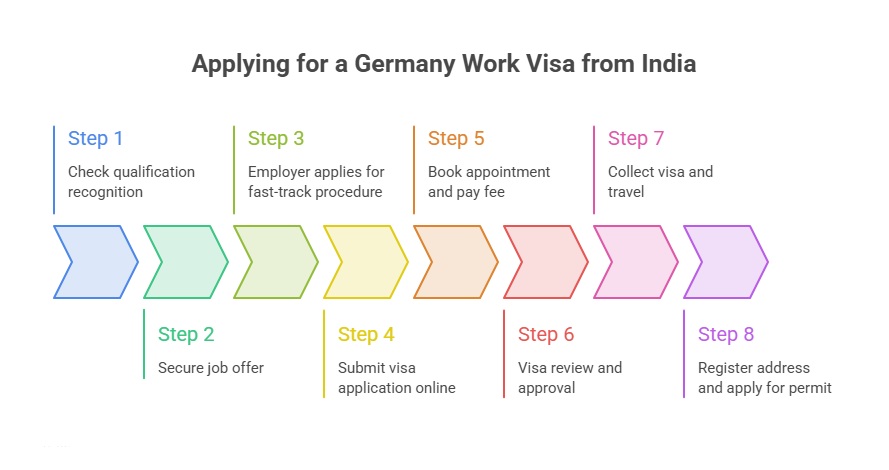
The steps to apply for a Germany work visa for Indians are as follows:
Step 1: Check that your degree or vocational qualification is recognised in Germany, using the anabin database or a Statement of Comparability from the Central Office for Foreign Education (ZAB).
Step 2: Secure a signed employment contract or binding job offer from a German employer that meets the salary threshold for your visa route.
Step 3: Your employer may apply for the fast-track procedure for skilled workers at the local foreigners authority in Germany to receive a pre-approval.
Step 4: Create an account on the Consular Services Portal and submit your national (D) visa application for employment, uploading all necessary documents.
Step 5: Book an appointment and give your biometrics at the German mission or VFS Global centre for your region, and pay the required visa fee.
Step 6: The German mission reviews your application and, where required, obtains approval from the Federal Employment Agency.
Step 7: Collect your passport with the national visa and travel to Germany before the visa expires.
Step 8: Register your address in Germany within two weeks and apply for your EU Blue Card or residence permit at the local foreigners authority.
Also, read...
Requirements for the Germany Work Visa
Meeting Germany's requirements depends on your visa route, qualification, and salary. The EU Blue Card, the Skilled Worker visa, and other employment routes share most of the same documents. The list below brings together the eligibility conditions and documents you will need.
The eligibility criteria for a Germany work visa are as follows:
- A signed employment contract or binding job offer from an employer in Germany.
- A university degree recognised in Germany, or vocational training recognised as equivalent to a German qualification.
- A gross annual salary that meets your route's threshold — €50,700 for the EU Blue Card, or €45,934.20 for shortage occupations, recent graduates, and qualifying IT specialists.
- For first-time applicants aged 45 or older, a gross annual salary of at least €55,770, unless you can show adequate pension provision.
- Approval from the Federal Employment Agency, where your visa route requires it.
- A professional licence to practise, for regulated professions such as doctors and nurses.
- A valid passport with at least two blank pages.
- Two recent biometric passport photographs meeting German visa photo standards.
- Health insurance cover from your date of entry until your German health insurance begins.
- A CV, proof of work experience, and certified translations of documents not in German or English, where required.
Also, read...
High-demand occupations in Germany
Cost of Applying for a Germany Work Visa From India
The total cost of applying for a Germany work visa depends on your visa route, whether your employer uses the fast-track procedure, and a few document-related charges. Costs below are shown in euros and their approximate Indian Rupee equivalent, at a rate of roughly ₹110 to the euro.
|
Cost Item |
Fee |
Notes |
|
National (D) Visa Fee |
€75 (approx. INR 8,250) |
Paid by the applicant in Indian Rupees at the German mission's exchange rate; a VFS service charge applies where you submit at VFS |
|
Fast-Track Procedure for Skilled Workers |
€411 (approx. INR 45,200) |
Optional; usually paid by the employer to the foreigners authority in Germany for a pre-approval |
|
ZAB Statement of Comparability |
€200 (approx. INR 22,000) |
Needed only if your degree or university is not rated as comparable in the anabin database |
|
Residence Permit / EU Blue Card Issuance |
Up to €100 (approx. INR 11,000) |
Paid in Germany to the local foreigners authority when your residence permit is issued |
|
Certified Translations |
INR 1,000-3,000 per document (approx.) |
Needed for documents not issued in German or English |
|
Health Insurance (until employment starts) |
Varies by provider |
Covers you from arrival until your German statutory or private health insurance begins |
*Are you looking for step-by-step assistance with Germany immigration? Contact Y-Axis, the world's No. 1 overseas immigration consultancy, for end-to-end assistance!
FAQs
Can I apply for a Germany work visa without a job offer?
Most Germany work visas, including the EU Blue Card and the Skilled Worker visa, need a job offer from a German employer. However, the Opportunity Card (Chancenkarte) lets qualified professionals enter Germany to look for work for up to one year. It uses a points system and requires proof of funds. You can work part-time for up to 20 hours a week while you search.
What is the processing time for a Germany work visa from India?
Processing time depends on your visa route, the German mission, and how complete your application is. Applications through the Consular Services Portal are usually processed faster. Waiting times for appointments can still apply during busy periods. The fast-track procedure for skilled workers, arranged by your employer, can shorten the overall timeline to a few weeks.
What is the difference between the EU Blue Card and the Skilled Worker visa?
The EU Blue Card is for university graduates with a qualifying job offer and a salary of at least €50,700, or €45,934.20 for shortage occupations. It offers a faster route to permanent residence. The Skilled Worker visa covers professionals with a recognised degree or vocational training. It has no fixed salary threshold for applicants under 45, but pay must match local standards.
Is there a minimum salary requirement for a Germany work visa?
It depends on your route. The EU Blue Card requires a gross annual salary of €50,700, or €45,934.20 for shortage occupations, recent graduates, and qualifying IT specialists. First-time applicants aged 45 or older generally need at least €55,770 a year, unless they show adequate pension provision. For other skilled workers, the salary must be comparable to that of German employees.
Do I need to speak German to get a Germany work visa?
Not for most skilled roles. The EU Blue Card and the Skilled Worker visa do not require German language skills, unless your job or profession needs them. Regulated professions such as nursing and medicine usually require German, often at B1 or B2 level. The Opportunity Card requires basic German at A1 level or English at B2 level.
Can my spouse and children join me in Germany?
Yes. Your spouse and children can apply for family reunification visas once you hold a work visa or residence permit. Spouses of EU Blue Card holders do not need to prove German language skills. Your family members can live with you in Germany, and your spouse can generally work without restrictions. You must show enough living space and income to support them.
Do I need to get my Indian degree recognised in Germany?
Yes, for most skilled routes. You can check your degree in the anabin database. If your degree is rated as comparable and your university is listed as H+, a printout is usually enough. Otherwise, you need a Statement of Comparability from the Central Office for Foreign Education (ZAB). Regulated professions also need a separate professional licence.
Can I switch employers while on a Germany work visa?
Yes, but the rules depend on your permit. EU Blue Card holders must inform the foreigners authority of a job change during their first 12 months. After that, no notification is needed for suitable roles. Holders of other work permits may need the authority's approval before changing jobs. Always check the conditions on your residence permit before accepting a new offer.
What happens if my Germany work visa application is rejected?
If your application is rejected, the decision letter explains the reason. Common reasons include missing documents, an unrecognised qualification, or a salary below the required threshold. The letter also explains the legal options available to you. You can reapply once you have resolved the issue. The visa fee is usually not refunded after a rejection.
Does a Germany work visa lead to permanent residency?
Yes. EU Blue Card holders can apply for a settlement permit after 27 months, or after 21 months with German language skills at B1 level. Skilled workers can usually apply after three years of qualified employment. You must also meet other conditions, such as pension contributions and basic German language skills. A settlement permit is not tied to a specific employer.
Tags:
Germany work visa
Germany EU Blue Card
Germany work visa from India
Germany Skilled Worker visa
Germany Opportunity Card
work in Germany
Germany visa requirements
Germany immigration for Indians
Share
Options for you by Y-Axis

Get it on your mobile

Get News alerts

Contact Y-Axis
Latest Article
Popular Post
Trending Article
Posted On September 25 2026
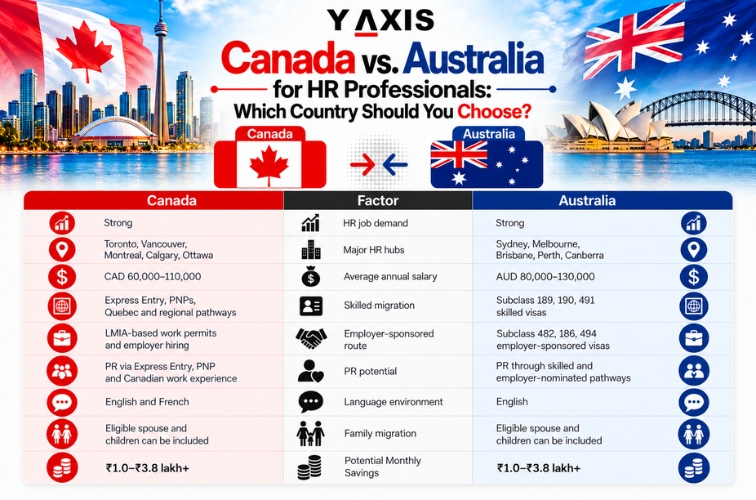
Canada vs. Australia for HR Professionals: Which Country Should You Choose?