

Posted on January 28 2026
How can I migrate to Canada as a Registered Nurse?

By , Editor
Updated February 02 2026
You can migrate to Canada as a registered nurse (RN) by getting your credentials assessed by the National Nursing Assessment Service (NNAS) and clearing the NCLEX-RN (National Council Licensure Examination), in most Canadian provinces and an OIIQ in Quebec. Canadian immigration pathways for registered nurses include Express Entry, Provincial Nominee Program (PNPs), Federal Skilled Worker Program (FSWP), and Canadian Experience Class (CEC). A foreign-registered nurse needs to have English/French proficiency (IELTS/CELBAN), at least 1 year of work experience, and a legal provincial nursing license.
*Want to work in Canada? Let Y-Axis guide you with the steps.
Immigration Pathways in Canada for Registered Nurses
Immigration pathways in Canada for registered nurses include Express Entry, the Federal Skilled Worker Program, the Canadian Experience Class, and Provincial Nominee Programs (PNPs), such as Ontario’s OINP or BC PNP. Registered Nurses (RNs) and Registered Psychiatric Nurses (RPNs) need to pass the credential assessment (NNAS), language tests, and secure a license to practice nursing legally in Canada.
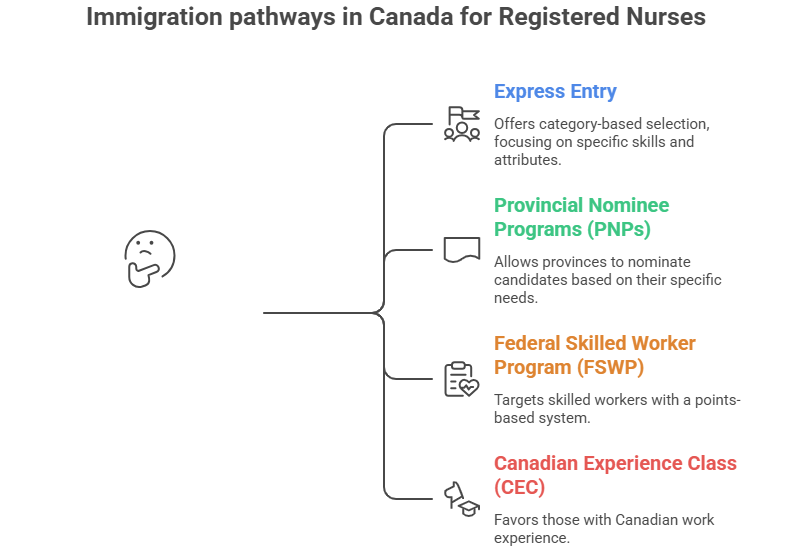
The following are the immigration pathways in Canada for registered nurses:
Express Entry (Category-Based Selection)
Express Entry is a category-based selection pathway for registered nurses to migrate to Canada for priority healthcare occupations. Foreign nurses can benefit from targeted draws that prioritise healthcare sectors with a critical labour shortage. Applying for the category-specific Express Entry draws for healthcare occupations provides registered foreign nurses with a greater chance of receiving an Invitation to Apply (ITA) with a comparatively lower CRS score. Being transparent, fast-tracked, and points-based, Express Entry is a suitable Canada immigration program for registered nurses with the required educational qualification/training and professional work experience.
*Want to apply for Express Entry? Let Y-Axis guide you with the process.
Provincial Nominee Programs (PNPs)
Provincial Nominee Programs are an immigration pathway for nurses to seek work opportunities in Canadian provinces facing labour shortages in the healthcare and nursing sectors. Foreign-registered nurses can migrate to provinces such as Ontario (Ontario Immigrant Nominee Program), British Columbia (British Columbia PNP), Alberta, and Nova Scotia via PNPs. A provincial nomination adds 600 points to your CRS score, increasing the chance of securing a permanent residence in Canada with a stable nursing job opportunity in the provinces’ healthcare and nursing sectors.
*Want to apply for Canada PNP? Let Y-Axis guide you with the steps.
Federal Skilled Worker Program (FSWP)
Registered nurses with foreign training/education and work experience can migrate to Canada through the Federal Skilled Worker Program (FSWP). To apply for FSWP, registered nurses must meet the eligibility criteria, including a recognised educational degree/training and work experience, as well as strong English or French language proficiency. The Federal Skilled Worker Program is a pathway for registered nurses to seek Canada PR and work opportunities, provided they have at least 1 year of professional work experience.
*Want to apply for FSWP? Let Y-Axis assist you with the process.
Canadian Experience Class (CEC)
The Canadian Experience Class (CEC) is an immigration pathway for foreign registered nurses with at least 1 year of Canadian work experience on a temporary work permit. Registered nurses working in Canada’s hospitals, long-term care facilities, or clinics can apply for PR status through the CEC pathway. The Canadian Experience Class (CEC) offers faster processing for registered nurses who have work experience in Canada’s healthcare/nursing sectors and meet the required language proficiency.
Also, read…
How to migrate to Canada as a Doctor?
Eligibility Criteria for Registered Nurses to Migrate to Canada
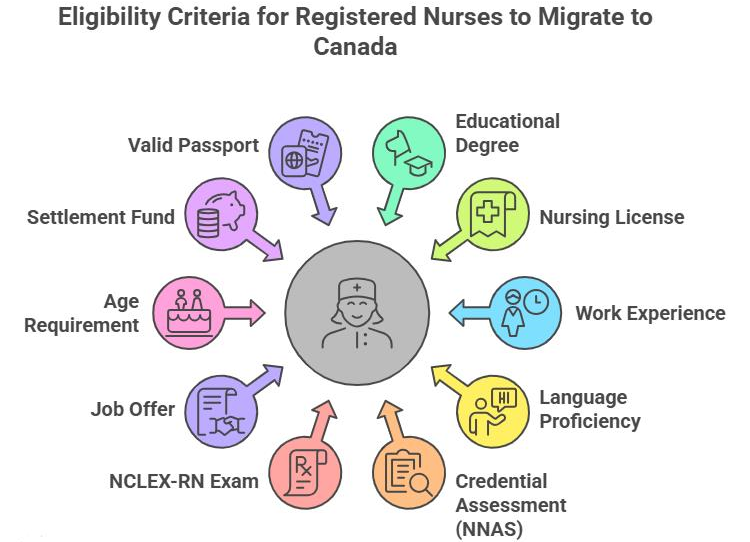
To migrate to Canada as a registered nurse (RN), you must have a recognised nursing degree/diploma with a valid practising license and at least one year of nursing work experience within the past 3 years. Registered nurses also need to pass language proficiency tests (IELTS/CELBAN), have their credentials assessed by NNAS, and pass the NCLEX-RN exam to secure a Canadian provincial license.
- Recognised educational degree/diploma.
- An authorised nursing license from the home country.
- Minimum 6-12 months of work experience (at least 1 year of Canadian work experience for CEC).
- Proof of language proficiency (IELTS or CELBAN for English and TEF/TCF for French.
- Proof of credential assessment from the National Nursing Assessment Service (NNAS).
- NCLEX-RN exam result.
- Valid job offer.
- Minimum age requirement.
- Sufficient settlement fund.
- Valid passport.
*Looking for nurse jobs in Canada? Sign-up with Y-Axis to find the right one.
How to Apply for Canada Immigration as a Registered Nurse?
Registered nurses can migrate to Canada after receiving credential recognition through the National Nursing Assessment Service (NNAS), clearing the NCLEX-RN exam, and applying to suitable immigration pathways. Additionally, foreign nurses need to secure a valid job offer and pass the language proficiency test to obtain a high CRS score.
Step 1: Check eligibility for various Canadian immigration pathways for doctors.
Step 2: Select a suitable pathway to migrate to Canada as a doctor based on your educational qualifications, work experience, and job offer.
Step 3: Clear the language proficiency tests (IELTS/CELPIP) to meet Canadian Language Benchmark (CLB) requirements (CLB 7 or higher).
Step 4: Secure an ECA (Educational Credential Assessment) to validate your nursing degree/diploma.
Step 5: Get your nursing credentials assessed through the National Nursing Assessment Service (NNAS)
Step 6: Pass the NCLEX-RN exam to apply for licensure with the provincial nursing board.
Step 7: Secure a nursing job offer from a Canadian employer (not mandatory for Express Entry).
Step 8: After receiving an Invitation to Apply (ITA), submit the application with the required documents (police clearance certificate, medical report, etc.) for Canada PR.
Step 9: Upon Confirmation of Permanent Residence (COPR), fly to Canada to live and work as a registered nurse.
*Are you looking for step-by-step assistance with Canada immigration? Contact Y-Axis, the world’s No. 1 overseas immigration consultancy, for end-to-end assistance!
FAQs
How to migrate to Canada as a registered nurse?
You can migrate to Canada as a registered nurse after getting your credentials assessed by the National Nursing Assessment Service (NNAS) and clearing the provincial licensing exams. The immigration pathways in Canada include Express Entry, Provincial Nominee Program (PNPs), Federal Skilled Worker Program (FSWP), and Canadian Experience Class (CEC). Additionally, you need to pass English/French proficiency tests (IELTS/CELBAN), have at least 1 year of work experience, and secure a valid job offer to migrate to Canada as a nurse.
Are nursing jobs in high demand in Canada?
Nursing jobs in Canada are in very high demand due to a rapidly ageing population and bulk retirement of staff, creating vacancies across several provinces and territories. Regions like Ontario, British Columbia, Alberta, and Quebec have a substantial shortage of trained nursing professionals, creating job opportunities for registered nurses from abroad.
What are the eligibility criteria for registered nurses to work in Canada?
To work as a registered nurse in Canada, you need to pass the NCLEX-RN exam (except in Quebec), have the required language proficiency, and hold a nursing diploma. The following are the eligibility requirements for registered nurses to migrate to Canada:
- Nursing degree/diploma.
- Legal nursing license from the home country.
- At least 1 year of work experience.
- Proof of language proficiency via IELTS or CELBAN for English and TEF/TCF for French.
- Credential verification at the National Nursing Assessment Service (NNAS).
- Clearance results in the NCLEX-RN exam.
- Valid job offer (not mandatory for Express Entry).
- Minimum age requirement.
- Sufficient funds.
- Valid passport.
How to get a credential assessment for registered nurses migrating to Canada?
Registered nurses migrating to Canada can have their credentials assessed by the National Nursing Assessment Service (NNAS), which evaluates education and licensure requirements against Canadian standards. You need to create an NNAS account and submit documents such as proof of identity and educational transcripts/certificates. The NNAS advisory report is essential for provincial bodies to verify your nursing license.
How to prepare for the Canadian nursing licensing exam?
To prepare for the Canadian nursing license exam (NCLEX-RN), you need to have extensive clinical knowledge and conduct scenario-specific study focusing on decision-making skills. Foreign nurses can refer to the official NCSBN/CNA prep guides to learn more about the comprehensive guidelines for preparing for the licensing nursing exam in Canada.
What is the average salary of a registered nurse in Canada?
The average salary for a registered nurse in Canada depends on the province, work experience, and the specialisation of the job role, ranging from CAD $70,000 to $95,000+ annually. The hourly rate for nursing is around $30 to over $50, with shortage provinces like Nunavut and NWT paying even higher. Experienced foreign nurses with valid registration can earn up to $90k-$100k+ annually in Canada.
What are the costs involved in migrating to Canada as a registered nurse?
Migrating to Canada as a registered nurse involves relocation costs ranging from CAD $2,000 to CAD $3,000 for licensing and other immigration processes. Foreign nurses migrating to Canada should also consider travel and initial settlement expenses, along with the English proficiency test fee, NCLEX-RN exam fee, and the cost of provincial registration.
Is a job offer mandatory to migrate to Canada as a registered nurse?
A job offer is not required to migrate to Canada as a registered nurse, as Express Entry and targeted draws do not require a job confirmation as an eligibility requirement. Additionally, a severe shortage of skilled nurses allows them to apply for permanent residency in Canada with 6–12 months of work experience.
Can I migrate to Canada as a registered nurse if I am over 40?
Yes, you can migrate to Canada as a registered nurse, even if you are over 40, though your Express Entry points are reduced if you are older than 40. There is no upper age limit for Canada immigration as a foreign nurse applying through pathways like Provincial Nominee Programs (PNPs).
Can I apply for permanent residence in Canada as a registered nurse?
Yes, you can apply for permanent residence in Canada (PR) as a registered nurse through several immigration pathways, such as Express Entry with healthcare-specific draws and Provincial Nominee Programs (PNPs). Registered nurses need at least 6–12 months of continuous work experience, a completed Educational Credential Assessment (ECA), and high language proficiency (English or French) to qualify for Canada PR.
Tags:
Work in Canada
nurse jobs in Canada
Salary of nurses in Canada
National Nursing Assessment Service
Express Entry
Provincial Nominee Program
National Council Licensure Examination for Registered Nurses
Federal Skilled Program
Share
Options for you by Y-Axis

Get it on your mobile

Get News alerts

Contact Y-Axis
Latest Article
Popular Post
Trending Article
Posted On March 14 2026
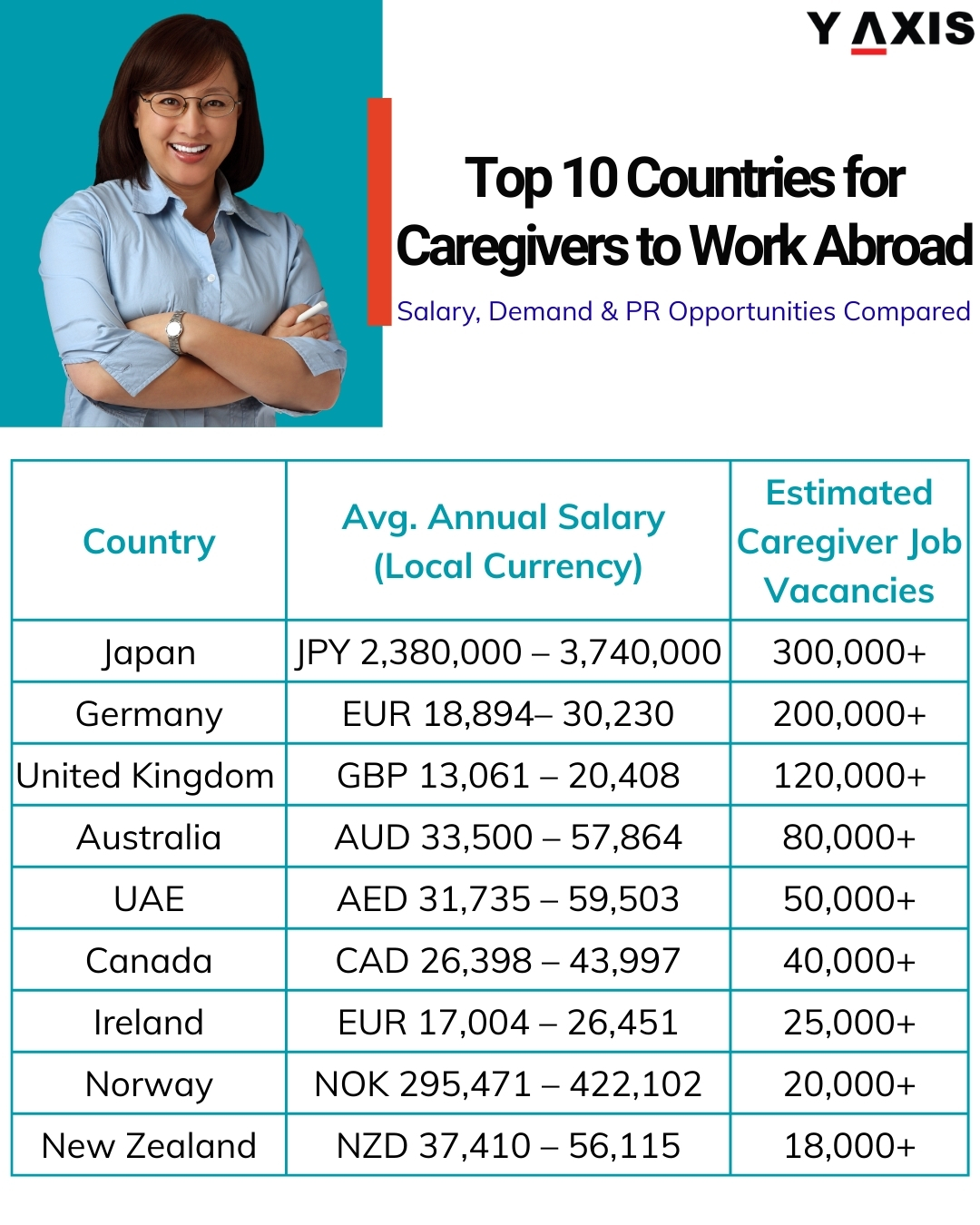
Top 10 Countries for Caregivers to Work Abroad: Salary, Demand & PR Opportunities Compared