


Posted on December 12 2025
What are the fast-track hiring options in Australia for Skilled Professionals?

By , Editor
Updated February 12 2026
What are the fast-track hiring options in Australia for Skilled Professionals?
The most common fast-track hiring options in Australia for skilled professionals include the Skill in Demand (SID) Visa (subclass 482) and the National Innovation Visa (NIV) (Subclass 858). The fast-track hiring options in Australia are visa pathways that provide priority processing, along with allowing Australian employers to recruit highly skilled foreign professionals faster in sectors with labour shortages.
Qualifying for a fast-track visa option in Australia can help accelerate the visa processing time, with a simplified visa documentation process and faster PR pathways, as compared to the other work visa pathways in Australia. While both the Subclass 482 visa and the Subclass 858 visa serve different purposes, they are considered the primary fast-track hiring options in Australia, as they facilitate faster hiring in sectors experiencing skill shortages. Some of the other fast-track hiring options in Australia include the Employer Nomination Scheme (ENS) Subclass 186 visa.
*Want to work in Australia? Let Y-Axis guide you with the process.
Fast-track hiring options in Australia for skilled workers
Some of the fast-track hiring options in Australia for skilled workers are as follows:
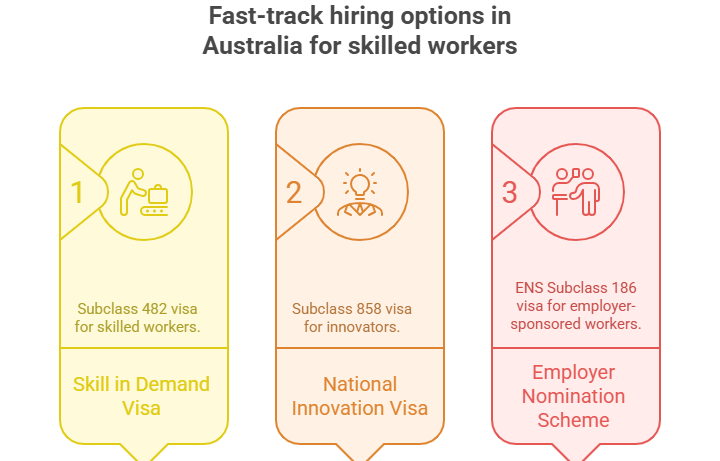
Skill in Demand (SID) Visa (Subclass 482)
The Skills in Demand visa is an employer-sponsored visa that allows qualifying skilled workers to reside and work in Australia for a maximum of four years. Through the Subclass 482 visa pathways, Australian employers hire skilled foreign professionals to fill labour shortages when there is no local talent available for that job role. The Skills in Demand visa is considered a fast-track hiring option as it offers priority processing for workers in high-demand occupations, without the need for a points test, offering a PR pathway, and allows the visa holder to start working in Australia within 2-4 months. Healthcare workers, engineers, IT professionals, and skilled trades workers can benefit the most from the Subclass 482 visa pathway.
To qualify for the SID visa, you must have:
- A valid job offer from a registered Australian employer
- An employer sponsorship for a job role that is listed on the skilled occupation list
- Skills and work experience that align with the nominated occupation
*Want to apply for a Skills in Demand visa? Let Y-Axis guide you with the process.
National Innovation Visa (subclass 858)
The National Innovation visa, also known as the Subclass 858 visa, is a fast-track visa pathway for exceptionally skilled foreign nationals in priority sectors, such as IT, engineering, and healthcare. The Subclass 858 visa is considered a fast-track hiring option, as successful visa holders are granted a direct PR grant and receive priority visa processing by the DHA, without the need for employer sponsorship. Entrepreneurs, Innovative Investors, Global Researchers, Academics, Business Leaders, Tech Innovators, athletes, and creatives will benefit the most from the Subclass 858 fast-track visa pathway.
To qualify for the NIV visa, you must:
- Have exceptional achievements in high priority sectors in Australia like IT, healthcare, Fintech, engineering, AI, or research.
- Be nominated by an Australian citizen, PR holder, or a recognized organization
- Have a high salary (above the Fair Work high-income threshold)
- Demonstrate functional English proficiency (IELTS 4.5)
- Prove that you can contribute to the Australian economy
*Want to apply for a Subclass 858 visa? Let Y-Axis help you with the process.
Employer Nomination Scheme (ENS) Subclass 186 visa
The Employer Nomination Scheme is a visa for skilled foreign workers, issued with a nomination from an Australian employer. The Subclass 186 visa pathway serves as a fast-track hiring option, allowing employers in Australia to hire in critical job roles or through accredited sponsorship. The Employer Nomination Scheme can be considered as a fast-track hiring option as it is employer-driven, does not require a point test, and offers direct PR benefits.
To qualify for the ENS visa, you must:
- Be nominated by an Australian employer
- Work in an occupation that is listed on Australia’s Skills Occupation List
- Have a positive skills assessment
- Meet the English language, health, and character requirements
- Be under 45 years of age
*Want to apply for a Subclass 186 visa? Let Y-Axis assist you with the procedure.
Steps to Apply for Fast-Track Hiring Options in Australia
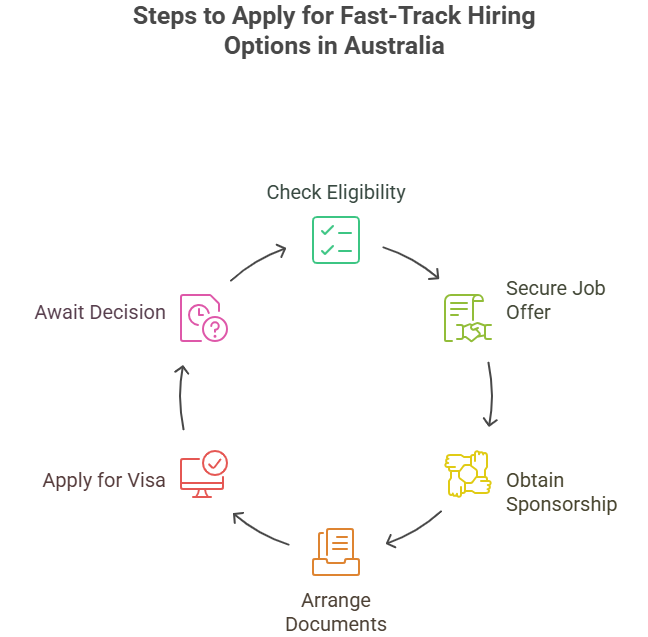
You can follow the steps given below to apply for a fast-track hiring option in Australia:
Step 1: Check your eligibility for the fast-track hiring option in Australia, depending on your skills, experience, and qualifications.
Step 2: Secure a job offer from a registered Australian employer if you are applying for an employer-sponsored visa. Y-Axis Resume Marketing Services can help you find the right job in Australia.
(Subclass 858 or National Innovation Visa does not require a job offer)
Step 3: Obtain an employer sponsorship or nomination from a registered Australian employer, along with the job contract.
Step 4: Arrange the documents required, including a passport, educational qualifications, proof of work experience, English language proficiency, character and medical certificates, etc.
Step 5: Apply for the Australian work visa via the official DHA website
Step 6: Await a decision on your visa.
(The processing time may vary depending on the type of visa you have applied for and the complexity of your application.)
Step 7: Fly to Australia once your Australian work visa is approved.
*Are you looking for step-by-step assistance with Australian immigration? Contact Y-Axis, the world’s No. 1 overseas immigration consultancy, for end-to-end assistance!
FAQs
What are fast-track hiring options in Australia for skilled professionals?
Fast-track hiring options in Australia refer to skilled migration pathways that prioritise applicants working in high-demand occupations or sponsored by Australian employers. These pathways are designed to address skill shortages and reduce visa processing times by prioritising critical sectors. Fast-track hiring does not guarantee instant approval but allows eligible professionals to move through the migration system more efficiently. These options often involve employer sponsorship, priority occupation lists, or visas aimed at highly skilled global talent. They are particularly beneficial for professionals seeking quicker entry into the Australian workforce and long-term settlement opportunities.
Which Australian visas are considered fast-track hiring options?
Australia offers several visa pathways that support fast-track hiring for skilled professionals. These include the Temporary Skill Shortage Visa (Subclass 482), Employer Nomination Scheme (Subclass 186), Skilled Independent Visa (Subclass 189), Skilled Nominated Visa (Subclass 190), and the Global Talent Visa (Subclass 858). Employer-sponsored visas are generally processed faster when linked to priority occupations. The Global Talent Visa offers one of the quickest routes to permanent residency for exceptionally skilled individuals. Each visa has different eligibility criteria, sponsorship requirements, and processing timelines depending on occupation and demand.
Which Australian visa offers the fastest processing for skilled workers?
Employer-sponsored visas, particularly the Temporary Skill Shortage Visa (Subclass 482), are often processed faster than points-tested visas when linked to priority occupations. The Global Talent Visa (Subclass 858) is also known for relatively quick processing, as it targets highly skilled professionals with international recognition. Processing speed depends on factors such as occupation demand, document completeness, skills assessment timelines, and government priorities. Australia does not offer paid priority processing; instead, applications are prioritised based on economic and labour market needs.
What is Australia’s Priority Migration Skilled Occupation List (PMSOL)?
The Priority Migration Skilled Occupation List (PMSOL) identifies occupations critical to Australia’s economic growth and labour market needs. Applicants sponsored for roles on this list receive higher processing priority from the Department of Home Affairs. Occupations typically include healthcare professionals, engineers, IT specialists, and construction workers. While PMSOL does not guarantee visa approval, it significantly improves processing speed compared to non-priority roles. Targeting PMSOL occupations increases the chances of faster hiring and migration outcomes for skilled professionals.
Is employer sponsorship mandatory for fast-track hiring in Australia?
Employer sponsorship is required for most fast-track hiring pathways in Australia, especially under the Subclass 482 and Subclass 186 visas. Sponsorship allows employers to address urgent skill shortages by hiring overseas professionals. However, not all fast-track routes require sponsorship. The Global Talent Visa and some points-tested visas, such as Subclass 189 and 190, allow eligible professionals to apply independently. Sponsorship generally results in faster processing because employer demand demonstrates immediate labour market need.
Can Indian professionals apply for Australia’s fast-track hiring visas?
Yes, Indian nationals are fully eligible to apply for Australia’s fast-track hiring options. Indian professionals form a significant portion of Australia’s skilled migrant workforce, particularly in IT, healthcare, engineering, and education. Applicants must meet visa-specific criteria such as skills assessment, English language proficiency, occupation eligibility, and sponsorship or nomination where required. With the Australia–India Economic Cooperation and Trade Agreement (AI-ECTA), mobility opportunities for skilled Indian professionals have further strengthened.
Which industries benefit most from fast-track hiring in Australia?
Fast-track hiring in Australia strongly supports industries experiencing persistent labour shortages. These include healthcare and aged care, IT and software development, engineering, construction, mining, infrastructure, education, and renewable energy. Technology-driven sectors such as artificial intelligence, cybersecurity, and data analytics are also prioritised. Professionals working in these industries are more likely to receive employer sponsorship, faster visa processing, and stronger long-term settlement opportunities due to ongoing demand across Australian states and territories.
Does Australia offer priority processing for skilled visas?
Australia does not offer paid priority or super-priority visa processing services. Instead, applications are prioritised based on occupation demand, employer sponsorship, sector importance, and government workforce priorities. Visas linked to critical skill shortages or employer-sponsored roles are processed faster than general skilled migration applications. Applicants cannot pay for faster decisions, but choosing the right visa pathway and occupation significantly influences processing speed.
What is the Global Talent Visa and how does it support fast hiring?
The Global Talent Visa (Subclass 858) is designed for exceptionally talented professionals with international recognition in fields such as technology, AI, fintech, medtech, academia, and research. It offers a direct pathway to permanent residency and is often processed faster than other skilled visas. Applicants must demonstrate outstanding achievements or future potential and be nominated by an Australian organisation or individual. This visa supports fast hiring by enabling Australia to attract top global talent without employer sponsorship requirements.
Do fast-track Australian visas lead to permanent residency?
Yes, many fast-track hiring visas in Australia offer direct or clear pathways to permanent residency. Employer Nomination Scheme (Subclass 186), Skilled Independent (Subclass 189), Skilled Nominated (Subclass 190), and Global Talent visas all grant permanent residency. Temporary visas like Subclass 482 can also lead to PR through employer nomination. These pathways make fast-track hiring options suitable for professionals planning long-term settlement in Australia.
How long does it take to get PR through fast-track options in Australia?
The time required to obtain permanent residency depends on the visa pathway and applicant profile. Employer-sponsored and Global Talent visas are generally faster than points-tested skilled visas. Some applicants may receive PR within a year, while others may take longer depending on skills assessment timelines, nomination approvals, and application volumes. Fast-track hiring reduces entry time into Australia but PR timelines still depend on meeting eligibility and residence requirements.
Are English language tests required for fast-track Australian visas?
Yes, English language proficiency is required for most Australian skilled migration visas. Applicants typically need to submit IELTS, PTE, TOEFL, or equivalent test scores unless exempt based on nationality or education history. Higher English scores can improve eligibility and points ranking for skilled visas. Even under fast-track hiring routes, meeting English requirements is mandatory to ensure workplace communication and integration in Australia.
Can dependents accompany skilled professionals under fast-track visas?
Most Australian skilled migration visas allow applicants to include eligible dependents, such as spouses and dependent children. Dependents can live, study, and work in Australia, subject to visa conditions. Family inclusion makes fast-track hiring options attractive for professionals seeking long-term settlement. Permanent visa holders also gain access to public services such as healthcare and education for their families.
What is the role of skills assessment in fast-track hiring?
A positive skills assessment from an approved assessing authority is mandatory for most Australian skilled migration visas. It verifies that an applicant’s qualifications and work experience meet Australian standards. Occupations in high demand may experience faster assessment processing. Completing skills assessment early improves overall application timelines and supports faster hiring outcomes under employer-sponsored or points-tested pathways.
Can fast-track visa holders change employers in Australia?
Job mobility depends on the visa type. Employer-sponsored visa holders, such as Subclass 482 holders, usually require a new nomination if they change employers. Permanent visa holders have full work flexibility. Global Talent visa holders also enjoy greater freedom to work across roles. Understanding job mobility rules is important when selecting a fast-track hiring pathway aligned with career goals.
Is the Australia Graduate Visa considered a fast-track hiring option?
The Temporary Graduate Visa (Subclass 485) is not officially a fast-track hiring route. However, it allows employers to hire international graduates quickly without sponsorship, making recruitment faster and simpler. The Graduate Visa serves as a transition route from study to skilled employment and can later lead to employer-sponsored or skilled PR visas. It indirectly supports fast workforce entry for graduates.
What salary requirements apply to fast-track hiring visas in Australia?
Employer-sponsored visas must meet Australia’s Temporary Skilled Migration Income Threshold (TSMIT) and market salary requirements. Salary thresholds ensure fair wages and protect local labour markets. While fast-track options may prioritise processing, salary requirements remain mandatory. Applicants and employers must ensure offered salaries comply with visa rules to avoid delays or refusals.
How can professionals improve their chances of fast-track hiring in Australia?
Professionals can improve eligibility by targeting shortage occupations, gaining relevant work experience, improving English scores, completing skills assessments early, and securing employer sponsorship. Applying under priority sectors and choosing the correct visa pathway significantly increases the chances of faster processing and successful outcomes.
Is fast-track hiring suitable for long-term settlement in Australia?
Yes, fast-track hiring options are well suited for long-term settlement. Many pathways lead to permanent residency and eventually Australian citizenship. These routes support stable employment, family inclusion, and access to public benefits, making Australia an attractive destination for skilled professionals planning long-term relocation.
Why is Australia attractive for fast-track skilled migration?
Australia offers strong demand for skilled talent, competitive salaries, high quality of life, clear PR pathways, and a transparent immigration system. Its focus on priority occupations and employer-led migration makes fast-track hiring an effective way for skilled professionals to build long-term careers and settle permanently.
Tags:
Fast track hiring in Australia
work in Australia
Fast-track hiring options in Australia
Australian immigration
Australian visas
Australia work visas
Migrate to Australia
Subclass 482 visa
Subclass 858 visa
Skills in demand visa
Share
Options for you by Y-Axis

Get it on your mobile

Get News alerts

Contact Y-Axis
Latest Article
Popular Post
Trending Article

Posted On April 01 2026
Study vs Work Abroad – Which is Better for Indians in 2026?