

Posted on June 04 2026
What are the Eligibility Requirements for a Thailand Work Visa?

By , Editor
Updated July 03 2026
What are the eligibility requirements for a Thailand work visa?
To be eligible for a Thailand work visa, you need to secure a job offer from an authorised employer along with an official pre-approval letter from the Thai Ministry of Labour. Upon successful job confirmation, Indian workers have to apply for a Non-Immigrant visa category “B” to legally enter the country. After arriving in Thailand, you need to get your official work permit approved by submitting the necessary documents such as work experience letter, offer letter and educational transcripts among others. Factors such as applicant’s qualifications, the employer's business size, and compliance with Ministry of Labour restrictions are highly relevant for work visa approval in Thailand.
*Want to apply for a Thailand work visa? Let Y-Axis guide you with the process.
Eligibility Criteria for Thailand Work Visa: Employee vs Employer Requirements
Indians can legally work in Thailand by finding a job role that aligns with their qualification, profile and salary requirements. The process to apply for a Thailand work visa is broadly categorised into two parts where you need to get a non-immigrant B visa approved to legally enter Thailand and then secure a work permit to officially start the role.
Watch to Know More: Jobs in Thailand | Work Visa Fees & Opportunities
Explore job opportunities in Thailand, work visa fees, in-demand industries, salary expectations, and career prospects for international professionals.
The table below is a comprehensive guide to major requirements and documentation for employees and employers to apply for a work visa in Thailand:
| Employee Eligibility Criteria | Documents Required from Employee | Employer Eligibility Criteria | Documents Required from Employer |
|---|---|---|---|
| Must have a valid job offer or employment contract from a Thai-registered company. | Passport valid for at least 6 months with at least two blank pages. | Company must have fully paid-up registered capital of at least 2 million THB per foreign employee. | Company registration certificate and incorporation documents. |
| Must possess the educational qualifications, professional certifications, or specialized skills required for the position. | Completed visa application form with recent passport-sized photographs. | Company must employ at least four Thai nationals for every one foreign employee. | Shareholder list and company profile. |
| Must have a clean immigration and criminal record. | Educational certificates, diplomas, transcripts, and professional certifications. | Employer must provide a formal employment offer detailing job title, duties, and salary. | Employment contract or official employment letter specifying role and remuneration. |
| Must obtain or enter Thailand on a Non-Immigrant B (Business) Visa before a work permit can be issued. | Updated CV/Resume. | Business must be legally registered and operating in Thailand. | VAT registration certificate and tax registration documents. |
| Must satisfy health requirements and be free from prohibited communicable diseases. | Medical certificate issued within the last 3–6 months (depending on embassy requirements). | Employer must obtain a WP.3 pre-approval letter from the Ministry of Labour before the visa application. | WP.3 pre-approval letter issued by the Ministry of Labour. |
| Must demonstrate sufficient financial means to support themselves during the visa process. | Proof of funds (typically 20,000 THB for an individual or 40,000 THB for a family). | Company must comply with Thai labour and immigration regulations for hiring foreign workers. | Latest financial statements, balance sheets, and audited accounts. |
| Must meet any nationality-specific or embassy-specific requirements. | Police Clearance Certificate (if required by the embassy or based on nationality). | Employer must be able to justify the need for hiring a foreign worker for the position. | Corporate tax filings and other supporting business records. |
| Must comply with Thai immigration regulations throughout the application process. | Any additional embassy-requested supporting documents. | Employer must support the work permit and visa application process. | Supporting letters, authorization documents, and company seal (if required). |
Also, read...
Highest Paying Jobs in Thailand for Indians
How to apply for a Thailand work visa from India?
Applying for a Thailand work visa from India involves looking for a job role aligned with interests, profile and salary expectations first. Upon successful confirmation of a job offer, you need to secure a non-immigrant “B” visa to fly to Thailand from India legally. Upon arrival, Indian workers need to verify the necessary documents like offer letter, PCC, educational certificate and passport with the Thai Ministry of Labour for a work permit.
The steps to apply for a Thailand work visa for Indians are as follows:
Step 1: Browse for a job role aligned with your work experience, educational qualification, field of interest and salary expectations in the Thailand job market.
Step 2: Upon job confirmation, the Thai employer will apply for an official Letter of Approval (Form WP.3) or get pre-approval via the Board of Investment (BOI) on your behalf.
Step 3: Once the Thai Ministry of Labour approves Form WP.3, the employer will send it to you.
Step 4: After receiving the WP.3 Approval Letter, you need to compile the necessary documents such as offer letter, passport, proof of funds, educational transcripts, work experience letter among others.
Step 5: Log in to the official website of Thailand Electronic Visa to create an account for visa application [Non-Immigrant B visa].
Step 6: Appear for the interview and biometrics on the scheduled date of appointment at the Thai Embassy/Consulate.
Step 7: Upon Non-Immigrant B visa approval, legally fly to Thailand.
Step 8: Apply for the Thailand work permit within 90 days of arrival by submitting the necessary documents at the Department of Employment.
Step 9: Begin working in Thailand legally after securing a Thai work permit.
Note on restricted occupations: Thai law reserves 39 occupations exclusively for Thai nationals under the Alien Employment Act. These include roles such as legal practitioner, accountant, civil engineer, architect, garment stitching worker, and agricultural labourer, among others. Foreign workers, including Indians, are prohibited from taking up these roles regardless of qualifications. Always confirm that your intended job role is open to foreign nationals before applying for a Thailand work visa.
*Are you looking for step-by-step assistance with overseas immigration? Contact Y-Axis, the world’s No. 1 overseas immigration consultancy, for end-to-end assistance!
FAQs
What are the eligibility requirements for a Thailand work visa?
To qualify for a Thailand work visa, applicants must have a valid job offer from a Thai-registered company, possess the required qualifications for the role, maintain a clean criminal and immigration record, and obtain a Non-Immigrant B Visa. Meeting employer-sponsored work permit requirements is also essential.
Is a job offer mandatory for a Thailand work visa?
Yes, a confirmed job offer or employment contract from a Thai employer is mandatory. The employer must sponsor the application and provide supporting documents, including an employment letter and a WP.3 approval letter from the Ministry of Labour before the visa process begins.
What is the Non-Immigrant B Visa in Thailand?
The Non-Immigrant B Visa is the entry visa required for foreign nationals intending to work or conduct business in Thailand. Applicants must obtain this visa before applying for a work permit, which legally authorizes employment within the country.
What documents are required from employees for a Thailand work visa?
Applicants generally need a valid passport, completed visa application form, passport photographs, educational certificates, CV, medical certificate, proof of funds, and a police clearance certificate if requested by the Thai Embassy or Consulate handling the application.
What is the WP.3 approval letter?
The WP.3 approval letter is a pre-approval document issued by the Thai Ministry of Labour. It confirms that the employer is authorized to hire a foreign worker and is one of the most important documents required during the work visa application process.
How much financial proof is required for a Thailand work visa?
Applicants may need to show proof of sufficient funds during the visa process. Typically, individuals should demonstrate at least 20,000 THB, while families may be required to show a minimum of 40,000 THB in available financial resources.
What are the employer requirements for hiring foreign workers in Thailand?
Thai employers must maintain at least 2 million THB in paid-up registered capital per foreign employee and generally employ four Thai nationals for every foreign worker. They must also comply with labour, tax, and immigration regulations before sponsoring a foreign employee.
Is a medical certificate required for a Thailand work visa?
Yes, applicants are usually required to submit a medical certificate issued within the prescribed validity period. The certificate confirms that the applicant is free from prohibited communicable diseases and meets Thailand's health requirements for foreign workers.
Can a Thailand work visa be obtained without a work permit?
No, a work visa and work permit serve different purposes. The Non-Immigrant B Visa allows entry into Thailand, while the work permit authorizes employment. Foreign nationals must obtain both documents before legally working in the country.
How long does the Thailand work visa process take?
Processing times vary depending on the embassy, employer documentation, and Ministry of Labour approvals. Generally, obtaining the WP.3 approval, securing the Non-Immigrant B Visa, and receiving the work permit can take several weeks from the initial application stage.
📞 Call: +91-7670800000
📩 Email: info@y-axis.com
🌐 Visit: https://www.y-axis.com
Tags:
Work in Thailand
Thailand work visa
migrate to Thailand
Thailand immigration
overseas immigration
eligibility criteria for a Thailand work visa
apply for a Thailand work visa
Thailand work visa for Indians
Thailand work visa from India
Share
Options for you by Y-Axis

Get it on your mobile

Get News alerts

Contact Y-Axis
Latest Article
Popular Post
Trending Article
Posted On October 15 2026
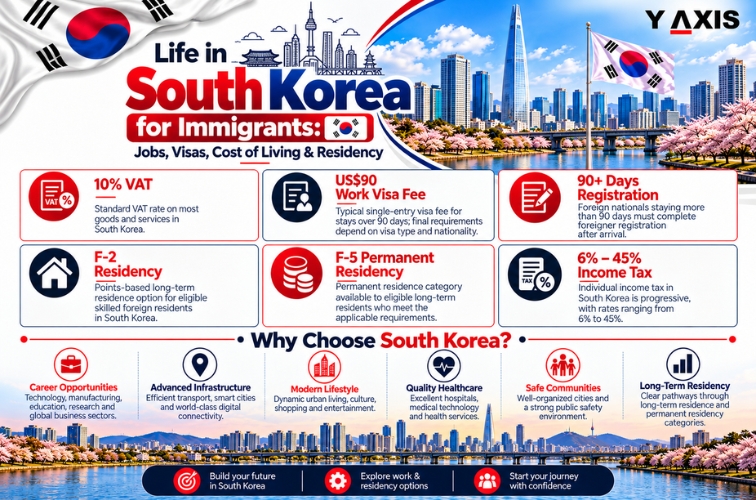
Life in South Korea for Immigrants: Jobs, Visas, Cost of Living & Residency